A 5-quart pot is a versatile medium-size cooking vessel with a nominal capacity of 20 U.S. cups, 160 U.S. fluid ounces, or about 4.73 liters. It is useful for soups, stews, chili, grains, sauces, pasta, and many family meals. Its physical diameter and height are not standardized, however, because stockpots, saucepans, casserole pots, and Dutch ovens can all hold 5 quarts while having very different shapes.
Quick Answer
A 5-quart pot holds 20 U.S. cups, 160 fluid ounces, 1.25 U.S. gallons, or about 4.73 liters. There is no universal 5-quart diameter or height: dimensions depend on whether the vessel is a stockpot, saucepan, casserole, or Dutch oven. For many households, 5 quarts is a practical everyday size for soups, stews, pasta, and one-pot meals.
Key Takeaways
- Capacity: 5 U.S. liquid quarts = 20 cups = 160 fl oz = 1.25 gallons ≈ 4.73 liters.
- Dimensions vary: a 5-quart rating tells you volume, not a fixed diameter or height.
- Best uses: soups, stews, chili, grains, sauces, pasta, beans, and moderate batch cooking.
- Family size: it often works well for meals serving roughly 4–6 people, but servings depend on the recipe and portion size.
- Before buying: check base diameter, handles, lid, induction compatibility, and the exact oven-temperature limit for every component.
Note: The conversions in this guide use the U.S. liquid quart. The U.S. National Institute of Standards and Technology lists one U.S. liquid quart as approximately 0.946353 liter.
What Is a 5-Quart Pot?
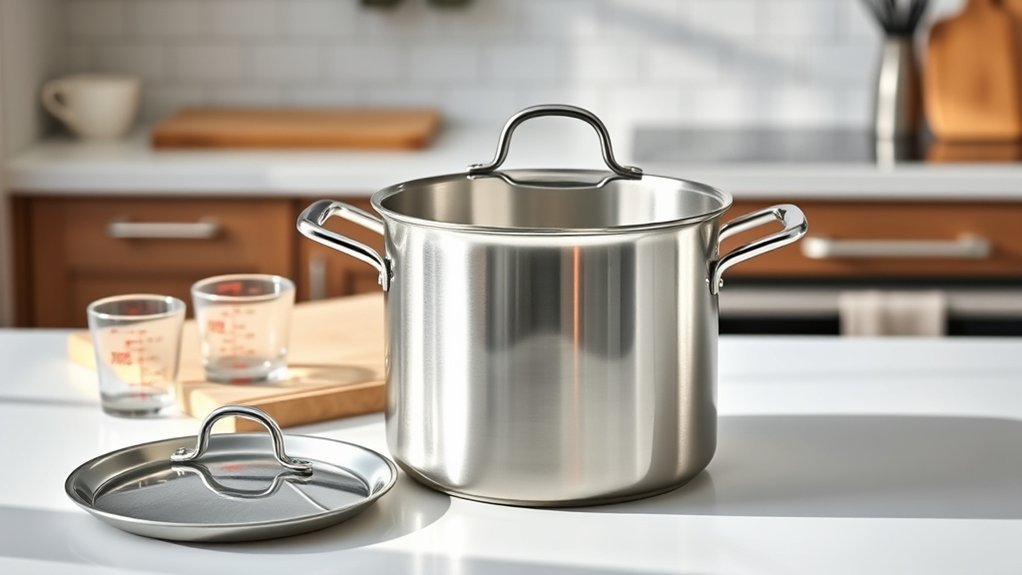
A 5-quart pot is any cooking vessel with a nominal capacity of five U.S. liquid quarts. That equals 20 U.S. cups or approximately 4.73 liters, making it a useful middle-ground size between smaller saucepans and larger stockpots.
The term describes capacity rather than shape. A 5-quart stockpot may be relatively tall and narrow, while a 5-quart Dutch oven or casserole can be wider and shallower. That difference affects browning area, evaporation, storage space, burner fit, and how easy the vessel is to lift.
Common 5-quart cookware includes stainless-steel stockpots, clad saucepans, aluminum or ceramic-coated pots, bare cast-iron Dutch ovens, and enameled cast-iron Dutch ovens.
Many models include a fitted lid, but lid construction varies. Glass lids make it easy to watch food, while metal lids are generally more resistant to breakage and may tolerate higher oven temperatures. Always use the manufacturer’s specifications rather than assuming the lid has the same heat limit as the pot.
5-Quart Pot Dimensions Explained
There is no single standard set of dimensions for a 5-quart pot. Two vessels can hold the same 5-quart volume while differing substantially in diameter and height.
For example, current manufacturer specifications show this variation clearly. GreenPan lists one 5-quart stockpot with a 9.5-inch diameter and 4.3-inch depth, while Meyer lists a 5-quart stockpot with an 8-inch diameter and roughly 5.7 to 6 inches of depth. A 5-quart cast-iron Dutch oven can have still different proportions.
Typical Measurements
Instead of relying on one supposed “standard” dimension, check the specifications for the exact model you plan to buy. The most useful measurements are:
| Measurement | Why It Matters |
|---|---|
| Capacity | Confirms that the vessel holds 5 U.S. quarts, or about 4.73 L. |
| Top/body diameter | Affects stirring room, browning area, and lid size. |
| Base diameter | Helps determine how well the pot matches a stovetop burner or induction zone. |
| Height/depth | Influences evaporation, boil-over risk, and cabinet clearance. |
| Overall width | Includes handles and matters for storage and oven fit. |
Do not confuse overall width with cooking-surface diameter. Handles can push the outside width past 12 inches even when the vessel itself is much narrower.
Shape and Capacity
Shape changes how a 5-quart pot cooks even though the volume stays the same. A taller vessel generally provides more depth for boiling and simmering, while a wider vessel exposes more surface area for browning and evaporation.
A stockpot is a practical choice for soup, stock, beans, and boiling. A wider Dutch oven works especially well for braises, stews, browning meat, and oven cooking. A 5-quart saucepan or sauté-style pot provides a broad working surface for sauces, grains, and one-pot meals.
The best shape therefore depends less on the “5-quart” label and more on what you plan to cook.
How Many Cups Are in a 5-Quart Pot?
A 5-quart pot holds 20 U.S. cups because one U.S. liquid quart equals four cups.
The same nominal capacity can be expressed several ways:
| Unit | 5-Quart Capacity |
|---|---|
| U.S. liquid quarts | 5 qt |
| U.S. cups | 20 cups |
| U.S. fluid ounces | 160 fl oz |
| U.S. gallons | 1.25 gal |
| Liters | About 4.73 L |
Five U.S. liquid quarts equal about 4.73 liters—not 5 liters and not 6 liters.
Cup Conversion Basics
For recipe scaling, the simplest conversion is 5 quarts × 4 cups per quart = 20 cups. That makes a 5-quart pot one-quarter larger than a 4-quart pot and one-sixth smaller in capacity than a 6-quart pot.
Capacity should not be converted directly into a fixed weight of dry food. Five quarts of flour, dried beans, sugar, pasta, and rice can all weigh very different amounts because their densities and shapes differ.
When a recipe lists ingredients by weight, use a kitchen scale rather than assuming that a 5-quart vessel corresponds to a particular number of pounds.
Practical Cooking Capacity
The 20-cup figure describes the vessel’s nominal volume. It does not mean that every recipe should fill the pot all the way to the rim.
Soups, pasta water, beans, grains, and other foods that foam or boil vigorously need headspace for stirring and expansion. The amount of headspace required depends on the food and cooking method, so the manufacturer’s instructions and the recipe should take priority.
Warning: A normal 5-quart stockpot or saucepan is not a pressure cooker. If you are using a 5-quart pressure-cooking appliance, follow that appliance’s MAX-fill markings and manual. For example, Instant Pot instructs users not to exceed its pressure-cooking 2/3 line and to stay at or below 1/2 full for foods such as rice or dried vegetables that expand during cooking.
How Much Food Fits in a 5-Quart Pot?
In pure volume terms, a 5-quart pot holds 20 cups. Practical food capacity is lower whenever a recipe needs space for boiling, stirring, foaming, or expansion.
For many soups, stews, chili recipes, and one-pot dinners, a 5-quart vessel is a convenient size for approximately 4 to 6 main-course servings. This is a planning estimate rather than a fixed rule: serving size, the amount of solids, and the amount of broth or sauce can change the result considerably.
A thinner soup served in small bowls may produce more portions, while a dense stew or large pieces of meat and vegetables may produce fewer.
For batch cooking, leave enough room to stir comfortably. A larger 6- or 8-quart pot is often easier when a recipe is expected to come close to the 5-quart rim.
Common Uses for a 5-Quart Pot
A 5-quart pot handles a wide range of everyday cooking tasks without taking up as much storage space as a very large stockpot.
- Soups and stews: enough depth for broth, vegetables, meat, and stirring room.
- Chili and beans: useful for moderate family batches.
- Pasta: suitable for many household portions, although a larger pot provides more water and headspace for big batches.
- Rice and grains: enough room for recipes that expand substantially during cooking.
- Stocks and broths: useful for smaller batches of vegetable, chicken, or meat stock.
- Sauces and curries: particularly useful when a wide 5-quart shape provides more cooking surface.
- Braising and oven cooking: appropriate when the specific pot, lid, handles, and knob are rated for the required oven temperature.
Do not assume every 5-quart vessel is oven-safe. Material and component limits vary substantially among products.
5-Quart Pot vs. 4- and 6-Quart Pots
A 5-quart pot sits in a useful middle range between compact everyday cookware and larger batch-cooking pots.
| Pot Size | U.S. Cups | Approx. Liters | Typical Role |
|---|---|---|---|
| 4 qt | 16 cups | 3.79 L | Smaller meals, sides, sauces, grains |
| 5 qt | 20 cups | 4.73 L | Family meals, soup, chili, moderate batch cooking |
| 6 qt | 24 cups | 5.68 L | Larger recipes and extra headspace |
| 8 qt | 32 cups | 7.57 L | Large batches, stock, gatherings |
A 4-quart pot may be easier to handle for small households, while a 6-quart pot gives more headspace for recipes that bubble or expand. An 8-quart stockpot becomes more practical when cooking stock, pasta, or soup for a crowd.
If you frequently find yourself filling a 5-quart pot almost to the top, moving up one size is usually more useful than trying to maximize every inch of capacity.
Which Materials Work Best?
The best material for a 5-quart pot depends on how you cook. Capacity alone does not determine performance.
| Material / Construction | Advantages | Considerations |
|---|---|---|
| Clad or bonded stainless steel | Durable, easy to maintain, suitable for acidic foods, often oven-friendly | Heating performance depends on the aluminum/copper core or base construction |
| Enameled cast iron | Excellent heat retention, good for braising and long simmering, no seasoning required | Heavy and usually more expensive |
| Bare cast iron | Excellent heat retention and durable construction | Heavy; requires drying and seasoning care |
| Coated nonstick | Easy food release and cleanup | Coating, utensil, dishwasher, and temperature limits vary by manufacturer |
| Aluminum or hard-anodized aluminum | Lightweight and responsive to temperature changes | Induction compatibility requires a suitable magnetic base; surface treatment varies |
For stainless cookware, a thick aluminum or copper layer is often what improves heat distribution. The phrase “18/10 stainless steel” describes a stainless composition; by itself, it does not tell you how evenly the entire pot will heat.
Pro Tip: If you cook on induction, hold a magnet against the bottom of the pot. A strong attraction is a useful sign that the base contains the ferromagnetic material needed for induction cooking. Also check the cookware manufacturer’s induction symbol or specifications.
Is a 5-Quart Pot Big Enough for Family Meals?
For many households, yes. A 5-quart pot is often a comfortable size for a one-pot dinner for roughly 4 to 6 people, especially for chili, stew, curry, soup, grains, or pasta dishes.
That serving estimate is not a fixed capacity rule. A family serving small bowls of soup can obtain more portions than a family serving a dense stew as the entire meal.
The pot’s manageable size is one of its advantages. It is generally easier to lift, clean, and store than a very large stockpot while still providing enough volume for moderate batch cooking.
If you routinely cook for six or more people, make stock in large quantities, or want generous leftovers, a 6- or 8-quart vessel may provide more comfortable headspace.
How to Measure a 5-Quart Pot
You can measure a pot in two different ways: capacity and physical dimensions.
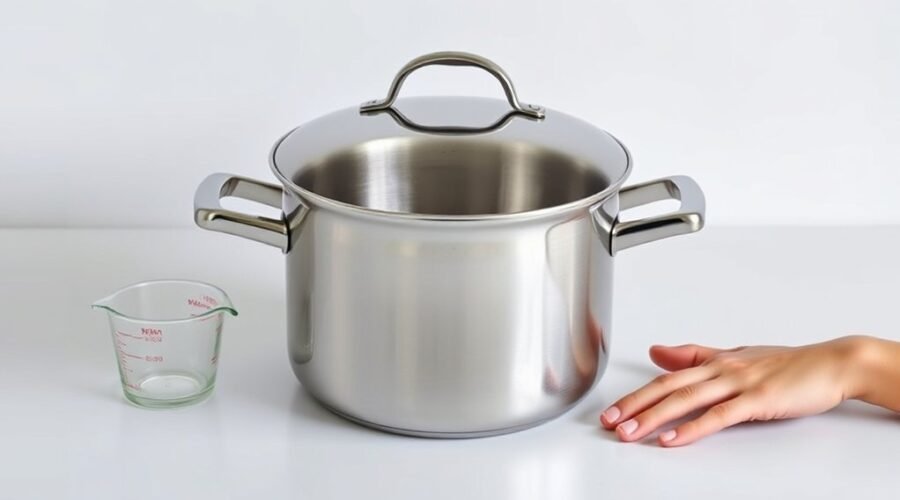
To verify nominal volume, five U.S. liquid quarts equals 20 U.S. cups. Water can be measured into an empty vessel to check approximate capacity, but filling a pot to the brim for measurement should not be confused with a safe cooking level.
For physical fit, measure:
- Inside top diameter: straight across the opening, excluding wall thickness.
- Base diameter: the flat area that contacts the burner or cooktop.
- Interior depth: from the inside bottom to the upper rim.
- Overall width: from handle to handle.
- Total height: including the lid and knob when storage clearance matters.
Those measurements are more useful than a generic “5-quart dimensions” figure because cookware manufacturers use different shapes and handle designs.
What to Look for in a 5-Quart Pot
A good 5-quart pot should match your stove, cooking methods, storage space, and lifting comfort—not simply meet a capacity number.
- Material and construction: choose clad stainless steel for versatility, cast iron for heat retention, or an appropriate coated surface when easy release is a priority.
- Base size: make sure the base is appropriate for your burner or induction zone.
- Induction compatibility: confirm a magnetic base or manufacturer induction rating if you use induction.
- Handles: look for handles that feel secure when the pot is full and heavy.
- Lid fit: a well-fitting lid helps control evaporation and retain moisture.
- Oven rating: check the maximum temperature for the pot, lid, knob, and handles separately.
- Cleaning instructions: confirm whether the pot is dishwasher-safe or requires hand washing.
- Storage dimensions: consider overall handle width and total height with the lid installed.
Oven limits can vary significantly even among similarly sized cookware. For example, GreenPan lists one 5-quart stockpot body as oven-safe to 600°F while its glass lid is limited to 425°F, whereas Meyer lists a different 5-quart stockpot at 445°F. The safe temperature is therefore a model-specific specification, not a feature of the 5-quart size itself.
Frequently Asked Questions
What Can You Cook in a 5 Quart Pot?
A 5-quart pot works well for soups, stews, chili, pasta, beans, rice, grains, curries, sauces, stock, and many one-pot meals. Wider 5-quart Dutch ovens are also useful for browning and braising, while taller stockpots provide more depth for boiling and simmering.
Is a 5qt Pot Big Enough?
A 5-quart pot is large enough for many everyday household meals and often works well for approximately 4 to 6 main-course servings. If you regularly cook very large batches, boil large quantities of pasta, or want substantial leftovers, a 6- or 8-quart pot may be more convenient.
How Many People Can 5 Quarts Feed?
There is no fixed serving count because portions and recipes differ. As a practical planning rule, a 5-quart pot often suits a 4-to-6-person main meal. Brothy soup served in smaller bowls may provide more servings, while a dense stew with large ingredients may provide fewer.
What Size Pan Is 5 Quarts?
Five quarts describes volume rather than one physical pan size. A 5-quart vessel holds 20 U.S. cups or about 4.73 liters, but its diameter and depth depend on whether it is designed as a stockpot, saucepan, casserole, sauté pan, or Dutch oven.
Is 5 Quarts the Same as 5 Liters?
No. Five U.S. liquid quarts equal approximately 4.73 liters. A 5-liter pot is therefore slightly larger than a 5-quart pot.
Can a 5-Quart Pot Go in the Oven?
Some can and some cannot. Oven safety depends on the exact pot, coating, handles, lid, and lid knob. Check the manufacturer’s temperature rating for every component and follow the lowest applicable limit.
Will a 5-Quart Pot Work on an Induction Cooktop?
It will work on induction only if its base is induction-compatible and contains suitable ferromagnetic material. Cast iron, enameled steel, and many magnetic stainless-steel bases work, while plain aluminum, copper, glass, and nonmagnetic stainless steel generally do not unless the cookware includes a compatible magnetic base.
Conclusion
A 5-quart pot is a practical medium-size choice for soups, stews, chili, pasta, grains, sauces, and many family meals. Its capacity is straightforward—20 U.S. cups, 160 fluid ounces, or about 4.73 liters—but its physical dimensions are not standardized. Compare the exact diameter, base, height, handles, construction, stovetop compatibility, and oven limits of the model you are considering. For many households, 5 quarts offers a useful balance between cooking space and manageable storage.
Sources
- National Institute of Standards and Technology — SI Conversion Factors — U.S. liquid-quart, gallon, fluid-ounce, and liter conversions.
- Instant Pot — Frequently Asked Questions — pressure-cooking maximum-fill and expanding-food guidance.
- Whirlpool Product Help — Induction Compatible Cookware — ferromagnetic cookware requirements and magnet-test guidance.
- GreenPan — Lima 5-Qt Stockpot — example 5-quart dimensions and separate pot/lid oven-temperature limits.
- Meyer — 5-Qt Stainless Steel Stockpot — example 5-quart dimensions, construction, induction compatibility, and oven rating.