
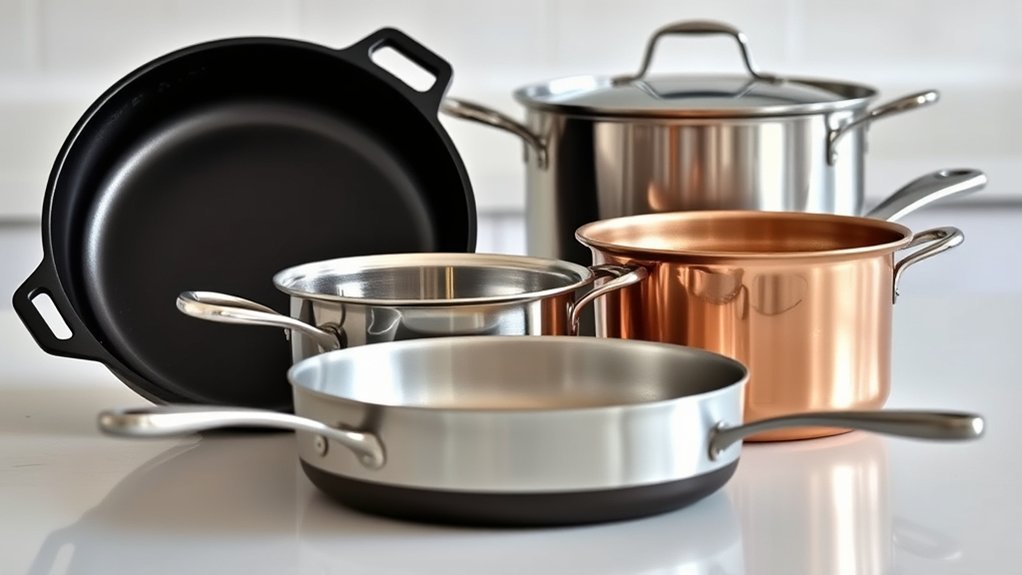
The safest cookware is not one universal material. For most kitchens, stainless steel, cast iron, carbon steel, glass, enameled cast iron, and well-made ceramic can all be sensible choices when used as intended. Safety depends on the material, construction, food being cooked, temperature, surface condition, and whether the product meets food-contact standards. PTFE nonstick, aluminum, and copper also require a more nuanced look than simple “safe” or “unsafe” labels.
Quick Answer
For everyday cooking, quality stainless steel is one of the most versatile low-maintenance choices. Cast iron and carbon steel are durable options for high-heat cooking, while glass, enameled cast iron, and verified food-safe ceramic are useful for non-reactive cooking. No material is risk-free in every condition, so correct use matters.
Key Takeaways
- Stainless steel is durable and generally suitable for everyday cooking, although it can release small amounts of nickel and chromium, especially with acidic foods and new cookware.
- Cast iron and carbon steel avoid synthetic nonstick coatings and retain heat well, but they need seasoning and are less suitable for long storage or long simmering of acidic foods.
- Pure ceramic, enamel, and glass can be highly non-reactive, but quality and manufacturing matter because poorly made or improperly glazed products may contain lead or cadmium.
- PTFE nonstick cookware is not automatically unsafe. FDA and BfR guidance indicates that properly used coatings have very low migration; the main avoidable hazard is severe overheating, especially an empty pan.
- Construction and condition matter. Buy from reputable manufacturers, follow temperature limits, and retire cookware when damage affects a coating, lining, or structural integrity.
What Is the Safest Cookware Material?
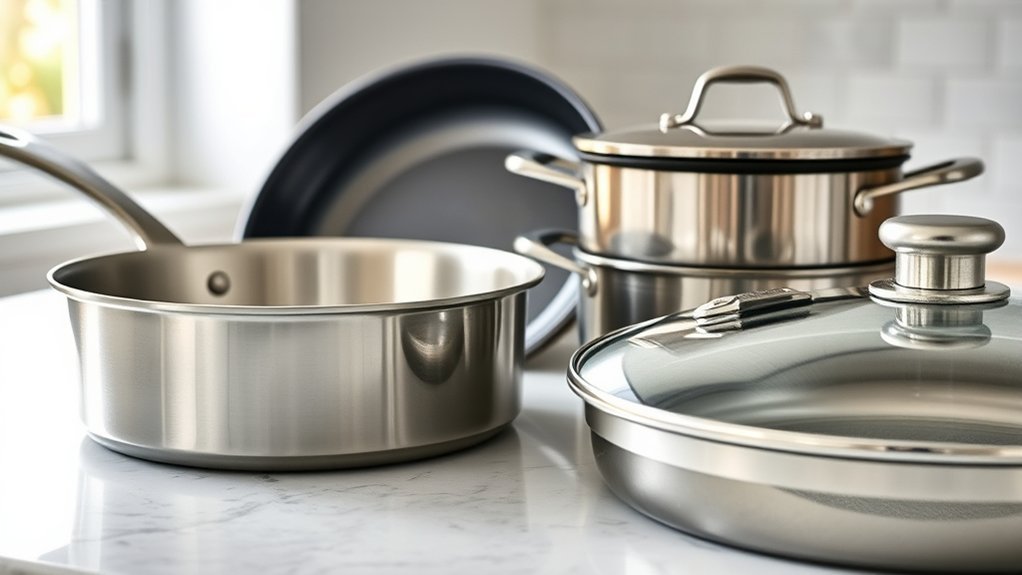
There is no single scientifically established “safest cookware material” for every person and cooking method. A practical shortlist includes stainless steel, cast iron, carbon steel, glass, enameled cast iron, and well-made ceramic. These materials can perform safely when they are manufactured for food contact and used within their intended temperature and care limits.
Stainless steel is valued for durability and corrosion resistance. Cast iron and carbon steel develop seasoned cooking surfaces without synthetic nonstick coatings. Glass and many ceramic or enamel surfaces are useful when a non-reactive food-contact surface is desired.
The phrase “non-toxic cookware” is best treated as a marketing description rather than a guarantee that a pan releases absolutely nothing. Metals, coatings, glazes, and seasonings can all interact with food to some degree. The relevant questions are how much transfer occurs, whether it is within accepted safety limits, and whether the cookware is being used correctly.
| Material | Best for | Main safety consideration |
|---|---|---|
| Stainless steel | Everyday cooking, boiling, sautéing, searing | Nickel-sensitive users may prefer nickel-free grades; acidic foods can increase metal release. |
| Cast iron | Searing, frying, baking | Can add iron to food; avoid long acidic cooking or storage in bare iron. |
| Carbon steel | Searing, stir-frying, eggs after seasoning | Needs seasoning and rust prevention; acidic foods can strip seasoning. |
| Pure ceramic / glass | Baking, casseroles, non-reactive cooking | Verify food-safe manufacture; avoid thermal shock and damaged pieces. |
| PTFE nonstick | Low- to medium-heat delicate foods | Do not severely overheat, especially while empty; follow manufacturer limits. |
Stainless Steel Cookware: Durable and Non-Reactive
Stainless steel cookware combines iron with chromium and, in many grades, nickel. Chromium forms a protective oxide layer that improves corrosion resistance. The familiar 18/10 label generally refers to about 18% chromium and 10% nickel in the stainless alloy.
Stainless steel is often described as non-reactive because it is far less reactive than bare copper, bare aluminum, or uncoated iron. Still, “non-reactive” is not absolute. Research has measured nickel and chromium release during cooking, with greater release in some new pans, during longer cooking, and with acidic foods. One study of 18/10 grade 316 cookware found the measured amounts under common test conditions were below known allergy-triggering thresholds, while noting that highly sensitive people may react at lower individual thresholds. See the 2017 stainless-steel cookware study indexed by PubMed.
Stainless steel is a durable everyday choice, but “non-reactive” does not mean zero metal transfer under every cooking condition.
For most users, stainless steel supports searing, simmering, boiling, and sauce-making without a degradable nonstick coating. Multi-ply pans with an aluminum or copper core can improve heating while keeping stainless steel on the food-contact surface.
Note: Health Canada advises people with a nickel allergy not to use cookware containing nickel. It also recommends adding salt after water has started boiling to reduce pitting in stainless steel.
Stainless steel can work on gas and electric ranges, and magnetic grades or magnetic outer layers work on induction. Dishwasher compatibility varies by manufacturer, especially for pans with exposed aluminum edges or special finishes, so follow the care instructions for the specific product.
Why Cast Iron Belongs in a Safe Kitchen
Cast iron is primarily iron with carbon and silicon. It contains no synthetic nonstick coating, and a well-maintained seasoning layer can provide a useful low-stick surface.
Its strongest thermal advantage is heat retention, not perfectly even heat distribution. Cast iron takes time to preheat, and temperature can vary across the pan, but its high thermal mass helps it stay hot when food is added. That makes it useful for searing, frying, baking, and other jobs where stable heat is valuable.
Cast iron can transfer iron into food, especially with acidic foods and longer cooking. A systematic review found that iron cookware often increases the iron content of prepared food and that some studies reported improved hemoglobin, although the overall evidence was mixed and more research was recommended. See the 2021 systematic review indexed by PubMed.
That iron transfer should not be marketed as a guaranteed treatment for iron deficiency. People who need to limit iron intake for medical reasons should discuss cookware choices with a qualified clinician.
For routine use, dry cast iron after washing and apply a thin layer of oil when needed to protect the seasoning and prevent rust. Health Canada advises against cooking or storing acidic foods in uncoated cast iron for long periods.
Pure Ceramic Cookware: Benefits and Limits
Pure ceramic cookware is made primarily from fired clay and mineral materials rather than a metal pan with a thin ceramic-style coating. When the product is properly manufactured for food contact, the cooking surface can be non-reactive and useful for baking, casseroles, and gentle stovetop cooking where the manufacturer permits it.
It is not accurate to say that every ceramic product is automatically free of lead, cadmium, or other metals. Pigments and glazes can contain these elements, and improperly manufactured or damaged foodware can create exposure concerns. The FDA specifically warns about lead-glazed pottery that is not properly made or fired.
Pure Ceramic Benefits
Quality pure ceramic cookware offers a smooth, non-reactive food-contact surface and does not depend on PTFE for release performance. Its thermal mass can support steady cooking once heated, and many pieces are oven-safe within their stated temperature limits.
| Property | Effect | Practical value |
|---|---|---|
| Material | Fired ceramic body | No metal core in true ceramic cookware |
| Reactivity | Generally low when food-safe and intact | Useful for acidic foods |
| Thermal behavior | Slow heating and good heat retention | Steady baking and simmering |
| Temperature tolerance | Varies by product | Follow the maker’s oven and stovetop limits |
| Handling | Hard but brittle | Protect from impacts and thermal shock |
Pure Ceramic Limits
Pure ceramic is more brittle than metal cookware. It can chip or crack after impact, and sudden temperature changes can cause thermal shock. Moving a very hot ceramic vessel onto a cold or wet surface, or adding cold liquid to a very hot empty vessel, may damage products that are not designed for that stress.
Glaze quality also matters. The FDA’s guidance on lead-glazed traditional pottery explains that improperly fired lead-containing glaze can contaminate food. Buy food-contact ceramic from a reliable manufacturer and do not cook in decorative pottery labeled as unsuitable for food use.
Warning: Do not assume handmade, imported, antique, or brightly decorated ceramic is food-safe unless its intended food-contact use is clear. Decorative ware may use glazes or pigments that are not suitable for cooking or food storage.
What Ceramic-Coated Cookware Is Made Of
Ceramic-coated cookware is different from pure ceramic. It usually starts with an aluminum or stainless-steel pan and adds a thin inorganic-rich coating, commonly made through a sol-gel process. Many such coatings are silica-based and are marketed as PTFE-free, although the exact formulation varies by manufacturer.
| Component | Function | Notes |
|---|---|---|
| Aluminum or stainless body | Provides structure and heat conduction | Core material affects weight and heating |
| Ceramic-style sol-gel layer | Creates the cooking surface | Exact chemistry and temperature limits vary |
| Finish integrity | Affects release and easy-clean performance | Wear commonly reduces nonstick performance over time |
The word “ceramic” can therefore describe very different products. A ceramic-coated aluminum frying pan is not the same material as a solid ceramic pot. Look for a clear statement of the substrate, coating type, food-contact compliance, maximum temperature, utensil restrictions, and warranty.
Scratches and surface wear commonly reduce release performance. That does not prove that every scratch causes hazardous chemical exposure, so the safer wording is to follow the manufacturer’s replacement guidance when the coating is badly worn, flaking, blistered, or otherwise damaged.
Glass and Enameled Cast Iron
Glass cookware provides a non-reactive surface and is useful for baking, casseroles, and food storage. Its main limitation is breakage and thermal shock. Use glass only on burners or under broilers when the manufacturer specifically allows that use.
Enameled cast iron combines the heat retention of cast iron with a glass-like enamel food-contact surface. It is useful for acidic sauces and long braises because the food does not directly contact bare iron. Avoid hard impacts and follow the manufacturer’s guidance if the interior enamel chips or cracks.
Cookware Materials to Avoid or Use With Extra Care
Cookware safety is better judged by a specific product and use condition than by fear-based material lists. Some products do deserve extra care, especially when the food-contact surface is damaged, the composition is unknown, or the cookware is used beyond its temperature limits.
PTFE Nonstick Cookware
PTFE is a fluoropolymer that falls within broad PFAS definitions, but it should not be treated as equivalent to small-molecule PFAS such as PFOA and PFOS. The FDA states that authorized polymerized PFAS nonstick coatings have negligible amounts capable of migrating to food.
The German Federal Institute for Risk Assessment (BfR) likewise states that adverse health effects are not expected when PTFE cookware is used as intended. Its key warning is severe overheating: at about 360°C (680°F) and above, especially when a pan is heated empty, PTFE can decompose and release hazardous gases. See the BfR’s 2025 PTFE cookware assessment.
Warning: Never leave an empty PTFE-coated pan heating unattended. Use the manufacturer’s recommended heat range and remove a pan from service if the coating is extensively peeling, blistering, or otherwise structurally damaged.
Uncoated and Anodized Aluminum
Bare aluminum conducts heat well and is widely used in cookware. Acidic or salty foods and worn or pitted surfaces can increase aluminum transfer to food. That is a reason for sensible use, not proof that all aluminum cookware is “toxic.” Health Canada notes that evidence linking aluminum exposure with Alzheimer’s disease remains conflicting and recommends avoiding long storage or prolonged cooking of acidic or salty foods in aluminum.
Anodized aluminum has a hardened surface that reduces aluminum transfer compared with ordinary aluminum, particularly with acidic foods. Avoid badly scratched or worn anodized cookware and follow the maker’s instructions.
Product quality matters as well. In December 2024, the FDA warned that certain imported cookware made from aluminum, brass, and specific aluminum alloys had demonstrated lead leaching. That finding concerns particular products and manufacturing quality, not every aluminum pan.
Copper Cookware
Copper offers excellent temperature control, but bare copper is reactive. Food-contact copper pans are generally lined with stainless steel or another suitable material. Do not use a copper pan when its protective lining is badly worn through, especially for acidic foods.
Poorly Made Ceramic and Decorative Ware
Ceramic, enamel, and glass products can be a concern when pigments or glazes contain lead or cadmium and are not properly formulated or fired. Use food-contact cookware from reputable manufacturers and keep decorative or unknown pottery out of cooking and food-storage service.
Why Cookware Construction Matters
Material choice is only part of cookware safety and performance. Layering, thickness, bonding, handles, rivets, bases, coatings, and liners determine how a pan behaves under heat and how long its food-contact surface stays intact.
In stainless steel, an aluminum or copper core improves heat conduction while stainless steel provides the cooking surface. Fully clad pans carry conductive layers up the sidewalls, while disc-bottom pans concentrate them at the base. Neither design is automatically safer; build quality and intended use matter more.
Cast iron and carbon steel rely on seasoning and rust control. Enameled cast iron adds a glass-like barrier. Copper relies on an intact lining. Coated pans depend on the durability and temperature limit of the coating. These differences explain why two pans marketed with the same headline material can perform very differently.
Pro Tip: When comparing cookware, read the construction from the inside out: food-contact surface, core, exterior, handle material, maximum oven temperature, and care restrictions. That tells you more than a front-of-box “non-toxic” claim.
Which Pots and Pans You Actually Need
A functional cookware set can begin with three core pieces: a skillet, a stock pot, and a saucepan. The exact sizes depend on household size and cooking habits, but an 8- to 12-inch skillet, a roughly 6-quart stock pot, and a roughly 3-quart saucepan cover many routine tasks.
This compact setup supports frying, sautéing, boiling, simmering, grains, soups, and sauces without buying a large matching set full of rarely used pieces.
Mixing materials can be more useful than buying every piece in one material. For example, a stainless-steel saucepan, cast-iron or carbon-steel skillet, and stainless stock pot provide broad coverage.
Essential Cookware Pieces
A versatile skillet handles frying, sautéing, browning, and searing. Stainless steel works well for pan sauces; cast iron provides strong heat retention; carbon steel is lighter and becomes more low-stick with seasoning.
A stock pot is useful for pasta, soups, broths, and batch cooking. Stainless steel is a practical choice because it handles water, salt, and a range of ingredients without requiring seasoning.
A 3-quart saucepan offers enough depth for sauces, grains, reheating, and smaller soups while controlling splatter. Stainless steel or enameled cookware is especially versatile when acidic ingredients are common.
Set Size and Versatility
Cookware selection is most efficient when guided by functional coverage rather than piece count. A larger set is worthwhile only when you will use the extra pieces and the lids, handles, oven limits, and materials match your cooking style.
| Piece | Primary function | Practical material choices |
|---|---|---|
| Skillet | Frying, sautéing, browning, searing | Stainless steel, cast iron, carbon steel, nonstick for delicate foods |
| Stock pot | Pasta, soups, broths, batch cooking | Stainless steel, enameled steel |
| 3-quart saucepan | Sauces, grains, reheating | Stainless steel, enamel |
A ceramic-coated skillet can be easy to clean, but its release performance usually has a shorter service life than an uncoated stainless, cast-iron, or carbon-steel pan. Set size matters less than having the right surfaces for the foods you actually cook.
Safe Cookware by Cooking Method
The safest practical choice often depends on the cooking method and food chemistry rather than a single material ranking.
| Cooking method | Good choices | Why |
|---|---|---|
| Boiling pasta or vegetables | Stainless steel | Durable, easy to maintain, suitable for water-based cooking |
| Searing meat | Cast iron, carbon steel, stainless steel | Handles high cooking temperatures and browning well |
| Long tomato or wine braise | Stainless steel, enameled cast iron, glass where appropriate | Better suited to prolonged acidic contact than bare iron or bare copper |
| Eggs, crepes, delicate fish | PTFE or ceramic-coated nonstick, seasoned carbon steel | Low-stick surface; use coated pans within stated heat limits |
| Baking and casseroles | Glass, ceramic, cast iron, enameled cast iron | Stable oven performance when rated for the temperature |
| Precision sauces | Stainless-lined copper | Fast response with a non-copper food-contact lining |
Carbon steel behaves similarly to cast iron in that it develops a seasoned surface and is well suited to searing and stir-frying. It is generally lighter and more responsive to burner changes than thick cast iron.
Copper provides excellent thermal control, but the food-contact surface should have an intact suitable lining for routine cooking, especially with acidic foods.
How to Pick the Right Cookware Set
Selecting a cookware set becomes easier when you use the same safety and performance checks for every piece.
- Identify the food-contact surface. “Stainless exterior” or “ceramic technology” does not necessarily tell you what touches the food.
- Match the material to your cooking. Choose stainless or enamel for acidic sauces, cast iron or carbon steel for searing, and coated nonstick for delicate low- to medium-heat foods.
- Check maximum temperatures. Pay attention to coating, lid, knob, and handle limits, not just the metal body.
- Look for transparent manufacturing information. Reputable brands should identify materials, care instructions, and food-contact use clearly.
- Inspect condition over time. Replace or repair cookware when a functional coating or lining is peeling, blistering, deeply damaged, or worn through.
- Consider allergies and medical needs. Nickel-sensitive users may prefer nickel-free stainless grades; people advised to limit iron should discuss frequent cast-iron use with a clinician.
- Buy useful pieces, not maximum piece count. A smaller set of durable pans often provides better value and less waste.
Maintenance also shapes the decision. Cast iron and carbon steel need seasoning and thorough drying. Stainless steel is comparatively low-maintenance, but dishwasher suitability still depends on the product. Coated cookware benefits from gentler utensils and cleaning methods that preserve the surface.
Frequently Asked Questions
What Cookware Is Safest for Health?
There is no single safest material for everyone. Quality stainless steel, cast iron, carbon steel, glass, enameled cast iron, and food-safe ceramic are all reasonable options when properly manufactured and used. Stainless steel is one of the most versatile choices, while nickel-sensitive users may prefer nickel-free alternatives.
Which Pan Is Not Cancerous?
Cookware should not be divided into “cancerous” and “non-cancerous” categories. For routine use, choose cookware designed for food contact, follow its temperature limits, and avoid products with unknown composition or unsafe contamination. Stainless steel, cast iron, carbon steel, glass, and properly made enamel or ceramic are common durable choices.
What Pans Should You Stay Away From?
Avoid cookware that is not intended for food use, products with unknown or suspect lead-containing materials, badly damaged linings or coatings, and cookware used beyond its stated temperature limits. Bare copper with a failed lining and decorative pottery of uncertain food safety also deserve caution.
What Do Chefs Use Instead of Non-Stick Pans?
Professional kitchens commonly use stainless steel, carbon steel, cast iron, aluminum, and lined copper, depending on the task. Nonstick pans are also used for delicate foods. Material choice is usually driven by heat response, durability, release performance, weight, maintenance, and the food being cooked.
Is PTFE Nonstick Cookware Safe?
Current FDA and BfR guidance indicates that authorized PTFE nonstick cookware is not expected to harm consumers when used as intended. The important precaution is to avoid severe overheating, particularly heating an empty pan to very high temperatures.
Is Aluminum Cookware Safe?
Aluminum cookware is widely used, but acidic or salty foods and worn surfaces can increase transfer into food. Anodized aluminum reduces transfer compared with ordinary aluminum. Use reputable cookware, avoid badly worn pieces, and follow the manufacturer’s care guidance.
Conclusion
The safest cookware material is not a single champion. Stainless steel offers excellent everyday versatility; cast iron and carbon steel provide durable high-heat performance; glass, enamel, and well-made ceramic provide useful non-reactive surfaces; and coated cookware can be appropriate when used within its limits. The best set balances material stability, construction quality, cooking method, surface condition, and proper care rather than relying on fear-based “toxic” or “chemical-free” labels.
Sources
- Health Canada: The safe use of cookware and bakeware — material-specific guidance for aluminum, copper, stainless steel, cast iron, ceramic, glass, nonstick coatings, and silicone.
- U.S. FDA: Questions and Answers on PFAS in Food — migration and authorized uses of PFAS in nonstick cookware coatings.
- German Federal Institute for Risk Assessment: PTFE cookware assessment — safe intended use and overheating risk around 360°C.
- U.S. FDA: Lead-Glazed Traditional Pottery — lead migration concerns in improperly manufactured or fired pottery.
- PubMed: Release of nickel and chromium from 18/10 stainless steel pots — evidence on metal release under common cooking conditions.
- PubMed: Systematic review of iron-containing cookware — evidence on iron transfer to food and hemoglobin outcomes.
