
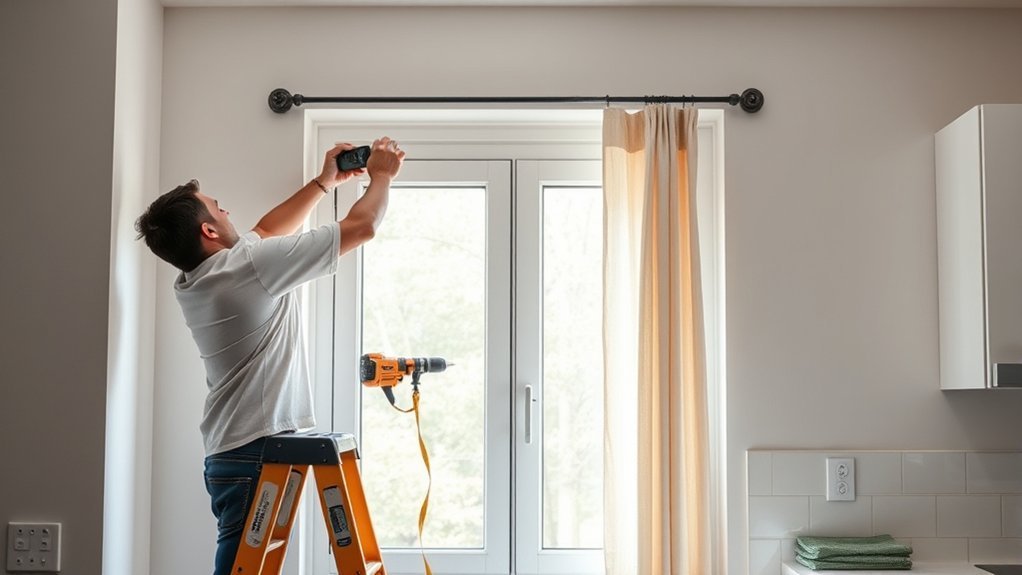
Hanging kitchen café curtains starts with accurate measurements, but good placement matters just as much. Measure the window and planned rod span, decide how much of the glass you want covered for privacy, and choose hardware that fits the mounting surface and curtain weight. A level rod, suitable fasteners, and enough fabric fullness will give the window a cleaner, more functional finish.
Quick Answer
To hang kitchen cafe curtains, measure the window or rod span, choose panels totaling about 1.5 to 2 times that width, and position the rod where it gives the privacy you want—often at a sash meeting rail or near mid-window. Mount the rod level, use fasteners suited to the surface, then hang and evenly distribute the fabric.
Key Takeaways
- Use the window’s architecture and your privacy needs to choose the café-rod height; the exact halfway point is a starting point, not a rule.
- For a gathered look, total curtain width of about 1.5 to 2 times the finished rod span usually works well.
- Use brackets, anchors, and fasteners rated for the wall or window-frame material and the weight of the rod and curtains.
- Keep kitchen curtains safely away from stovetops, open flames, and anything else that could ignite the fabric.
- After installation, test that the window, faucet, handles, and curtain panels can all move without interference.
At a Glance
| Time Required | About 30–60 minutes for a straightforward installation |
| Difficulty | Easy to moderate |
| Tools Needed | Tape measure, pencil, level, screwdriver or drill, suitable screws/anchors, and optionally a stud finder |
| Cost | Varies by curtain and hardware; installation adds little extra cost if basic tools are already available |
Measure for Cafe Curtains
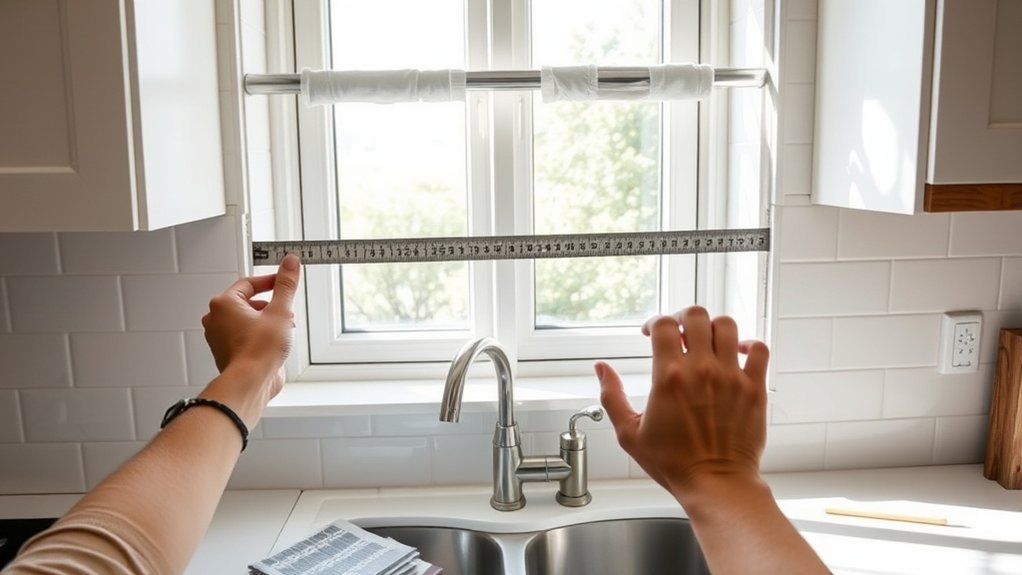
Start by measuring the window width and deciding exactly where the café rod will sit. Traditional café curtains cover the lower part of a window, but the rod does not have to be positioned at the mathematical midpoint. A sash meeting rail, glazing bar, or another existing horizontal line can provide a more natural location.
Think about privacy before fixing the height. If the window faces a sidewalk or neighboring property, hold a piece of fabric or paper across the glass at several heights and check the view from both inside and outside. Raise the rod when you need more privacy; lower it when preserving daylight and the view matters more.
For the curtain width, measure the finished rod span that the fabric will actually cover. A common starting point is total curtain width of about 1.5 to 2 times the rod width, depending on how gathered you want the fabric to look. IKEA likewise recommends about 1.5 times the rod or track width for a full look and twice the width for an extra-full look.
For the drop, measure from the point where the curtain will hang from the rod or rings to the desired lower edge. Café curtains normally finish at or slightly above the sill so they do not bunch on the surface.
Pro Tip: Install or temporarily position the café rod before ordering made-to-measure curtains. Measuring the actual rod span and drop reduces guesswork and makes the finished fit more predictable.
Choose the Right Curtain Rod
Choose a curtain rod that fits the mounting location, curtain weight, and width of the window. Slim café rods and tension rods suit lightweight panels, while heavier fabrics need more substantial hardware and stronger bracket support.
Also check how far the rod projects from the frame. Window handles, cranks, deep trim, faucets, and backsplash details can interfere with fabric if the rod sits too close to the glass.
For any bracket-mounted system, follow the manufacturer’s instructions for maximum rod span, bracket spacing, fastener type, and supported load. Longer rods may require a center or intermediate support to prevent bowing.
Rod Style Options
Several rod styles can work for kitchen café curtains:
- Tension rods: Useful for lightweight curtains inside a suitable recessed frame when you want a no-drill installation.
- Café rods: Slim rods designed specifically for short curtains and small window spans.
- Decorative rods: Better when the hardware is intentionally part of the room’s design.
- Standard adjustable rods: Useful for outside mounting or for wider windows that need more projection and stronger support.
- Double rods: Appropriate when café curtains are combined with another curtain layer.
Metal rods are widely available in both lightweight and heavier-duty versions. Wood can also work well when the rod and brackets are rated for the curtain load. The material alone does not determine strength, so check the specific product specifications.
Mounting And Finish
For an inside mount, measure the usable width and depth of the recess before buying the rod. Make sure there is enough room for the rod, brackets or tension mechanism, curtain heading, and any moving window hardware.
For an outside mount, the rod normally extends beyond both sides of the window frame. About 4–6 inches per side is a useful starting range when space allows. IKEA’s current curtain-planning guidance recommends adding at least 6 inches on each side for fabric curtains so the window can be covered and the curtains can move clear of the glass.
Outside-mounted full-length curtains are often installed several inches above the frame to make a window look taller, but that rule should not be confused with café-curtain placement. A café rod is normally positioned across the lower portion of the window according to privacy needs and the window’s horizontal lines.
Decide on Inside or Outside Mounting
An inside and outside mount create different results, so inspect the window before drilling.
Inside mounting keeps the rod within the window opening. It works especially well for café curtains because the treatment stays close to the glass and trim. Before choosing it, confirm that the recess is deep enough and that the curtain will not interfere with latches, cranks, screens, or an inward-opening sash.
Outside mounting places the hardware on the trim or surrounding wall. It is useful when the recess is shallow, the frame cannot accept hardware, or you want the fabric to cover more of the window. Measure the complete rod span rather than only the glass when calculating curtain fullness.
Note: Hardware that is meant to visually disappear should generally match or closely relate to the surface behind it. Black or bronze hardware can blend into dark frames or muntins, but it usually creates noticeable contrast against white or pale trim.
Mount the Brackets Level
Once the mounting position is chosen, mark both bracket locations lightly with a pencil. Measure from the same reference point on each side, then use a level to confirm that the marks are horizontally aligned.
Before drilling, identify the mounting material. Screws driven into solid wood or a stud may provide suitable support when allowed by the hardware instructions. Drywall, plaster, masonry, tile, or hollow trim may require different anchors or installation methods. Use fasteners that are specifically rated for the surface and the combined weight of the rod and curtains.
Drill pilot holes when the hardware instructions call for them, secure the brackets, and check their alignment again before installing the rod. For wider rods, install any required center support before hanging the fabric.
Warning: Keep curtains and other combustible fabric away from stovetops and open flames. The U.S. Fire Administration specifically advises keeping curtains and other materials that can catch fire away from the stovetop. If a kitchen window is close enough for fabric to drift toward a burner, use another window-treatment arrangement.
Hang the Curtains on the Rod
How you attach the curtain depends on its heading. Rod pockets and grommets slide directly onto compatible rods, while rings, clips, or pleat hooks require separate attachment hardware.
- Slide a rod-pocket or grommet curtain onto the rod without forcing the fabric.
- Space curtain rings or clips evenly so the folds look consistent.
- Insert pleat hooks according to the curtain and hook manufacturer’s instructions.
- Return the rod to its brackets and secure any retaining screws or end stops.
- Distribute the fabric evenly across the span.
- Open and close the curtain several times to check for snagging or binding.
Also operate the window itself. Make sure the curtain does not catch on a crank, handle, latch, screen, faucet, or nearby cabinet door.
Choose the Right Cafe Curtain Size
A properly sized café curtain should cover the intended area without looking either stretched flat or excessively bulky.
For width, use the span the curtain will actually cover. If the rod is inside the frame, this is usually close to the inside rod width. If it is outside mounted, use the complete rod span. Panels totaling about 1.5 times the rod width give moderate fullness, while about 2 times the rod width creates a fuller gathered appearance.
For height, measure from the curtain’s actual hanging point to the desired hem. Do not assume every café curtain must begin at exactly half the window height. Aligning the rod with a meeting rail or another horizontal part of the frame often looks cleaner, provided the position gives enough privacy.
When buying washable fabric, check the manufacturer’s care instructions and shrinkage information before hemming or ordering a precise custom drop.
For café curtains, the best-looking rod height is usually the point where privacy needs and the window’s existing architecture agree—not an arbitrary measurement applied to every window.
Pick Hardware That Disappears
If the goal is to make the fabric—not the rod—the focus, choose understated hardware with a slim profile and minimal ornament.
Matching the rod or brackets to the window frame, muntins, or surrounding wall can reduce visual contrast. White hardware can blend into white trim, while black or dark bronze hardware often works quietly against black or dark window frames.
- Use slim hardware for lightweight curtains.
- Match visible brackets to the surrounding surface when possible.
- Choose small finials where space beside the frame is limited.
- Keep all visible hardware consistent across neighboring windows.
- Prioritize load capacity and correct mounting over appearance.
Hardware should only “disappear” visually after it has been installed securely. Never substitute undersized brackets or unsuitable anchors simply because they look less noticeable.
Fix Common Cafe Curtain Placement Problems
If café curtains look uneven or awkward, the problem usually comes from rod height, width, alignment, fabric fullness, or hardware rather than the curtain style itself.
Stand several feet back and check whether the rod follows the window’s horizontal lines. Then inspect each bracket with a level. If the curtain sags in the middle, verify that the rod is not extended beyond its rated span and add the manufacturer-required center support if applicable.
If the fabric looks too flat, more width may be needed. If it is excessively bulky, reduce the fullness or use a lighter fabric. If the curtain catches on a window handle or faucet, increase the rod projection or change the mounting position.
Align With Window Grid
Windows with sash meeting rails, muntins, or glazing bars already contain strong horizontal lines. Whenever the privacy level works, aligning the café rod with one of those lines can make the curtain feel integrated with the window rather than placed randomly across it.
For a double-hung sash window, the meeting rail is often a natural reference point. On a plain pane without horizontal divisions, start around the lower half of the glass, then adjust the height after checking the sightline from outside.
- Use existing horizontal architecture as a visual guide.
- Prioritize the privacy level actually needed in the room.
- Repeat the same placement across matching windows.
- Check alignment from across the room, not only from directly in front of the window.
- Keep the hem clear of a wet or crowded windowsill when practical.
Choose Proper Hardware
Hardware should match both the curtain and the mounting surface. A lightweight tension rod may be enough for a sheer café panel in a secure recess, while a wider outside-mounted rod may need fixed brackets and additional support.
Check the rod manufacturer’s instructions before deciding how many brackets are required. IKEA’s current curtain-planning guide, for example, increases the number of brackets as rod length increases rather than treating two brackets as suitable for every span.
For drywall or other hollow construction, use anchors designed for that surface and load unless the screws are secured into suitable framing. On wood trim, verify that the screws are an appropriate length and will not damage hidden parts of the window assembly.
Hang Cafe Curtains on Awkward Windows
Awkward kitchen windows often need a custom mounting decision rather than a different curtain. Begin by identifying what makes the window difficult: a shallow recess, projecting trim, unusual shape, crank handle, nearby faucet, inward-opening sash, backsplash tile, or limited wall space.
Measure the usable width and test the intended rod height before buying curtains. A tension rod can solve some shallow-space problems when the frame provides a suitable pressure surface and the curtain is light enough. Outside brackets may work better when hardware inside the recess would interfere with the window.
Shallow Recesses and Unusual Frames
If the recess is too shallow for brackets or a tension rod, mount the rod to suitable trim or wall material outside the opening. On arched or irregular windows, keep the café curtain on the lower rectangular portion rather than trying to force a straight rod through the curved section.
Before drilling into tile, stone, metal, or specialty window frames, use hardware and drilling methods appropriate to that material. When the window manufacturer restricts drilling into the frame, use another mounting surface or an approved no-drill system.
Work Around Window Cranks, Faucets, and Sinks
Kitchen windows often sit directly behind a sink. Make sure the curtain does not rest against a wet sill or fall into the faucet area. If necessary, shorten the drop slightly or move the rod forward enough to clear handles and fixtures.
Casement and awning windows may have cranks or handles that project inward. Open the window fully before finalizing the rod position so you can confirm the curtain and hardware will not block operation.
After installation, test the complete setup: open and close the window, move the curtains from side to side, operate nearby cabinet doors, and check the fabric from outside after dark if privacy is important.
Child-Safety Note: Café curtains themselves are often cord-free, but they may be layered with blinds or other cord-operated coverings. The U.S. Consumer Product Safety Commission recommends cordless window coverings where young children are present and warns that accessible window-covering cords can create a strangulation hazard.
Frequently Asked Questions
What are the common mistakes in hanging curtains?
Common mistakes include measuring only the glass instead of the finished rod span, placing the rod without checking privacy, using too little fabric, installing brackets out of level, choosing anchors that do not suit the mounting surface, and failing to test the window after installation. In kitchens, another important mistake is allowing curtain fabric to hang near a stovetop or flame.
How do beginners hang curtains?
Measure the window and planned rod span, mark the bracket locations, check the marks with a level, install fasteners appropriate to the mounting surface, attach the brackets, add the curtains to the rod, and reinstall the rod. Finish by distributing the fabric evenly and testing both the curtains and window operation.
How do you install kitchen cabinet curtains?
Measure the cabinet opening, choose a lightweight curtain with the desired fullness, and select a small tension rod or fixed rod that fits the cabinet material and opening. Install the rod level, hang the fabric, and confirm that doors, drawers, shelves, and nearby appliances still operate normally.
What is the rule for hanging curtains?
There is no single height rule that fits every curtain. Full-length outside-mounted curtains are often placed above and beyond the window frame, while café curtains are positioned across the lower portion of the window according to privacy needs and architectural lines. In either case, measure carefully, keep the rod level, and use securely rated hardware.
How full should cafe curtains be?
About 1.5 times the finished rod width creates moderate fullness, while around twice the rod width gives a more gathered look. Fabric weight and heading style also affect how full the finished curtain appears.
Can cafe curtains use a tension rod?
Yes. A tension rod can work well for lightweight café curtains when the window recess provides suitable parallel surfaces and enough depth. Check the rod’s size and load limits, confirm that pressure will not damage the frame, and periodically make sure the rod remains secure.
Conclusion
Well-hung kitchen café curtains depend on three things: accurate measurements, secure hardware, and thoughtful placement. Use the window’s own lines and your privacy needs to choose the rod height, size the fabric from the actual rod span, and keep every bracket level. Finally, check that the curtain clears the window hardware, sink area, and cooking surfaces. Those practical details matter more than following a single universal mounting rule.
Sources
- IKEA — How to Measure and Plan Your Curtain Solution — supports rod-width, outside-extension, and bracket-planning guidance.
- IKEA — MAJGULL Curtain Guidance — supports the 1.5× to 2× fullness guidance.
- U.S. Consumer Product Safety Commission — Window Covering Cords — supports child-safety guidance for corded window coverings.
- U.S. Fire Administration — Keep Combustibles Away From the Stovetop — supports kitchen-curtain fire-safety guidance.
- The Curtain Cafe — Measuring Made-to-Measure Cafe Curtains — supports using sash meeting rails, glazing bars, and privacy needs when positioning cafe curtains.
