
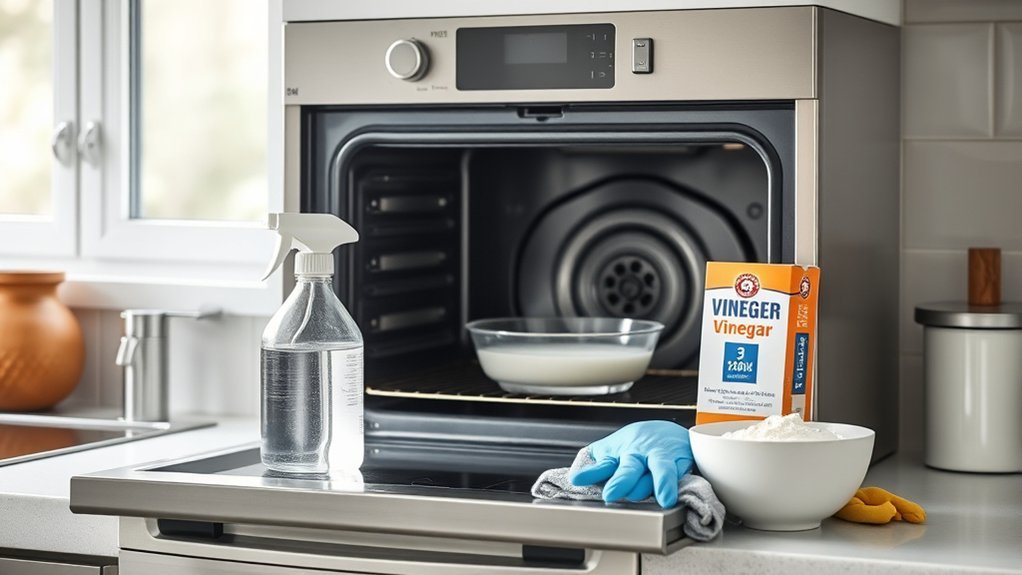
Cleaning an oven with vinegar can help soften light food residue and make wiping easier, but the safest method depends on the oven. Check the owner’s manual before putting vinegar, water, baking soda, or any cleaner inside the cavity. Some manufacturers allow vinegar during manual cleaning, while some built-in Steam Clean cycles require water only and some manufacturers recommend soap and water instead of vinegar. For heavy baked-on soil, a baking soda and water paste is usually more useful than vinegar alone.
Quick Answer
To clean an oven with vinegar safely, first check the owner’s manual. If manual steam cleaning is allowed, use an oven-safe dish with water and optional white vinegar, then wipe the cooled oven. For stubborn baked-on stains, use baking soda and water first and vinegar afterward only to help remove remaining residue.
Key Takeaways
- Your oven’s owner’s manual takes priority over any generic vinegar-cleaning recipe.
- A built-in Steam Clean cycle may require plain water and may prohibit vinegar or other additives.
- Steam works best on light or recently baked-on soil; heavy deposits often need baking soda paste or an approved cleaner.
- Use baking soda with water first. If the manufacturer allows vinegar, spray it afterward to help remove remaining baking-soda residue.
- Do not scrub or soak the door gasket, and keep liquid away from vents, slots, gas openings, and electrical components.
- Do not line the oven floor with foil, silicone liners, or other materials unless the appliance manufacturer specifically permits it.
At a Glance
| Time Required | About 45–90 minutes for light cleaning, including heating and cooling; overnight soaking may help heavy baked-on stains. |
| Difficulty | Easy to moderate |
| Tools Needed | Soft cloths or sponges, spray bottle, oven-safe dish if manual steaming is permitted, plastic scraper, and cleaning gloves |
| Cost | Usually low if you already have white vinegar, baking soda, and basic cleaning supplies |
Warning: Check your oven manual before using vinegar or a homemade steam method. Never pour cleaner into vents, slots, gas openings, or electrical components. Do not scrub or saturate the door gasket. Hot steam, hot liquid, and the baking dish can cause burns, so let the oven cool before wiping.
Why Clean Your Oven With Vinegar

Vinegar can be useful for light oven cleaning, especially when it is combined with moisture and wiping. The steam from heated water softens some dried food residue, while diluted white vinegar can help remove film and odors after the surface has cooled.
Vinegar is not the strongest choice for heavy grease. Acidic cleaners are better known for breaking down mineral deposits, while alkaline cleaners such as baking soda are generally more useful on greasy and organic soils. For that reason, a vinegar steam treatment works best as a maintenance method rather than a guaranteed substitute for every form of deep cleaning.
Cleaning food spills before they become thick, carbonized deposits can also reduce smoke and odors during normal oven use. The goal is regular maintenance, not a claim that vinegar will make a properly functioning oven inherently more energy-efficient.
Note: Oven manufacturers do not all give the same advice. Bosch recommends soap, warm water, and a damp cloth instead of vinegar, while Whirlpool describes white vinegar as optional for some manual steam-cleaning situations. Follow the instructions for your exact model.
Check Your Oven Manual Before Cleaning
Before putting vinegar, baking soda, dish soap, or water inside an oven, identify which cleaning system the appliance uses. A conventional manual-clean oven, a high-temperature self-cleaning oven, and an oven with a dedicated Steam Clean feature may require different procedures.
If the oven has a built-in Steam Clean function, use the amount and type of water stated in the manual. Do not automatically add vinegar. For example, Whirlpool’s instructions for some Steam Clean models specifically say not to use cleaners or other additives.
If the oven has a high-temperature Self Clean cycle, prepare and run that cycle exactly as directed by the manufacturer rather than combining it with a bowl of vinegar or another homemade cleaning solution.
Also check whether the oven has a special catalytic, continuous-clean, or proprietary enamel surface. These finishes can have cleaner restrictions that differ from standard porcelain-enamel cavities.
What You’ll Need to Steam Clean
If your manufacturer allows manual steam cleaning, gather the supplies before you begin:
- An oven-safe glass or metal dish with enough depth to contain the water safely
- Distilled or filtered water if recommended by the manufacturer
- Distilled white vinegar, only if your oven manufacturer permits it
- A liquid measuring cup
- Soft cleaning cloths or nonabrasive sponges
- A spray bottle for a diluted vinegar rinse, if permitted
- Baking soda for stubborn baked-on residue
- A plastic scraper for residue that does not wipe away easily
- Cleaning gloves
Remove loose crumbs before adding moisture. Depending on the cleaning method, racks and accessories may also need to come out first. Built-in cleaning modes commonly have specific rack-removal instructions, so check the manual instead of assuming the racks can stay inside.
How to Steam Clean an Oven With Vinegar
The correct procedure depends on whether the appliance has a dedicated Steam Clean function or whether the manufacturer permits a manual steaming method.
If Your Oven Has a Built-In Steam Clean Cycle
- Let the oven cool to the temperature required by the manufacturer.
- Remove racks or accessories if the manual tells you to remove them.
- Wipe out loose crumbs and excess grease.
- Add the specified amount of water in the location stated in the manual.
- Do not add vinegar, baking soda, oven cleaner, or another additive unless the manufacturer explicitly allows it.
- Run the Steam Clean cycle without opening the door during operation.
- When the cycle ends, allow the oven to cool enough to handle safely.
- Absorb remaining water and wipe away softened food soil with a soft cloth or sponge.
If the Manufacturer Allows Manual Steam Cleaning
For ovens without a dedicated Steam Clean function, some manufacturers publish a separate manual-steaming method. Whirlpool, for example, describes heating an oven without a Steam Clean cycle to 450°F for about 20 minutes, using an oven-safe vessel containing water, with white vinegar listed as optional. That is an example, not a universal specification.
- Confirm in the owner’s manual that manual steam cleaning will not damage the oven.
- Remove racks and accessories if required.
- Place the recommended amount of water in a stable, oven-safe dish. Add vinegar only if the manufacturer allows it.
- Position the dish where the manufacturer recommends. Do not place it directly on the oven floor unless the instructions explicitly say to do so.
- Heat the oven for the specified time and temperature.
- Turn the oven off and keep the door closed while the steam works, if that is part of the approved procedure.
- Let the oven and dish cool enough to handle safely before removing the dish.
- Wipe the softened residue away with a damp cloth or nonabrasive sponge.
Pro Tip: Steam cleaning is most effective on light or relatively fresh residue. Remove loose crumbs and wipe up excess grease before steaming so you are softening the soil that actually needs attention instead of spreading loose debris around the oven.
How Long to Let the Steam Work
There is no single correct steaming time for every oven. A dedicated Steam Clean function controls its own cycle, while a manufacturer-approved manual method may specify a particular temperature and heating period.
For example, Whirlpool’s general guide for manual steaming in an oven without a Steam Clean feature uses about 20 minutes of heat at 450°F. Other ovens can require a different method, so do not extend the time simply because the soil looks stubborn.
Once heating is complete, allow enough cooling time to avoid burns. The oven can remain warm while you wipe it, but the interior, liquid, racks, and dish must be safe to touch.
If residue is still firmly baked on after steaming, switch to a baking soda treatment or another cleaner approved for the oven rather than repeatedly heating vinegar for progressively longer periods.
How to Wipe Away Softened Grime
Once the steam has softened the food soil and the oven is safe to touch, use a damp soft cloth or nonabrasive sponge to wipe the cavity. Work from the cleaner upper areas toward the dirtier oven floor so loosened residue is easier to collect.
Wipe With Damp Cloth
Use gentle passes instead of aggressive scrubbing. Enamel surfaces can be damaged by inappropriate abrasive pads or sharp tools.
| Area | Tool | Method |
|---|---|---|
| Walls | Damp soft cloth | Wipe softened residue gently |
| Floor | Cloth or nonabrasive sponge | Collect loosened food and moisture |
| Corners | Soft sponge or cloth | Work carefully around seams and openings |
Keep cleaning liquid away from ventilation slots, fan openings, gas passages, electrical connections, and other areas the manual tells you to avoid.
Rinse Frequently
Rinse the sponge or cloth regularly so loosened grease and food are not spread over cleaner surfaces. Replace the rinse water when it becomes visibly dirty.
Wring the cloth out well rather than flooding the oven interior. Excess liquid can run into seams, vents, or door openings where it does not belong.
Finish with a clean damp cloth to remove cleaner residue, followed by a soft dry cloth where appropriate.
Tackle Stubborn Spots
If a stain remains after steaming, do not immediately attack it with a metal scraper or harsh abrasive. Apply a small amount of baking soda and water paste to the affected area if the oven manufacturer permits it.
Allow the paste to sit for at least 20 minutes; very stubborn residue may benefit from several hours or an overnight treatment. Then loosen it with a damp nonabrasive sponge or plastic scraper.
After most of the baking soda has been removed, a light spray of white vinegar can help dissolve and lift remaining baking-soda residue if vinegar is permitted for that surface.
How to Remove Tough Oven Stains
For heavily baked-on food, baking soda usually works better than vinegar alone. A practical starting mixture is about 1/2 cup baking soda with 3 tablespoons of water, adjusted slightly until it forms a spreadable paste.
Apply the paste to approved interior surfaces while the oven is cool. Avoid heating elements, igniters, burner openings, vents, fans, the door gasket, and any surface the owner’s manual says should not be coated.
Let the paste remain for 20 minutes to several hours. For particularly stubborn deposits, manufacturer cleaning guides from Whirlpool and Maytag allow an overnight treatment on suitable oven surfaces.
Wipe away as much paste and loosened grime as possible with a damp cloth. A nonabrasive sponge or plastic scraper can help with remaining spots.
If permitted by the manufacturer, lightly mist remaining baking-soda residue with white vinegar. The fizz occurs because the acid and baking soda react with one another; it can make leftover powder easier to see and wipe away, but it should not be treated as a chemically stronger grease cleaner than baking soda itself.
If heavy carbonized soil still will not release, consult the owner’s manual for an approved oven cleaner or cleaning cycle rather than escalating to harsher homemade mixtures.
When Baking Soda Works Better Than Vinegar
Baking soda is usually the better household option for thick, greasy, baked-on food deposits. When mixed with a small amount of water, it forms a mild alkaline paste that stays on vertical surfaces longer than a thin vinegar spray.
Its mild abrasive action can also help loosen residue when used with a nonabrasive sponge, provided the oven manufacturer permits it.
- Use vinegar or steam primarily for light residue, wiping, and maintenance where the manufacturer allows it.
- Use baking soda and water for heavier greasy or baked-on deposits.
- Use vinegar after the baking-soda treatment, rather than premixing equal amounts, when you want to remove remaining baking-soda film.
Whirlpool’s oven-cleaning guidance and similar guidance from other manufacturers describe this baking-soda-first approach for stubborn residue.
Areas to Avoid When Cleaning an Oven
Homemade cleaners should not be spread indiscriminately through the entire appliance. Pay particular attention to these areas:
- Door gasket: Do not scrub, soak, pull, or move it. The gasket helps seal the oven door.
- Vents and slots: Keep liquids and paste out of ventilation and door-frame openings.
- Gas burner openings and igniters: Do not coat them with cleaning solution.
- Heating components: Follow the manual regarding exposed bake or broil elements.
- Fans and electrical parts: Do not spray cleaning liquid directly into openings.
- Special oven coatings: Follow the manufacturer’s instructions for catalytic, continuous-clean, or proprietary surfaces.
GE Appliances advises keeping water and cleaner off the door gasket, and other manufacturers provide similar model-specific precautions.
How to Clean Oven Racks
Remove the racks from a cool oven if the manual permits or requires removal. Soak ordinary racks in warm or lukewarm soapy water, then scrub them with an appropriate nonabrasive tool and rinse thoroughly.
Dry the racks before reinstalling them. Specialty racks, including some extension or ball-bearing designs, can have different cleaning requirements, so check the manual before soaking them or putting them through a high-temperature cleaning cycle.
Do not assume vinegar is necessary for racks. Mild dish soap and water are often sufficient for routine grease and food residue.
How to Clean the Oven Door and Glass
For the inside glass, start with a damp cloth and mild soapy water or another cleaner approved for the appliance. A baking soda and water paste can be useful on stubborn food residue if the manufacturer permits it.
If white vinegar is approved for the glass or enamel, it can be used lightly after the baking-soda paste has been wiped away to remove remaining film.
Avoid flooding the edges of the door. Moisture can enter between glass panes through openings in the door assembly. Do not disassemble the door unless the manufacturer’s instructions specifically describe the procedure.
How to Keep Your Oven Cleaner Longer
Preventive maintenance reduces the need for heavy scrubbing. The most useful habit is dealing with spills once the oven is cool enough to clean safely.
Wipe Spills Immediately
After cooking, allow the oven to cool to a safe temperature and wipe fresh spills with a damp cloth. For light residue, mild soap and water may be all that is needed.
If the manufacturer allows diluted vinegar, it can be used for light wiping, but the surface should be rinsed as needed so cleaner residue is not left behind before the oven is heated again.
Prompt cleanup prevents many spills from being repeatedly baked onto the cavity and becoming harder to remove.
Use Oven Liners Only If the Manufacturer Allows Them
Do not automatically put foil, a silicone liner, or another liner directly on the oven floor. GE Appliances warns that foil and similar liners can trap heat, damage an electric oven, interfere with performance, and block airflow in gas ovens.
Whirlpool also advises against lining the oven bottom with foil or another liner on affected models. Gas ovens depend on proper airflow around burner passages, so blocking openings is especially important to avoid.
If your manual permits spill protection, follow its exact placement instructions. Some manufacturers allow a limited piece of foil or a baking sheet on a lower rack rather than on the oven floor, but it must not cover the entire rack or block airflow.
Schedule Regular Light Cleans
There is no need to perform a full vinegar steam treatment every week. Instead, inspect the oven regularly and clean based on how heavily it is used.
Wipe small spills after the oven cools. Clean racks when grease or residue becomes visible. Use a baking soda paste or an approved cleaner when baked-on deposits develop.
If the oven begins smoking because of food buildup or produces persistent burnt-food odors, clean it before the soil becomes heavier. Always remove cleaning residue before cooking again.
Note: Cleaning frequency depends on cooking habits. An oven used daily for roasting and high-fat foods will usually need attention sooner than an oven used occasionally for low-spill baking.
Frequently Asked Questions
What Happens When You Put a Bowl of Vinegar in the Oven?
If your oven manufacturer permits the method, heating water with vinegar in an oven-safe dish creates moisture and steam that can soften light dried food residue. Vinegar may also help with some surface film and odors. It is not appropriate for every oven, so check the manual before heating vinegar inside the appliance.
Is It Safe to Clean the Inside of an Oven With Vinegar?
It can be safe on ovens and surfaces whose manufacturers permit vinegar, but it is not a universal recommendation. Avoid saturating the gasket, vents, gas openings, electrical components, and special coatings. Some manufacturers recommend different cleaners, so the owner’s manual should always take priority.
Can I Use Dawn and Vinegar to Clean My Oven?
Do not assume a 1:1 dish-soap-and-vinegar recipe is suitable for every oven. If the manufacturer permits mild dish detergent for manual cleaning, use a small amount diluted in water and rinse the surface thoroughly. Do not leave soap or cleaner residue in the cavity before heating the oven.
How Can I Make a Homemade Oven Cleaner?
For an oven that allows baking soda, mix about 1/2 cup baking soda with roughly 3 tablespoons of water to form a spreadable paste. Apply it to approved surfaces in a cool oven, let it sit for 20 minutes or longer, then wipe it away. If vinegar is permitted, lightly spray remaining baking-soda residue afterward and wipe again.
Can I Put Vinegar in My Oven’s Steam Clean Cycle?
Only if the manufacturer specifically says you can. Some built-in Steam Clean cycles require plain distilled or filtered water and prohibit cleaners or additives. Do not substitute a homemade vinegar mixture for the procedure in the owner’s manual.
Should I Mix Baking Soda and Vinegar Before Putting Them on Oven Stains?
Usually, no. Baking soda and vinegar react with each other, so a better approach is to let baking soda and water work on the baked-on soil first. Wipe away most of the paste, then use a small amount of vinegar afterward, if permitted, to help remove remaining baking-soda residue.
Can I Put Foil or an Oven Liner on the Bottom to Keep It Clean?
Not unless your oven manufacturer specifically permits it. Foil and silicone liners placed on the oven floor can trap heat, damage surfaces, affect airflow, and create additional hazards in some gas ovens. Follow the manual’s instructions for catching spills.
Conclusion
Cleaning an oven with vinegar can be a useful light-maintenance method, but it should never override the manufacturer’s instructions. If manual steam cleaning is approved, moisture can soften food residue so it wipes away more easily. For stubborn baked-on stains, baking soda and water are usually more effective than vinegar alone. Keep cleaners away from gaskets, vents, gas openings, and electrical components, and avoid putting foil or liners on the oven floor unless the manufacturer specifically allows them. Regular spill cleanup will make future deep cleaning easier.
Sources
- Whirlpool — Steam Clean Ovens: How to Clean Your Oven With Steam — manual steam-cleaning method, water quantity, optional vinegar, and cooling guidance.
- Whirlpool Product Help — Steam Cleaning the Oven — built-in Steam Clean instructions and warning against additives on applicable models.
- Whirlpool — How to Clean an Oven Inside and Out — baking soda paste, vinegar rinse, racks, and stubborn-residue guidance.
- GE Appliances — Using Aluminum Foil or Silicone Liners — oven-floor liner, heat, airflow, fire, and gas-oven safety guidance.
- GE Appliances — Cleaning the Oven Door Interior — approved door-cleaning methods and gasket precautions.
- Bosch Home Appliances — Cleaning Your Oven With Vinegar — manufacturer-specific recommendation to use soap, warm water, and a damp cloth instead of vinegar.
