
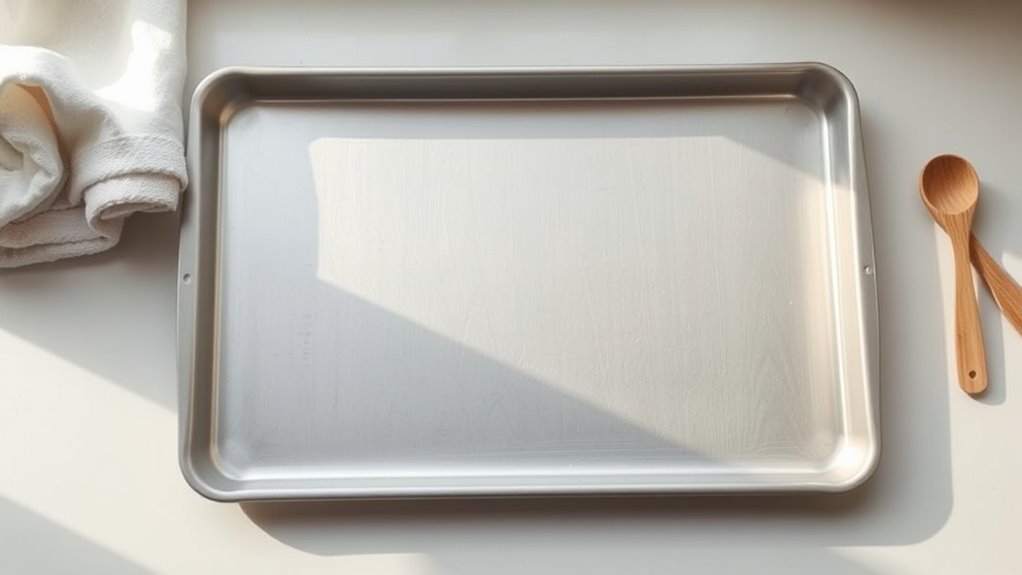
You probably don’t realize that the sheet’s edge profile and material change how cookies brown and lift. You’ll feel the subtle cool of heavy-gauge aluminum, see a low rim catching butter-slick edges, and notice whether a matte or glossy finish lets rounds slide free. Picture a slim, precise rectangle that balances even heat with easy access — and keep going to learn which details matter most.
What a Cookie Sheet Looks Like (Shape, Rim, Finish)
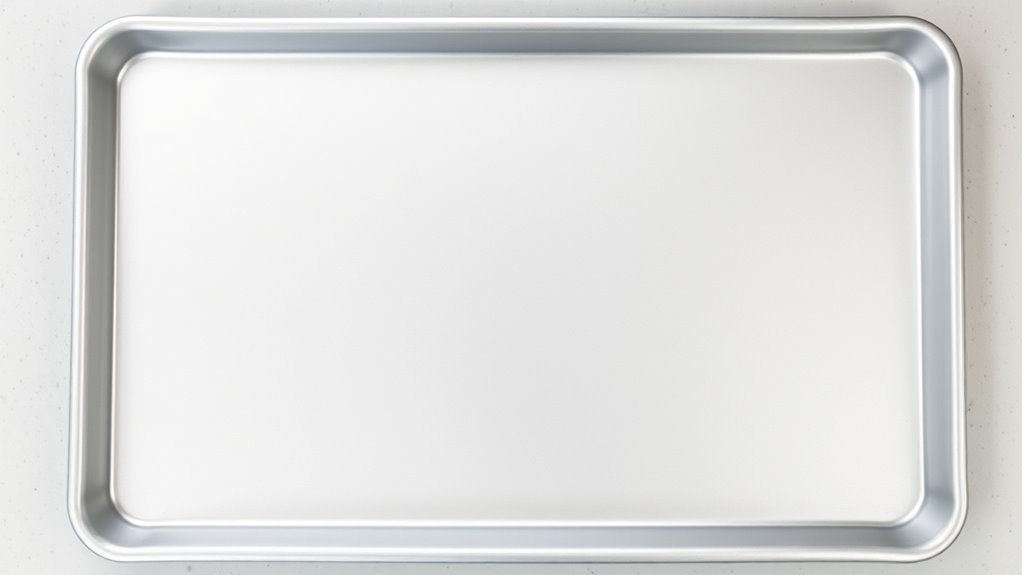
When you slide a cookie sheet out of the oven, you’ll first notice its flat, rectangular expanse—often around 10 x 15 inches for standard pans or up to about 20 x 14 inches for extra-large—and that broad, uninterrupted surface invites even rows of cookies.
Your fingers trace the low rim or absence of one; this minimal edge lets you reach in, flip and free the baked goods, and it breathes hot air around each piece so browning stays uniform.
You’ll see finishes that gleam or feel satin: non-stick coatings that release with a gentle nudge, or raw aluminum that conducts heat like a promise of deep, even color.
The steel beneath your touch feels solid, heavy-gauge or stainless, resisting warp the way resolve holds its shape.
A smooth, stain-resistant plane cleans quickly, a practical elegance that frees you from fuss—so the cookie sheet becomes a tool of small rebellions, reliable and beautifully plain.
Quick Checklist to Choose the Right Cookie Sheet
Pick a sheet that fits your oven—around 17–18 inches for roomy, even baking—and feel the weight of heavy-gauge or stainless steel for steady heat.
Notice the finish and nonstick surface under your fingertips so cookies release cleanly and cleanup stays simple.
Decide whether you want flat edges for perfect browning or a rimmed, reinforced edge to catch spills and resist warping.
Size And Fit
Aim for a sheet that feels substantial in your hands and measures close to 18 x 13 inches so it slides into your oven without scraping the racks.
For size and fit, check dimensions against your oven and visualize how many cookies you’ll free on a single tray; nothing’s more liberating than a pan that gives you space to breathe.
Prefer a shallow rim or rimless edge so your wrist and spatula glide in smoothly when you lift warm rounds.
Notice the weight — a denser sheet resists warping and nests heat evenly, promising consistent browning.
Consider nonstick surfaces or the option to use parchment for easy release and cleaning.
Choose fit that honors your oven and your impulse to bake boldly.
Material And Finish
If you want cookies that brown evenly and lift cleanly, choose sheets made from aluminum or stainless steel with a smooth, reliably finished surface; they conduct heat so your edges crisp while centers stay tender. Nonstick coatings let dough slide off without scraping, and a sturdy, rolled edge keeps the pan flat and comfortable in your hands.
You’ll feel the cool, satin metal and see even color across each sheet — freedom from guesswork.
- Aluminum: fast, even heat for consistent caramelization.
- Stainless steel: durable, sleek surface that resists pitting and warping.
- Nonstick finish: effortless release and quicker cleanup.
Pick a baking sheet sized for your oven, solidly built to survive high heat, and let your baking be joyful and uncompromised.
Rim And Edge Design
After you’ve settled on the right material and finish, pay close attention to the rim and edge—these small details shape handling, heat behavior, and the sheet’s lifespan. You’ll want rolled edges or a slight raised rim to stop warping, guide hot air, and give your hands a secure grip. Heavy-gauge steel with a safe non-stick coating frees you from sticky resistance; it feels solid, responds predictably, and lasts. Size matters for freedom—10 x 15 inches is common, but choose larger if you crave scale.
| Feature | Benefit | Tip |
|---|---|---|
| Rolled edge | Resists warping | Easier grip |
| Slight rim | Even airflow | Keeps cookies contained |
| Flat surface | Uniform browning | Choose heavy-gauge |
Standard Cookie Sheet Sizes and Which to Pick
You’ll reach for a half-sheet when you want a full, even roast of cookies across an 18 x 13-inch expanse, its sturdy surface promising uniform browning.
If you’re working with a smaller oven or baking in singles, a 9 x 13 quarter-sheet feels intimate and efficient, keeping heat focused and edges crisp.
Always check the metal’s gauge and conductivity—heavy aluminum or stainless steel will hold temperature steady and keep your batches looking and tasting their best.
Half Sheet Versus Quarter
Two sizes will cover almost every baking need: the roomy half sheet (about 18 x 13 inches) for crowd-pleasing batches and roasting, and the compact quarter sheet (9 x 13 inches) for small runs or tight oven space.
You’ll feel the cool, thin metal sing under your fingertips as heat spreads evenly across shallow edges, crisping cookie rims and browning sheets of roasted vegetables.
Choose by intention: do you want liberation through abundance or nimble freedom in a small kitchen?
- Half sheet — large, versatile, ideal for mass baking and serving.
- Quarter sheet — compact, perfect for experiments, side dishes, or single trays.
- Both — the balanced choice for creative control and practical flexibility.
Choosing Based On Oven
When your oven hums to life, pick a sheet that fits its rhythm: standard cookie sheets (about 18 x 13 inches) slide into most conventional ovens and give you room to bake dozens at once, while the slightly smaller half-sheet variant (commonly listed as 13 x 18 inches) lets you maneuver in tighter spaces without scraping racks. Choose flat, slightly raised edges so cookies rest safely and you lift with confidence. In convection ovens, lean toward lightweight aluminum for airy circulation and even browning. Seek non-stick finishes or parchment for easy release and swift cleanup. Your choice should feel like liberation: roomy, nimble, and honest. Match size to oven, prefer flatness for control, and honor your baking cadence.
| Oven Type | Best Sheet |
|---|---|
| Conventional | 18 x 13 in |
| Small oven | 13 x 18 in |
| Convection | Lightweight aluminum |
| Cleanup | Non-stick/parchment |
Material And Heat Conductivity
Pick a sheet by feel as much as by size: aluminum sings with swift, even heat so cookies brown uniformly across an 18 x 13 surface, while stainless steel feels steadier in your hands and resists warping if you like higher temps or heavy use.
You’ll sense the difference—aluminum’s light, responsive touch vs. stainless’s cool, solid weight—because material dictates heat conductivity and the freedom to bake without fear. Choose flat-bottomed pans to keep that promise.
- Aluminum: best heat conductivity, large half-sheet friendly.
- Stainless steel: durable, warp-resistant, ideal for intense use.
- Non-stick or lined: easier release, consider greasing with pure metals.
Pick what frees you—size and substance together.
Materials Explained: Aluminum, Steel, and Stainless for Cookie Sheets
Materials matter as much to your baking as butter and sugar: aluminum sheets conduct heat quickly and feel featherlight in your hands, steel brings a satisfying heft and resilience that resists warping, and 18/0 stainless offers a cool, non-reactive surface that won’t stain or leach flavors.
You’ll notice aluminum’s swift, even warmth in the crisp edges and uniform color of cookies; its lightness lets you maneuver trays like a conductor shaping tempo.
Steel, denser and thicker, holds heat longer — you feel its weight, a promise against warping and an ally when you crave predictable browning.
Stainless presents a clean, almost clinical calm: its resistance to rust and staining comforts you if purity matters.
Consider maintenance too: aluminum and coated steel can be forgiving, while stainless asks for gentle care to keep its sheen.
Choose by sensation and intent — speed, stability, or purity — and let your sheets amplify the freedom of your baking.
Surface Finishes and Release (Nonstick, Textured, Polished, Speckled)
Four common finishes — nonstick, textured, polished, and speckled — change how your cookies brown, release, and age. You’ll feel freedom in choices: nonstick surfaces let cookies slide away with minimal oil or parchment, freeing you from sticky frustration.
Textured finishes whisper airflow beneath dough, crisping edges and yielding even, bronze tops. Polished sheets gleam, durable and cool to the touch, though you’ll often grease them for confident release. Speckled coatings cloak tiny scuffs, keeping the pan handsome as it seasons.
- Nonstick: easy release, less fat, clean lines on baked edges.
- Textured: embossed patterns boost convection, producing uniform crunch.
- Polished/Speckled: aesthetic polish or camouflage; both rely on quality metal beneath.
Choose high-conductivity aluminum or stainless steel to pair with these finishes so heat sings through dough, producing golden-brown results that feel both intentional and liberating.
Rim and Edge Types: Flat Sheet, Half-Sheet, and Rimmed Baking Sheet
After you choose a finish, the sheet’s rim and edge shape will shape how your cookies bake and how the pan performs day-to-day.
You’ll feel the difference: a flat sheet offers a whisper-flat field where dough spreads and edges caramelize evenly, nothing to interrupt heat or your touch. A half-sheet, about 13 x 18 inches, gives you roomy freedom with a low lip that keeps spills modest while still letting air circulate for crisp bottoms.
Choose a rimmed baking sheet when you want containment — the raised perimeter holds juices and roasted sugars, so vegetables and saucy bakes don’t escape the pan or your intentions.
Aluminum or stainless cores conduct heat and withstand rehearsal after rehearsal, and nonstick or polished faces release with a soft sigh.
Pick the rim that matches your practice: flat for pure cookie craft, half-sheet for versatility, rimmed for constraint turned useful.
Your bakeware should liberate your methods, not limit them.
How Construction Affects Performance: Heat, Warping, and Durability
When you slide dough onto a well-built sheet, you should feel confidence in how it will darken and rise: thick, flat bases made from aluminum or stainless steel conduct heat quickly and evenly so cookies bake with uniform color and crisp edges, while encapsulated rims and rolled edges keep the pan rigid under high heat so it won’t cup or wobble.
You’ll notice an immediate tactile assurance: a cool, seamless surface that promises predictable response to oven temperature and resists the stress of repeated cycles.
- Heat conduction — thin, even metal gives uniform warmth and predictable browning.
- Structural stability — encapsulated rims and rolled edges prevent warping, keeping your sheets true.
- Clean lines — seamless, rounded corners stop food traps and simplify maintenance.
Choose a sheet that feels honest in your hands; its precise construction liberates you to bake without fear of distortion, uneven cooking, or surprise failures, letting your baking be purposeful and beautiful.
Real-World Performance: Browning, Release, Cleaning, and Longevity
You’ll notice the difference the moment a tray comes out of the oven: even, amber-brown bottoms and crisp edges that sing of steady heat, not hot spots.
You feel the plate’s cool weight in your hands — a flat cookie sheet with rolled edges that keeps heat honest and prevents warping — and you know each cookie will brown uniformly because the aluminum or stainless steel beneath conducts warmth like a promise fulfilled.
A reliable nonstick or coated surface grants effortless release; baked goods lift away without protest, freeing you to create without fear.
Cleaning becomes a meditation, not a chore: seamless construction and dishwasher-safe finishes shed crumbs and caramel with a few strokes, restoring the metal’s quiet gleam.
Treat it gently — avoid scorching temperatures and metal utensils — and its longevity rewards you with years of even baking.
This is liberation baked into form: function that lets you make, taste, and keep.
Frequently Asked Questions
What’s the Difference Between a Baking Sheet and a Cookie Sheet?
A baking sheet and a cookie sheet differ in size, thickness, and edge design: you’ll use a baking sheet for sturdier, even heat and versatile Baking Materials, while a cookie sheet’s thinner metal and low or no rim lets cookies slide off effortlessly.
You’ll feel the cool metal, see the gleam of aluminum or nonstick sheen, and choose the tool that frees your baking, honoring texture, speed, and liberated creativity.
What Do I Use if I Don’t Have a Cookie Sheet?
Think of your kitchen as a rebel’s stage: use a half-sheet pan, baking pan, pizza stone, oven-safe skillet, or roasting pan as Alternative Options.
You’ll feel the cool metal, smell warm dough, and watch edges crisp. Line pans with foil for easy release, preheat stones for even browning, and embrace the improvisation—you’re freeing your baking from one tool and harnessing texture, heat, and scent to create perfect cookies anyway.
Is a Cookie Sheet Just Parchment Paper?
No — a cookie sheet isn’t just parchment paper. You’ll feel the cookie sheet’s cool, rigid metal under your palms, its heat-ready surface supporting your baking; parchment Properties give a slick, crinkly, disposable barrier that prevents sticking.
You’ll love using both: the sheet offers durable structure and even browning, while parchment liberates you from scrubbing. Together they create a tactile, elegant workflow that frees your baking to be bold and joyful.
Is a 9×13 Pan a Cookie Sheet?
No — a 9×13 pan isn’t a cookie sheet. You’ll feel the difference: taller sides confine steam and warmth, altering texture and browning.
Embrace Pan Variations—flat, low-edged sheets let air circulate, crisping edges and freeing cookies to sing.
When you choose wisely, your baking becomes a small act of liberation: tactile, golden, and precise.
Swap pans to sculpt outcome; let surfaces, edges, and space determine your finished bite.
Conclusion
You’ll spot the perfect cookie sheet at a glance: sleek, flat, often rectangular with low or no rims, cool to the touch and gleaming or matte under the light. It should feel sturdy, not flimsy, and slide into the oven like a whisper. Choose the right size and finish, and your cookies will brown evenly, release cleanly, and sing with crisp edges—small details that turn baking into a quietly beautiful ritual.