
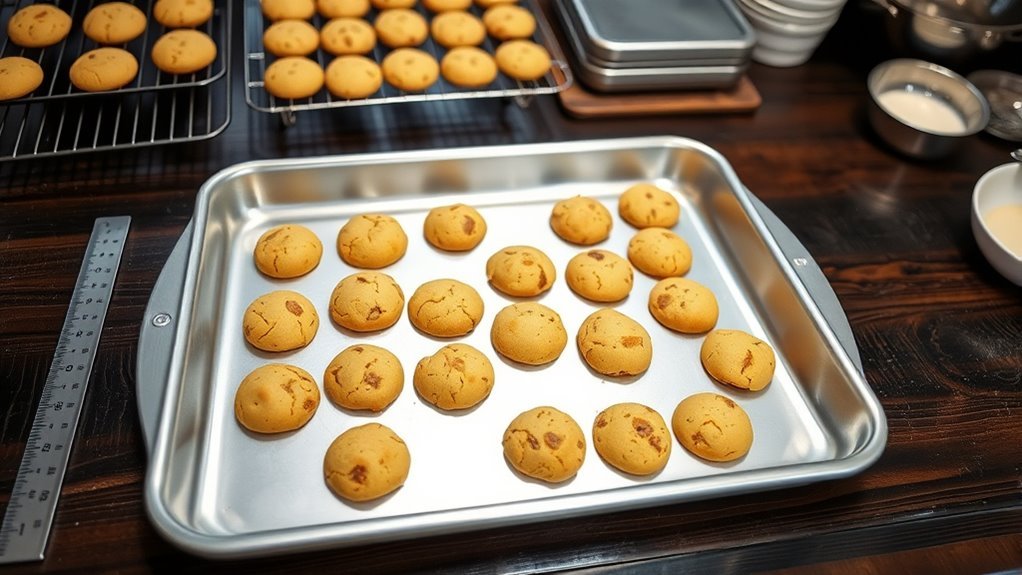
You probably don’t know that a “half” sheet pan is not half of a full commercial sheet but a standard home size that fits most ovens. You’ll feel how its shallow rim and broad surface speed up browning and evaporation, giving crisper vegetables and chewier cookies. I’ll explain the exact dimensions, capacity differences with 1″ vs 2″ depths, and which materials work best—so you can pick the right pan for every task.
What a Half Sheet Pan Is and Common Use Cases
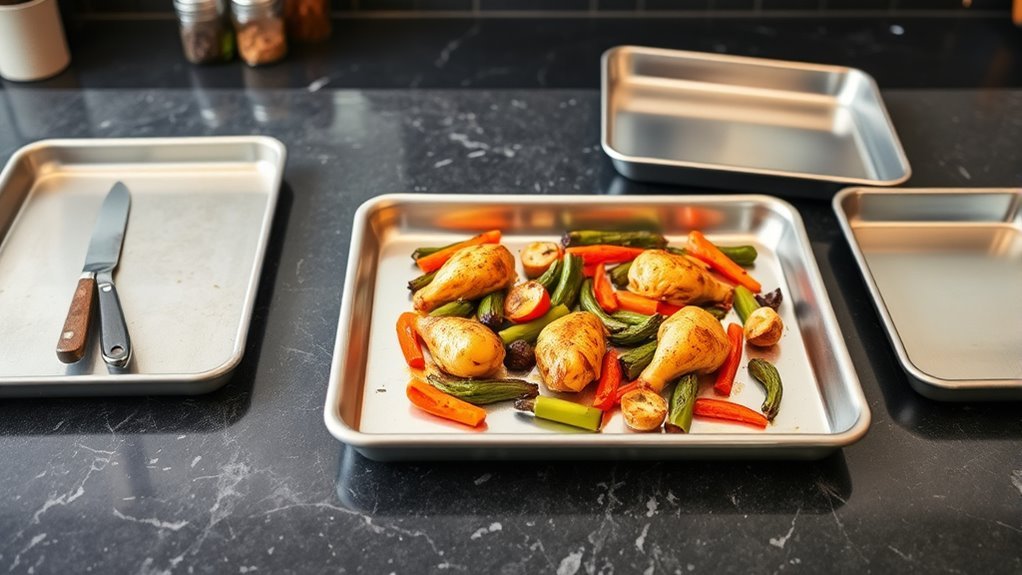
A half sheet pan measures about 18 by 13 inches with roughly a 1-inch depth, and you’ll find it fits a wide range of tasks from roasting vegetables to baking cookies or sheet cakes.
You’ll recognize the half sheet as a workhorse: its broad, shallow surface lets heat sweep across food, browning edges and caramelizing sugars so roasted carrots snap with sweetness and cookies develop crisp, golden rims.
Made often from aluminum or stainless steel, the half sheet resists warping and stands up to high heat, so you can push temperatures without fear.
In your home or a busy bakery, it handles batches that free you from constant turning or juggling pans — one sheet holds more than you think.
Use it for roasted vegetables, traybakes, sheet cakes, or cookie runs; you’ll appreciate how its size and material give reliable, even results while keeping your workflow liberated and efficient.
Standard Half Sheet Pan Dimensions (L × W × Typical Depth)
When you slide a standard half sheet pan into the oven, you’ll notice its roughly 18-by-13-inch footprint with about a 1-inch rim — a shallow, broad surface that lets air and heat circulate evenly around whatever you’re roasting or baking. You’ll feel how that low edge frees the surface, making it easy to turn cookies or slide roasted vegetables onto a platter. Those half sheet pan dimensions (18″ × 13″ × ~1″) are designed to fit most home ovens, giving you efficient workspace without crowding.
| Dimension | Measurement | Sensory note |
|---|---|---|
| Length | 18 in | Long enough for rows of cookies |
| Width | 13 in | Broad to spread ingredients thin |
| Depth | ~1 in | Shallow rim for quick evaporation |
With these precise dimensions you gain control—space to breathe, heat to circulate, and the freedom to bake and roast with confidence.
How Much Fits: Real Capacity for Baking and Roasting
Moving from dimensions to actual use, you’ll find a standard half sheet pan (about 18″ × 13″ with a ~1″ rim) holds roughly 4 quarts of ingredients, giving you plenty of room for a big batch of cookies, a sheet cake, or a generous layer of roasted vegetables.
You can load it with dozens of cookies spaced to brown evenly, a single-layer cake batter that spreads to the pan’s size, or a crowded mound of root vegetables that caramelize under even heat.
That size balances capacity and control: you get volume without losing airflow and crisping. In both home and bakery kitchens, the pan’s shallowness lets moisture escape, sharpening textures and concentrating flavor — you smell sugars turning amber, hear edges crisp.
Use that sense to liberate your cooking: scale recipes confidently, roast larger quantities, or split trays for different seasonings. Know the size, trust the capacity, and plan yields accordingly.
How Depth (1″ Vs 2″) Changes What a Half Sheet Pan Can Hold
Although the footprint stays the same, swapping a 1″ rim for a 2″ one changes how much you can pour, pile, and roast—doubling depth roughly doubles volume, so a 2″ half sheet holds about twice the batter or vegetables of a 1″ pan.
Same footprint, double depth—swap a 1″ rim for 2″ and you roughly double how much you can pour, pile, roast.
You’ll notice the size difference immediately: a shallow 1″ pan lets air kiss the surface, promoting crisp edges on cookies and bronzing on roasted carrots. It feels light, open, democratic—ingredients spread thinly and finish faster.
A 2″ pan, by contrast, feels capacious and protective; batter pools into a thick, yielding center, casseroles bake with hearty insulation, and deep-dish pizzas rise with substance.
Because volume grows, heat penetration slows, so you’ll adjust time and maybe temperature.
Choose depth by intent: pick 1″ when you want speed, surface browning, and liberation from sogginess; pick 2″ when you need capacity, heft, and the freedom to serve larger, more substantial portions.
Materials (Aluminum, Stainless, Nonstick) and Performance
When you reach for a half sheet pan (about 18 x 13 inches), the material dictates how it performs: aluminum delivers fast, even heat that crisps edges and browns bottoms.
Stainless steel feels solid in your hands and resists warping and corrosion, so it lasts through heavy use.
A nonstick coating lets food slide off and speeds cleanup, though you’ll want gentle tools to keep that surface intact.
Aluminum Heat Conductivity
Because aluminum conducts heat so well, you’ll notice faster, more even cooking with a half sheet pan than with heavier materials like stainless steel.
With aluminum sheet pans, heat sweeps across the surface, browning edges uniformly and crisping textures without hot spots. You’ll feel the lightness when you lift a loaded tray—easy maneuvering that frees you to move fast in the kitchen.
That rapid transfer shortens bake times and encourages steady air circulation, so cookies, roasted vegetables, and sheet cakes develop consistent color and crumb.
Aluminum’s rust-proof quality and the potential to build a natural nonstick patina mean less oil and simpler release.
For bakers craving efficiency and freedom, aluminum delivers predictable results and liberated workflow.
Stainless Steel Durability
Stainless steel stands out for its rugged durability and resistance to corrosion, so you’ll trust it for heavy-duty, high-heat baking tasks where warping and surface damage are concerns.
You feel the solid weight of an 18 x 13-inch half sheet pan in your hands; that mass signals resilience. Stainless steel durability means the pan endures repeated oven cycles, scrubbing, and the occasional metal spatula without surrendering its surface.
Heat moves slower than on aluminum, so you’ll adjust times or preheat thoughtfully, but you gain strength and longevity.
In commercial kitchens and liberated home setups alike, these pans resist dents and scratches, maintain shape under racks and full trays, and repay you with consistent service for years.
Nonstick Coating Performance
Although nonstick coatings look like a simple fix for sticky batters and delicate fish, their performance depends on material, pan construction, and how you use them.
You’ll appreciate how a coated half sheet pan (about 18 by 13 inches) releases cookies and fragile fillets with minimal oil, speeding cleanup and lightening your rituals.
Know that nonstick coatings on aluminum marry fast, even heat with effortless release, but can weaken under high oven temps or metal tools.
Lower-end coatings scratch or degrade sooner; premium brands resist higher heat and abrasion.
If you crave freedom from tedious scraping, choose a robust nonstick or pair a stainless steel pan when durability matters—accepting a little extra greasing for long-term resilience.
Half vs Quarter, Full, and Jelly-Roll Pans: Quick Size Comparison
Think of sheet pans as a size ladder: a full sheet measures about 26 x 18 inches for commercial-scale batches, a half sheet—what most home cooks use—is 18 x 13 inches, a quarter sheet is roughly 9 x 13 inches for single portions, and a jelly-roll pan resembles a half sheet but usually has a 1-inch raised edge for thin cakes you’ll roll.
When you compare half vs quarter, full, and jelly-roll pans, you’ll notice immediate differences in capacity and control. The half sheet gives roomy, even heat for cookies and roasted vegetables; its broad surface lets steam escape and surfaces brown.
The quarter sheet concentrates heat, so smaller portions cook faster and you waste less energy. The full sheet is liberating when you need scale — more trays, more output.
The jelly-roll’s raised rim guides batter and keeps edges clean when you roll cakes. Knowing these sizes helps you choose the pan that matches portion, pace, and culinary freedom.
Best Recipes and Tasks for a Half Sheet Pan
With its roomy 18 x 13-inch surface and even heat, a half sheet pan lets you roast colorful vegetables until their edges caramelize and juices concentrate while proteins crisp up.
You can toss chicken, peppers, and onions with bold spices and slide the pan into the oven for a single-sheet dinner that smells like a restaurant.
For baking, use the shallow 1-inch depth to spread cookie dough or toast nuts and granola so every piece browns evenly.
Sheet Pan Dinners
Ever wondered how to get a whole dinner on the table with almost no fuss? With a half sheet pan (18 x 13 inches) you’ll conjure sheet pan dinners that free your evenings.
Lay protein and chopped vegetables in a single layer; the pan’s raised edges contain juices while promoting even air circulation so everything caramelizes, not steams. Use parchment to lift out food and speed cleanup.
You’ll notice crisp edges, browned sugars, and concentrated aromas as flavors mingle on the tray. Portioning matters: give each piece room for heat to circulate.
This approach saves time, reduces dishes, and empowers you to improvise—swap vegetables, season boldly, and claim a satisfying, liberated meal from one efficient, versatile pan.
Baking & Roasting
Looking for reliable ways to bake and roast for a crowd? You’ll love how an 18 x 13-inch half sheet pan lets you bake cookies, brownies, and sheet cakes with even heat, and roast vegetables or chicken thighs in one go. It holds about 10–12 cups, so you can batch-cook, prep meals, or toast nuts and granola without crowding.
| Task | Best Use |
|---|---|
| Cookies & Brownies | Even baking, crisp edges |
| Roasted Veg/Meat | High-heat browning, caramelization |
| Granola/Toasting | Thin layer, uniform toasting |
Use sensory cues—golden edges, fragrant caramelized vegetables—to judge doneness. You’ll gain freedom by scaling recipes easily, reclaiming time while producing consistent, bold results through purposeful baking and roasting.
Will a Half Sheet Pan Fit My Oven? Measuring and Storage Tips
One quick check will save you from awkward fits: measure your oven’s interior width and depth before buying or pulling out a half sheet pan.
Will a half sheet pan fit my oven? A standard half sheet pan is about 18 x 13 inches, so you want at least 19 inches of interior width to allow for circulation and easy insertion. Measure from side wall to side wall and front to back, feeling the metal edges and imagining the pan sliding in so you sense clearance.
If space is tight, choose a low-profile, lightweight half sheet pan that slips into racks without scraping.
For storage, stack pans flat or stand them upright in a cabinet or drawer to free countertop territory. That simple, tactile approach—measuring, testing the fit, then storing smartly—gives you freedom in the kitchen and guarantees you can roast vegetables, bake cookies, or prep sheet cakes without compromise.
Buying Checklist: Size, Material, Durability, and Warranty
Now that you know how to check whether a half sheet pan will fit your oven, it’s time to pick the right pan for the jobs you plan to do.
Choose size first: the standard half sheet is 18″ by 13″, roomy enough for roasting vegetables or baking smaller batches.
Feel the weight—heavy-gauge metal tells you the pan will resist warping and hold steady heat, delivering even browning you can trust.
Heft matters—choose heavy-gauge metal to resist warping and ensure steady heat for reliable, even browning.
Decide on material: aluminum gives you fast, responsive heat; stainless steel buys durability and rust resistance.
Run your fingers over the surface—non-stick coatings or textured finishes change how food releases and how easily you clean.
Think about temperature limits and whether the finish is oven-safe at high heat.
Finally, check warranty details. A limited lifetime warranty signals the maker stands behind build quality and frees you from repeat replacements, so you can cook boldly and sustainably.
Frequently Asked Questions
What Is the Difference Between a Half Sheet Pan and a Quarter Sheet Pan?
A half sheet pan is larger than a quarter sheet pan: you get 18 x 13 inches versus 9 x 13 inches, so the half doubles the footprint.
You’ll notice the half usually holds 3–4 quarts and the quarter 1–2 quarts, with depths around 1–2 inches.
Pan dimensions shape capacity and cooking surface, so you’ll choose the half for big batches and meal prep, and the quarter for smaller, more liberated portions.
Is a Half Sheet Cake a 9×13?
Yes — sometimes.
Think of a half sheet cake as a flag cut from a larger banner; you’ll often use a 9×13 pan, but true half sheet cake dimensions usually mean about 18×13 inches.
You’ll savor precise measurements: a 9×13 yields fewer servings and shorter bake time, while an 18×13 half sheet frees you to serve more guests.
Choose the pan that lets you celebrate and claim your space.
Is a 12X18 Cake Pan a Half Sheet?
No — a 12×18 cake pan isn’t technically a half sheet.
You’ll notice the pan dimensions differ from the standard 18×13 half sheet, so it may feel roomier and sit differently in your oven.
You can still bake cookies or a sheet cake in it, but you’ll want to adjust time or temperature and trust your instincts.
Embrace the freedom to experiment; the senses will guide you to perfect results.
Will a Half Sheet Pan Fit in a Standard Oven?
Yes — most of the time it will. Like a key sliding into a lock, a half sheet pan usually fits standard oven dimensions, since home ovens commonly have at least an 18-inch interior width.
You should measure your oven to be sure, allowing clearance for air circulation and racks.
You’ll enjoy even roasting and baking when you confirm fit; then you’ll freely expand your cooking repertoire with confidence.
Conclusion
You’ll find a half sheet pan is a helpful, hardy home essential: about 18 by 13 inches with a shallow 1-inch depth that delivers crisp edges, even browning, and quick moisture escape. Whether roasting, baking, or broiling, its roomy, reliable reach fits most ovens and recipes. Choose aluminum for speed, stainless for strength, or nonstick for easy cleanup. Measure your oven, mind the depth, and pick durable materials for long-lasting, versatile performance.
