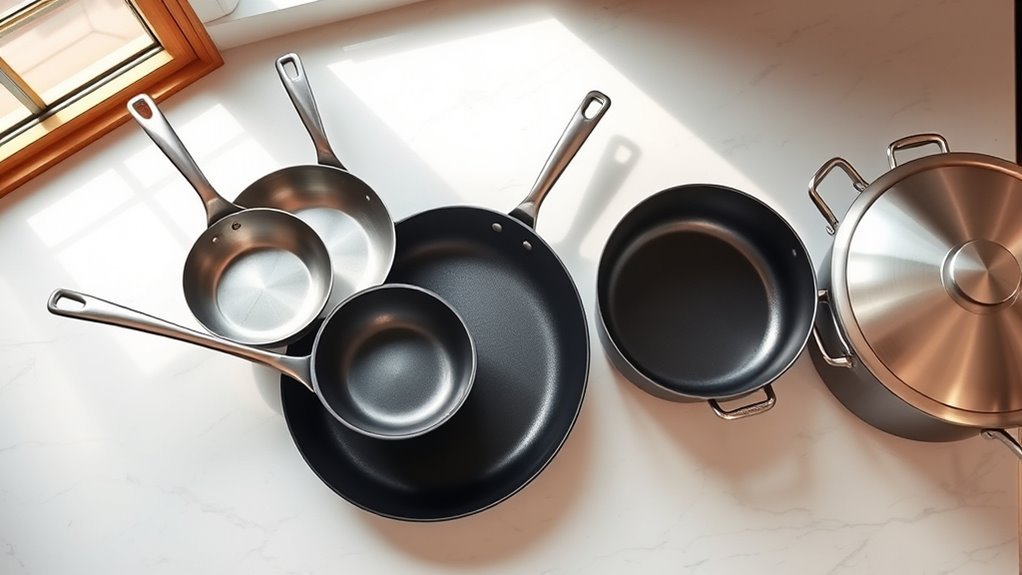
Choosing pans is like picking tools for a small orchestra—you want pieces that play well together and sound right for the meal. You’ll feel the weight of cast iron, hear the sizzle in stainless steel, and appreciate a nonstick that frees delicate eggs without fuss. I’ll walk you through the key sizes, materials, and priorities so you can build a functional set that fits your kitchen, budget, and cooking rhythm—starting with the skillet sizes.
What Pans Do Most Home Cooks Actually Need?
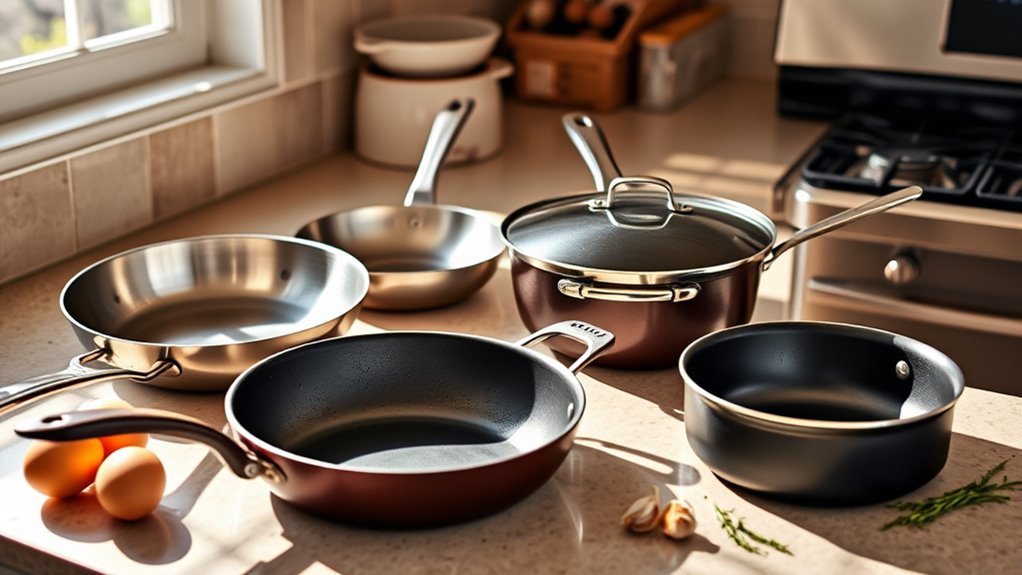
Wondering which pans you’ll actually use day after day? You want freedom in the kitchen, so pick tools that expand what you can make without clutter.
Reach for a 10-12 inch large skillet when you brown meat or toss vegetables; its even heat gives you a deep, caramelized aroma and crisp edges.
Keep a 10-inch nonstick skillet for eggs and pancakes — it lets you flip without fear and cleans quickly, so you’re back to living, not scrubbing.
A 3-4 quart saucepan handles sauces, grains, and small boils; its steady simmer sharpens flavors.
For slow, soulful meals, the 5-7 quart Dutch oven locks in moisture for braises and even bakes bread that smells like home.
Finally, a 6-12 quart stockpot handles soups, stews, and pasta for company or leftovers.
With these sizes, you streamline your cookware, cook boldly, and reclaim time for what matters.
Which Materials Matter: Stainless, Cast Iron, Aluminum, and Nonstick
Think about how a pan feels in your hand and how quickly it heats — stainless and aluminum heat differently and their weight changes how you handle them.
Consider the upkeep and lifespan: cast iron needs seasoning and care, stainless can tolerate the dishwasher, and aluminum and nonstick need gentler treatment.
Finally, weigh nonstick performance and safety against durability so you pick coatings and materials that match the foods you cook.
Heat Conductivity And Weight
Because heat and heft shape how a pan performs, you’ll want to match material to cooking tasks: feel the warmth spreading under your hand and choose accordingly.
Stainless steel with aluminum cores gives reliable heat conductivity and even browning for precision work. Cast iron’s weight considerations mean slow, steady heat and superb retention for searing and braises. Nonstick properties favor delicate foods and easy release, but you’ll handle them gently to avoid scratching.
- Stainless steel (tri-ply): precise, even heating; durable for high heat.
- Cast iron: heavy, slow to change temperature; excellent retention and depth of flavor.
- Aluminum/nonstick: light, very responsive; ideal for eggs and quick sautés, may need special induction designs.
Pick materials that free you to cook boldly.
Maintenance And Longevity
When you care for a pan the right way, it rewards you with years of reliable performance and better-tasting food. You’ll learn how maintenance extends the longevity of each cookware material: stainless steel resists rust and loves deglazing, cast iron demands seasoning and oiling, aluminum benefits from anodizing, and nonstick surfaces need gentle handling and lower heat.
| Material | Care Image |
|---|---|
| Stainless steel | Warm soapy water, savory browned bits |
| Cast iron | Rust-free, oiled patina |
| Aluminum | Quick, even heat, light weight |
| Nonstick surfaces | Smooth glide, soft utensils |
| General tip | Hand wash, avoid metal, dry immediately |
Treat pans like tools of freedom — clean, dry, and respect their limits to keep them serving you.
Nonstick Coatings And Safety
You’ve kept your pans clean and oiled; now look at what’s on their cooking surface—nonstick coatings shape how you cook, clean, and stay safe.
You’ll smell searing steak on stainless, feel the rugged weight of cast iron, and notice how aluminum heats quickly. Choose coatings that balance durability with release; PTFE offers slick release, ceramic resists abrasion differently. Always prefer PFOA-free labels for safety.
- Stainless: durable, great for browning and deglazing; needs oil to prevent sticking.
- Cast iron: when seasoned, gains a natural nonstick layer and holds heat; needs maintenance to avoid rust.
- Aluminum: distributes heat fast, often sold with nonstick layers; uncoated aluminum can react with acids.
Pick pans that free you to cook boldly and clean easily.
Choose Pan Sizes for Your Cooking Habits
Match pan size to the portions you usually cook—use a 10-inch for 1–2 people and a 12-inch when you’re feeding a family or batch-cooking.
Check your stove and storage so oversized skillets or a 12-quart stockpot won’t crowd burners or cabinets.
Think about the food: an 8–12 inch nonstick for eggs and delicate items, a 10–12 inch stainless for sautéing and sauces, plus a 3–4 quart saucepan for boiling and a 6–12 quart stockpot for soups and pasta.
Match Size To Portions
Think about how many plates you usually feed each night and pick pans that let food cook evenly without crowding; for one or two people, an 8-inch or 10-inch frying pan and a 3–4 quart saucepan handle most tasks, while a 12-inch skillet and a 6–12 quart stockpot give you room for family-sized batches.
A 9×13 baking dish is the go-to for casseroles and sheet cakes. Match portion sizes to pan capacity so flavors develop and textures stay true. You’ll notice sizzle, steam, and caramelization happen best when ingredients aren’t cramped.
Start with these essential cookware choices and expand when needed:
- 10″ frying pans for daily sautéing and eggs
- 12″ skillet for larger batches and meats
- 6–12 qt stock pot for pasta and soups
Choose liberating tools that suit your appetite.
Consider Stove And Storage
Because your stove layout and storage shape how you cook, pick pan sizes that fit both the burners and the space you have, not just the recipes you like.
Match pan sizes to burners so heat distribution stays even — larger pans on small burners waste energy and warp food.
Think about the servings you make: a 10–12-inch skillet handles 2–4 people, while family meals need larger pans and sturdier burners.
Organize by frequency of use: keep a 10-inch nonstick and a 5-quart stockpot within reach, tuck seldom-used skillets away.
Maximize storage space with nesting or stackable sets, and favor lighter materials if you often lift full, larger pans.
Choose tools that free you, not ones that limit you.
Think About Food Types
You’ve already matched pans to burners and storage; now consider what you actually cook most often so your cookware works with your menu.
Think about food types and how they move in the pan: quick, delicate sizzles or slow, comforting braises. Choose frying pans and nonstick skillets by portion — 8–10″ for eggs and fish, 10–12″ for steaks or stir-fries.
Match saucepan sizes to tasks so sauces don’t boil over and vegetables steam evenly.
- For solo or duo meals, a 10″ frying pan and a 3–4 quart saucepan cover most needs.
- For family meals, step up to 12″ skillets and larger saucepans.
- Keep a 5–7 quart Dutch oven and a 6–12 quart stockpot for braises, soups, and pasta.
Pick tools that free you to cook boldly.
Choosing Frying-Pan Sizes: 8″, 10″, or 12″
Pick the right pan size and you’ll notice a big difference in how your food cooks and how much you can make at once.
Choose an 8-inch frying pan when you want nimble control: it heats fast, fits small burners, and excels with single servings and delicate eggs.
A 10-inch pan is the versatile middle ground — ideal for 1–2 people, offering enough surface for a full omelet or sauté without wasting heat.
Go larger with a 12-inch when you demand scale and sear: more surface means you can brown proteins and stir multiple ingredients without crowding, and the mass helps retain heat for even cooking.
Consider your burners — oversized pans need matching flames for best cooking efficiency — and your liberation: pick sizes that free you from limits, whether solo or feeding a few.
Balance stove compatibility, meal size, and desired control, and you’ll own frying pans that empower every plate.
Saucepan Vs Saucier: 1–1.5 Qt and 3–4 Qt – Which to Buy
Wondering whether a saucepan or a saucier will better suit your kitchen needs? You feel the smooth weight in your hand and imagine stirring freedom into food: choose a 1–1.5 quart saucepan when you need compact control for heating small soups or sauces, boiling, or steaming; reach for a 3–4 quart saucier when you want room to whisk, reduce, and concentrate flavors.
Both often come in stainless steel for even heat distribution, but their shapes guide your cooking methods.
- Saucepan: tall, straight sides, great for boiling, simmering, and tight saucepan sizes for single servings.
- Saucier: rounded edges, superior for whisking, risotto, and faster evaporation that intensifies sauces.
- Choose by use: pick the saucepan for steady simmering and steaming, the saucier for active stirring and reduction.
You’ll liberate your cooking by matching form to function and trusting the pan that moves with you.
Stockpots and Pasta Pots: Pick the Right Capacity (6, 8, 12 Qt)
After you’ve matched pan shape to the task for sauces and reductions, it’s time to think bigger for stocks and pasta. Choose a 6-quart stockpot for intimate, everyday freedom—perfect for soups, small stocks, or pasta for 2–4 people.
Move up to an 8-quart when you want extra room for family meals or batch cooking; it handles 6–8 servings without crowding ingredients. For parties or serious meal prepping, the 12-quart gives you the breathing space to make large stocks or pasta for 10+ servings.
Pick material that serves your goals: stainless steel provides durability and even heating so flavors develop reliably; aluminum heats fast if weight matters.
Seek tight-fitting lids and sturdy handles for safe lifting and controlled simmering. Think of capacity as empowerment: choose the size that matches how you cook, feed, and liberate your time—and avoid overbuying a pot that won’t get used.
Dutch Oven Sizing: When One Pot Replaces Others
How much kitchen real estate do you really need in one pot? You want freedom: one vessel that handles weeknight stews, slow braises, and even bread. A 5–7 quart Dutch oven often answers that call. Its enameled cast iron walls feel weighty in your hands and promise even heat distribution and exceptional heat retention, so liquids simmer steadily and crusts form beautifully.
Think of what you’d replace and why:
- 5–6 qt — ideal for 2–4 people: soups, small roasts, and sauces without crowding.
- 6–7 qt — roomy enough to replace a stockpot for pasta or larger stews.
- Weight and fit — pick a size that suits your stovetop, oven, and strength.
Choosing a versatile Dutch oven reduces clutter and streamlines your cooking needs. You’ll gain a single, durable workhorse that frees you to cook boldly, knowing heat and moisture are under control.
Essential Bakeware to Pair With Your Pans (Sheet Pans, 9×13)
You’ll reach for an 18×13 sheet pan when you want crispy-roasted vegetables, perfectly spaced cookies, or a one-pan sheet meal that fills the oven.
A 9×13 baking dish is your go-to for bubbling lasagna, layered casseroles, and desserts that need even heat—choose glass for visibility or ceramic for gentle browning.
Both stack neatly for compact storage and expand what your pans can do in the kitchen.
Sheet Pan Sizes
Two common sheet pan sizes—half-sheet (18×13 inches) and quarter-sheet (9×13 inches)—cover most home baking and roasting needs. The larger pan is ideal for cookies and roasted vegetables, while the smaller one works perfectly for casseroles and tighter oven spaces.
You’ll notice the difference in heat and color as foods brown; choose based on batch size and oven fit. Consider standard sizes when planning meals so everything nests or fits predictably.
- material options: aluminum for even heat, nonstick coatings for easier release and cleanup.
- versatility: use sheet pans for roasting, sheet-pan meals, or as impromptu serving trays.
- storage considerations: pick pans that stack or nest to free cabinet space and simplify your kitchen.
9×13 Dish Uses
Think of a 9×13 dish as your kitchen workhorse: it lets you layer lasagna, set a brownie pan’s perfect crackly top, or roast a sheet’s worth of veggies with juices that concentrate and caramelize along the sides.
You’ll reach for a 9×13 baking dish when casseroles demand depth and even cooking from edge to center, so every bite is balanced. This versatile bakeware also makes sheet cakes and desserts bake uniformly, and it holds generous roasts or pan-seared vegetables for bold family meals.
Use it for freeing one-pan meals—toss protein, veg, and sauce together, bake, and serve from the same vessel. Its standard size fits ovens and common tools like foil or parchment, simplifying prep, storage, and cleanup.
Prioritize Purchases by Budget, Storage, and How Often You Cook
Because your budget, storage, and cooking frequency shape what you actually use, prioritize versatile, high-impact pieces first: you’ll feel freer with fewer, better tools.
Pans come in various sizes, but focus on essential items that serve many dishes. Think about your cooking style and storage space before buying a full cookware set; a 10–12 inch stainless steel skillet plus a 5–7 quart Dutch oven cover braising, roasting, frying, and stewing.
- If you cook daily, invest in a durable nonstick skillet and a heavy-duty stockpot for reliable performance and longevity.
- For occasional cooks, choose a 3–4 quart saucepan and a large skillet to keep your kitchen uncluttered while handling everyday meals.
- If you prepare large meals, prioritize larger pots and pans that match your scale so you’ll cook confidently and efficiently.
Choose pieces that free you from excess, fit your shelves, and match how often you cook—then buy with intention, not impulse.
Compatibility and Care: Induction, Ovenproofing, Lids, and Long-Term Maintenance
When you buy cookware, consider not just how it cooks but how it lives on your stove and in your kitchen—induction-compatible bases, ovenproof materials, tight-fitting lids, and simple care routines all determine whether a pan becomes a daily workhorse or relegated to the back shelf.
Choose pans with a magnetic base — cast iron or stainless steel — so your set works on induction cooktops. Verify oven safe temperatures; many cast iron and stainless pieces, and some nonstick cookware, handle up to 500°F, but check the manufacturer.
Favor pots with well-fitting lids to trap steam and deepen flavor when braising or simmering. For long-term care, season cast iron regularly to build that natural nonstick layer and ward off rust.
Clean stainless steel gently to keep its shine. Treat nonstick cookware kindly: use silicone or wooden utensils and hand-wash with mild soap to prolong life.
Thoughtful choices and simple maintenance free you from frequent replacements and keep cooking joyful.
Frequently Asked Questions
What Are the Most Useful Pan Sizes?
The most useful pan sizes are an 8–10″ small skillet, a 10–12″ large skillet, a 3–4 qt saucepan, and a 5–7 qt Dutch oven.
You’ll love non stick benefits for eggs and pancakes, feel stainless steel advantages for searing, and learn cast iron care for lasting flavor.
Consider pan materials comparison to match cooking techniques; choose tools that free your creativity and let you cook with bold, sensory confidence.
What Size Pots and Pans Are Essential?
You need a 10–12″ skillet, a 10–11″ cast iron, a 3–4 qt saucepan, a 6–12 qt stockpot, and a 5–7 qt Dutch oven.
Testing the theory that one set frees you, you’ll feel slick nonstick options, varied material types, and even heat distribution.
You’ll appreciate maintenance tips for longevity and add specialty cookware as you gain confidence.
You’ll cook boldly, savor textures, and claim kitchen freedom.
Is a 10 or 12 Inch Pan Better?
Choose based on needs: you’ll pick a 10-inch versatility for delicate omelets and easy storage, or a 12-inch capacity for searing and larger batches.
You’ll feel the difference as food sizzles across improved heat distribution in the bigger pan, which prevents overcrowding.
Match cooking techniques to size—sauté or sear in 12, finesse in 10.
Trust personal preference and stove fit to free your cooking.
Which Pans to Stay Away From?
Don’t bite off more than you can chew: avoid low-quality nonstick pans for their non stick drawbacks and ceramic coating issues that flake when overheated.
Skip overly heavy cast iron if cast iron maintenance will bog you down.
Beware cheap aluminum for aluminum safety concerns and pans lacking warranties.
Favor options highlighting stainless steel pros, but trust your senses—smooth heat, sturdy feel, and freedom from toxic smells will help you choose cookware that empowers.
Conclusion
You’ve learned which pans cover most kitchen tasks, but one decision still matters—what will you reach for when dinner calls? Picture the sizzle, the aroma of browned meat, the smooth pour of a finished sauce. Choose a dependable skillet, a reliable saucepan, a roomy Dutch oven, and a sheet pan, then let them earn their place. Buy for how you cook, not for looks, and those few pieces will transform weeknight chaos into calm.