
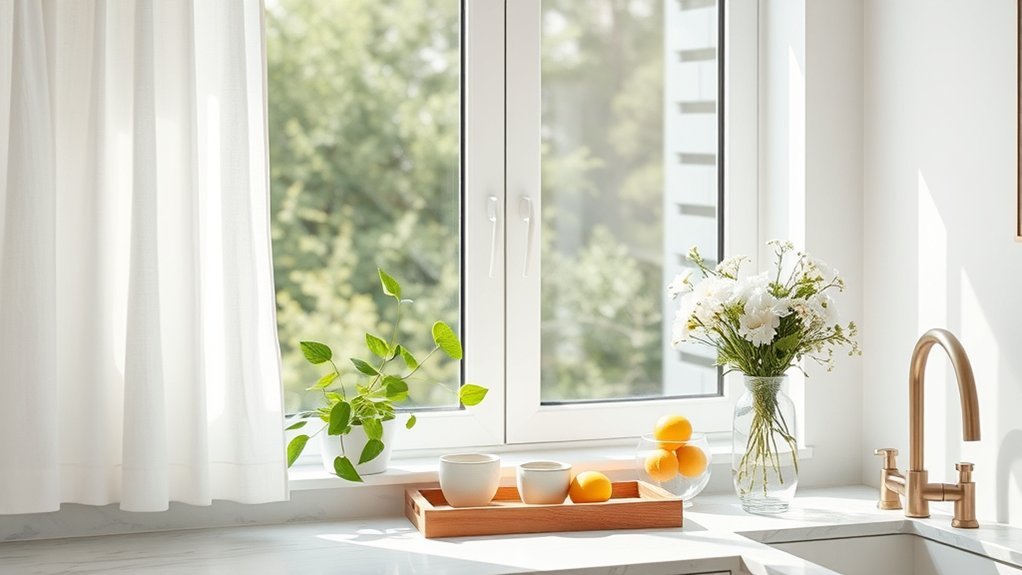
A well-decorated kitchen window should balance natural light, privacy, easy cleaning, and style. Cafe curtains, Roman or roller shades, woven textures, window film, shelves, trim, tile, and a few plants can all work. The best choice depends on whether the window sits above a sink, near a cooktop, faces a neighbor, or belongs to a quieter breakfast area.
Quick Answer
To decorate a kitchen window, choose one main treatment that handles privacy and light, then add one or two simple accents. Cafe curtains work well for partial privacy, Roman and roller shades give adjustable coverage, woven materials add texture, and plants, shelves, tile, or trim can finish the window without making it feel crowded.
Key Takeaways
- Choose treatments according to the window’s location, not appearance alone.
- Cafe curtains preserve upper-window daylight while adding lower-level privacy.
- Roman shades add softness and pattern, while roller shades and shutters can be easier to maintain in busy kitchens.
- Keep curtains and other combustible materials away from a stovetop.
- Use cordless window coverings wherever young children may be present.
- Keep windowsills and shelves lightly styled so plants and decor do not block useful daylight or window operation.
Choose a Kitchen Window Treatment
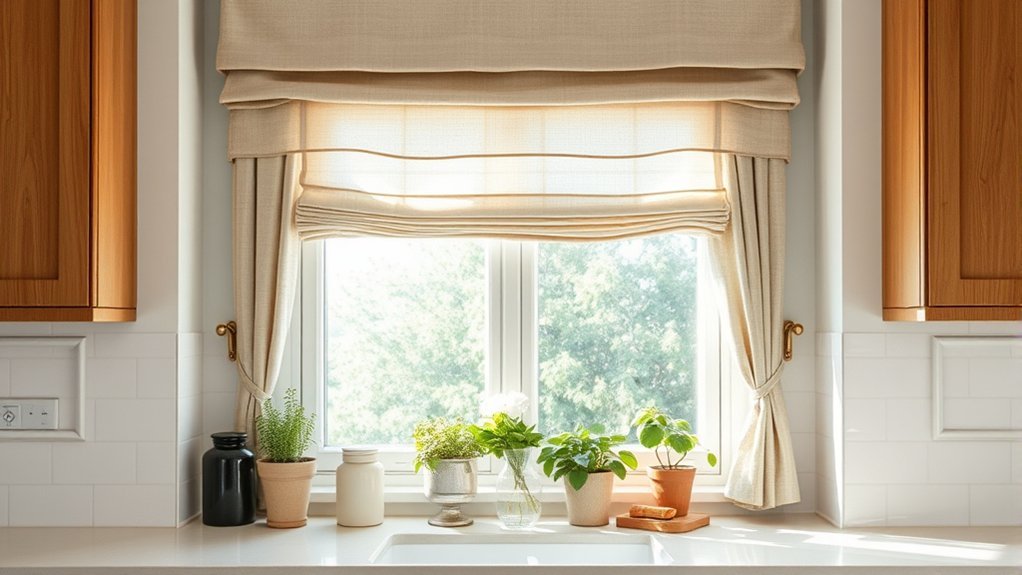
Choosing a kitchen window treatment starts with three questions: How much privacy do you need, how much daylight do you want to keep, and how easy will the material be to clean? The answers help narrow the choices before color or pattern enters the decision.
Cafe curtains cover the lower part of a window while leaving the upper glass exposed. That makes them especially useful where you want privacy at eye level without making the kitchen noticeably darker.
Cafe curtains add a charming vintage touch, offering partial coverage that feels bright, relaxed, and comfortably lived-in.
Roman shades create a clean, tailored line and give you adjustable coverage. A flat fabric surface can also carry a print or strong color more clearly than gathered curtains.
Roller shades are another practical option. Their simple profile suits modern kitchens, and many materials can be wiped more easily than heavily gathered fabric. Always follow the manufacturer’s cleaning instructions because materials differ.
Woven shades made with bamboo, grasses, or similar natural-looking materials add texture and warmth beside tile, stone, metal, and painted cabinetry. Depending on the weave, a liner may be needed when stronger privacy is required.
Black blinds or dark shades can add contrast beside pale cabinets, while neutral shades blend more quietly into the room. Layering treatments, such as a cafe curtain with a separate upper shade, can provide more flexible privacy and light control when the window location allows it.
Warning: Do not let curtains, towels, plants, or other combustible decor hang where they can reach a cooktop or open flame. The U.S. Fire Administration advises keeping curtains and anything else that can catch fire away from the stovetop.
Note: If young children live in or visit the home, the U.S. Consumer Product Safety Commission recommends cordless window coverings because accessible cords can create a strangulation hazard.
Match the Treatment to the Window Location
The same treatment does not work equally well at every kitchen window. First consider what happens around the glass during a normal day.
| Window Location | Good Options | Main Priority |
|---|---|---|
| Above a sink | Roller shade, cafe curtain, washable Roman shade, shutters | Easy cleaning and splash resistance |
| Close to a cooktop | Securely mounted shade, blind, shutter, or suitable window film | Keep combustible fabric away from heat and flame |
| Street- or neighbor-facing | Cafe curtain, Roman shade, shutter, privacy film | Privacy without losing all daylight |
| Small window | Light-filtering shade, cafe curtain, film | Preserve the limited glass area and natural light |
| Breakfast nook | Roman shade, woven shade, curtains, shutters | Comfort and decorative impact |
Add Color and Pattern
Color can turn a kitchen window from a practical opening into a focal point. Patterned cafe curtains or Roman shades can introduce color without taking up counter or wall space, making them useful in both large and compact kitchens.
| Element | Effect | Style |
|---|---|---|
| Bold patterns | Adds visual interest | Eclectic, cottage, or playful |
| Contrasting colors | Highlights the window frame | Modern or rustic |
| Seasonal accents | Refreshes the room | Flexible and casual |
If cabinets, counters, and backsplash tile already contain several strong colors, a simpler window treatment usually keeps the space balanced. In a mostly neutral kitchen, the window is a natural place to introduce a botanical print, stripe, check, geometric motif, or stronger accent color.
Contrasting trim can also sharpen architectural details. Instead of matching every finish exactly, repeat one existing color from the backsplash, hardware, cabinetry, rug, or nearby furniture to help the window feel connected to the rest of the room.
Bring in Natural Textures
Natural textures can soften a kitchen filled with hard surfaces. Bamboo Roman shades, woven wood shades, linen-look fabrics, wood trim, and small plants can add visual warmth beside stone, tile, stainless steel, or glossy cabinets.
Linen or cotton curtains provide a soft fabric texture, although their suitability depends on how close they are to splashes, grease, and heat. Near a busy sink, choose a fabric that can be cleaned according to its care label or consider a simpler wipeable treatment.
Plants and herbs can add fresh color to the sill, but the window needs to suit the plant. Penn State Extension notes that many indoor herbs need substantial direct sunlight and recommends suitable containers and drainage. A bright window can work well for basil, rosemary, thyme, chives, or other herbs when their individual growing needs are met.
Reclaimed wood frames or open shelving can introduce rustic contrast. Combining wood, fabric, stone, plants, and metal works best when only a few textures are emphasized rather than using every material at once.
Add Shelves for Display and Storage
Shelves around a kitchen window can create practical storage while using wall space that might otherwise remain empty. They work especially well when cabinets would block too much daylight.
Open shelving beside or above the window can hold cookbooks, plants, decorative glassware, crockery, or frequently used items. Custom-built shelves can follow the available wall dimensions and make an awkward space more useful.
Open shelving by the window invites daylight in, creating a bright, tailored space for books, plants, and elegant everyday pieces.
Rustic wood can warm up sleek cabinets, while painted shelves can blend into the wall for a quieter look. Metal or glass shelving can reduce visual weight when the goal is to keep the area feeling open.
Keep shelves far enough from the sash, crank, handle, or blind mechanism that the window can still open, close, lock, and be cleaned properly. Avoid overloading shelves with objects that block a large portion of the glass.
Pro Tip: Before drilling for a shelf, use painter’s tape to mark its proposed length and height. Open the window and operate the shade or blind to confirm that the shelf will not interfere with either one.
Frame the Window With Tile or Trim
A tile border around a kitchen window can connect the opening visually to the backsplash. It can be subtle and continuous or used as a contrasting frame with a different color, shape, or pattern.
Wood or painted trim gives the window a more architectural outline. Simple square trim suits many modern kitchens, while wider or more detailed profiles can support traditional, cottage, or farmhouse styles.
The strongest result usually comes from repeating a finish or color that already appears elsewhere in the room rather than adding an unrelated material only around the window.
Tile Border Accents
Tile can turn the window into a deliberate focal point while connecting the backsplash, counters, and surrounding wall. In areas exposed to sink splashes, a properly installed tiled surround also creates a surface that can generally be wiped clean more easily than painted drywall.
Choose the tile size and layout according to the available space. Small-format tile can follow narrow areas around a frame, while larger pieces create fewer visual breaks. Grout color also changes the effect: high contrast emphasizes the pattern, while a closer match creates a calmer surround.
- A bright edge: Use a contrasting color to make the window stand out.
- A patterned frame: Use decorative tile as a small focal area rather than covering the whole room with pattern.
- A seamless surround: Continue the backsplash material around the window for a connected look.
- A custom border: Combine shape, scale, and finish to fit the kitchen’s existing style.
Trim For Character
Trim can turn a kitchen window into a stronger architectural feature. Painted trim can repeat the cabinet or wall color, while contrasting trim makes the outline more noticeable.
Decorative tile produces a crisp surround, while wood trim brings warmth. Reclaimed boards can suit a rustic kitchen, but they should be properly finished for the conditions around the window and should not interfere with cleaning or operation.
For a restrained design, use trim that echoes materials already present in the room. The goal is to make the window feel intentional without forcing it to compete with every other surface.
Add Softness and Privacy
Window treatments can add privacy without making the kitchen feel closed off. The right choice depends on how exposed the window is during the day and at night.
Cafe curtains provide lower-level coverage while leaving the upper glass open. Semi-opaque shades soften glare. Roman shades add fabric and adjustable coverage. Woven shades add texture, and dark blinds can create stronger contrast in a modern kitchen.
- Cafe curtains: Useful for privacy at the lower half of the window.
- Semi-opaque shades: Diffuse bright light while maintaining a softer appearance.
- Roman shades: Combine adjustable coverage with fabric color or pattern.
- Woven wood shades: Add natural depth and filtered light, depending on the weave.
Privacy window film is useful when you want a minimal treatment that does not take up visual space. Frosted or patterned films can obscure the view while allowing some daylight through, but privacy performance and visible-light transmission vary by product.
Shutters provide another durable option. Adjustable louvers can control view and light without adding loose fabric, although the frame and panels need enough clearance to operate.
Remember that some light-filtering fabrics and solar-style shades offer much less privacy after dark when the kitchen lights are on. Check the treatment from outdoors at night before assuming it gives complete privacy.
Choose Easy-to-Clean Kitchen Window Materials
Kitchen windows are exposed to more moisture, grease, food particles, and frequent touching than many bedroom or living-room windows. A treatment that looks attractive but is difficult to maintain may become frustrating quickly.
For a window directly above a sink, consider a material that can be removed and washed or wiped according to the manufacturer’s instructions. Roller shades, shutters, blinds, and some synthetic fabrics can be easier to maintain than heavily pleated or delicate fabrics.
If you prefer fabric, choose a design that can be taken down without dismantling the entire window setup. Cafe curtains on removable rings or a simple rod are often easier to launder than elaborate layered treatments.
Near a cooking zone, avoid loose fabric that could blow toward the stovetop. Safety should take priority over the decorative effect.
Measure Before Buying or Hanging a Treatment
Good measurements prevent a window treatment from blocking handles, rubbing against a faucet, leaving unwanted privacy gaps, or preventing the window from opening.
- Measure the opening: Record the width and height in several places because window frames are not always perfectly square.
- Choose inside or outside mounting: An inside mount fits within the opening, while an outside mount attaches to the surrounding trim or wall.
- Check operating hardware: Note handles, locks, cranks, latches, and screens.
- Check nearby fixtures: Make sure a faucet, shelf, backsplash ledge, or cabinet door will not hit the treatment.
- Follow the product instructions: Required clearances and deductions differ among shade, blind, shutter, and curtain systems.
An outside-mounted shade can visually enlarge a small window and may cover more of the frame when closed. An inside mount gives a cleaner built-in appearance when the opening is deep and square enough. Neither is automatically better; choose according to the window and the manufacturer’s mounting requirements.
Style the Kitchen Window Sill
The windowsill is a useful place for small decorative details, but it should remain easy to clean and should not prevent the window from opening. A tiled sill can echo the backsplash, while plants, herbs, colored glass, or one decorative object can add personality without creating clutter.
| Detail | Effect | Best For |
|---|---|---|
| Tiled sill | Creates a cohesive finish | Traditional or modern kitchens |
| Potted herbs | Adds greenery and usable herbs | Bright windows with suitable growing conditions |
| Decorative film | Adds visual privacy | Windows that need coverage without fabric |
Potted herbs bring fragrance, function, and fresh color when the window provides suitable growing conditions. Decorative window film can add privacy or pattern without using sill space at all.
Above the sill, open shelving can display favorite crockery or small objects. Woven shades or lightweight curtains can soften the hard lines around the window. For the cleanest result, choose one main decorative idea and one supporting accent instead of filling every available surface.
Control Light, Glare, and Heat
Window treatments do more than change the room’s appearance. They can also help manage glare and unwanted solar heat while letting you adjust how much daylight enters the kitchen.
The U.S. Department of Energy notes that proper use of interior shades and blinds can reduce unwanted solar heat gain and help maximize useful daylight.
For a window that receives harsh afternoon sun, an adjustable roller, blind, Roman shade, shutter, or other light-filtering treatment may make the work surface more comfortable. For a naturally dim kitchen, avoid unnecessarily heavy treatments that cover a large portion of the glass even when fully open.
The most successful kitchen window decor does three jobs at once: it manages light, protects privacy, and supports the way the kitchen is actually used.
Frequently Asked Questions
How Can I Make My Kitchen Windows Look Nice?
Start with one practical treatment, such as a cafe curtain, Roman shade, roller shade, shutter, or privacy film. Then add a small amount of color, trim, plants, or shelving. Matching one window accent to the cabinetry, backsplash, hardware, or nearby textiles helps the design feel connected instead of cluttered.
What Are Some Creative Ways to Decorate a Small Kitchen Window?
For a small window, preserve as much glass as possible. Try a cafe curtain, compact roller or Roman shade, frosted film, a narrow herb arrangement, one hanging plant, or a small shelf above the opening. Avoid oversized valances or crowded sill displays that block the limited daylight.
What Are Some Good Ideas for Kitchen Window Coverings?
Useful kitchen window coverings include cafe curtains, Roman shades, roller shades, woven shades, shutters, blinds, and privacy film. Choose according to the window’s location, cleaning needs, desired privacy, and amount of sunlight. Near a sink or cooking area, practical maintenance and safety should come before decorative layering.
What Are Some Creative Ways to Decorate My Windows?
Use plants, seasonal accents, stained-glass-style film, patterned shades, contrasting trim, a small window shelf, decorative rods, or carefully chosen lighting nearby. Keep the arrangement simple enough that the window still opens easily and continues to provide useful daylight.
What Is the Safest Window Treatment Near a Stove?
Avoid loose curtains or other combustible materials that could reach the stovetop. A securely mounted shade, blind, shutter, or suitable window film may be more practical depending on the window. Always maintain the clearances required by the appliance and window-treatment manufacturers.
How Can I Get Privacy Without Blocking Kitchen Light?
Cafe curtains are useful because they cover the lower part of the glass while leaving the top open. Light-filtering shades, adjustable shutters, and frosted or patterned privacy films can also work. Check nighttime privacy separately because some light-filtering materials become easier to see through when interior lights are on.
Conclusion
A beautifully dressed kitchen window can improve privacy, soften hard surfaces, manage glare, and give the room a clear focal point. Cafe curtains are useful for partial privacy, Roman shades add tailored softness, rollers and shutters offer practical control, and woven textures, shelves, tile, trim, plants, and window film provide additional ways to personalize the space.
The U.S. Environmental Protection Agency notes that people spend about 90% of their time indoors. Small interior details therefore form part of the spaces people experience every day. For a kitchen window, the best result is not simply decorative: it keeps useful daylight, provides the privacy you need, stays practical to clean, and remains safe around cooking equipment and children.
Sources
- U.S. Consumer Product Safety Commission — Window Covering Cords — cordless window-covering and child-strangulation safety guidance.
- U.S. Fire Administration — Cooking Fire Safety — guidance on keeping curtains and other combustible materials away from stovetops.
- U.S. Department of Energy — Residential Window Guidance — information on daylight, solar heat gain, shades, and blinds.
- Penn State Extension — Growing Herbs Indoors — indoor-herb light, container, drainage, and growing guidance.
- U.S. Environmental Protection Agency — Improving Your Indoor Environment — source for the approximately 90% indoor-time statistic.

1 thought on “How to Decorate Kitchen Window: Ideas & Styling Tips”