
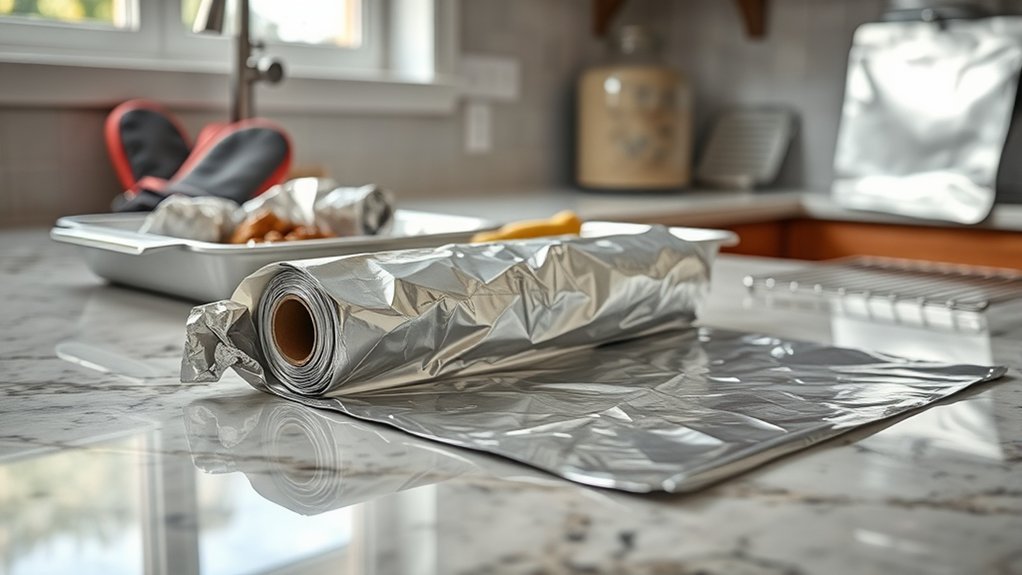
Aluminum foil is an indispensable kitchen staple prized for its thermal conductivity, pliability, and moisture retention. Manufactured by rolling nearly pure aluminum into micro-thin sheets, it excels at roasting, grilling, insulating hot foods, and streamlining kitchen cleanup. However, maximizing its utility requires knowing how to select the proper gauge for demanding tasks and understanding critical safety boundaries—specifically regarding chemical reactions with acidic ingredients, oven heating elements, and microwave hazards.
Quick Answer
Aluminum foil is safe for most baking, roasting, and short-term food storage tasks. Choose standard foil (0.016 mm) for basic wrapping and heavy-duty foil (0.024 mm) for grilling or lining roasting pans. Never use foil in microwaves, avoid placing it directly on oven floors, and keep it away from acidic foods like citrus and tomatoes to prevent metal leaching.
Key Takeaways
- Shiny vs. Dull Side: For domestic cooking, both sides perform identically; the dual finish is simply a byproduct of the industrial rolling process.
- Thickness Dictates Use: Standard foil (16 microns) tears easily under heavy meat bones; heavy-duty foil (24 microns) resists punctures and high grill heat.
- Acid Reactivity: Highly acidic or salted foods corrode foil, causing microscopic aluminum migration and unpleasant metallic flavors.
- Fire & Appliance Hazard: Never line the bottom floor of an electric or gas oven with foil, as it can melt permanently onto porcelain enamel.
- Eco-Efficiency: Recycling aluminum foil saves up to 95% of the energy needed to produce primary aluminum from raw bauxite ore.
What Aluminum Foil Is and How It’s Made
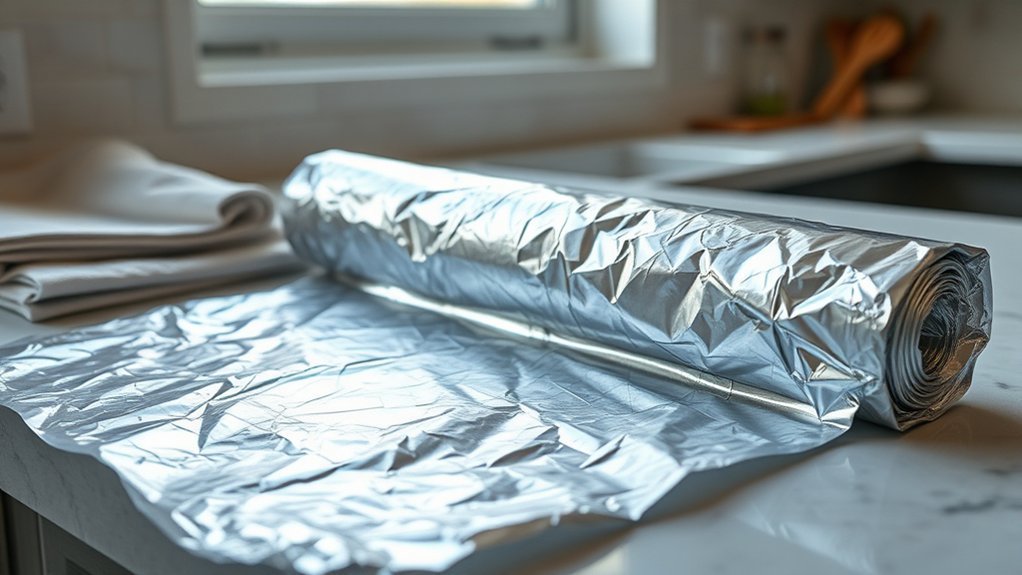
Aluminum foil is a sheet of refined aluminum alloy that measures less than 0.2 mm (0.0079 inches) thick. In residential kitchens, typical foil measures approximately 0.016 mm (16 microns or 0.63 mils). While rudimentary hammered metal sheets date back centuries, continuous commercial foil rolling was pioneered in Switzerland in 1910 by Dr. Robert Victor Neher, rapidly replacing older tin foil across commercial food packaging.
Modern production begins with continuous casting of molten aluminum ingots, which are passed through industrial reduction mills under thousands of pounds of pressure. As the metal thins, it becomes prone to tearing under mill tension. To prevent breakage, technicians pass two sheets through the heavy rollers simultaneously in a technique known as “pack rolling.”
Pack rolling presses two sheets together through polished rollers: the outer faces contact polished steel and become mirror-shiny, while the inner mating faces emerge with a matte, satin finish.
From an environmental standpoint, aluminum processing is energy-intensive during initial bauxite smelting. However, aluminum is infinitely recyclable without structural degradation. According to industry life-cycle data from The Aluminum Association, recycling post-consumer aluminum foil requires only 5% of the initial energy consumed during primary smelting, cutting industrial greenhouse gas emissions by up to 95%.
The Shiny vs. Dull Side: Does It Actually Matter?
A persistent culinary debate centers on whether the shiny side of aluminum foil should face upward or downward during cooking. The common belief is that the reflective shiny side repels radiant heat, while the matte side absorbs it.
In standard domestic ovens, heat transfer occurs predominantly through convection (circulating heated air) and conduction (direct surface contact), with thermal radiation playing only a negligible role. Empirical culinary tests and laboratory thermography confirm that the temperature variance between facing the shiny side up versus down is statistically imperceptible. You can use either side against your food with identical roasting and baking outcomes.
Pro Tip: The only notable exception is specialty non-stick aluminum foil (such as Reynolds Wrap Non-Stick). In these products, food-safe silicone coating is applied exclusively to the dull side. Manufacturers print a visible label on the sheet reminding cooks to place food directly on that matte, coated surface.
How to Choose the Right Foil Thickness
Foil performance hinges entirely on selecting the appropriate gauge for the physical stress and thermal demands of your recipe. Standard foil will tear when handling sharp turkey bones or heavy skewers, while extra heavy-duty foil can be overly rigid for delicate crimping.
| Grade / Type | Thickness (Approx.) | Best Culinary Uses | Vulnerabilities |
|---|---|---|---|
| Standard Foil | 0.016 mm / 16 µm (0.63 mil) | Covering casserole dishes, short-term cold wrapping, sandwich wraps. | Punctures easily against bones; tears during heavy basting. |
| Heavy-Duty Foil | 0.024 mm / 24 µm (0.94 mil) | Lining broiler pans, outdoor grill packets, wrapping large roasts, ribs. | More rigid; slightly harder to fold into tight decorative pleats. |
| Extra Heavy-Duty | 0.038 mm / 38 µm (1.50 mil) | Direct wood-fire/charcoal coals, commercial butchering, deep freezer wrap. | Higher cost; excessive stiffness for light table covers. |
For most routine home cooking, heavy-duty foil offers the best durability. It resists puncturing when shifting heavy food with stainless steel tongs, preventing sauces from leaking through and burning onto your sheet pans.
Common Kitchen Uses for Aluminum Foil
Aluminum foil remains ubiquitous in home and commercial culinary preparation due to its barrier properties and malleable structure:
- Oven Roasting and Pan Lining: Covering rimmed sheet pans catches grease splatters and caramelized juices, preserving baking surfaces and reducing kitchen sanitization time.
- Tent Covering for Poultry: Crafting a loose foil dome over roasting turkeys or chickens prevents breast meat from scorching while thighs reach safe internal temperatures.
- Aromatic Steam Packets (En Papillote): Sealing delicate proteins like salmon fillets with compound butter and fresh herbs inside a tightly folded foil pouch traps steam, ensuring moist, gently cooked fish.
- Outdoor Grilling Barricade: Perforated foil laid across grill grates prevents fragile vegetables and flaking fish from dropping into coals while infusing smoky flavor.
- Resting Cooked Meats: Loosely tenting foil over a rested steak or prime rib insulates exterior meat fibers, allowing muscle juices to redistribute smoothly before slicing.
- Emergency Kitchen Tools: Heavy-duty foil can be twisted into emergency funnels for liquid transfers, shaped into pie crust shields to protect delicate pastry edges, or balled up to scrub carbon buildup from cast iron grates.
Foil vs. Parchment Paper: When to Use Which
Many home cooks treat parchment paper and aluminum foil as interchangeable sheet-pan liners, but their material properties dictate very different culinary applications:
- Use Aluminum Foil When: Cooking at temperatures exceeding 450°F (232°C), broiling directly under an open flame, crimping form-fitting packets for the barbecue, or protecting roast meats during long smoker sessions.
- Use Parchment Paper When: Baking delicate cookies, cakes, pastries, or roasting sheet-pan vegetables. Parchment is coated with heat-resistant silicone, providing superior non-stick release without reacting to acidic balsamic glazes or citrus dressings.
Why Aluminum Foil Works for Cooking and Storage
Aluminum foil’s unique mechanical and chemical properties stem from its elemental structure:
- High Thermal Conductivity: Aluminum conducts thermal energy far more rapidly than glass, earthenware, or stainless steel. When used to cap a baking dish, it equalizes surface heat, mitigating scorching and shortening cook times.
- Impermeable Barrier: Solid aluminum foil thicker than 0.025 mm forms an absolute physical barrier against water vapor, oxygen, odors, and ultraviolet light. This keeps enclosed foods from oxidizing or picking up extraneous odors from neighboring refrigerator foods.
- Dead-Fold Characteristic: Unlike plastic wraps that require static cling or elastic tension, aluminum foil features complete plastic deformability without elasticity (“dead-fold”). It remains precisely crimped around odd contours, forming an effective physical seal.
Note: While aluminum foil acts as an effective short-term moisture barrier, it is not genuinely airtight when folded by hand. For long-term freezing exceeding three months, wrap meats tightly in heavy freezer-grade foil to eliminate air pockets, then seal them inside an airtight freezer bag to completely prevent freezer burn.
Aluminum Foil Safety Tips and Mistakes to Avoid
While aluminum foil is safe for conventional culinary tasks, improper usage can cause appliance damage, fire risks, and metal leaching.
Warning: Never line the bottom floor of an electric or gas oven with aluminum foil. Modern ovens position heating elements under a smooth porcelain bottom cavity. Foil traps intense radiant heat, reaching temperatures high enough to permanently melt aluminum onto the enamel floor, resulting in catastrophic appliance damage and potential electrical fire.
Adhere to these essential kitchen safety guidelines:
- Avoid Direct Acid and Salt Contact: Ingredients with high acidity (lemons, tomatoes, vinegar, wine) or heavy salt concentrations act as electrolytes. When in contact with aluminum at baking temperatures, they accelerate galvanic and chemical corrosion. This breaks down the foil, leaving pinhole perforations, grey chemical residues, and an astringent metallic flavor in your meal.
- Keep Out of Standard Microwaves: The electromagnetic fields inside a microwave oven excite free electrons in thin metal sheets. Because foil lacks the electrical resistance to dissipate high surface charges safely, electric current concentrates rapidly along crinkled ridges, triggering electrical arcing (sparks) that can ignite surrounding paper or permanently crack the magnetron tube.
- Never Reuse Foil After Contact with Raw Meat: Deep microscopic creases in crumpled foil harbor raw animal fluids and bacteria, such as Salmonella and Campylobacter. Trying to wash and reuse contaminated foil is unsafe; discard it or rinse clean before placing in municipal scrap recycling bins.
- Protect Cut Cookware: Avoid using metal scrapers or knives directly against foil-lined pans, as sharp blades can slice through thin metal and transfer shredded foil fragments directly into food.
Frequently Asked Questions
Is aluminum foil safe to use for cooking?
Yes, cooking with aluminum foil is safe for healthy individuals under standard conditions. While trace quantities of aluminum migrate into food during thermal preparation, the human body absorbs less than 1% of ingested dietary aluminum, efficiently excreting the remainder through healthy kidneys. The European Food Safety Authority (EFSA) establishes a tolerable weekly intake (TWI) of 1 milligram of aluminum per kilogram of body weight, a threshold that occasional foil cooking does not exceed.
Should you avoid aluminum foil due to health or Alzheimer’s concerns?
No convincing clinical evidence links the routine culinary use of aluminum foil to Alzheimer’s disease or neurological decline. Medical organizations, including the Alzheimer’s Association, have stated that decades of modern medical research have failed to establish a causal connection between normal environmental or culinary aluminum exposure and Alzheimer’s development. However, individuals with severe chronic kidney disease should minimize aluminum exposure, as their renal systems cannot process trace dietary minerals as effectively.
What is aluminum foil made of?
Household aluminum foil is composed of an alloy consisting of 98.5% to 99.5% pure aluminum, supplemented with trace proportions of iron and silicon (typically conforming to Aluminum Association Alloy 8011 or 1235 specifications). These minor metallurgical additives impart essential tensile strength, flexibility, and puncture resistance to ensure the foil does not shatter when subjected to pack rolling or kitchen shaping.
Are tinfoil and aluminum foil the same thing?
No, tinfoil and aluminum foil are completely different materials. True tinfoil was produced from elemental tin during the late 19th and early 20th centuries. Tin was costlier, stiffer, and imparted an unpleasant tin flavor into wrapped foods. Commercial aluminum foil superseded tin completely after 1910 due to aluminum’s superior tensile flexibility, lower production cost, non-toxic nature, and complete lack of residual metallic odor.
Conclusion
Aluminum foil remains an irreplaceable asset in home kitchens because of its exceptional heat distribution, moldable structure, and impervious moisture barrier. By matching foil thickness to your specific culinary application—reserving standard rolls for light food wrapping and upgrading to heavy-duty foil for roasting and smoking—you can achieve consistent, mess-free results. So long as you avoid contact with acidic foods, keep foil out of microwaves, and avoid using it on the bottom floor of your oven, aluminum foil delivers safe, reliable performance across all your cooking and baking needs.
Sources
- The Aluminum Association — Standards, alloys, manufacturing processes, and life-cycle recycling energy recovery statistics.
- European Food Safety Authority (EFSA) — Scientific opinion on the safety of dietary aluminum intake and weekly tolerable limits.
- Alzheimer’s Association — Expert consensus and scientific reviews examining environmental and culinary aluminum exposure myths.
- USDA Food Safety and Inspection Service (FSIS) — Guidelines on food packaging, safe meat handling, and preventing cross-contamination.

1 thought on “What Is Aluminum Foil? Uses, Benefits & Kitchen Safety”