
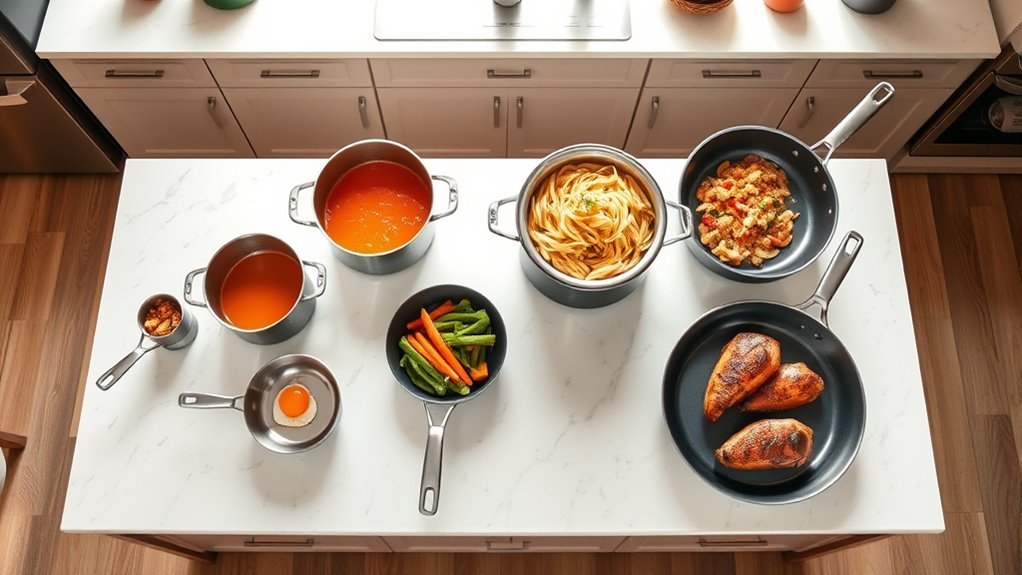
Choosing the right pots and pans saves time, space, and money, so you’ll want sizes that match how many people you cook for and the meals you make. Start with a few versatile pieces—small saucepan, medium skillet, larger stockpot—and consider a Dutch oven or sauté pan for braises and big batches. Pick sizes now and you’ll avoid clutter later, but which specific dimensions should you prioritize?
Quick Answer : Essential Pot and Pan Sizes for Home Cooking
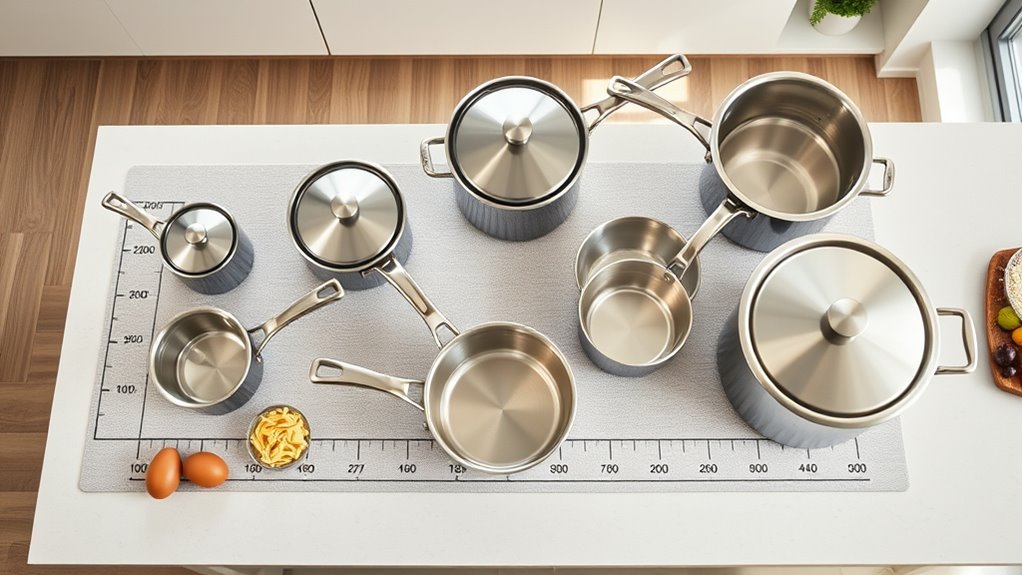
Start with a small and a medium pan: a 20 cm (8″) frying pan handles single portions and quick meals, while a 26 cm (10″) pan covers family-sized cooking.
You’ll keep a 20 cm (2‑quart) saucepan for sauces and reheating, and step up to a 24 cm (3‑quart) or larger when you need to boil pasta or simmer stews.
Add a 28 cm (11″) sauté pan with a lid for frying larger quantities and gentle simmering.
For true freedom in the kitchen, own a Dutch oven for braises, long stews, and one-pot roasts that free you from complicated steps.
Cast iron skillets give you heat retention and versatility for stovetop-to-oven meals.
Include a 24 cm (9.5″) casserole dish when you want reliable baking and roasting.
Reserve a 6–12 quart stock pot for big batches, soups, and seafood boils.
These choices let you cook simply, scale up, and reclaim time without excess gear.
Essential Cookware Sizes Explained: Saucepans, Skillets, Sauté Pans, Stock Pots
When you’re equipping your kitchen, choose sizes that match how and how much you cook: a 2‑quart saucepan handles sauces and small boils, an 8–10″ skillet covers most everyday frying, a 3–5‑quart sauté pan gives you room to brown and stir without overcrowding, and a 6‑quart stock pot lets you make family‑size soups, stocks, or pasta with ease.
Start with a 2‑quart saucepan — saucepans typically run 1–4 quarts and are ideal for sauces, small soups, and boiling single portions.
Start with a 2‑quart saucepan — perfect for sauces, small soups, and boiling single portions.
For frying, pick a skillet in the 8–12″ range; an 8–10″ skillet suits daily use while larger skillets handle multiple servings or big cuts.
Choose a 3–5‑quart sauté pan for its wide base and higher sides so you can sear and stir freely.
Finally, add a 6‑quart stock pot to make stocks, soups, or pasta; stock pots scale up to 20 quarts if you need bigger batches.
These pieces free you to cook boldly and confidently.
Match Cookware to Household Size and Meal Type
Think about how many mouths you cook for and the meals you make most often — that will guide the sizes you actually need. You want cookware that frees you to cook without waste or clutter.
For one or two people, stick with a 20cm (8″) frying pan and a 20cm (2-qt) saucepan for daily meals and sides. Families of four will appreciate a 26cm (10″) skillet plus a 24cm (5-qt) stock pot to handle larger portions.
When you host or batch-cook, choose a 28cm (11″) sauté pan and a 28cm (7-qt) Dutch ovens-style pot to manage volume.
- Single/couple: 20cm fry pan, 20cm saucepan
- Family of four: 26cm fry pan, 24cm (5-qt) stock pot
- Entertaining/batch: 28cm sauté, 28cm (7-qt) Dutch ovens-style
- Sides/sauces: 20cm saucepan, 24cm (4-qt) casserole
Mix materials—cast iron for searing, non stick for eggs—to match dishes and reclaim your kitchen freedom.
Choosing a Dutch Oven or Braiser: When to Pick 4–7 Qt Versus Larger
Although a 4–7 quart Dutch oven or braiser is perfectly sized for feeding 4–6 people and handling casseroles, soups, and stews, you’ll want to match capacity to how you cook: Choose 4–7 quart when you make family meals, brown meats, and sauté vegetables without overcrowding. A 4‑quart holds about 16 cups; a 7‑quart about 28 cups, giving you recipe flexibility. If you batch cook, host often, or want large roasts, move up to 8 quarts or more. Remember weight: a 7‑quart can top 10 pounds, so pick what you can lift confidently.
| Scenario | Best pick | Why it frees you |
|---|---|---|
| Daily family meals | 4–7 quart | Right capacity, manageable weight |
| Soups & stews | 4–7 quart | Enough liquid space for recipes |
| Batch cooking | 8+ quart | Prevents overflow, saves time |
| Heavy lifting concern | Smaller end | Easier to maneuver, safer |
Choose boldly; match capacity to purpose and your physical freedom in the kitchen.
Starter Kit: The Five Cookware Pieces to Buy First and Why
Because you’re outfitting your kitchen for everyday cooking, start with five pieces that cover almost every basic task: You’ll gain freedom to cook whatever you want with a compact starter kit that balances versatility and simplicity.
Get these essentials and stop overbuying:
- 10-inch non-stick frying pan — quick for eggs, sautés, and easy cleanup.
- 12-inch cast iron skillet — for searing, baking, and deep frying with superior heat retention.
- 2-quart saucepan — ideal for boiling, simmering, and making sauces in small to medium batches.
- 6-quart stock pot (plus a 3-quart casserole dish) — the pot handles soups, stews, and pasta; the casserole doubles for oven braises and stovetop slow-cooking.
This cookware selection liberates you from specialty pieces while covering most recipes.
The non-stick handles delicate tasks; cast iron gives you one durable workhorse; the saucepan and stock pot cover liquid cooking; the casserole expands into baking and braising.
You’ll cook confidently with fewer, better tools.
Frequently Asked Questions
Which Pans to Stay Away From?
Avoid non stick materials with Teflon, lightweight aluminum, cheap thin stainless steel, unseasoned cast iron, and pans with plastic handles.
You’ll want heavy duty options that offer even heat retention and won’t warp or react with food.
Prefer cookware with glass lids for visibility and durable construction.
You’ll free yourself from unsafe choices by choosing sturdy, well-made pieces that perform reliably and protect your health and independence.
Is a 10 or 12 Inch Pan Better?
It depends: choose the 10 inch advantages if you want lighter, easier handling and precise control for small meals, and pick the 12 inch versatility when you need more surface for browning and family-sized dishes.
Consider your cooking styles—10-inch suits quick sautés, 12-inch fits one-pot meals.
Both can offer good heat distribution, though the 12-inch may take longer to heat and feel heavier to maneuver.
Are Pans Measured From Top or Bottom?
They’re usually measured from the top rim, though some makers list base size too.
You’ll want to learn pan measurement techniques so you can compare cookware dimension standards and account for pot size variations.
Top measurements reflect cooking surface and lid fit; bottom measurements matter for stovetop contact.
When choosing appropriate sizes, consider shape, depth and volume so you’ll pick pans that free you to cook boldly and efficiently.
Is a 12 Inch Pan Considered Large?
Isn’t a 12-inch pan plenty for most cooks? You’ll find it’s considered large, giving you room for generous food portions and one-pot meals.
You’ll use varied cooking techniques—sautéing, searing, braising—so pick material types that suit your style. Good heat distribution matters, so choose quality construction.
You’ll appreciate sturdy handles and manageable weight, letting you cook boldly and freely without being limited by tight pans.
Conclusion
You’ve got the tools to pick cookware that fits your kitchen and life: small pans for singles, mid-sized for families, and larger pots for batch cooking or entertaining. Start with a versatile 2–3 qt saucepan, a 20–26 cm skillet, a 28 cm sauté pan, and a 5–7 qt stock pot or Dutch oven. Buy what you’ll use, not what looks flashy — don’t bite off more than you can chew, and you’ll cook smarter, not harder.
