
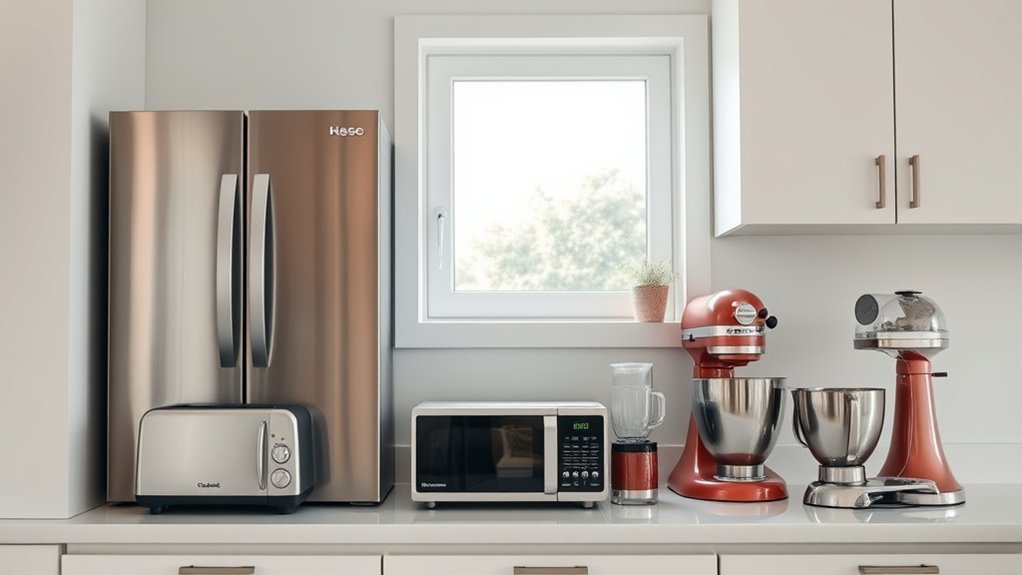
A kitchen appliance is an electrical, gas-powered, or mechanical device engineered to prepare, cook, preserve, or clean food with minimal manual effort. These tools range from foundational major installations—such as refrigerators, ranges, and dishwashers—to versatile small countertop devices like air fryers, food processors, and blenders. By converting electrical or gas energy into heat, cold, or mechanical motion, kitchen appliances streamline routine culinary workflows, elevate safety, and improve energy efficiency in modern homes.
Quick Answer
A kitchen appliance is any machine designed to assist with food storage, cooking, meal prep, or dish cleaning. They fall into two primary classes: major appliances (stationary fixtures like refrigerators, ovens, and dishwashers) and small appliances (portable tools like blenders, toasters, and air fryers). They operate primarily through dielectric heating, vapor-compression cooling, resistive heating, or motor-driven mechanical blades.
Key Takeaways
- Core Categories: Kitchen appliances are classified into stationary major appliances (white goods), portable countertop units, and specialized cooking tools.
- Operating Principles: Different units convert energy through specific mechanisms, including dielectric radiation (microwaves), vapor compression (refrigeration), resistive coils, electromagnetic induction, and electric motors.
- Efficiency Matters: Models certified under the EPA Energy Star program cut electricity consumption by 10% to 50% compared to standard base models.
- Electrical Safety: High-draw appliances should always be plugged directly into Ground Fault Circuit Interrupter (GFCI) outlets rather than light-duty power strips.
What a Kitchen Appliance Is
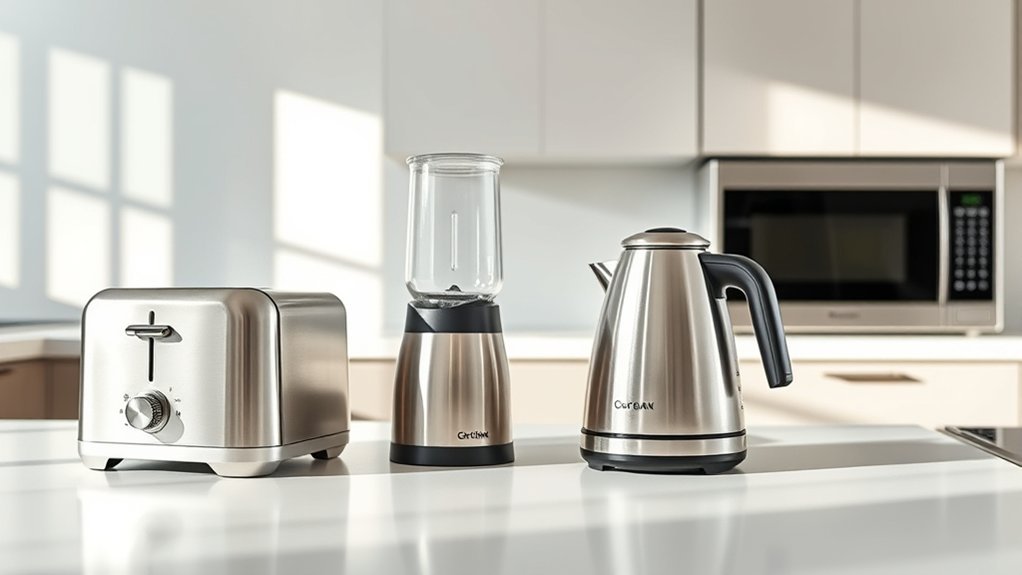
At its core, a kitchen appliance is an enclosed machine or purpose-built device designed to automate or accelerate food-related tasks. While basic cookware (like skillets, knives, and cutting boards) relies entirely on manual operation, appliances use external energy sources—primarily standard residential electric circuits (120V or 240V) or natural gas/propane lines—to perform work.
These machines perform four primary functions across the culinary cycle:
- Food Preservation: Lowering temperatures to retard bacterial growth (refrigerators, deep freezers).
- Thermal Processing: Applying heat to alter food chemistry, tenderize ingredients, or kill pathogens (ovens, cooktops, microwaves).
- Mechanical Preparation: Cutting, mixing, pureeing, or kneading raw ingredients (blenders, stand mixers, food processors).
- Sanitation: Cleaning and sanitizing food-contact surfaces using high-temperature water and specialized detergent cycles (automatic dishwashers).
For example, while hand-chopping a mirepoix takes ten minutes of manual knife work, a motorized food processor completes the task in seconds. Modern iterations frequently incorporate microprocessors, digital thermal sensors, and wireless connectivity to give home cooks precise control over timing, temperature, and power consumption.
Main Types of Kitchen Appliances
Kitchen appliances are categorized by physical footprint, installation requirements, and functional scope. Understanding these categories helps homeowners plan kitchen layouts, balance electrical loads, and allocate budgets effectively.
Kitchen appliances fall into major stationary fixtures, portable countertop units, and specialized task devices, each fulfilling distinct roles in culinary preparation.
- Major Appliances (White Goods): These are permanent or semi-permanent fixtures that anchor the kitchen workspace. They require dedicated plumbing lines, high-amperage electrical connections, or gas hookups. Common examples include refrigerators, freezers, ranges, wall ovens, cooktops, and built-in dishwashers.
- Small Countertop Appliances: Portable, self-contained devices designed to sit on countertops and stow away in cabinets. They operate on standard 120V household outlets and handle discrete tasks. Examples include toasters, electric kettles, drip coffee makers, and countertop blenders.
- Specialty Appliances: Units tailored to specific cooking methodologies or niche preparation styles. Examples include sous vide immersion circulators, air fryers, waffle makers, dehydrators, and ice cream churners.
- Combination / Hybrid Units: Space-saving appliances that merge multiple functional modalities into a single housing, such as combination convection-microwave ovens or multi-cookers that switch between pressure cooking, slow cooking, and searing.
Common Kitchen Appliance Examples
Modern residential kitchens rely on a standard ecosystem of appliances to manage everyday meal prep, storage, and clean-up:
- Refrigerator / Freezer: Operates continuously to maintain interior temperatures between 35°F and 38°F (1.7°C to 3.3°C), preventing perishable food spoilage.
- Microwave Oven: Rapidly reheats liquids, defrosts frozen meats, and warms prepared dishes in minutes without requiring long preheat cycles.
- Range / Cooktop: Delivers direct conductive or radiant heat via gas flames, electric resistance coils, or electromagnetic induction fields for surface frying, boiling, and simmering.
- Convection Oven: Uses heating elements paired with an internal circulation fan to circulate hot air evenly, eliminating cold spots for consistent baking and roasting.
- Dishwasher: Sprays pressurized, heated water (often 120°F to 155°F) mixed with enzyme-based detergents to sanitize cookware and tableware while consuming substantially less water than hand-washing.
- Air Fryer: A compact countertop convection oven that circulates high-velocity superheated air around food, creating a crispy exterior with minimal added oil.
- Multi-Cooker (Instant Pot): Traps steam in an airtight vessel to build pressure, raising the boiling point of water to cook stews, grains, and braised meats up to 70% faster than traditional stovetop methods.
Note: While clothes washing machines and dryers are occasionally installed in adjacent pantry or utility alcoves, they are categorized as laundry appliances rather than kitchen appliances because they do not participate in food handling.
How Kitchen Appliances Work
Every kitchen appliance relies on specific physics principles to convert electrical energy or fuel into usable thermal energy or mechanical work:
- Dielectric Heating (Microwaves): A magnetron tube generates non-ionizing electromagnetic radiation at roughly 2.45 GHz. Water, fat, and sugar molecules in food absorb these waves and rapidly oscillate, creating dipole friction that heats food from within, as outlined by the U.S. Food and Drug Administration.
- Vapor-Compression Cycle (Refrigerators & Freezers): A closed-loop system pumps a chemical refrigerant through an evaporator, compressor, condenser, and expansion valve. The refrigerant evaporates at low temperatures inside the cabinet, absorbing latent heat from the interior, and then compresses and condenses outside the cabinet to release that heat into the room.
- Resistive Heating Elements (Electric Ovens & Toasters): Electric current passes through high-resistance metal alloy wiring (typically nichrome). The material’s internal resistance converts electrical energy directly into radiant heat (Joule heating).
- Electromagnetic Induction (Induction Cooktops): Alternating current passes through a copper coil beneath a ceramic glass surface, generating a high-frequency magnetic field. When ferromagnetic cookware (cast iron or magnetic stainless steel) enters this field, the magnetic current induces eddy currents within the pan’s base, turning the pan itself into the heat source.
- High-Torque Electric Motors (Blenders & Mixers): Universal or brushless DC motors convert electrical current into rapid rotational torque. A drive shaft transfers this rotational force directly to hardened stainless steel blades, slicing or pureeing solid food via sheer kinetic impact.
Pro Tip: Induction cooktops transfer approximately 85% to 90% of their electromagnetic energy directly into the cooking vessel, compared to roughly 70% for standard electric smooth-tops and roughly 40% for open gas flames, making induction the most thermally efficient surface cooking technology available.
Kitchen Appliance Uses in Daily Cooking
Integrating the correct appliance into daily cooking routines reduces manual labor, eliminates repetitive chopping and stirring, and maintains precise temperature windows:
| Appliance | Core Culinary Function | Efficiency Advantage |
|---|---|---|
| Microwave Oven | Defrosting frozen ingredients, reheating prepared foods | Cuts reheating time by 75% compared to conventional ovens |
| Food Processor | Dicing aromatics, slicing produce, emulsifying dressings | Reduces manual knife preparation from 20 minutes to under 2 minutes |
| Slow Cooker | Low-temperature simmering of tough cuts, stocks, and stews | Enables 6–8 hours of hands-off cooking with zero scorching risk |
| Air Fryer | Crisping vegetables, poultry, and frozen goods | Requires little to no preheat time; uses 70–80% less oil than deep fryers |
| Dishwasher | Washing, rinsing, and high-heat sanitizing of tableware | Saves up to 20 gallons of water per cycle over continuous hand-washing |
Big vs. Small Kitchen Appliances
Navigating kitchen purchases requires understanding the structural, electrical, and financial differences between major fixtures and countertop companions:
| Feature | Major Appliances (White Goods) | Small Countertop Appliances |
|---|---|---|
| Portability | Stationary; installed into cabinetry or plumbed lines | Portable; stored in pantries or set on counters |
| Power Hookup | Dedicated 120V/240V circuits; some require gas/water lines | Standard 120V wall outlets (15A/20A branch circuits) |
| Average Lifespan | 10 to 15+ years with regular maintenance | 3 to 7 years depending on motor build and usage |
| Repairability | High; modular components (compressors, pumps, elements) | Moderate to low; often more cost-effective to replace |
| Primary Role | Whole-household storage, high-volume cooking, sanitation | Task-specific prep, rapid heating, quick single servings |
According to appliance lifespan benchmarks from the Association of Home Appliance Manufacturers (AHAM), major investments like gas ranges and refrigerators frequently exceed a decade of active service. Conversely, small appliances offer lower upfront cost and modular flexibility, letting home cooks adopt modern techniques (such as precision immersion cooking or air frying) without undertaking cabinet remodeling.
How to Choose the Right Kitchen Appliance
Purchasing an appliance requires evaluating spatial limits, utility consumption, cooking preferences, and maintenance requirements:
- Measure Cabinetry and Entryways: Always record three distinct dimensions: width, depth (including door handles and required rear ventilation clearance), and height. Ensure hallways and doorways can accommodate the unit during delivery.
- Check Electrical and Plumbing Capacity: High-output electric ranges and induction cooktops generally require a dedicated 240-volt, 40- to 50-amp circuit. Built-in dishwashers require a dedicated hot-water supply line, shut-off valve, and drain connection.
- Prioritize Energy Star Certifications: Look for the blue Energy Star label when buying major units. Certified refrigerators consume roughly 9% less energy than federal minimum baseline standards, while certified dishwashers save approximately 3,870 gallons of water over their operating lifetime.
- Assess Noise Levels (Decibel Ratings): For open-concept kitchens, appliance acoustics significantly affect living comfort. Dishwashers operating at 44 dBA or lower are virtually silent, while models above 50 dBA produce an audible hum during wash cycles.
- Evaluate Component Availability: Select brands with established domestic parts distribution networks. Readily available replacement water filters, door gaskets, and heating elements prevent an entire unit from being retired prematurely.
Smart Kitchen Appliance Features
The integration of internet connectivity, solid-state sensors, and unified communication protocols (such as Matter and Thread) has transformed traditional kitchen machines into networked devices.
Voice Control
Modern smart kitchen appliances interface directly with ecosystem assistants like Amazon Alexa, Google Assistant, and Apple Home. Voice commands simplify kitchen tasks when hands are covered in dough or handling raw poultry, minimizing cross-contamination risks.
| Appliance | Voice Command Example | Operational Result |
|---|---|---|
| Smart Oven | “Preheat the oven to 375°F convection” | Initiates preheat cycle hands-free while food prep continues |
| Smart Microwave | “Defrost one pound of ground beef” | Calculates exact wattage pulse cycles without keypad entry |
| Range Hood | “Set vent fan to medium” | Evacuates cooking steam without touching greasy buttons |
Energy Monitoring and Diagnostics
Beyond voice convenience, smart modules monitor energy draw in real time, alerting homeowners to sudden surges that signal mechanical trouble (such as a failing compressor motor or clogged condenser coils). Connected companion apps send push notifications when water filters require replacement, oven cycles finish, or refrigerator doors remain slightly ajar. Many smart ovens also incorporate internal HD cameras, letting cooks monitor pastry browning remotely without opening the door and losing internal chamber heat.
Kitchen Appliance Care and Safety
Maintaining appliances preserves energy efficiency, prevents premature mechanical failure, and mitigates household safety hazards.
Cleaning and Maintenance
Routine care prevents food residues from hardening onto surfaces, harboring bacteria, or restricting airflow:
- Clean Refrigerator Coils Annually: Dust and pet hair coating the condenser coils underneath or behind the refrigerator force the compressor to run hotter and longer, increasing electricity consumption by up to 35%. Vacuum coils using a specialized condenser brush.
- Clear Dishwasher Filters Monthly: Removable cylindrical mesh filters trap food soil. Unclogging this screen under running water ensures proper drainage and prevents foul odors and redeposited grit on glassware.
- Descale Coffee Makers and Kettles: Mineral scale from hard water insulates internal heating elements, reducing brewing temperatures and restricting water flow. Run a 50/50 white vinegar and water solution or an acid-based descaling agent quarterly.
- Clean Microwave Splatters Immediately: Baked-on grease and food residues absorb microwave energy, reducing heating efficiency and risking localized carbonization or arcing.
Safe Usage Practices
Operating high-wattage kitchen equipment requires attention to electrical loads, heat ventilation, and safe clearances:
Warning: Never power high-draw heating appliances—such as toasters, air fryers, multi-cookers, or portable induction burners—through lightweight extension cords or multi-outlet power strips. These devices draw 1,200 to 1,800 watts and can easily overheat undersized wiring, creating a severe fire hazard. Plug them directly into dedicated wall outlets.
| Safety Practice | Primary Hazard Mitigated | Execution Protocol |
|---|---|---|
| Inspect Power Cords | Electrical shock and short circuits | Check for cracked insulation, exposed copper, or bent prongs before use |
| Maintain Countertop Clearances | Cabinet heat damage and fire ignition | Keep air fryers and toasters at least 6 inches away from walls and upper cabinets |
| Use GFCI Outlets | Fatal ground faults near sinks | Ensure all countertop receptacles within 6 feet of water sources feature GFCI protection |
| Vent Gas Appliances | Carbon monoxide and nitrogen dioxide buildup | Run the exhaust hood whenever cooking on gas burners to maintain indoor air quality |
Repair and Replacement
When an appliance malfunctions, diagnosing the underlying cause determines whether part replacement or unit retirement is the most sensible financial path:
- Oven Fails to Heat: On electric ovens, a burned-out bake element typically displays visible blistering or breaks. Replacement heating elements are inexpensive and easy to swap with basic hand tools. On gas ovens, a worn glow-bar igniter is the most common culprit.
- Refrigerator Leaking Water: Usually caused by a frozen or clogged defrost drain line behind the freezer panel, rather than a failing sealed refrigeration system. Clearing the drain with warm water frequently resolves the issue.
- Small Appliance Motor Failure: If a blender or mixer emits an electrical burning odor or stops spinning under load, internal motor brushes or thermal fuses have likely failed. When replacement parts exceed 50% of the cost of a new model, replacing the unit is generally recommended.
- Responsible Disposal: When retiring major appliances, recycle them through local municipal white-goods collection programs or utility bounty initiatives, which reclaim metal scrap and safely evacuate ozone-depleting refrigerants according to EPA regulations.
Frequently Asked Questions
What is an example of a kitchen appliance?
A common example of a kitchen appliance is a microwave oven. It uses electrical energy to power a magnetron tube, generating electromagnetic waves that rapidly heat water molecules in food. Other universal examples include refrigerators, dishwashers, gas or electric ranges, toasters, and blenders.
What are 5 essential appliances in a kitchen?
The five most essential kitchen appliances found in standard households are the refrigerator (food preservation), cooktop/range (surface heating), oven (baking and roasting), microwave (rapid reheating), and dishwasher (automated sanitation).
Is a fridge considered a kitchen appliance?
Yes, a refrigerator is considered a major kitchen appliance (also known as a “white good”). It runs continuously using a vapor-compression refrigeration cycle to maintain internal food storage temperatures between 35°F and 38°F, preventing perishable food spoilage and foodborne illness.
What is the difference between major and small kitchen appliances?
Major kitchen appliances are large, stationary installations (such as ovens, stoves, and refrigerators) that usually require dedicated electrical circuits, plumbing, or gas connections and have typical lifespans of 10 to 15 years. Small kitchen appliances (like blenders, toasters, and food processors) are lightweight, portable units that run on standard 120V countertop outlets and typically last 3 to 7 years.
Conclusion
Kitchen appliances form the functional backbone of the residential home, translating electrical and gas energy into dependable thermal regulation and mechanical power. Whether outfitting a space with high-durability major installations like induction ranges and high-efficiency refrigerators or adding countertop flexibility through air fryers and food processors, selecting the right appliance comes down to matching household cooking routines, available physical space, and utility demands. By respecting electrical safety limits, conducting regular maintenance like coil vacuuming and descaling, and selecting Energy Star certified equipment, home cooks can maximize culinary efficiency while minimizing lifetime energy costs.
Sources
- U.S. Environmental Protection Agency (ENERGY STAR) — Energy efficiency specifications and consumption baselines for residential appliances.
- Association of Home Appliance Manufacturers (AHAM) — Industry standards, average lifespan data, and performance ratings for major household appliances.
- U.S. Food and Drug Administration (FDA) — Technical mechanisms, dielectric heating principles, and radiation safety standards for microwave ovens.
- National Fire Protection Association (NFPA) — National Electrical Code (NEC) guidelines for kitchen branch circuits, GFCI receptacle requirements, and cooking appliance fire safety.

1 thought on “What Is a Kitchen Appliance? Types, Examples & Uses”