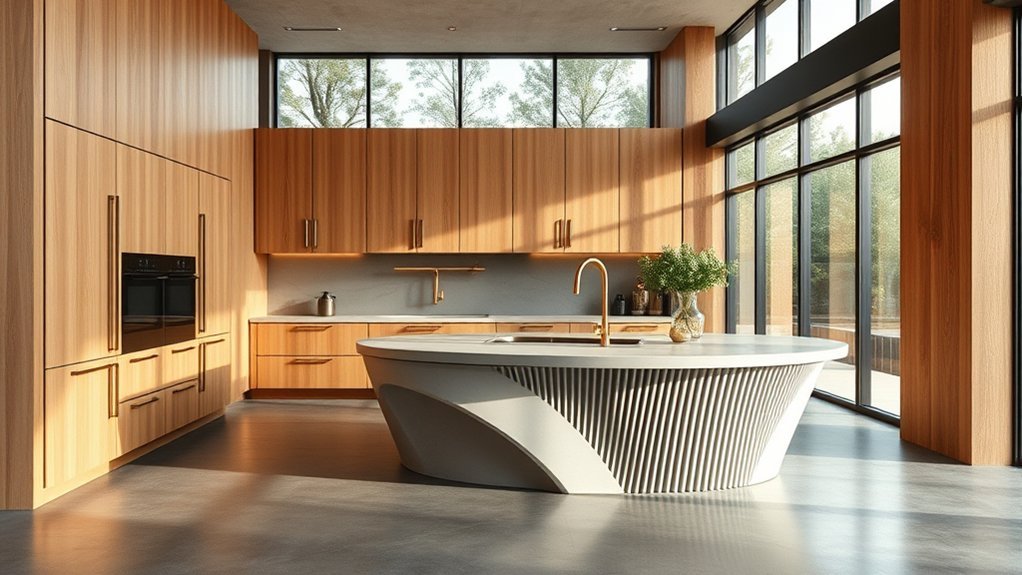
The strongest 2026 kitchen trends combine warm natural materials with smarter function. Wood cabinetry, paneled appliances, concealed storage, slab-style doors, natural stone, warm neutrals, and better lighting are all gaining attention. At the same time, late-2026 design is becoming more layered and personal, so the goal is less about strict minimalism and more about creating a kitchen that feels organized, comfortable, and connected to the rest of the home.
Quick Answer
The 2026 kitchen trend centers on warm wood, natural stone, concealed storage, paneled appliances, slab cabinet fronts, softer colors, and highly functional layouts. Clean lines remain important, but newer designs are adding curves, texture, statement surfaces, smart technology, and more personal details instead of following severe minimalism.
Key Takeaways
- Wood cabinetry has moved ahead of white among renovating homeowners, with medium and light wood tones leading the shift.
- Slab cabinet doors, paneled refrigerators and dishwashers, pantry storage, and concealed work zones support the streamlined “invisible kitchen” look.
- Warm neutrals, greens, natural wood, quartzite, textured tile, and slab backsplashes are replacing colder, flatter palettes.
- Curved islands, arched details, layered lighting, smart appliances, and accessible storage add comfort and function.
- Minimalism is still influential, but late-2026 design is becoming warmer, more textured, and more personal rather than completely bare.
What the 2026 Kitchen Trend Looks Like
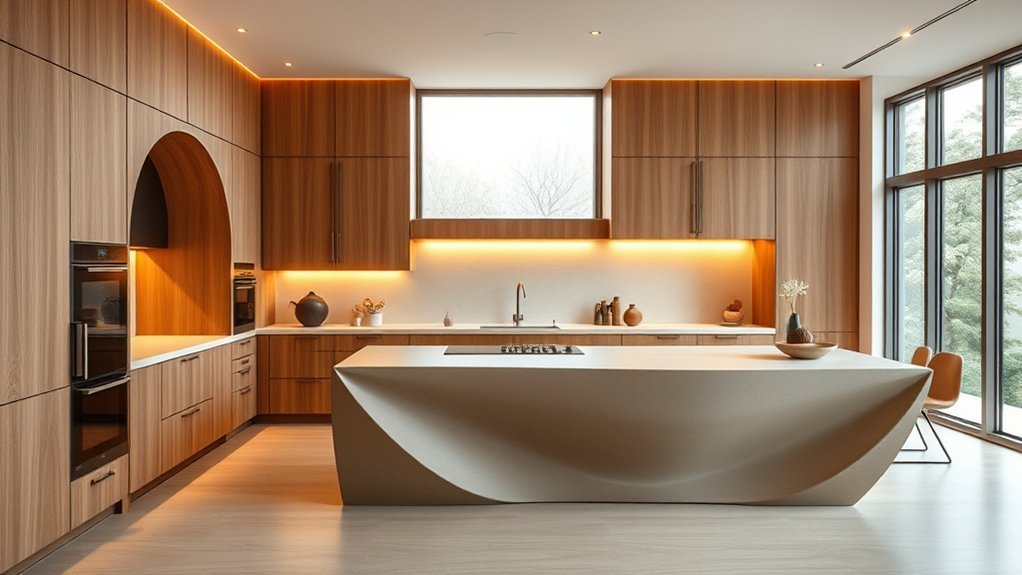
The clearest 2026 direction is a combination of warmth, natural materials, better storage, and visual simplicity. According to the NKBA 2026 Kitchen Trends Report, neutrals remain highly popular, while greens, blues, wood grain, slab cabinet doors, paneled appliances, and natural surfaces are all expected to play important roles.
Rather than one rigid style, several related ideas are coming together. White oak, walnut, medium wood tones, quartzite, warm off-whites, mushroom, taupe, sage, and other earthy colors help kitchens feel less cold. Clean cabinet fronts and concealed appliances reduce clutter, while distinctive stone, handcrafted tile, curved islands, lighting, and decorative details keep the room from feeling sterile.
Natural wood is especially significant. NKBA reports that 59% of surveyed industry professionals identified wood-grain cabinetry as growing in popularity, with white oak the most popular wood type at 51%.
The strongest 2026 kitchen is not simply minimalist. It combines streamlined architecture with warmer wood, natural texture, useful storage, better lighting, and details that make the room feel personal.
That distinction matters because newer research is also showing a move toward more collected interiors. Clean-lined kitchens remain relevant, but they are increasingly softened with expressive stone, tile, aged metals, handmade finishes, art, and other elements that give the space character.
Why Invisible Kitchens Are Taking Over
An “invisible kitchen” hides much of the room’s working equipment behind cabinetry or carefully planned storage. Refrigerators, dishwashers, small appliances, outlets, charging areas, pantry goods, and cooking tools can recede from view when they are not needed.
The concept has strong support in current industry research. NKBA reports that panel-faced refrigerators and dishwashers are among the features professionals expect to gain popularity, along with slab cabinet fronts and more sophisticated storage.
The appeal is practical as well as visual. Hiding equipment makes an open kitchen easier to integrate with nearby dining and living areas, while thoughtful storage can reduce the amount of equipment left on counters.
Seamless Cabinet Integration
Seamless cabinet integration uses matching fronts, continuous materials, and restrained hardware so large appliances do not dominate the room.
Panel-ready refrigerators and dishwashers can sit behind doors that match adjacent cabinetry. Flat-panel doors, integrated pulls, finger channels, and push-to-open systems can further reduce visual breaks.
NKBA’s research identifies flat or slab cabinet doors as a growing feature, with 69% of respondents pointing to the style. Paneled refrigeration was identified by 72%, while paneled dishwashers reached 85%.
The result can resemble built-in furniture rather than a row of individual appliances. This is particularly useful in open-plan homes where the kitchen is visible from a living or dining space.
Hidden Storage Zones
Hidden storage is one of the more practical parts of the 2026 kitchen trend. Instead of simply adding cabinets, designers are creating storage around specific tasks and objects.
- Appliance garages can hide coffee makers, mixers, and toasters.
- Tall pantry cabinets can consolidate food storage.
- Deep drawers make pots, dishes, and cookware easier to reach.
- Pull-out trays can improve access inside lower cabinets.
- Charging drawers can keep cords and devices off the countertop.
The 2026 U.S. Houzz Kitchen Trends Study found that 76% of renovating homeowners include specialty built-ins. Pantry cabinets lead those additions at 47%, followed by beverage stations at 24% and walk-in pantries at 16%.
Warm Minimalist Materials
Warm minimalism keeps the straightforward architecture of a modern kitchen but replaces clinical finishes with natural grain, tactile stone, warmer colors, and softer details.
White oak, walnut, quartzite, limestone-look surfaces, warm off-whites, textured tile, and brushed or aged metals can all work within this approach. The important point is restraint: the materials should complement one another rather than compete for attention.
However, warm minimalism is no longer the only direction. Late-2026 design research also points toward more layered interiors, where clean cabinetry is combined with distinctive materials, vintage-inspired pieces, decorative lighting, and handmade details.
Note: Think of minimalism as an architectural foundation rather than a rule that every surface must be empty. A streamlined kitchen can still include expressive stone, art, lighting, texture, and objects you actually use.
Warm Neutrals That Set the Mood
Warm neutrals remain one of the clearest 2026 color directions. Mushroom, taupe, beige, sand, warm off-white, clay, and greige can soften cabinetry and walls without making a kitchen feel dark.
NKBA reports that 96% of respondents identified neutrals as popular colors, while green and blue also scored strongly. This supports a broader shift toward natural palettes rather than one single fashionable shade.
- Mushroom and taupe work well on cabinetry or walls.
- Warm off-white keeps a room bright without the sharpness of pure white.
- Sage and olive complement oak, walnut, and stone.
- Sand and beige work as flexible background colors.
- Soft clay and muted terracotta can introduce warmer accent color.
That does not mean white kitchens have disappeared. Houzz’s 2026 renovation data still shows white as an important cabinet and backsplash color. The change is better described as a broadening of the palette: homeowners have more interest in wood, off-white, earth tones, and natural color than in the cool gray-and-bright-white combinations that dominated many earlier kitchens.
Natural Wood Finishes and Tonal Hardware
Wood cabinetry is one of the most measurable changes in the 2026 kitchen market. In Houzz’s survey of 1,780 U.S. homeowners with recent, current, or planned kitchen renovations, 29% chose wood as their cabinet color, narrowly ahead of white at 28%.
Medium wood accounts for 15% of choices, light wood 11%, and dark wood 3%. The figures show a real shift toward visible grain and warmth, although painted cabinetry remains important.
Wood-Toned Cabinetry
White oak and walnut fit the current natural-material direction particularly well, but maple, ash, cherry, and other woods can create the same basic effect when their grain is allowed to show.
- Medium wood gives cabinetry depth without making the room overly dark.
- Light oak can keep compact kitchens visually open.
- Walnut works well on an island or lower cabinets where more contrast is wanted.
- Mixed wood and painted cabinetry can create a two-tone effect.
- Consistent grain direction can make slab doors look more intentional.
For homeowners planning a long-lived kitchen, the more useful question is not which wood is temporarily fashionable, but which tone works with the flooring, natural light, countertop, and adjoining rooms.
Tonal Hardware Pairings
Warm brass, brushed gold, bronze, nickel, and other low-glare metals can all pair effectively with natural wood, but brass should not be described as the universal 2026 hardware leader.
Houzz’s 2026 kitchen research found brushed nickel to be the most common cabinet-hardware finish among surveyed renovators at 28%, followed by black at 18% and brushed gold at 12%.
For a quieter appearance, choose a metal with a muted or brushed surface and repeat it selectively on cabinet hardware, lighting, faucets, or nearby furniture. The finishes do not have to match perfectly, but they should look intentional together.
Flat Panel Cabinet Fronts for a Clean Look
Flat-panel or slab cabinet fronts fit the 2026 preference for simpler geometry and easy visual continuity. Their broad surfaces place more emphasis on wood grain, color, proportion, and hardware than on decorative door profiles.
They can also be relatively easy to wipe down because there are fewer grooves and raised details to collect residue.
- Flush fronts create a highly streamlined appearance.
- Wood veneer can turn the grain itself into the main decorative feature.
- Matte painted fronts soften stronger colors.
- Finger pulls and integrated channels can reduce visible hardware.
- Slab doors can work in compact, modern, organic, and transitional kitchens.
NKBA’s 2026 research supports the direction, with 69% of surveyed professionals identifying flat slab cabinet doors as gaining popularity.
Curved Islands and Slab Backsplashes
Straight lines still dominate cabinetry, but softer geometry is becoming a useful counterpoint. Rounded island ends, curved peninsulas, arched pantry doors, and shaped range hoods can break up a room filled with rectangular cabinets and appliances.
Houzz’s 2026 Emerging Summer Trends Report found searches for “rounded kitchen island” up 123%, while searches for curved peninsulas and islands also increased.
Slab backsplashes are another major surface direction. Instead of using many small tiles behind the counter, the countertop material or another large-format surface can continue vertically onto the wall.
NKBA identifies slab or solid-surface backsplashes as gaining popularity, while Houzz reports that 28% of renovating homeowners choosing a backsplash use a slab-style treatment. Tile still has a larger overall share, so slab surfaces should be considered a significant alternative rather than a complete replacement.
Pro Tip: When combining a curved island with expressive stone, let one element be the focal point. A dramatic island shape plus heavily veined stone plus bold tile can make a small kitchen feel busier than intended.
Lighting, Smart Technology, and Wellness
Some of the most important 2026 kitchen trends are functional rather than decorative. NKBA identifies natural light, quality lighting, task lighting, smart appliances, charging, ventilation, and wellness-oriented features as important areas of development.
Layered kitchen lighting normally works better than relying on one bright ceiling fixture. A practical plan may combine ambient lighting for the room, task lighting over work surfaces, under-cabinet lighting, interior cabinet lighting, and decorative fixtures over an island or table.
NKBA reports that 95% of respondents identified natural lighting as an important design consideration, 93% identified quality lighting, and 92% cited task lighting for work zones. Under-cabinet lighting was also among the lighting features expected to remain popular.
Smart technology is becoming less visible too. App-controlled appliances, concealed charging, connected lighting, smart refrigerators, and automated features can be integrated without turning the kitchen into a display of gadgets.
Ventilation deserves equal attention. A powerful, properly specified range hood can matter more to everyday comfort than many decorative upgrades, particularly in kitchens that open directly into living areas.
Accessibility and Long-Term Function
Another important 2026 development is designing kitchens for changing needs rather than only for current aesthetics.
Houzz reports that 53% of renovating homeowners address current or future special needs during kitchen renovation. Aging-related planning has also increased, which makes accessible storage, safer circulation, appropriate lighting, usable work zones, and easy-to-reach appliances increasingly relevant.
Useful long-term choices can include wide pathways, drawers instead of very deep lower cabinets, good task lighting, lever-style controls, pull-out shelves, reachable storage, and places where tasks can be performed comfortably.
The updated NKBA Kitchen & Bath Planning Guidelines also place greater emphasis on accessible design, activity zones, storage systems, lighting, automation, power planning, ventilation, and material performance.
How to Soften Stainless Steel Kitchens
Stainless steel remains highly relevant rather than disappearing behind panel-ready cabinetry. Houzz’s 2026 renovation data shows stainless steel remains the appliance finish selected by 72% of renovating homeowners.
The challenge is making a kitchen with several stainless appliances feel warm rather than industrial. Natural wood, textured stone, warmer wall colors, fabric, plants, and softer lighting can balance the reflective metal.
Burlwood, marble, quartzite, oak, walnut, textured tile, and muted paint colors all work because they introduce grain and variation around the smooth appliance surfaces.
Burlwood, marble, warm wood, and muted backsplashes can soften stainless steel without hiding the material or sacrificing its practical appeal.
Flat-panel cabinetry can reinforce the clean geometry while warm surfaces prevent the composition from becoming clinical. Short backsplashes can work in some rooms, while full-height tile or slab backsplashes may be more practical where cooking creates frequent splashes.
Green Countertops and Calm Stone Surfaces
Green is clearly important in the broader 2026 color story, but current research does not establish green stone as the dominant countertop choice. It is better treated as one expressive way to apply the larger nature-inspired trend.
NKBA reports strong professional interest in green as a kitchen color family, while quartz and natural quartzite remain major countertop materials. A muted green quartzite, marble, soapstone-like surface, or engineered material can therefore combine two directions: natural-looking stone and earthy color.
- Muted jade or olive tones can complement oak and walnut.
- Honed finishes reduce glare and emphasize texture.
- Quiet veining works well with simple slab cabinetry.
- A dramatic green island can become the room’s focal point.
- Neutral surrounding surfaces can prevent strong stone from overwhelming the space.
Material selection should still be based on durability, stain resistance, maintenance, heat tolerance, manufacturer guidance, and the way the surface will actually be used. A fashionable color is not a substitute for appropriate material performance.
Creamy Tiles and Cabana Stripe Accents
Creamy white and off-white tile fits comfortably within the warmer 2026 palette. Houzz’s renovation data shows white and off-white continue to account for a large share of backsplash colors, even as warmer woods and stronger accent colors become more visible elsewhere.
Creamy tile works because it keeps a kitchen light while softening the sharp contrast created by pure white surfaces.
Larger tiles can reduce the number of grout lines and create a simpler background, while handmade or irregular tile can add texture to an otherwise streamlined kitchen.
Cabana stripes should be treated differently. They can be an effective decorative accent, but there is not strong national survey evidence showing striped kitchen backsplashes as one of the dominant 2026 trends.
If you like the look, use stripes as a personal design choice on a small backsplash section, café curtain, rug, banquette fabric, or decorative wall rather than assuming the pattern is required for an up-to-date kitchen.
This reflects a wider late-2026 direction: homeowners are increasingly comfortable adding individual character to a warm, natural foundation instead of copying one prescribed minimalist look.
Butler Pantries and Hidden Storage Ideas
Storage is one of the strongest functional themes in current kitchen renovation data, but a full butler pantry is only one way to achieve it.
Houzz reports that 76% of renovating homeowners incorporate specialty built-ins. Pantry cabinets are the most common option at 47%, walk-in pantries appear in 16% of projects, and butler’s pantries or prep kitchens appear in 7%.
Among homeowners who do add or upgrade a butler pantry, small-appliance storage, prep counters, and enclosed cabinetry are common priorities.
- Appliance garages keep frequently used machines available without leaving them exposed.
- Pull-out shelves improve access to deep storage.
- Pantry cabinets concentrate food storage in one zone.
- Drawer dividers can organize utensils and small tools.
- Secondary prep counters can move entertaining mess away from the main kitchen.
A separate room is not necessary to use the same principle. A tall pantry wall, pocket-door cabinet, beverage station, or concealed appliance zone can provide many of the same advantages in a smaller kitchen.
Frequently Asked Questions
What Is the 2026 Trend for Kitchens?
The broad 2026 kitchen trend combines natural wood, warm neutrals, stone, streamlined cabinetry, concealed storage, paneled appliances, stronger lighting, and highly functional layouts. Curves and personal decorative details are also becoming more visible, so the look is warmer and less rigid than earlier forms of minimalism.
What Are the Hottest Kitchen Trends Right Now?
Current trends include wood cabinetry, specialty storage, slab backsplashes, warm neutrals, greens, paneled appliances, rounded islands, smart technology, better task lighting, and kitchens planned around everyday function. Houzz’s 2026 study also shows functionality becoming a stronger remodeling driver, with 38% citing deterioration or dysfunction and 41% citing dissatisfaction with the old kitchen style.
What Kitchen Cabinet Colors Will Look Outdated in 2026?
No cabinet color becomes automatically outdated in one year. Cool gray has lost some momentum while wood, warm neutrals, off-white, and green are receiving more attention. White is still widely used: Houzz found white cabinetry in 28% of surveyed renovations, just behind wood at 29%. The safest long-term choice is a color that fits the home’s light, flooring, architecture, and surrounding rooms.
What Are the Trendy Kitchen Design Trends for 2026?
Popular directions include natural wood, slab cabinet doors, warm and organic colors, paneled appliances, natural stone, smart appliances, concealed charging, pantry storage, multifunctional islands, improved lighting, accessible planning, curved details, and surfaces that connect the kitchen visually with adjoining living areas.
Are White Kitchens Out of Style in 2026?
No. White kitchens are becoming less dominant, but white remains widely used. Houzz found wood cabinets slightly ahead of white cabinets in 2026 renovations, while white and off-white remain prominent for walls and backsplashes. Warmer whites and wood combinations can make an all-light kitchen feel more current without requiring a complete color change.
Is Minimalist Kitchen Design Still Popular in 2026?
Yes, but it is changing. Slab cabinet fronts, paneled appliances, uncluttered storage, and continuous surfaces remain popular. At the same time, newer 2026 design research points toward more layered interiors with natural variation, handcrafted details, expressive stone, aged metals, and personal objects. The result is often warm minimalism rather than an empty or clinical room.
Conclusion
The 2026 kitchen trend is best understood as a move toward warmth, natural materials, thoughtful storage, and practical refinement. Wood cabinetry, slab fronts, paneled appliances, stone surfaces, warmer colors, integrated storage, improved lighting, and smart technology all have strong research behind them.
At the same time, the newest direction is becoming less rigid. Curved forms, expressive stone, handcrafted tile, layered finishes, and individual details are softening the minimalist look. A successful 2026 kitchen therefore does not need to follow every trend. The strongest approach is to combine durable materials and useful storage with a palette and level of detail that suit the home and the people who use it.
Sources
- NKBA | KBIS 2026 Kitchen Trends Report press release — supports color, cabinetry, natural materials, paneled appliances, lighting, smart technology, and storage trends.
- NKBA | KBIS 2026 Kitchen Trends Report research page — methodology and major themes from 634 North American kitchen and bath professionals.
- 2026 U.S. Houzz Kitchen Trends Study — homeowner data on cabinetry, storage, renovation priorities, pantries, styles, and project choices.
- Houzz 2026 kitchen renovation research — supports built-in storage, pantry, cabinetry, hardware, and accessibility figures.
- 2026 U.S. Houzz Emerging Summer Trends Report — supports increasing interest in curved islands, arched details, natural textures, and warmer design.