
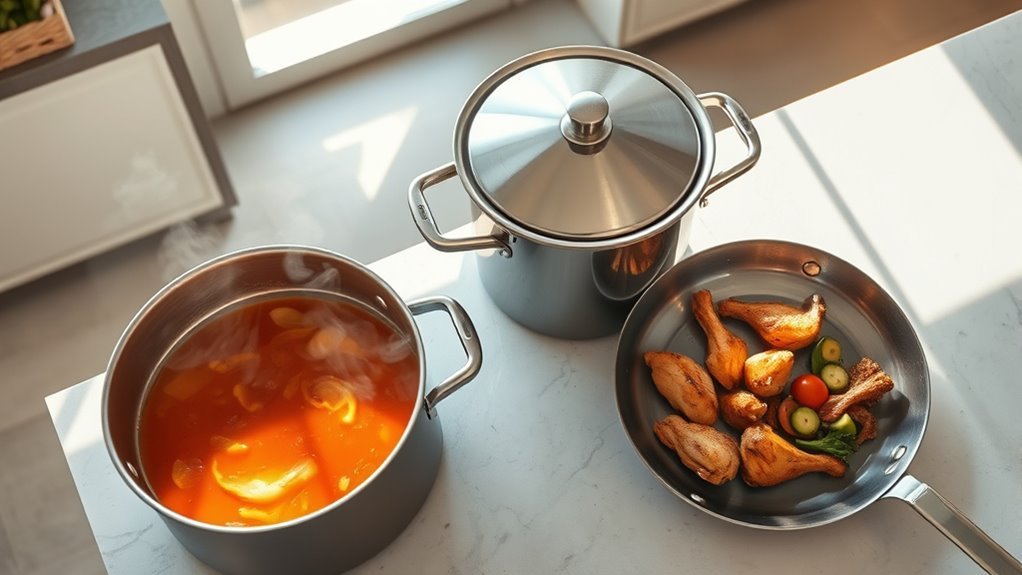
The difference between pots and pans comes down to shape and job. Pots are deep, with tall sides, two handles and a lid, and they are made for cooking liquids: boiling, simmering and stewing. Pans are shallow, with low sides and usually one long handle, and they are made for dry-heat cooking such as frying, searing and sautéing.
The line blurs with pieces like the saucepan (shaped like a small pot, called a pan) and the Dutch oven (called an oven, used like a pot). Here is how to tell them apart and when to use each.
Pots vs Pans at a Glance
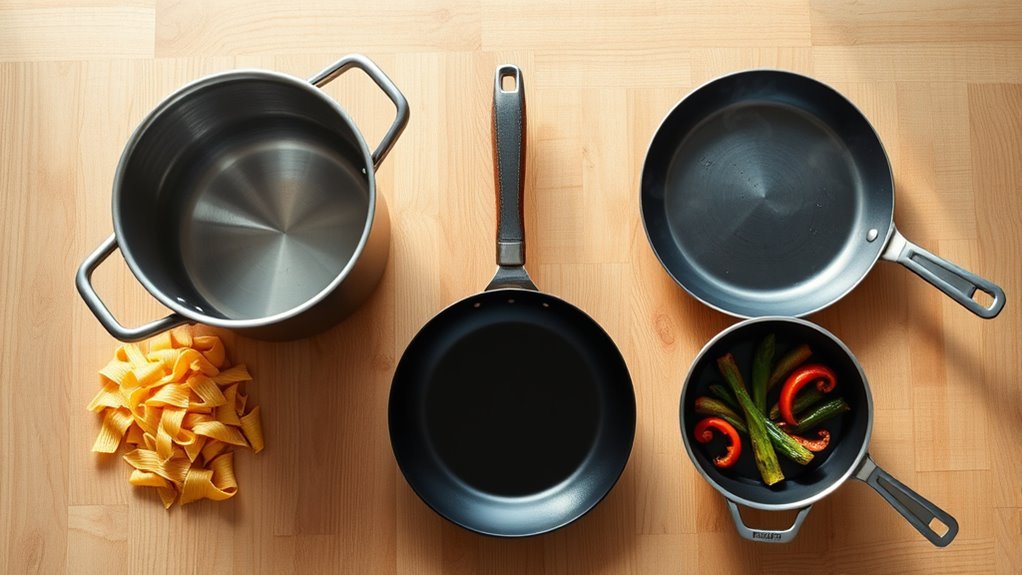
| Feature | Pots | Pans |
|---|---|---|
| Sides | Tall, usually straight | Low, straight or flared |
| Handles | Often two short loop handles | Usually one long handle |
| Lid | Almost always | Sometimes |
| Main job | Boiling, simmering, steaming, stewing | Frying, searing, sautéing, browning |
| Moisture | Traps steam and liquid | Lets steam escape for browning |
| Typical capacity | 3 to 20 quarts or more | Measured by diameter, 8 to 12 inches |
What Is a Pot?
A pot is a deep cooking vessel. Because the sides are tall, it holds a large volume of food and liquid with a small footprint. The lid traps heat and steam, which makes pots efficient for long, wet cooking.
- Stockpot: The largest, for stock, soup and pasta, usually 6 quarts and up.
- Dutch oven: A heavy pot with a tight lid, for braises, stews and baking bread.
- Stewpot or soup pot: A mid-size pot with two handles.
- Steamer pot: A pot with a perforated insert. See how to use a steamer pot.
What Is a Pan?
A pan is shallow and wide. The large surface area lets moisture evaporate, which is what allows food to brown. Most pans have one long handle so you can shake, flip and tilt them.
- Skillet or frying pan: Flared sides that make it easy to flip and slide food out.
- Sauté pan: Straight sides and a lid, which keeps splatter in and holds more liquid.
- Saucepan: Taller sides and a lid, used for sauces, rice and small amounts of liquid. It sits between a pot and a pan.
- Saucier: A saucepan with a rounded bottom for whisking.
- Griddle and grill pan: Very low sides for pancakes or ridged searing. See what a grill pan is used for.
How Cooking Techniques Differ
Pots keep food in contact with liquid, so they cook with moist heat. The liquid keeps the temperature near the boiling point, which is gentle and even. That suits pasta, soups, stews, beans and anything that needs to soften.
Pans cook with dry heat. Hot metal touches the food directly, and moisture escapes quickly, so the surface browns (the Maillard reaction). That suits steaks, vegetables, eggs and pancakes.
When to Use a Pot and When to Use a Pan
| You want to | Reach for |
|---|---|
| Boil pasta or potatoes | Stockpot |
| Make soup or stock | Stockpot or Dutch oven |
| Cook rice or a small sauce | Saucepan |
| Sear a steak or fry an egg | Skillet |
| Sauté vegetables, then simmer | Sauté pan |
| Braise short ribs | Dutch oven or braiser |
You can use some pieces both ways. A Dutch oven can sear meat and then braise it, and a deep sauté pan can simmer a sauce. If you are not sure what to buy first, see the pans you actually need.
Does Material Matter More for Pots or Pans?
Pans depend more on heat response. A pan that heats unevenly leaves hot spots that burn food, so clad stainless, aluminum, carbon steel and cast iron are popular. Pots benefit from a thick, heavy base so soups and sauces do not scorch.
Nonstick suits pans for eggs and delicate foods. For stockpots and Dutch ovens, durable stainless steel or enameled cast iron is more common. Read about the healthiest cookware materials and what ply stainless steel is best if you are deciding.
Care Tips for Both
- Do not put a hot pan or pot in cold water, since sudden temperature changes can warp thin metal.
- Match the burner to the base. A small pan on a large burner wastes heat; a large pan on a small burner heats unevenly.
- Check manufacturer instructions before using a dishwasher. See can you put pots and pans in the dishwasher.
Frequently Asked Questions
Are pots and pans the same thing?
No. Pots are deep with tall sides, two handles and a lid, and they are best for liquids. Pans are shallow with low sides and usually one long handle, and they are best for frying and searing. Some pieces, like the saucepan, sit between the two.
What does it mean when someone says pots and pans?
It is a general phrase for kitchen cookware. Pots cover deep vessels for boiling and simmering, while pans cover shallow vessels for frying and sautéing. Together they describe the main cookware in a kitchen.
Is a saucepan a pot or a pan?
A saucepan is usually considered a pan by name, but it is built like a small pot, with tall straight sides, a lid and one long handle. It is used for sauces, rice and small amounts of liquid, so it works in between.
Is a Dutch oven a pot or a pan?
A Dutch oven is a pot. It has deep sides, a heavy lid and two handles, and it is used for braises, stews and baking. It can also sear food, but its main job is moist, slow cooking.
Conclusion
Think of pots as tall vessels for liquid and pans as shallow surfaces for browning. Once you know the job you want to do, the right piece is easy to pick.
