
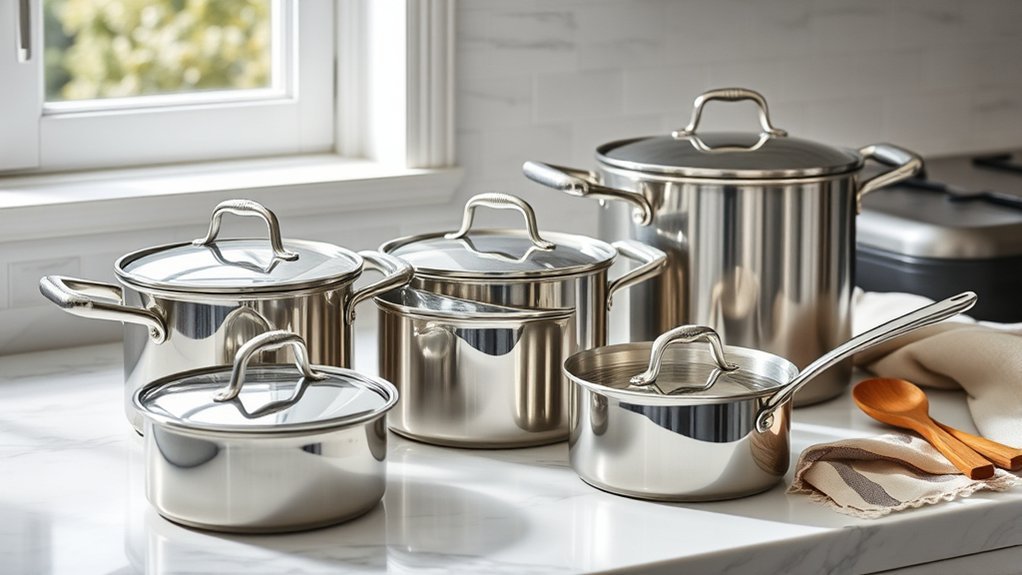
Most kitchens can cover nearly every saucepan job with two or three useful sizes rather than a large matching set. A 1- to 1.5-quart saucepan handles small portions and reheating, a 3- to 4-quart pan covers most everyday cooking, and a 5- to 7-quart vessel gives you room for soups, pasta, and batch meals. Material, construction, lid fit, handle balance, and stovetop compatibility matter just as much as capacity.
Quick Answer
For most kitchens, the most useful saucepan sizes are about 1 to 1.5 quarts for small jobs, 3 to 4 quarts for everyday sauces, grains, vegetables, and reheating, and 5 to 7 quarts for larger meals. At the upper end, the vessel may be sold as a stockpot rather than a saucepan.
Key Takeaways
- 1 to 1.5 quarts: best for melting, reheating, sauces, oatmeal, and small grain portions.
- 3 to 4 quarts: the most flexible everyday range for many households.
- 5 to 7 quarts: useful for soup, pasta, stocks, and batch cooking, although cookware this large is often labeled a stockpot.
- Choose clad stainless steel when durability and broad cooking versatility matter; choose nonstick when easy release is a priority.
- For induction, look for a clearly marked compatible base or check whether a magnet sticks firmly to the bottom.
What Saucepan Sizes Do You Need?
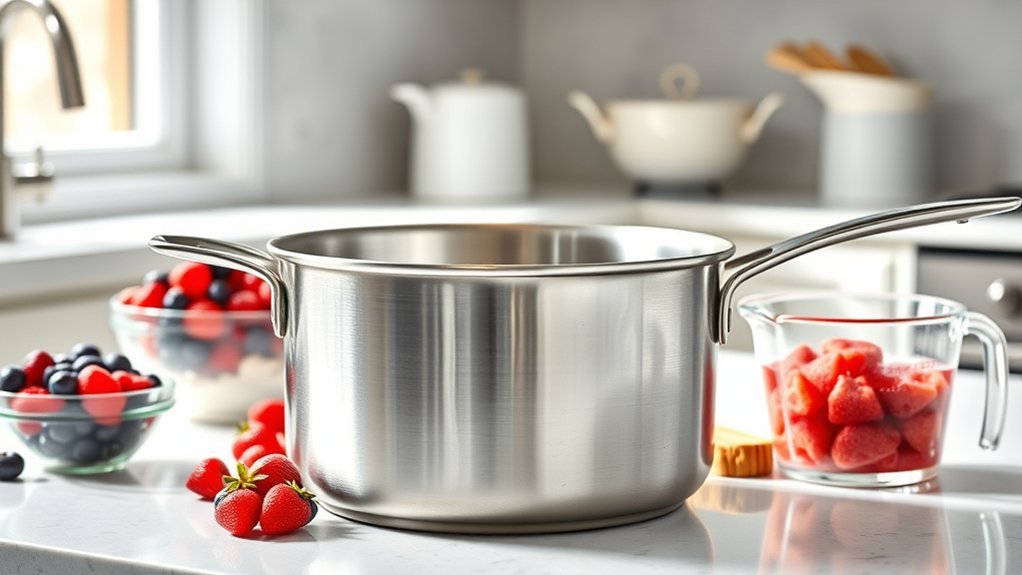
Choosing a saucepan size is easier when you match capacity to the food you actually cook. You do not necessarily need every size. Many households can work comfortably with one compact saucepan, one medium saucepan, and a larger pot for meals that need extra volume.
For reference, the U.S. National Institute of Standards and Technology lists 1 U.S. liquid quart as about 4 cups or 946 milliliters. That makes a 3-quart pan roughly 12 cups to its nominal capacity and a 4-quart pan roughly 16 cups. In normal cooking, however, you should not expect to fill a pan completely to the rim.
| Size | Approx. Capacity | Best For |
|---|---|---|
| 1–1.5 qt | 4–6 cups | Butter, chocolate, gravy, oatmeal, small portions, reheating |
| 2–2.5 qt | 8–10 cups | Small soups, grains, vegetables, modest batches of sauce |
| 3–4 qt | 12–16 cups | Everyday sauces, rice, vegetables, soup, leftovers, modest pasta batches |
| 5–7 qt | 20–28 cups | Family soup, pasta, stocks, chili, meal prep, batch cooking |
Note: The printed quart capacity usually describes the vessel’s total nominal volume. Boiling water, milk, pasta, rice, beans, and other foods that foam or expand need unused space at the top to reduce boil-over risk.
A 3- to 4-quart medium saucepan is usually the most flexible single size. It is large enough for grains, vegetables, sauce, soup, and many reheating jobs without being as cumbersome as a stockpot.
At about 5 to 7 quarts, terminology becomes less consistent. Some cookware may be described as a large saucepan or soup pot, while manufacturers such as All-Clad sell a 6-quart vessel intended for soups, pasta, grains, and batch cooking as a stockpot. The shape and handle design matter more than the label.
The Best Small Saucepan for Quick Tasks
A small saucepan, usually around 1 to 1.5 quarts, works well when a larger vessel would leave food spread thinly across the bottom. Common jobs include melting butter or chocolate, warming gravy, reheating a cup or two of soup, cooking oatmeal, and preparing modest portions of grains or vegetables.
A compact pan should still feel substantial enough to sit securely on the burner. Look for a flat base, a handle that does not make the empty pan tip backward, and a rim that pours cleanly. A fitted lid adds flexibility for rice, grains, steaming, and low-volume simmering.
Stainless steel is a durable choice, but construction matters. Premium pans often combine stainless steel with a more conductive aluminum core. For example, All-Clad’s 1.5-quart D3 saucepan uses bonded tri-ply construction rather than relying on stainless steel alone for heat distribution.
A nonstick interior can be convenient for sticky or delicate foods and makes cleanup easier, but it is not automatically necessary for sauces. Stainless steel is often preferable when you want to whisk vigorously, use metal utensils where permitted, deglaze, or keep the pan for many years.
When a 3-Quart Saucepan Makes Sense
A 3-quart saucepan is a useful middle size for households that need more room than a small sauce pot but do not want to pull out a stockpot for routine meals.
It can handle rice, grains, vegetables, soup, sauces, reheating, and modest quantities of pasta. Actual serving capacity varies substantially with the food. A current Le Creuset 3-quart stainless saucepan is listed for approximately 3 to 4 servings, which is a more useful general benchmark than assuming every 3-quart pan feeds four to six people.
The size also remains manageable for pouring and storage. When full, however, even a 3-quart pan can become heavy, so handle comfort and balance are worth checking before purchase.
Best Uses for 3-Quart
Three quarts gives you enough room for many everyday jobs while keeping ingredients deep enough for efficient simmering. It is especially useful for:
- Rice, quinoa, oatmeal, and other grains
- Small to medium batches of soup or chili
- Tomato, cream, cheese, or pan sauces
- Boiled or steamed vegetables
- Heating leftovers without using a large pot
- Custards, puddings, and similar mixtures when the pan material is appropriate
- Smaller quantities of pasta when adequate water and boil-over headroom remain
Do not judge pasta capacity by the dry serving count alone. Long pasta, vigorous boiling, and starchy foam all require more room than a thick sauce or finished soup occupying the same nominal volume.
Pro Tip: When choosing between two saucepan sizes, think about your messiest high-volume recipe rather than the smallest one. Extra headroom is much more useful during a boil than unused capacity is inconvenient during a gentle simmer.
Why It’s the Sweet Spot
The 3-quart saucepan is often called a sweet spot because it balances capacity, weight, burner fit, and storage. It can replace a small pan for many jobs while remaining easier to handle than a 5- or 6-quart vessel.
For households cooking for one to four people, this size often covers sauces, grains, vegetables, small soups, and reheating. It is also easier to lift and pour than a family-size stockpot.
A tight-fitting lid helps retain steam and reduces evaporation when that is desirable. A clad body or well-designed conductive base can reduce temperature differences across the cooking surface, while a comfortable handle makes the filled pan easier to control.
Why a 5- to 7-Quart Saucepan Helps
A 5- to 7-quart vessel gives you the headroom needed for family-size cooking, larger soups, chili, pasta, potatoes, stocks, and meal prep. At this capacity, many products are better described as stockpots or soup pots rather than traditional long-handled saucepans.
The larger volume reduces crowding and makes stirring easier when ingredients expand. It also provides a safer margin below the rim for boiling and simmering.
Because a full 6-quart pot can be heavy, two short side handles or a long handle plus a helper handle may be easier to control than a single narrow stick handle.
Versatile Family-Size Cooking
For larger households, a 5- to 7-quart vessel can prepare soup, stew, pasta, grains, and one-pot meals without forcing you to split the recipe into separate batches.
All-Clad describes its 6-quart D3 stockpot as suitable for soups, sauces, pasta, grains, batch cooking, and family dinners. Cuisinart likewise sells a 6-quart stainless stockpot for larger-volume cooking.
Construction remains important at this size. A broad, flat base should sit securely on the cooking zone. If you are buying a heavy pan, test the handles with both hands and consider how comfortable the pan will be when it contains several quarts of food or water.
Great For Batch Meals
A larger pot is particularly useful for batch meals because it leaves room to stir soup, chili, curry, sauce, grains, and vegetables without pushing food over the rim.
It also makes meal-prep cooking simpler: one large batch can be portioned into several meals instead of repeating the same stovetop work. For pasta, the extra water capacity and headroom are useful when compared with a medium saucepan.
Choose the size based on your recipes rather than the largest pan that fits in the cabinet. Someone cooking one or two portions most nights may use a 6-quart pot only occasionally, while a household that prepares soup, pasta, or freezer meals weekly may rely on it constantly.
Stainless Steel vs. Nonstick Saucepan Materials
Stainless steel and nonstick saucepans solve different problems. Stainless steel is durable, resists corrosion, and tolerates a broad range of cooking techniques. High-performing stainless cookware often surrounds an aluminum core with stainless layers so the pan combines a durable cooking surface with better heat distribution.
Le Creuset, for example, describes its tri-ply stainless saucepan as having an aluminum core bonded between stainless-steel layers. All-Clad uses a similar principle in its bonded stainless cookware.
Nonstick cookware focuses on easy release and cleanup. It can be convenient for foods that readily stick, but coating type and care instructions vary. Do not assume every nonstick pan has the same oven temperature, utensil restrictions, or dishwasher guidance.
Warning: Follow the manufacturer’s instructions for coated cookware. For example, All-Clad advises low-to-medium stovetop heat for its PTFE nonstick cookware, warns against overheating an empty pan, and recommends nonabrasive utensils. Heat limits differ by product, so the pan’s own care guide should take priority.
The FDA’s current guidance also provides useful context around PFAS and cookware. It states that PFAS used in authorized nonstick cookware applications are polymerized and tightly bound to the surface, with studies showing negligible amounts capable of migrating to food. That does not eliminate the need to use a coated pan according to its manufacturer’s instructions or replace a coating that has become badly damaged.
A practical material comparison looks like this:
- Clad stainless steel: durable, versatile, suitable for browning and deglazing, and available in induction-compatible versions.
- PTFE-based nonstick: excellent release, but usually requires more care with heat and utensils.
- Ceramic-coated nonstick: also provides easy release, but heat and utensil limits still depend on the manufacturer.
- Cast iron: durable and usually induction-compatible, but much heavier and uncommon in the classic long-handled saucepan format.
- Aluminum: an excellent heat conductor and commonly used as the internal core or base layer of stainless cookware; bare aluminum itself is not normally induction-compatible unless the cookware includes a magnetic layer.
How Saucepan Shape Changes Cooking Results
Saucepan shape changes how quickly moisture evaporates, how easily food can be stirred, and how the pan fits a burner.
A wider pan exposes more liquid surface area, so water can evaporate more quickly during reduction. A taller, narrower vessel exposes less surface area relative to its volume and can be useful when you want to limit evaporation or contain splatter.
Straight sides provide substantial usable volume without greatly increasing the footprint. Gently rounded interior corners can make whisking easier because sauce is less likely to collect in a sharp corner. The exterior base, however, should remain stable and appropriately shaped for the cooktop.
Base diameter matters too. A pan whose base closely matches the heating zone generally uses the burner more effectively than a tiny pan placed on an oversized element. On gas, avoid flames extending far beyond the base and up the sides or handles.
Pan thickness and construction affect temperature behavior. A heavier conductive layer can smooth rapid temperature swings, while thinner cookware may respond faster but can also develop more pronounced hot spots if poorly constructed.
Picking the Right Lid, Handle, and Base
The lid, handle, and base often determine whether a saucepan remains pleasant to use after the novelty of a new purchase wears off.
A well-fitting lid helps retain steam and slows evaporation. This is useful for grains, covered simmering, steaming, and bringing liquids back to temperature after ingredients are added. Glass lids let you see inside, while metal lids are generally lighter and less vulnerable to breakage; oven limits vary by model.
The main handle should feel secure and balanced. A pan that tips when empty or twists in your hand when full is harder to control. Larger saucepans benefit from a helper handle, especially when they may contain several pounds of food and liquid.
Look for a flat, stable base that sits without rocking. In stainless cookware, either full cladding or a well-made encapsulated base can provide a conductive aluminum layer while maintaining a durable cooking surface.
- Lid: check fit, handle clearance, and oven rating.
- Main handle: look for secure attachment and comfortable balance.
- Helper handle: particularly useful on heavier 3- to 4-quart pans and larger vessels.
- Pouring rim: a flared or rolled rim can make transferring liquids cleaner.
- Base: it should be flat, stable, and compatible with your stovetop.
- Weight: enough for stability, but not so heavy that you cannot safely pour from it.
Best Saucepans for Induction Stovetops
For an induction stovetop, cookware needs a base that responds to a magnetic field. Cast iron normally qualifies, and many stainless-steel pans do too, but not every stainless-steel construction is induction-compatible.
ENERGY STAR recommends a simple magnet test: if a refrigerator magnet sticks firmly to the bottom of the cookware, the pan should work with induction. New cookware may also carry an induction-compatible symbol or state compatibility on its packaging.
Pro Tip: Test the flat center of the pan’s bottom rather than the sidewall. Induction performance depends on the material interacting with the cooking zone at the base.
A 3- to 4-quart induction-compatible saucepan is a practical everyday choice. For good performance, also check that the base diameter is appropriate for your cooktop’s cooking-zone requirements; some induction units may not detect very small pans on large zones.
Do not assume that heavier always means better. Weight can help with stability and heat retention, but construction quality, base flatness, compatibility, and handle comfort matter more than weight alone.
Which Saucepan Size Fits Your Cooking?
The best saucepan size depends on the meals you make repeatedly, not on the number of pieces in a cookware set.
If you mainly cook for one person, a 1- to 1.5-quart saucepan plus a 3-quart pan may cover most jobs. For two to four people, a 3- to 4-quart saucepan is usually the most useful everyday size, with a smaller pan added for reheating and sauces. Families and batch cooks may want a 5- to 7-quart stockpot or large saucepan as well.
Before buying, use this checklist:
- What is the largest recipe you cook at least once or twice a month?
- Do you need enough headroom for boiling pasta, milk, potatoes, or grains?
- Will the base fit your most-used burner?
- If you have induction, does a magnet stick securely to the base?
- Can you lift and pour from the pan comfortably when it is full?
- Does a larger model include a helper handle?
- Does the lid fit securely without rattling excessively?
- Are the oven, dishwasher, utensil, and heat limits appropriate for how you cook?
- Do you want stainless-steel durability or the easier release of a coated surface?
- Will the pan fit in your cabinet with its handle and lid?
One U.S. liquid quart equals about 4 cups, so saucepan capacity rises quickly: a 3-quart pan is about 12 cups to the rim, while a 6-quart vessel is about 24 cups. Leave working headroom instead of treating nominal capacity as a safe fill line.
Material choice then narrows the decision. Clad stainless steel is a strong general-purpose option, while nonstick can simplify foods where release and cleanup are priorities. A fitted lid, stable base, comfortable handle, and appropriate stovetop compatibility are often more important than buying the largest possible pan.
Saucepan vs. Stockpot, Saucier, and Frying Pan
Cookware names can be confusing because manufacturers do not use every term identically. Capacity alone does not define the pan.
- Saucepan: usually has relatively tall sides and one long handle; commonly sold by quart capacity.
- Stockpot: usually larger, deeper, and equipped with two short side handles for lifting.
- Saucier: has rounded interior walls that make whisking and reducing sauces easier.
- Frying pan or skillet: has a broad cooking surface and low, flared sides and is commonly described by diameter, such as 10 or 12 inches.
This distinction explains why a 6-quart vessel may appear in one cookware line as a large pot rather than a saucepan, and why comparing a 10-inch pan with a 12-inch pan does not directly answer a saucepan-size question.
How Much Saucepan Capacity Do You Really Need?
Nominal capacity is measured to a defined volume, but cooking usually requires empty space above the food. The amount varies by recipe.
Gentle sauces and reheated soup can use more of the available volume than pasta, beans, rice, milk, or anything likely to foam, expand, or boil vigorously. Choosing a slightly larger pan for these foods can reduce splatter and boil-overs while making stirring easier.
If you are deciding between two sizes, think about the pan when it is full and hot. A large pan that is difficult to lift safely may be less useful than a medium saucepan plus a separate stockpot for occasional high-volume cooking.
Frequently Asked Questions
What Are the Most Useful Saucepan Sizes?
For many kitchens, the most useful combination is a 1- to 1.5-quart small saucepan, a 3- to 4-quart everyday saucepan, and a larger 5- to 7-quart vessel for soups, pasta, and batch meals. The largest piece may be sold as a stockpot rather than a saucepan. You do not need all three if your cooking volume is consistently small.
What Size Pots and Pans Are Essential?
A practical starter collection can include a small saucepan, a 3- to 4-quart saucepan, a larger stockpot, and one frying pan sized for your usual portions. Exact sizes depend on household size, storage space, burner dimensions, and the recipes you cook most often.
Which Pans Should You Stay Away From?
Avoid cookware with loose handles, badly warped bases, unstable construction, severely damaged coatings, or materials that are incompatible with your stovetop. Do not reject aluminum simply because it is aluminum; it is commonly used as the conductive core inside quality stainless cookware. With coated nonstick pans, follow the manufacturer’s heat, utensil, and replacement guidance.
Is a 10- or 12-Inch Pan Better?
This comparison usually refers to a frying pan rather than a saucepan. A 10-inch frying pan is lighter and convenient for smaller portions, while a 12-inch pan provides more cooking surface and reduces crowding when preparing several servings. Neither size is universally better; choose according to portion size, burner fit, storage space, and handling weight.
Is a 3-Quart Saucepan Big Enough for Pasta?
It can work for a modest quantity of pasta, especially shorter shapes, but a 3-quart pan is not ideal for every pasta meal. Pasta needs enough water and headroom for vigorous boiling and starchy foam. For larger portions or long pasta, a 5- to 7-quart pot is usually more comfortable.
How Can You Tell Whether a Saucepan Works on Induction?
Check for an induction-compatible symbol or place a refrigerator magnet against the flat bottom of the pan. ENERGY STAR advises that cookware will work with induction when the magnet sticks to the base. Stainless-steel cookware varies, so do not rely on the material name alone.
Sources
- National Institute of Standards and Technology — Metric Household — quart, cup, and liter capacity equivalents.
- ENERGY STAR — Electric Cooking Products — induction cookware compatibility and magnet-test guidance.
- U.S. Food and Drug Administration — Questions and Answers on PFAS in Food — current information on authorized nonstick cookware coatings and food-contact migration.
- Le Creuset — 3-Quart Essential Stainless Steel Saucepan — 3-quart capacity, serving guidance, tri-ply construction, and induction compatibility.
- All-Clad — D3 6-Quart Stainless Stockpot — large-pot classification, family cooking uses, clad construction, and induction compatibility.
- All-Clad — Use and Care Guide — current nonstick heat, utensil, cleaning, and thermal-shock guidance.
Conclusion
Most cooks do not need every available saucepan size. A 1- to 1.5-quart pan covers small jobs, a 3- to 4-quart saucepan handles most everyday cooking, and a 5- to 7-quart pot gives you room for soups, pasta, and batch meals. Choose capacity with working headroom in mind, then compare construction, handle balance, lid fit, weight, and stovetop compatibility. A well-chosen medium saucepan will usually earn more use than a large cookware set filled with sizes you rarely need.

1 thought on “What Saucepans Do I Need: Essential Sizes & Buying Guide”