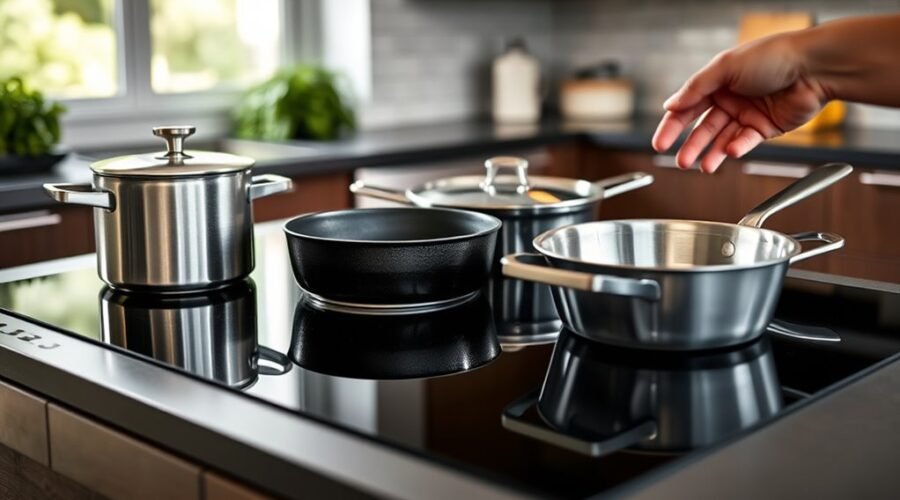
When it comes to selecting cookware for your induction cooker, it’s vital to tread carefully. Not all pots and pans are created equal; only those made from magnetic materials will efficiently harness the heat generated. Understanding which types work best can greatly enhance your cooking experience. Are you aware of the specific materials and designs that guarantee compatibility? Let’s explore the essentials that can make or break your induction cooking journey.
What Is Induction Cooking and How Does It Work?
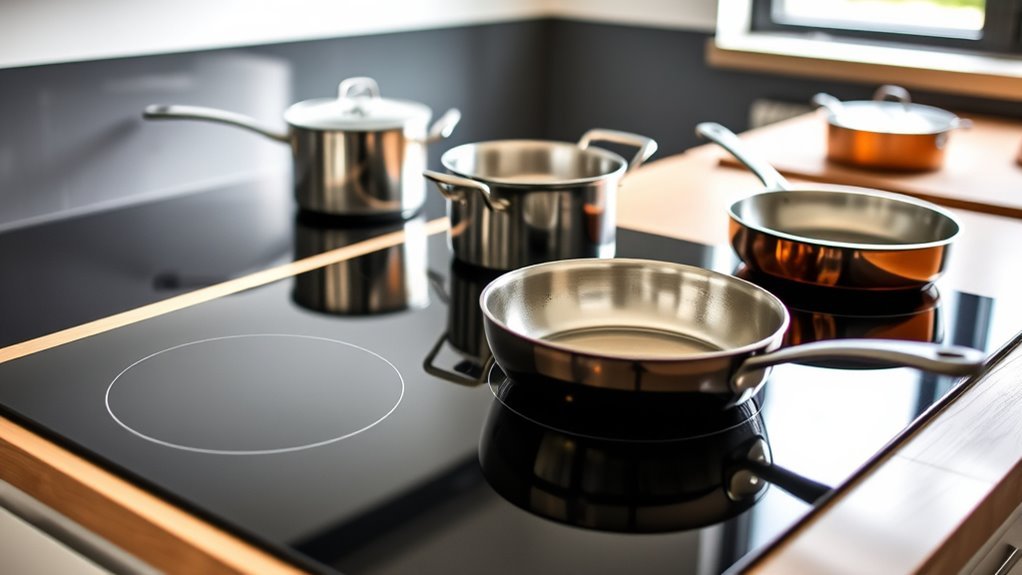
Induction cooking is a modern culinary technique that utilizes electromagnetic energy to directly heat compatible cookware, allowing you to achieve rapid and precise temperature control.
A copper coil beneath the cooktop generates a magnetic field that interacts with cookware made from magnetic materials like cast iron and certain stainless steels. This interaction causes the cookware to heat up, while the cooktop surface remains cool, enhancing safety.
To verify compatibility, you’ll need to perform a magnet test on your cookware. For peak performance, flat-bottomed pots and pans are necessary, as they guarantee efficient heat transfer and even cooking.
To ensure optimal performance, check your cookware with a magnet test and use flat-bottomed pots for even heating.
This technology not only provides precise temperature control but also cools down quickly after removing the cookware, making it a convenient option for any kitchen.
Embracing induction cooking empowers you to cook faster and with greater precision, elevating your culinary experience.
Why Choose Induction-Compatible Cookware?
Choosing cookware that’s compatible with induction cooking is crucial for maximizing the benefits of this innovative cooking method. Induction-compatible cookware leverages magnetic materials to generate heat directly within the pot or pan, promoting faster cooking times and enhanced energy efficiency.
Here’s why you should invest in it:
- Guarantees even heat distribution, preventing hot spots
- Offers precise temperature control for delicate dishes
- Enhances versatility with options like stainless steel and enameled cast iron
- Requires flat-bottomed cookware for ideal contact with the induction surface
- Provides high-quality performance for consistent cooking results
Types of Cookware That Work on Induction Cooktops
To use your induction cooktop effectively, you need cookware made from magnetic materials like cast iron or magnetic stainless steel.
Flat-bottomed pots and pans are essential for ideal heat transfer, ensuring even cooking.
Avoid non-magnetic materials, as they won’t heat on induction surfaces.
Magnetic Material Requirements
What types of materials are essential for cookware to function effectively on induction cooktops? To guarantee compatibility, your cookware must be made from magnetic materials. Here are key options to evaluate:
- Stainless steel: Look for options labeled as induction-ready.
- Enameled cast iron: Retains heat well and is magnetic.
- Carbon steel: Another viable magnetic choice.
- Cast iron: Classic and effective for induction cooking.
- Flat-bottomed cookware: Guarantees ideal contact with cooking surfaces.
To confirm compatibility, perform a simple magnet test; if the magnet sticks to the base, your cookware is suitable for induction cooking.
Avoid non-magnetic materials like pure aluminum, glass, and ceramic, as they won’t generate heat effectively.
Ideal Cookware Shapes
When selecting cookware for induction cooktops, the shape plays an essential role in guaranteeing efficient heat transfer. Flat-bottomed cookware is vital because it provides direct contact with the cooktop surface, maximizing induction compatibility and cooking performance. Magnetic materials like cast iron and magnetic stainless steel are the best options. Avoid curved cookware, such as traditional woks, as they disrupt the magnetic connection and lead to inconsistent heating.
| Cookware Type | Features |
|---|---|
| Flat-bottomed | Guarantees ideal heat transfer |
| Magnetic Stainless Steel | Compatible with induction cooktops |
| Cast Iron | Excellent heat retention and durability |
| Enameled Cast Iron | Non-reactive surface with induction compatibility |
Choosing the right shape enhances your cooking experience and efficiency.
Best Cookware Options
Choosing the right cookware for your induction cooktop can greatly impact your cooking efficiency and results. To guarantee peak performance, consider these best cookware options that are compatible with induction cooktops:
- Magnetic stainless steel: Durable and offers even heat distribution.
- Enameled cast iron: Excellent heat retention, perfect for slow cooking.
- Carbon steel: Lightweight yet effective for high-heat cooking.
- Nonstick cookware: Confirm it has a magnetic base for delicate foods.
- Flat-bottomed cookware: Essential for effective heat transfer and even cooking.
Before purchasing, perform a magnet test; if the magnet sticks to the base, it’s suitable for your induction cooking needs.
Choosing the right cookware can lead to liberated and efficient culinary experiences.
How to Test Your Induction Cookware for Compatibility?
To determine if your cookware is compatible with induction cooktops, you can perform a simple test using a magnet. If the magnet sticks firmly to the bottom, your cookware is likely induction-ready. Verify the cookware has a flat bottom; curved or warped bases can hinder effective heat transfer.
Check for manufacturer labels indicating “induction-compatible,” as not all stainless steel cookware is designed for induction. It’s wise to conduct the magnet test on individual pieces within a cookware set, since some items may not work even if the set is marketed as induction-friendly.
Here’s a quick reference:
| Cookware Type | Magnet Test Result | Induction Compatibility |
|---|---|---|
| Stainless Steel | Sticks | Induction-ready |
| Cast Iron | Sticks | Induction-ready |
| Pure Aluminum | Doesn’t stick | Non-magnetic cookware |
| Glass or Ceramic | Doesn’t stick | Non-magnetic cookware |
Testing verifies you’re using cookware that works with induction effectively.
What Cookware Materials Won’t Work on Induction?
Not all cookware materials work on induction cooktops, and it’s essential to know which ones won’t.
Non-magnetic options like pure aluminum, glass, and ceramic won’t generate heat, impacting your cooking efficiency.
To guarantee compatibility, always perform a magnet test on stainless steel and copper cookware before use.
Non-Magnetic Materials Overview
While many cookware materials excel on induction cooktops, non-magnetic options like pure aluminum, glass, ceramic, and non-magnetic copper fall short in generating heat.
These non-magnetic materials lack the necessary magnetic properties, resulting in ineffective cooking. When placed on an induction surface, they remain cold and may trigger an error, failing to activate the burner.
To guarantee effective cooking, remember these key points:
- Non-magnetic materials won’t heat up on induction.
- Aluminum cookware must have a magnetic base for compatibility.
- Glass and ceramic are unsuitable without modifications.
- Conduct a magnet test for cookware compatibility.
- Always choose induction-compatible pots and pans for ideal results.
Testing Cookware Compatibility
Understanding cookware compatibility is key for effective induction cooking. Certain materials won’t work on induction, including pure aluminum, glass, ceramic, and pure copper, as they lack the necessary magnetic properties.
Non-magnetic stainless steel cookware also fails the magnet test; if a magnet doesn’t stick, it’s unsuitable for induction. To guarantee your cookware is induction-ready, always perform a magnet test before use.
Additionally, induction cooktops require cookware with a flat bottom for ideal contact—curved or irregular shapes may not heat effectively.
While some non-magnetic materials can be modified with a magnetic base to work on induction, you must verify compatibility to avoid cooking frustrations.
Choose wisely to maximize your induction cooking experience.
Impact on Cooking Efficiency
When you choose cookware for induction cooking, it’s essential to recognize that certain materials simply won’t work, impacting your cooking efficiency. Non-magnetic cookware won’t generate heat on induction surfaces, leaving you with cold pans and unprepared meals.
Here are materials to avoid:
- Pure aluminum
- Glass
- Ceramic
- Non-magnetic stainless steel
- Any cookware lacking magnetic properties
Using these incompatible options doesn’t damage your induction cooktop, but it means you won’t achieve the desired heat.
To guarantee compatibility, perform a simple magnet test: if the magnet doesn’t stick, it’s not suitable for induction.
To enhance your cooking efficiency, opt for cookware with a ferromagnetic base, like enameled cast iron or magnetic stainless steel.
Key Tips for Choosing the Best Cookware for Induction Cooking
How do you guarantee your cookware is compatible with induction cooking? Start by choosing cookware made from magnetic materials like stainless steel, cast iron, or enameled cast iron.
Look for a magnetic stainless steel base; if a magnet sticks firmly, your cookware is suitable for an induction cooktop.
A simple magnet test can determine if your stainless steel cookware is induction-compatible. If it sticks, you’re good to go!
Verify your pots and pans have a flat bottom, maximizing contact with the cooking surface for even heat distribution.
Check for labels like “induction-ready” or a stamped coiled spring symbol on the bottom to confirm compatibility.
Avoid non-magnetic materials such as pure aluminum, glass, or copper, as they won’t heat effectively on induction cooktops.
Debunking Common Myths About Induction Cookware
While many people believe common misconceptions about induction cookware, it’s important to clarify these points for a better cooking experience.
Understanding these myths can help you make informed choices:
- Not all stainless steel pans are compatible. Only those with a magnetic base will work on induction cooktops.
- Induction cooking isn’t dangerous. The surface remains cool, reducing burn risks compared to gas or electric cooking.
- Induction cookware isn’t necessarily expensive. Affordable options exist, like magnetic stainless steel and enameled cast iron.
- You can’t use any pan. Only pans made from magnetic materials function properly on induction surfaces.
- Induction cooktops are easy to clean. Spills don’t bake onto the surface since it doesn’t get hot.
Top Recommended Induction Cookware
Selecting the right induction cookware is essential for maximizing your cooking efficiency and achieving excellent results. For effective induction cooking, look for pieces with a magnetic base.
Enameled cast iron, like the Merten Storck 5.3 Quart Dutch Oven, is a top option due to its rapid heating and versatility, able to withstand oven temperatures up to 600°F.
Enameled cast iron, such as the Merten Storck Dutch Oven, excels in rapid heating and versatility, enduring temperatures up to 600°F.
Magnetic stainless steel collections, such as All-Clad’s D3 Stainless and Copper Core, offer multi-layered construction for ideal heat distribution and cookware compatibility.
If you prefer nonstick, several frying pans with a magnetic base are available, ensuring easy cleanup while remaining induction-ready.
Always perform a magnet test before purchasing; if the magnet sticks firmly, you’ve found a suitable piece for your induction cooktop.
With these best options, you’ll enjoy the benefits of induction cooking, ensuring delicious results every time.
Frequently Asked Questions
How Can I Tell if My Cookware Is Induction Compatible?
To tell if your cookware is induction compatible, perform a simple cookware testing with a magnet. If it sticks, you’ve got magnetic materials like stainless steel or cast iron.
Be cautious—some aluminum options aren’t compatible unless they’ve magnetic bases. Check cookware labels for induction readiness and verify the bottoms are flat for ideal heat distribution.
Don’t fall for induction myths; not all cookware labeled as induction-compatible is created equal.
What Type of Cookware Is Best for Cooking on an Induction Stove?
For the best cooking on an induction stove, choose cookware made from magnetic materials like cast iron or stainless steel.
These options provide excellent heat distribution and energy efficiency, enhancing your cooking techniques. Brands like All-Clad offer durable choices.
Maintain your cookware by cleaning it regularly to preserve its safety features and performance.
What Happens if You Use a Regular Pan on an Induction Stove?
Using a regular pan on an induction stove leads to lackluster cooking due to inadequate heat distribution.
Induction technology relies on magnetic properties, so if your pan’s design isn’t compatible, it won’t activate. This inefficiency disrupts cooking efficiency and increases energy consumption.
While it won’t damage the stove, you’ll face frustration and wasted time.
Always check cookware materials with a magnet to verify safety and effectiveness before cooking.
Which Cookware Is Compatible With Induction?
For induction cooking, you’ll need magnetic cookware materials like cast iron, enameled cast iron, and magnetic stainless steel. Brands like All-Clad and Our Place offer reliable options.
Confirm your cookware has a flat bottom for ideal heat distribution efficiency. Consider weight, as heavier pots can provide better stability.
Maintain your cookware by cleaning it regularly to preserve its energy efficiency ratings. Enjoy the benefits of faster cooking and precise temperature control with the right pots!
Conclusion
In the domain of induction cooking, choosing the right cookware is like selecting the perfect brush for a masterpiece. Magnetic materials, such as cast iron and stainless steel, dance effortlessly on induction surfaces, ensuring efficient heat transfer. By understanding compatibility and debunking myths, you can elevate your culinary creations to new heights. Embrace the power of induction-compatible cookware, and watch as your kitchen transforms into a symphony of precision and performance, delivering delectable dishes with every meal.