
Premium robotic lawn mowers are moving beyond simple automation, and the 2027 lineup reflects that shift. Models like the ECOVACS Goat series, DREAME’s AWD options, and YARBO’s heavy-duty system promise sharper navigation, better traction, and more flexible setup. Each one targets a different kind of yard, from compact lawns to uneven acreage. The real question is which features justify the premium, and that is where the comparison becomes more revealing.
ECOVACS Goat O1000 RTK Robot Lawn Mower
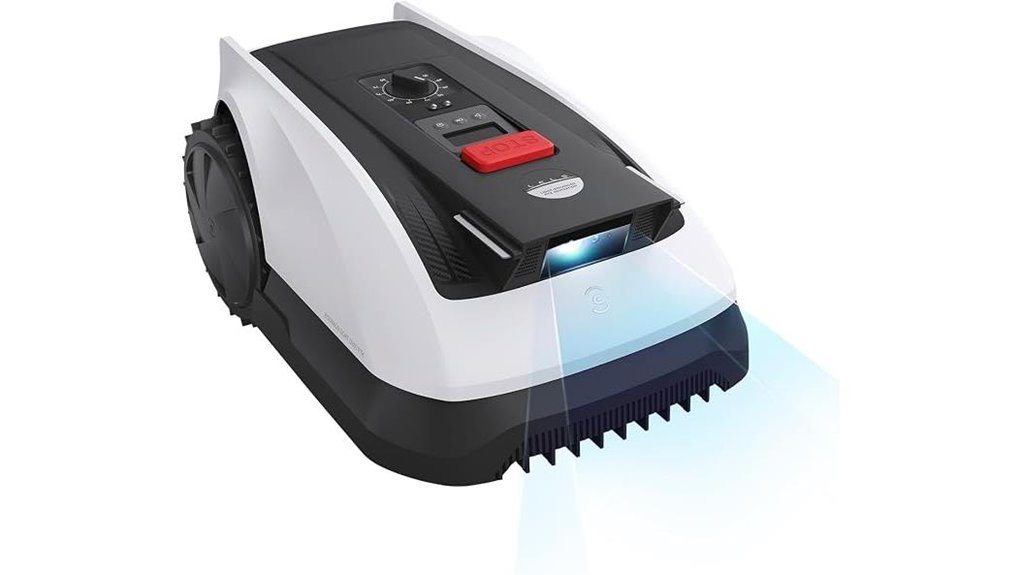
The ECOVACS Goat O1000 RTK Robot Lawn Mower stands out for homeowners who want a truly wire-free setup with precise, app-controlled mowing. It covers lawns up to one quarter acre and uses RTK, vision, and 3D ToF positioning for centimeter-level accuracy. Installation takes about five minutes because no boundary wire is needed. Intelligent route planning helps deliver even coverage and tidy patterns, while AIVI 3D detection avoids furniture, toys, pets, and trees. It also handles narrow passages and slopes up to 45%, with schedules, zones, and cutting height managed through the smartphone app.
Best For: Homeowners with up to a quarter-acre lawn who want a wire-free, app-controlled robot mower with precise navigation and automated mowing.
Pros:
- No boundary wire required, with setup in about five minutes
- RTK, vision, and 3D ToF provide centimeter-level positioning and neat mowing patterns
- AIVI 3D obstacle avoidance helps it navigate around furniture, toys, pets, and trees
Cons:
- Best suited for smaller lawns, up to 1/4 acre
- Average battery life of 65 minutes may require multiple sessions for larger mowing jobs
- Cutting width is relatively narrow at 8.66 inches, which can make mowing take longer
(Latest) DREAME LiDAR Robot Lawn Mower A3 AWD Pro 2500 Wire-Free,0.62 Acre
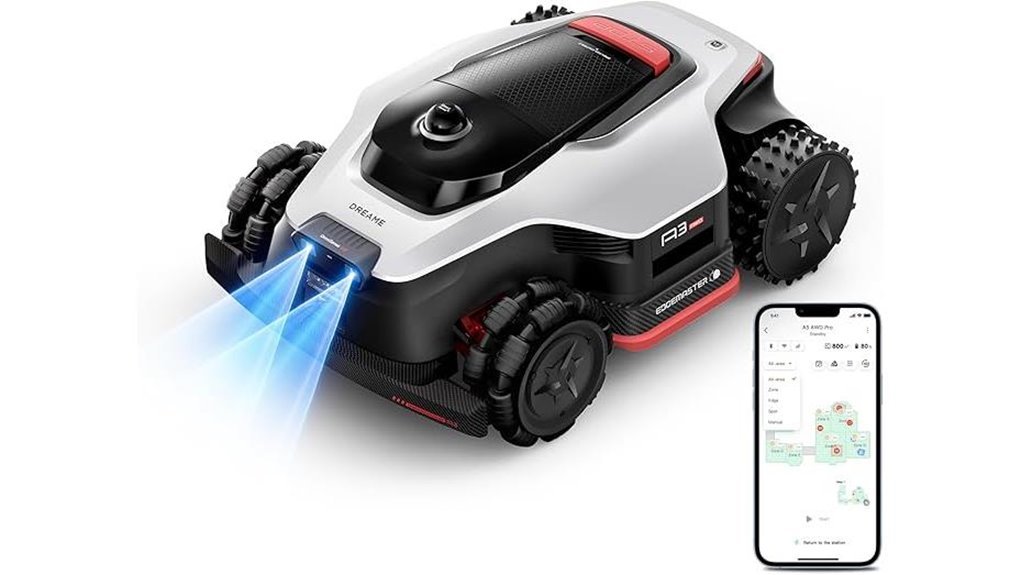
Built for challenging yards, the DREAME LiDAR Robot Lawn Mower A3 AWD Pro 2500 suits homeowners needing serious traction. Its 4WD hub motors manage slopes to 38.7 degrees, while heavy-duty wheels maintain grip in thick grass and wet conditions. A suspension system helps it cross roots, curbs, and 2.2-inch thresholds without trouble. OmniSense 3.0 pairs 360-degree LiDAR with binocular AI vision to map complex spaces, avoid 300-plus obstacles, and monitor up to 240 feet. Dual floating discs cut a 15.8-inch path, and the app controls height, boundaries, scheduling, and alerts.
Best For: Homeowners with challenging, uneven, or sloped yards who want a wire-free, high-traction robot mower with smart mapping and minimal hands-on maintenance.
Pros:
- True 4WD with strong slope handling up to 38.7° and reliable traction in thick or wet grass.
- OmniSense 3.0 LiDAR + AI vision helps navigate complex yards and avoid 300+ obstacles.
- App control makes it easy to manage mowing schedules, boundaries, cutting height, and alerts.
Cons:
- Premium features likely come with a higher price than basic robot mowers.
- Best suited for users who are comfortable relying on app-based setup and control.
- May be more than needed for small, flat, simple lawns.
ECOVACS Goat A2000 LiDAR PRO Robot Lawn Mower, Dual LiDAR Navigation
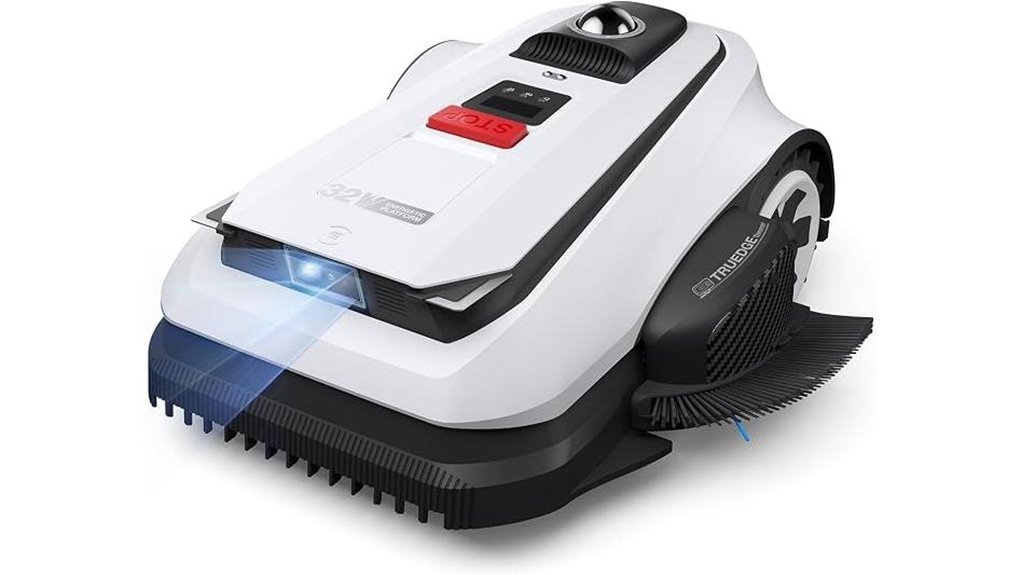
Dual LiDAR positioning makes the ECOVACS Goat A2000 LiDAR PRO ideal for precise, wire-free mowing. Its 2 cm navigation accuracy removes the need for perimeter wire or an RTK antenna, while automatic mapping simplifies setup on lawns up to half an acre. The integrated TruEdge trimmer supports clean edge cuts near driveways, sidewalks, and flower beds. A 32V motor and dual-blade disc handle thick grass, and the adjustable 1.2 to 3.6-inch cutting range adds flexibility. The 3.0Ah battery charges in about 50 minutes, while the app and AIVI 3D system manage zones and obstacles.
Best For: Homeowners with medium-sized lawns up to 1/2 acre who want a wire-free, app-controlled robot mower with precise LiDAR navigation and strong edge trimming.
Pros:
- Dual LiDAR provides highly accurate 2 cm navigation without needing a perimeter wire or RTK antenna.
- TruEdge trimming helps deliver cleaner cuts along driveways, sidewalks, and flower beds.
- Fast charging and smart app controls make setup and ongoing mowing convenient.
Cons:
- Best suited for lawns up to 1/2 acre, so it may not fit larger properties.
- Higher-end navigation and smart features likely come at a premium price.
- Cutting width is relatively narrow at 3.6 inches, which may mean longer mowing times on bigger yards.
YARBO Y40 Core Robot Lawn Mower Pro, Wire-Free, 6-Acres, Four-Season Care
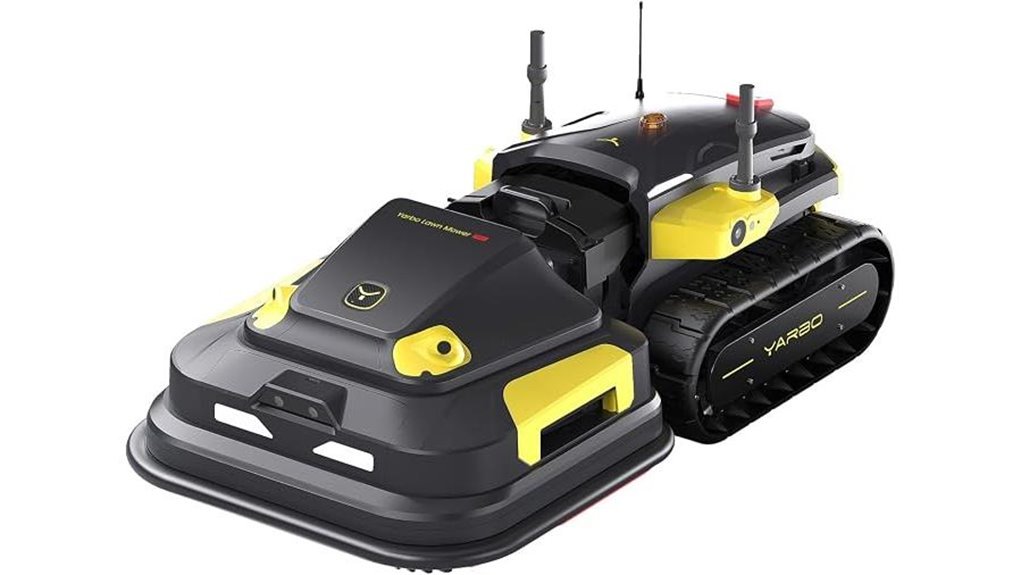
YARBO Y40 Core Robot Lawn Mower Pro suits large-property owners needing wire-free, all-season mowing. It covers up to 6 acres and targets homes, golf courses, turf farms, luxury hotels, and resorts. A 300W dual-motor system, razor and straight blades, and adjustable 0.8- to 4.0-inch cutting height support both cool-season and warm-season grass. Triple-fusion navigation combines RTK-GPS, binocular vision, and PPVS for accurate routing, while cameras and ultrasonic sensors help avoid obstacles. Patented tracks, steel skid shoes, and 70% climbing capability extend use on rough terrain.
Best For: Large-property owners, golf courses, turf farms, luxury hotels, and resorts that need a wire-free robot mower for up to 6 acres and varied terrain.
Pros:
- Wire-free setup with triple-fusion navigation for precise mowing paths
- Strong 300W dual-motor cutting system with adjustable 0.8- to 4.0-inch height
- Built for rough ground, with patented tracks and up to 70% climbing capability
Cons:
- Heavy unit at about 210 lbs, with assembly recommended for 2 adults
- Setup can be demanding and requires a 120° unobstructed sky view for the Data Center Set
- Remote control is sold separately, adding to overall cost
DREAME LiDAR 3500 Robot Lawn Mower A3 AWD Pro
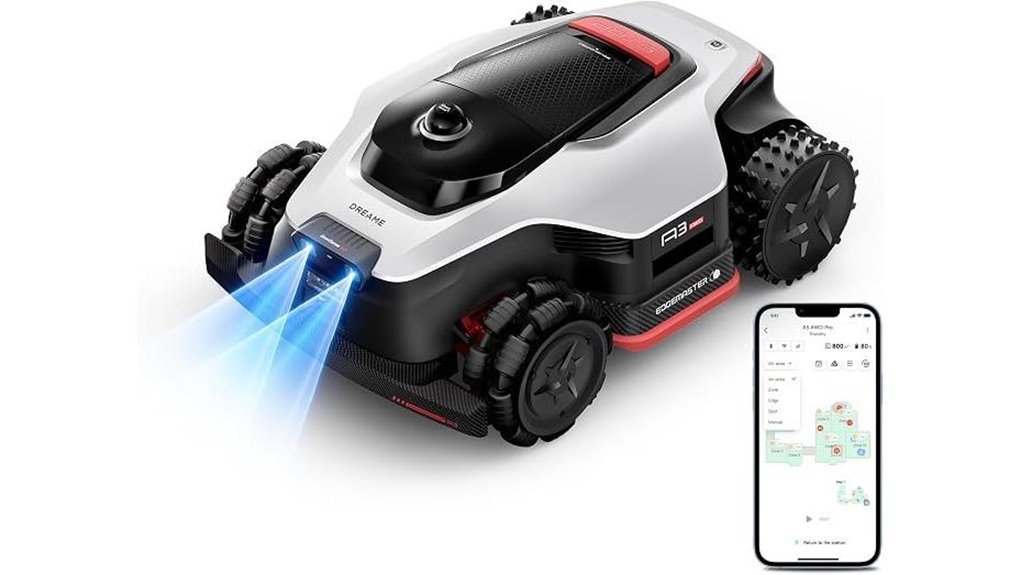
The DREAME LiDAR 3500 A3 AWD Pro suits homeowners with steep, uneven lawns. Its true 4WD hub motors climb slopes up to 38.7 degrees while off-road wheels improve grip in thick grass and damp ground. Dual floating cutting discs provide a 15.8-inch cut, and rush mode can cover 8,611 square feet per hour. OmniSense 3.0 pairs 360-degree LiDAR with binocular AI vision for wire-free mapping and obstacle avoidance. The app supports virtual boundaries, 100 zones, and height changes from 1 to 4 inches. Quiet operation, 4G tracking, and durable metal construction add practical value.
Best For: Homeowners with steep, uneven, or obstacle-filled lawns who want a wire-free, app-controlled robot mower that can handle tough terrain with minimal effort.
Pros:
- True 4WD hub motors and off-road wheels provide strong traction and slope-climbing ability on challenging terrain.
- OmniSense 3.0 uses 360° LiDAR and binocular AI vision for fast mapping and real-time obstacle avoidance without perimeter wires.
- Quiet operation, 4G tracking, and durable metal construction make it convenient and reassuring for regular use.
Cons:
- Likely more expensive than basic robot mowers due to advanced navigation, 4WD hardware, and security features.
- Best suited for lawns that need rugged performance; may be more than necessary for small, simple yards.
- Setup and app configuration may be more involved than a standard push mower or simpler automated model.
Factors to Consider When Choosing Premium Robotic Lawn Mowers in 2026

When evaluating premium robotic lawn mowers in 2026, yard size coverage should match the full mowing area without frequent recharging. Navigation precision, terrain and slope handling, and obstacle avoidance also determine how reliably the mower performs in complex outdoor layouts. Cutting width and height settings further influence efficiency and the quality of the finished lawn.
Yard Size Coverage
Yard size is one of the most important factors in choosing a premium robotic lawn mower, since coverage capacity can range from compact models for lawns up to 1/4 acre to high-end units built for properties as large as 6 acres. Smaller yards often perform well with cutting widths of 8 to 16 inches, while wider decks of 15 inches or more can improve efficiency on expansive properties. Larger lawns also benefit from models built to handle slopes and uneven ground, helping maintain steady performance across varied terrain. Customizable mowing zones are valuable for properties with distinct sections, obstacles, or landscaped areas, because they allow coverage to match the yard’s layout more precisely. Matching capacity to acreage helps prevent underpowered operation and unnecessary mowing cycles.
Navigation Precision
Navigation precision has become a defining feature of premium robotic lawn mowers in 2026, with LiDAR and RTK positioning systems now delivering centimeter-level mapping and obstacle avoidance. Dual-LiDAR designs further strengthen spatial awareness, helping mowers read intricate layouts and respond to more than 300 obstacles in real time. Intelligent route adjustment reduces missed strips and supports consistent coverage across irregular lawns. Automated yard mapping removes the need for boundary wires, streamlining setup while preserving accuracy. Smart backup protection and long-range obstacle detection improve reliability during routine operation, allowing the mower to move smoothly through changing conditions. In premium models, precise navigation is not merely convenient; it is a core performance metric that directly shapes mowing quality, efficiency, and user confidence.
Terrain And Slopes
Terrain and slope capability have become major differentiators in premium robotic lawn mowers, especially on properties with uneven grades, damp sections, or mixed surface changes. High-end units now handle slopes up to 70% (35°), giving them enough grip for challenging lawns without frequent intervention. Specialized wheel patterns and suspension systems improve traction and help keep the mower steady on softer or irregular ground. This stability matters when grass is wet or the terrain shifts from flat areas to inclines. Adjustable cutting height, typically from 1 to 4 inches, also supports consistent results across different grass types and seasonal growth. A mower suited to the landscape reduces slip risk, preserves cutting quality, and allows more reliable autonomous operation across demanding outdoor conditions.
Obstacle Avoidance
Obstacle avoidance has become a defining feature of premium robotic lawn mowers in 2026, with advanced systems such as 3D LiDAR and binocular AI vision detecting and steering around hundreds of objects in real time. These multi-sensor platforms can recognize lawn furniture, pets, and uneven terrain, then adjust routes without interrupting the cut. Sophisticated planning algorithms help the mower minimize missed areas while moving efficiently through complex layouts. Reliable detection also supports navigation through narrow passages and across slopes, where precise movement matters most. By reducing contact with obstacles, these systems lower the chance of damage to the mower and nearby property. For buyers, strong obstacle avoidance translates into safer operation, less supervision, and greater long-term dependability in demanding yards.
Cutting Width Height
Cutting geometry plays a major role in how efficiently a premium robotic lawn mower handles a yard. Wider cutting widths, reaching up to 15.8 inches on some models, reduce the number of passes needed and speed coverage across larger lawns. Cutting height matters just as much. Adjustable ranges, often from 1.2 to 4 inches, let the mower match grass species, seasonal growth, and desired finish. Precise settings help prevent scalping and protect turf health. Dual-blade systems can improve efficiency and leave a cleaner cut, especially when paired with flexible height control. A simple adjustment mechanism also adds convenience, making it easier to respond to changing lawn conditions without compromising consistency or appearance.
App And Scheduling
App and scheduling features are now central to premium robotic lawn mowers, giving users app-based control over mowing times, cutting settings, and virtual boundaries from almost anywhere. These controls let owners set mowing routines, adjust cutting height, and track progress in real time without visiting the lawn. Well-designed scheduling is especially useful for automated mowing at quiet hours, such as night or early morning, reducing disruption while keeping grass consistently trimmed. Advanced apps also support no-go zones, allowing the mower to avoid gardens, play areas, and other sensitive spaces. In larger or more complex yards, multi-zone management helps assign separate schedules to different sections, matching distinct grass growth patterns and maintenance needs. Strong app performance can make premium models far easier to manage daily.
Battery And Runtime
Battery and runtime are major considerations when comparing premium robotic lawn mowers in 2026, especially after evaluating app controls and scheduling features. Premium models usually carry batteries from 3.0Ah to 5.0Ah, a range that directly affects how long each mowing session lasts and how efficiently the mower covers the lawn. High-end units often run 65 minutes to more than 120 minutes per charge, though performance depends on deck design and power demand. Fast charging can sharply reduce downtime, with some mowers reaching full capacity in under an hour. Adjustable cutting heights may increase energy use, shortening runtime. Battery chemistry also matters: lithium-ion packs are lighter, charge faster, and last longer than lead-acid alternatives, making them the preferred choice for premium performance.
Frequently Asked Questions
How Noisy Are Premium Robotic Lawn Mowers During Nighttime Operation?
Premium robotic lawn mowers are usually very quiet at night, often producing about 55 to 65 decibels, roughly comparable to a normal conversation. In detached terms, that level is low enough for many users to operate them without major disturbance, though sound can still be noticeable near bedrooms or open windows. Blade noise, wheel hum, and terrain can raise the perceived volume slightly, especially on hard or uneven surfaces.
Can These Mowers Handle Steep Slopes After Rain?
Yes, though not always with heroic dignity; wet grass can turn a slope into a tiny alpine soap opera. Premium robotic mowers often manage steep inclines after rain only if traction, wheel design, and slope limits align. Mud, slick turf, and softened ground reduce grip and may trigger slipping or shutdowns. Manufacturers usually advise caution, since even high-end models perform best on damp but not saturated, stable terrain.
Do Premium Models Support Multi-Zone Scheduling for Separate Lawns?
Yes, premium models often support multi-zone scheduling for separate lawns, allowing distinct mowing times, paths, and cutting preferences for each area. This is usually managed through a companion app or onboard mapping system. Some units can handle several zones connected by narrow passages, while others require manual setup. The feature is especially useful for properties with front and back lawns, or sections with different grass growth patterns and maintenance needs.
How Often Do Blades Need Replacement on Wire-Free Mowers?
Blade replacement on wire-free mowers usually falls between one and three months of regular use, though dulling can appear sooner on sandy, rocky, or heavily rooted lawns. The theory that wire-free navigation increases blade wear is partly true; it does not, by itself, wear blades faster, but premium cutting systems often run more frequently and cover irregular paths, which can raise replacement needs. Inspection every few weeks is prudent.
Are Premium Robotic Mowers Compatible With Smart Home Systems?
Yes, many premium robotic mowers are compatible with smart home systems. They often integrate with Alexa, Google Assistant, or Apple HomeKit through Wi‑Fi, Bluetooth, or dedicated apps, allowing scheduling, status checks, and voice control. Compatibility varies by brand and model, so support for specific platforms should be verified before purchase. Some advanced units also connect with home automation routines, weather services, and geofencing features for smoother operation.
Conclusion
Taken together, these premium robotic mowers suggest a clear trend: 2027’s best models are moving beyond simple automation toward highly adaptive, terrain-aware lawn care. The ECOVACS, DREAME, and YARBO options each appear designed to solve different challenges, from wire-free setup to steep or rough ground. That theory—that smarter navigation and stronger traction define the next generation of mowing—seems well supported by the lineup, making the future of lawn maintenance remarkably more capable.
