
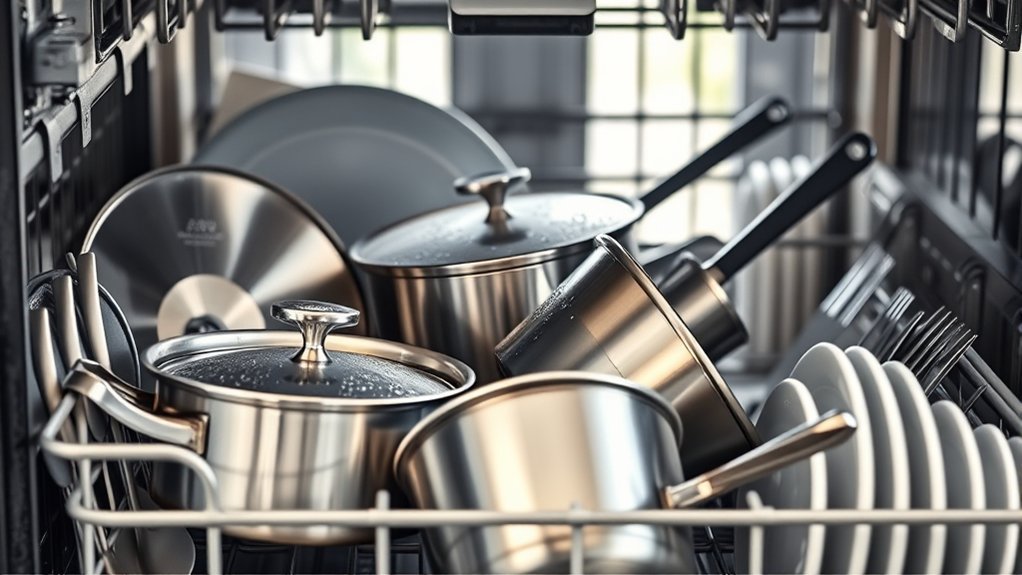
For current All-Clad fully bonded stainless steel cookware, hand washing is the safest default. All-Clad’s current collection comparison marks D3 Stainless, D5 Stainless, Copper Core, and G5 as not dishwasher safe. For routine care, let the pan cool, wash it with warm soapy water and a soft sponge or nylon pad, rinse thoroughly, and dry immediately. Exact instructions can vary by collection, so the product page or manual for your specific piece should always take priority.
Quick Answer
For current All-Clad fully bonded stainless cookware, hand washing is the safest choice. All-Clad currently marks D3, D5, Copper Core, and G5 as not dishwasher safe. Wash with warm soapy water and a soft sponge, rinse well, and dry immediately. Check your exact product page or manual because care instructions can vary by collection.
Key Takeaways
- Hand wash current All-Clad bonded stainless cookware unless the instructions for your exact product explicitly say otherwise.
- Let a hot pan cool before washing it to reduce the risk of thermal shock and warping.
- Use warm soapy water, a soft sponge or nylon pad, and immediate drying for routine cleaning.
- Bar Keepers Friend, Bon Ami, baking soda, or diluted white vinegar can address specific stainless-steel stains.
- Metal utensils are permitted on fully bonded stainless surfaces, although they may leave superficial marks; avoid them on nonstick surfaces.
- If a dishwasher-washed pan develops a sharp rim, exposed layers, or visible separation, stop using it and contact All-Clad for evaluation.
At a Glance
| Time Required | About 5–15 minutes for routine cleaning; longer for burned-on residue |
| Difficulty | Easy |
| Tools Needed | Mild dish soap, soft sponge or nylon pad, warm water, and a soft towel |
| Cost | Usually no additional cost if normal dishwashing supplies are already available; optional stainless-steel cleaner costs extra |
Is All-Clad Stainless Steel Dishwasher Safe?
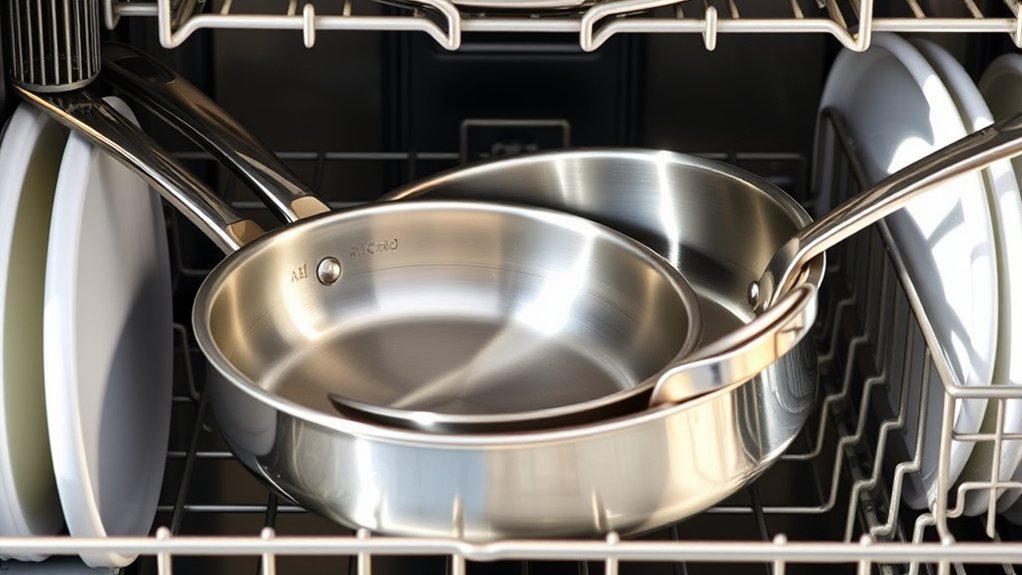
For current fully bonded stainless collections, the safest answer is no—use hand washing as the default. All-Clad’s current cookware collection comparison lists D3 Stainless, D5 Stainless, Copper Core, and G5 Graphite as not dishwasher safe.
For current All-Clad bonded stainless cookware, hand washing is the most reliable way to follow the manufacturer’s care guidance and preserve the finish.
All-Clad’s customer-service guidance recommends washing cookware by hand with mild soap or detergent and a sponge instead of putting it in the dishwasher. Its stainless-steel care instructions also recommend allowing the pan to cool, washing it in warm soapy water, rinsing it, and drying immediately.
Note: All-Clad has published different dishwasher wording on different product and support pages over time. If the wording on a general FAQ conflicts with the manual or care instructions for your exact pan, follow the instructions for that specific product. Hand washing is the conservative choice for bonded stainless cookware.
Older retailer listings and product descriptions may still use dishwasher-safe language. That history is one reason the topic remains confusing. Current care information should take priority over an old listing, cached page, or secondhand product description.
What Dishwasher Cycles Do to All-Clad
Dishwashers expose cookware to hot water, long wash cycles, strong detergents, and extended wet conditions. All-Clad currently warns that dishwasher heat and harsh detergents can affect cookware surfaces, which is why the company recommends hand washing for its bonded stainless collections.
There is also a specific historical concern involving certain multi-ply cookware. Litigation involving All-Clad’s D3, D5, and discontinued LTD collections alleged that repeated dishwasher cleaning could deteriorate metal layers at the rim and leave thin or sharp stainless-steel edges. A federal court approved a settlement concerning those claims in 2023.
That history should not be rewritten as a claim that every All-Clad pan will develop sharp edges. It concerned particular cookware and dishwasher-safe marketing that existed during an earlier period. The practical lesson for current owners is simpler: follow today’s collection-specific care instructions and inspect older dishwasher-washed cookware if its rim feels rough, thin, or sharp.
Warning: If the rim of a pan feels sharp, develops exposed layers, or shows visible metal separation, stop using the cookware until it has been evaluated. Do not continue handling a sharp rim during cooking or cleaning.
How to Wash All-Clad Stainless Steel by Hand
All-Clad stainless steel is straightforward to clean by hand. The key is to let the pan cool first, use gentle tools, and match the cleaning method to the type of residue.
- Let the pan cool before putting it in water.
- Rinse away loose food with warm water.
- Soak briefly in warm, soapy water if food is stuck.
- Wash with a soft sponge or cloth. A nylon scouring pad can be used for more difficult stainless-steel cleanup.
- Rinse thoroughly with warm water.
- Dry immediately with a soft towel to reduce spotting.
Hand Washing Basics
A gentle hand wash is the best routine for keeping bonded stainless cookware clean without unnecessary surface wear. All-Clad recommends warm soapy water, a sponge or soft cloth, and immediate drying.
- Let hot cookware cool before washing.
- Use mild dish soap for normal food residue.
- Use a nylon pad only when extra scrubbing is needed on stainless steel.
- Avoid steel wool, steel scouring pads, oven cleaner, bleach, and harsh detergents.
- Dry the cookware promptly after rinsing.
Pro Tip: Do not put a very hot stainless-steel pan directly under cold water. Letting it cool naturally reduces thermal shock and the risk of warping.
Removing Stubborn Stains
For tougher food residue, All-Clad recommends a non-chlorine stainless-steel cleaner such as Bar Keepers Friend, Bon Ami, or All-Clad cookware cleaner. Mix the cleaner with a little water to make a paste, apply it with a soft cloth or sponge, rub gently, rinse, and dry.
For burned food, All-Clad recommends adding baking soda and water and bringing the mixture to a boil. A wooden spoon can then be used to loosen the softened residue.
If food remains stuck, repeat the gentle process rather than switching to steel wool or aggressive scraping. The goal is to loosen the buildup without damaging the finish.
How to Remove Stains From All-Clad Stainless Steel
Different stainless-steel marks respond better to different treatments. Identifying the stain first usually produces a better result than scrubbing harder.
| Stain or residue | Recommended approach |
|---|---|
| Blue or rainbow discoloration | Wipe with white vinegar using a soft sponge or cloth, then rinse and dry. |
| Cloudy white hard-water spots | Use a 1:1 white-vinegar-and-water solution; All-Clad recommends boiling the solution for stubborn mineral deposits. |
| Burned-on food | Add baking soda and water, bring it to a boil, and loosen the residue carefully with a wooden spoon. |
| Stubborn grease or protein marks | Use an approved stainless-steel cleaner such as Bar Keepers Friend or Bon Ami with a soft sponge or cloth. |
Non-chlorine stainless-steel cleaners, diluted vinegar, and baking soda each solve different cleaning problems; aggressive scrubbing is usually unnecessary.
After any stain treatment, rinse the cookware thoroughly and dry it immediately. Avoid oven cleaners, chlorine bleach, steel wool, and steel scouring pads.
What Utensils and Heat Levels Are Safe?
Fully bonded All-Clad stainless steel is more tolerant of utensils than the original article suggested. According to All-Clad, metal, silicone, nylon, plastic, and wooden utensils can all be used on its bonded stainless collections. Metal tools may leave superficial marks, but those marks do not affect cooking performance.
That rule changes for nonstick cookware. On All-Clad nonstick surfaces, nylon, silicone, plastic, or wooden utensils are the safer choices because metal tools can scratch or damage the coating.
Safe Utensil Choices
- Bonded stainless steel: metal, silicone, nylon, plastic, and wood are permitted.
- For fewer cosmetic marks: silicone, nylon, plastic, and wood are gentler choices.
- Nonstick cookware: avoid metal or sharp utensils.
- Cleaning: nylon scrubbing pads are acceptable on stainless-steel surfaces, but steel wool and steel scouring pads are not.
- After cooking: allow the cookware to cool before washing.
Recommended Heat Levels
All-Clad recommends low to moderate stovetop heat for most cooking with bonded stainless steel. High heat is normally reserved for boiling liquids. Oven limits are a separate issue: current D3, D5, G5, and Copper Core cookware is rated up to 600°F.
| Heat level | Typical use | Important note |
|---|---|---|
| Low to moderate stovetop heat | Preheating, sautéing, browning, searing, simmering | Preferred for most cooking |
| High stovetop heat | Boiling liquids | Avoid prolonged overheating of an empty pan |
| Oven up to 600°F | D3, D5, G5, and Copper Core stainless collections | Extended exposure above 500°F may discolor stainless steel without affecting performance |
Overheating an empty pan can cause brown or blue staining and can damage cookware. When cooking on stainless steel, use controlled heat and allow food to release naturally before trying to turn it.
How to Care for All-Clad Lids and Bakeware
Lid and bakeware limits depend on the material, so the original 350°F blanket limit is not correct. All-Clad currently states that stainless-steel lids are oven safe up to 600°F, while glass lids are limited to 350°F.
Bakeware also varies by collection. All-Clad’s current Pro-Release bakeware is rated to 450°F and should be hand washed with soap and water to preserve the nonstick surface. Current stainless-steel bakeware is oven and broiler safe up to 600°F and should be cleaned with warm water, dish soap, and a sponge or soft cloth.
- Let lids and bakeware cool before washing.
- Check whether the lid is stainless steel or glass before using high oven temperatures.
- Hand wash Pro-Release bakeware to protect its nonstick surface.
- Avoid abrasive cleaners and aggressive scouring on coated bakeware.
- Dry stainless bakeware promptly after rinsing to reduce spotting.
Because All-Clad sells several cookware and bakeware materials, always confirm the limit for the exact piece rather than assuming one temperature applies to every lid or pan.
How to Store All-Clad Stainless Steel Without Scratches
After cleaning and drying, All-Clad stainless steel should be stored so polished surfaces are not repeatedly rubbed against other cookware.
If pans must be stacked, place a pan protector, soft cloth, or other clean liner between them. Avoid putting especially heavy cookware on top of lightweight pieces where it could create unnecessary pressure on handles, rims, or lids.
When stacking cookware, a soft separator between pieces is an easy way to reduce cosmetic scratching.
Keep cookware dry before it goes into a cabinet. Store pieces so they are easy to lift without dragging one pan across another, and periodically inspect frequently used cookware for new scratches, rim damage, loosened handles, or other changes.
Small cosmetic scratches on stainless steel normally do not prevent cooking, but sharp edges, visible layer separation, or structural damage deserve closer attention.
What the All-Clad Warranty Covers
All-Clad’s current cookware warranty is a limited lifetime warranty. For qualifying cookware purchased by the original purchaser from All-Clad or an authorized retailer in the U.S. or Canada, it covers defects in material, construction, or workmanship during the lifetime of the product when it is used normally and cared for according to the instructions.
Approved warranty claims can result in repair or replacement. A valid proof of purchase from All-Clad or an authorized retailer may be required.
- Covers qualifying defects in material, construction, or workmanship.
- Requires normal use and adherence to care instructions.
- Does not cover normal wear and tear.
- Does not cover ordinary stains, discoloration, or scratches.
- Does not cover damage caused by thermal shock, misuse, prolonged high heat on an empty pan, steel wool, scouring pads, abrasive cleaners, or bleach.
- Does not cover products purchased from unauthorized sellers where the published warranty exclusion applies.
Product registration can be useful for keeping ownership information organized, but the published cookware warranty places particular emphasis on proof of purchase and compliance with the care instructions. Keeping the receipt or other valid purchase documentation is therefore important.
Why All-Clad Dishwasher Claims Changed
All-Clad’s dishwasher messaging changed after litigation over earlier dishwasher-safe claims involving its D3, D5, and LTD multi-ply cookware.
The lawsuits alleged that cookware marketed as dishwasher safe could deteriorate after dishwasher cleaning and develop thin or sharp edges as bonded metal layers were affected. The cases were consolidated, and a federal court approved a class settlement in 2023.
The federal court opinion approving the settlement states that All-Clad completed packaging and labeling changes to remove dishwasher-safe representations from the relevant cookware marketing and worked with authorized retailers on corresponding changes.
This history helps explain why an older retailer page, box, review, or archived product description may conflict with current All-Clad guidance. For present-day care, the current manual or product page for the exact cookware is more useful than an older dishwasher-safe claim.
What to Do If You Already Washed All-Clad in the Dishwasher
One dishwasher cycle does not automatically mean a pan is unusable. Before using it again, clean and dry the cookware by hand and inspect it carefully.
- Run a finger carefully along the outside and inside of the rim without pressing hard.
- Look for unusually thin metal, exposed bonded layers, separation, cracks, or deformation.
- Check handles and rivets for movement.
- If the surface is smooth and the only issue is spotting or rainbow discoloration, use the normal stainless-steel cleaning methods described above.
- If the rim is sharp or the bonded construction appears to be separating, stop using the cookware and contact All-Clad customer service for an evaluation.
Note: The earlier class-action settlement concerned historical purchases and claims. Owners with a current cookware problem should use All-Clad’s present customer-service and warranty process rather than assuming an old settlement benefit is still available.
Frequently Asked Questions
Did All-Clad Have a Lawsuit About Their Dishwasher-Safe Cookware?
Yes. Class-action litigation involved D3, D5, and LTD cookware that had been marketed as dishwasher safe. Plaintiffs alleged dishwasher cleaning could deteriorate bonded layers and create sharp edges. A federal court approved a settlement in 2023, and the court record describes changes removing dishwasher-safe representations from the relevant marketing.
Why Shouldn’t You Put Stainless Steel Pots in the Dishwasher?
Stainless steel itself is not automatically incompatible with dishwashers, so the answer depends on the cookware’s construction and manufacturer instructions. For current All-Clad bonded stainless collections, hand washing is the safer choice because the company currently marks D3, D5, Copper Core, and G5 as not dishwasher safe and recommends hand washing for care.
What Brand Is Better Than All-Clad?
No cookware brand is universally better because materials and priorities differ. Cuisinart, Calphalon, Viking, and Fissler offer stainless-steel alternatives at different prices; Le Creuset and Lodge are well known for cast-iron cookware; T-fal and Scanpan emphasize nonstick options; and KitchenAid and Zojirushi cover broader kitchen categories. Compare construction, weight, heat response, maintenance, warranty, and budget rather than choosing by brand name alone.
How Do I Clean All-Clad Stainless Steel Cookware?
Let the pan cool, rinse away loose food, and wash it in warm soapy water with a soft sponge or cloth. Use a nylon pad for tougher stainless-steel residue. For stains, use an approved stainless cleaner, diluted white vinegar, or baking soda depending on the type of mark. Rinse thoroughly and dry immediately.
Is All-Clad D3 Dishwasher Safe?
All-Clad’s current cookware comparison marks D3 Stainless as not dishwasher safe. Hand wash D3 with warm soapy water, a soft sponge or nylon pad, and dry it promptly unless the instructions supplied with your specific product state otherwise.
Can You Use Metal Utensils on All-Clad Stainless Steel?
Yes. All-Clad says metal utensils are safe on its fully bonded stainless-steel cookware. They can leave superficial marks, so silicone, nylon, plastic, or wooden tools are better if cosmetic scratching is a concern. Do not apply the same rule to nonstick cookware, where metal utensils can damage the coating.
Conclusion
For current All-Clad bonded stainless cookware, hand washing is the safest and clearest recommendation. D3, D5, Copper Core, and G5 are currently listed by All-Clad as not dishwasher safe. Let the cookware cool, wash it with warm soapy water and a soft sponge or nylon pad, rinse thoroughly, and dry it immediately. Use white vinegar, baking soda, or an approved stainless-steel cleaner when ordinary washing does not remove stains. If older dishwasher-washed cookware develops a sharp rim, exposed layers, or visible separation, stop using it and contact All-Clad for evaluation.
Sources
- All-Clad Use & Care — stainless-steel cleaning, stain removal, heat limits, bakeware care, and thermal-shock guidance.
- All-Clad Cookware Collection Comparison — current dishwasher and oven ratings for D3, D5, Copper Core, G5, and other collections.
- All-Clad Customer Service FAQ — dishwasher recommendations, utensil guidance, lid temperature limits, and cleaning advice.
- All-Clad Warranty Information — limited lifetime warranty coverage and exclusions.
- U.S. District Court: In re All-Clad Metalcrafters Cookware Marketing and Sales Practices Litigation — historical dishwasher-safe litigation and settlement information.

2 thoughts on “Is All-Clad Stainless Steel Dishwasher Safe? Dishwasher Safety & Care Guide”