
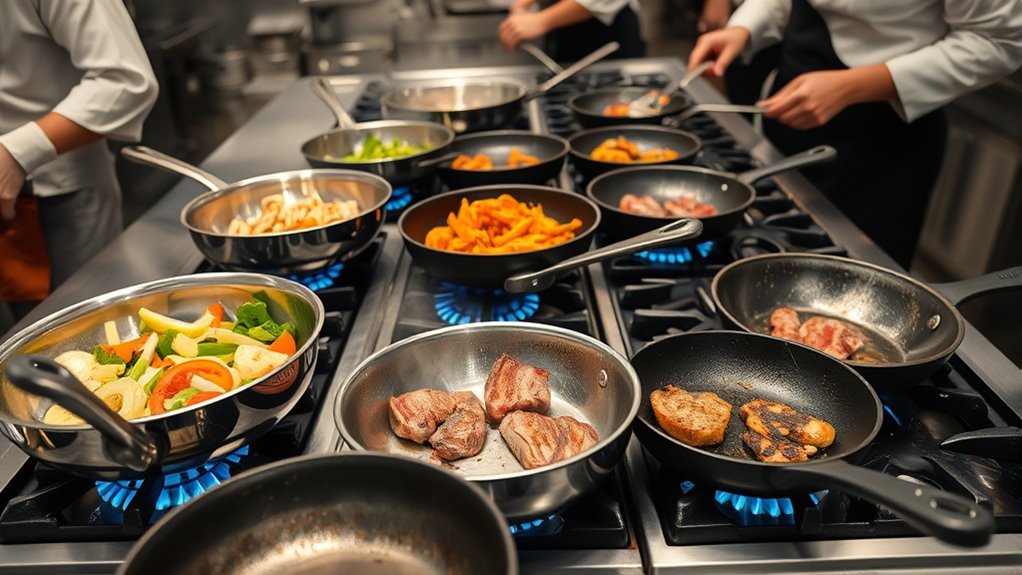
What pans do chefs use? Chefs mainly use five kinds of pans: aluminum or stainless-clad sauté pans for everyday cooking, carbon steel pans for hot searing, cast iron skillets for heavy browning, nonstick pans for eggs and fish, and rimmed half sheet pans for oven work. Each pan is chosen for one kind of job.
This page looks at pans only, pan by pan and task by task. For pots, bakeware and the wider kitchen, read our broader guide to what cookware chefs use.
Which Pan Do Chefs Reach For? Quick Answers
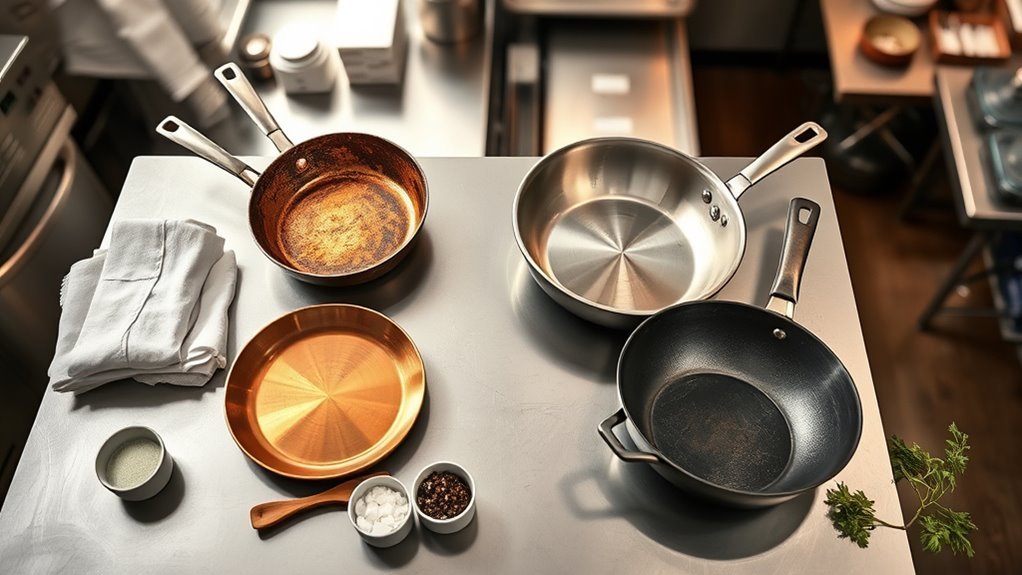
| Task | Pan chefs commonly choose |
|---|---|
| Everyday sautéing and pan sauces | Stainless-clad or aluminum sauté or fry pan |
| Hard sear on steak or fish | Carbon steel or cast iron |
| Eggs, omelets, crêpes | Nonstick or well-seasoned carbon steel |
| Stir-frying | Carbon steel wok or pan |
| Roasting vegetables, sheet-pan dinners | Aluminum half sheet pan |
| Braising and deep one-pot cooking | Enameled cast iron braiser or Dutch oven |
The Everyday Workhorse: Aluminum and Stainless-Clad Pans
The pans on a restaurant line are usually plain or anodized aluminum. Aluminum heats quickly, reacts fast when the heat changes, and is light enough to toss and shake all service. It is also inexpensive, so worn pans get replaced.
At home, a clad stainless pan is the closest equivalent. Layers of aluminum or copper inside stainless steel give fast heat, while the stainless surface does not react with tomatoes, wine or vinegar. It also lets you build a fond (the browned bits) for pan sauces. If food sticks, the usual fix is to preheat the pan, then add oil. Our guide on when a stainless steel pan is ready shows the water-bead test.
Carbon Steel: The Searing Specialist
Carbon steel is iron with a little carbon. It is lighter than cast iron and heats and cools faster. After seasoning, it builds a dark, slick surface that handles searing, stir-frying and eggs. It needs the same care as cast iron: dry it right after washing and rub on a thin coat of oil.
French makers such as de Buyer are well known for carbon steel pans, and many cooks consider them a good value for the performance. Avoid simmering acidic sauces in them for long, since that can strip the seasoning.
Cast Iron: Heat Storage for Deep Browning
Cast iron is heavy and slow to warm, but it holds heat so steadily that a cold steak does not drop the temperature much. Use it for steaks, fried chicken, cornbread and anything that goes from stovetop to oven. Learn more in how to care for a cast iron pan and what size cast iron skillet to buy.
Nonstick Pans for Delicate Foods
Chefs keep nonstick pans for foods that stick easily: eggs, crêpes, pancakes and flaky fish. Because the coating wears down, pros treat these pans as disposable. Use low to medium heat, skip metal utensils and replace the pan when the surface is scratched or flaking.
Gordon Ramsay promotes HexClad, a hybrid line that combines stainless steel and a nonstick surface. He is an equity partner in the company, so it is a business endorsement, not a survey of what chefs use.
Other Pans Chefs Rely On
- Sauté pan: Straight sides and a lid. Good for searing, then braising or reducing sauces in the same pan.
- Saucier: Curved bottom with no corners, ideal for whisking custards and sauces.
- Wok: Bowl-shaped carbon steel for high-heat stir-frying.
- Half sheet pan: A rimmed aluminum pan that measures 18 by 13 inches. It is used for roasting, baking and staging.
- Braiser: A wide, shallow, lidded pan for braises. See what a braiser is.
Which Pan Sizes Do Chefs Prefer?
Most cooks use pans in the 8 to 12 inch range. Eight inches suits an omelet, 10 inches suits one or two portions, and 12 inches suits larger cuts or batch searing without crowding. A pan measured as 10 inches is the diameter across the top rim, so the flat cooking surface is a little smaller. Crowded food steams instead of browning, so a bigger pan often gives better results.
How to Choose Like a Chef
- Match the pan to the job instead of buying one pan for everything.
- Check weight and handle comfort in the store or in the product details. A pan you can lift easily gets used more.
- Check your cooktop. For induction, the base must be magnetic. Use our induction-ready test.
- Check oven ratings. Handles and lids often have lower limits than the pan itself. Look for the manufacturer’s stated temperature.
- Buy fewer, better pans. Our pans you need guide shows a starter lineup.
Frequently Asked Questions
What pans do most chefs use?
Most chefs use aluminum or stainless-clad sauté pans for daily work, carbon steel or cast iron for searing, nonstick pans for eggs and fish, and aluminum half sheet pans for the oven. They choose a different pan for each task rather than one pan for everything.
What pans do Michelin star chefs use?
There is no single answer. Fine-dining kitchens use the same types as other professional kitchens, often including clad stainless, copper sauce pots, carbon steel and nonstick pans. What matters is that the pan suits the task, not a specific brand name.
What is the best pan for searing, according to chefs?
Carbon steel and cast iron are the usual picks for searing because they take high heat and hold it. A heavy stainless-clad pan also sears well when preheated properly and kept uncrowded.
Do chefs use nonstick pans?
Yes, but mostly for eggs, crêpes and delicate fish. Chefs avoid high heat and metal utensils with them and replace them when the coating wears, so they are usually seen as short-lived tools.
Conclusion
Chefs do not rely on one perfect pan. They keep a small set where each pan has a clear job: stainless or aluminum for daily cooking, carbon steel or cast iron for searing, nonstick for eggs and a sheet pan for the oven.
