
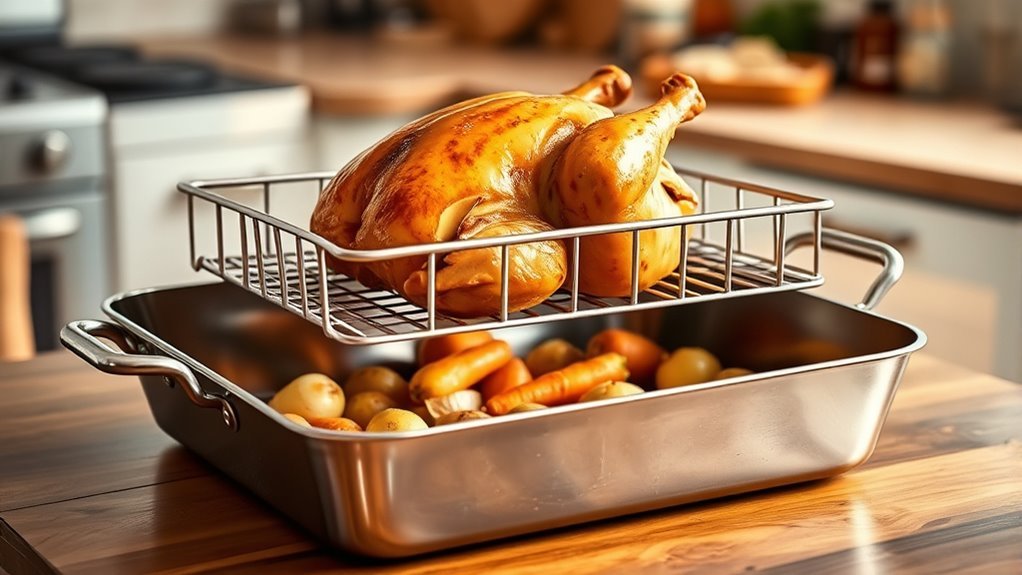
A roasting rack is a simple kitchen tool that can make a noticeable difference when cooking chicken, turkey, beef, or pork. It lifts food above the roasting pan, helping hot air reach more of its surface while keeping the meat out of collected drippings. Knowing when and how to use one can help you get better browning, easier cleanup, and more consistent results.
Quick Answer
A roasting rack is an oven-safe support placed inside a roasting pan to hold food above the bottom. It improves air circulation, keeps meat away from pooled fat and juices, and encourages more even browning. Flat racks suit many foods, while V-shaped racks help support whole poultry and larger roasts.
Key Takeaways
- A roasting rack is most useful for poultry and large cuts of meat that benefit from airflow underneath.
- Measure your pan before buying a rack, and check the rack’s oven-temperature limit separately from the pan’s.
- For deeper browning, many vegetables cook better directly on a baking sheet.
- An oven-safe cooling rack, sturdy vegetables, or folded aluminum foil can work as a temporary substitute.
- A roasting rack does not replace a food thermometer or proper cooking temperatures.
What Is a Roasting Rack and Why Is It Important?
)
A roasting rack is a raised metal or heat-resistant support that sits inside a roasting pan. Its main purpose is to hold food above the pan so heat can circulate underneath and cooking juices can collect below.
Without a rack, the bottom of a large roast may sit directly in hot fat and liquid. That contact can soften the surface and limit browning.
According to Williams Sonoma’s guide to essential roasting equipment, a roasting rack helps prevent meat from sitting in its drippings. It also allows more surface browning and makes collecting juices for gravy easier.
Most traditional roasting racks are made from stainless steel, coated steel, or other oven-safe materials. They usually have open spaces between their bars, allowing fat and juices to pass through.
You can use a roasting rack for:
- Whole poultry: Support chickens, turkeys, and ducks during roasting.
- Large meat cuts: Keep beef, lamb, and pork roasts above the collected juices.
- Smaller foods: Cook chicken pieces or other foods that benefit from airflow, provided the rack supports them securely.
- Other kitchen tasks: Cool baked goods or dry washed produce on a clean, suitable rack.
Many racks are removable, lightweight, and compact enough for ordinary kitchen storage. Some adjustable models also fold flat.
How Does a Roasting Rack Enhance Cooking?
A roasting rack improves cooking by exposing more of the food to circulating oven heat. It also separates meat from the fat and moisture collecting in the roasting pan.
This can improve browning, reduce soggy spots, and make the finished roast easier to remove. However, the rack alone does not guarantee perfectly cooked or juicy meat.
Better Air Circulation and Browning
When meat sits directly on a pan, the contact area receives less circulating hot air. Raising the meat allows more of its surface to cook through dry oven heat.
This is especially helpful when roasting poultry with skin. A rack can encourage browning underneath the bird as well as on top.
Separation From Fat and Juices
As meat cooks, some of its fat melts and drips into the pan. A rack keeps the roast above much of that liquid.
This may reduce the amount of rendered fat that remains in contact with the food. However, it does not remove all the fat inside the meat.
Easier Gravy Preparation
Roasting racks also make it easier to collect pan drippings. Those juices can form the base of flavorful gravy or pan sauce.
After roasting, remove the meat and rack, then separate excess fat from the collected juices before preparing your sauce.
A roasting rack improves airflow and helps prevent soggy undersides, but temperature control and proper cooking technique still determine the final result.
How to Use a Roasting Rack in the Oven
Using a roasting rack is straightforward. You need an oven-safe rack, a compatible roasting pan, your prepared food, and a food thermometer for meat or poultry.
- Check the equipment. Confirm that your rack and pan can withstand the temperature required by your recipe.
- Position the rack. Place it securely inside the roasting pan with its feet resting evenly on the bottom.
- Prepare the food. Season the meat and dry its surface if your recipe calls for crisp skin or better browning.
- Place the food on the rack. Center the roast so its weight is supported and it does not tip or slide.
- Roast in the oven. Follow an appropriate recipe and use a thermometer to monitor internal temperature.
- Remove and rest the meat. Use oven mitts and a secure lifting method. Follow the appropriate resting guidance before carving.
Warning: A roasting rack does not make undercooked meat safe. FoodSafety.gov recommends roasting meat and poultry at an oven temperature of at least 325°F (163°C). Whole poultry must reach 165°F (74°C). Whole cuts of beef, pork, lamb, and veal require a minimum internal temperature of 145°F (63°C), followed by a three-minute rest. Always use a food thermometer.
These temperatures come from the US government’s meat and poultry roasting charts. Check the thickest appropriate part of the food, avoiding bones when measuring temperature.
What Should You Look for in a Roasting Rack?
The best roasting rack for your kitchen should fit your pan, support your food securely, and tolerate your cooking temperature. Material, shape, wire spacing, and cleaning requirements also matter.
Start by choosing between the most common rack designs.
Flat vs. V-Shaped Roasting Racks
Flat racks provide a level surface. They work well for smaller cuts of meat, chicken pieces, and foods that sit securely without additional support.
V-shaped racks have sloped sides that cradle whole poultry and rounded roasts. They help keep large foods centered while allowing juices to drip into the pan.
Adjustable racks can change shape or position to accommodate different foods. Some also fold down for storage.
If you often roast whole chickens or turkeys, a sturdy V-shaped rack may be more convenient. A flat rack offers greater flexibility for smaller foods and everyday cooking.
Choose a Durable Material
Heavy-duty stainless steel is a practical option because it resists corrosion and has no nonstick coating to wear away. A well-built rack should remain stable under the weight of your food.
A nonstick finish can make food release and cleanup easier, but it is not essential. Coated racks require gentler cleaning and may have lower oven-temperature limits than uncoated steel.
For example, the manufacturer’s roasting pan temperature guide lists certain nonstick roasting racks as oven-safe up to 375°F, even though some matching pans have higher temperature limits.
Always follow the lower temperature limit when using a pan and rack together.
Check Dimensions and Pan Compatibility
A roasting rack must fit securely inside your pan without pressing against its walls. Measure the usable interior length and width of the pan, rather than relying only on its advertised capacity.
A classic small roasting rack may be listed at 10.25 x 2.5 x 7.5 inches for a 3.25-quart roasting pan. These original product-specific measurements need confirmation and should not be treated as a universal size.
Also consider:
- Weight capacity: The rack must support the roast without bending or tipping.
- Clearance: Leave enough space for drippings to collect below the food.
- Handles: Sturdy lifting handles can make removing a roast easier.
- Wire spacing: Narrow gaps provide better support for smaller foods.
- Cleaning: Removable racks are easier to wash than fixed designs.
Check that the entire pan-and-rack setup fits inside your oven. This includes the height of a large roast and clearance beneath the upper heating element.
Are Roasting Racks Compatible With Different Ovens?
Many roasting racks can be used in conventional gas and electric ovens. Some may also work in compatible halogen ovens or countertop roasters.
Compatibility depends on the rack’s material, dimensions, temperature rating, and the appliance manufacturer’s instructions. Never assume every metal rack is suitable for every cooking appliance.
What Are Creative Ways to Use a Roasting Rack?
A roasting rack can do more than support a Sunday roast. Its raised design also makes it useful for cooling baked foods, preparing vegetables, and keeping moisture away from certain ingredients.
However, the best use depends on whether your food needs airflow or direct contact with a hot pan.
Roast Vegetables With More Airflow
Some vegetables benefit from being raised above moisture, especially when you want a drier exterior. Firm vegetables and larger pieces are generally easier to support on a rack than small, delicate ingredients.
For stronger browning and caramelization, however, vegetables often perform better directly on a baking sheet. This gives them contact with the hot metal surface.
Tufts University’s vegetable-roasting guidance recommends spreading vegetables in a single layer and avoiding crowding, which can cause steaming instead of browning.
Use Vegetables as a Natural Rack
Sturdy vegetables such as carrots, potatoes, onions, and celery can support a roast when you do not have a traditional rack.
Place thick pieces across the bottom of the pan, then rest the meat on top. The vegetables help keep the roast above some of the collected juices while adding flavor to the drippings.
This approach is useful for smaller roasts, but make sure the vegetable base is stable enough to support the food.
A roasting rack keeps food above moisture, while a vegetable base provides support and adds flavor to the pan drippings.
Cool Baked Goods
A clean roasting rack can double as a cooling rack for cookies, cakes, bread, and pastries.
The open spaces let air circulate underneath, helping moisture escape instead of collecting against the bottom of the baked food.
Place the rack on a stable, heat-safe surface and make sure its wires provide enough support for delicate items.
Dry Herbs and Fresh Produce
You can also use a clean rack to air-dry freshly washed herbs and produce.
Spread the items out so air can reach their surfaces. For small herbs, place them on a clean, breathable support that prevents leaves from falling through the wires.
This is useful for removing surface water before storage or cooking. It is not a substitute for a proper food-dehydration method when long-term preservation is the goal.
Do You Need a Roasting Rack for Every Dish?
No, a roasting rack is helpful for many meat and poultry dishes, but it is not essential for every oven recipe. Whether you need one depends on the cooking method and the texture you want.
Use these simple guidelines:
- Whole turkey or chicken: A rack helps support the bird and keeps it above pooled juices.
- Beef or pork roast: A rack is useful when you want more exposed surface area and easier access to drippings.
- Roasted vegetables: A baking sheet without a rack often works better for direct-contact browning.
- Casseroles and braised dishes: A rack is usually unnecessary because the ingredients cook in liquid or sauce.
- Small cuts of meat: A rack is optional if the food can cook evenly using a suitable pan.
A rack can allow some fat to drain from meat, but it does not remove a predictable percentage of total fat. The original claim that a roasting rack can reduce fat content by up to 30% could not be verified as a general result.
For everyday cooking, focus on the rack’s practical benefits: airflow, browning, food support, and easier handling.
Maintenance Tips for Your Roasting Rack
Regular cleaning helps a roasting rack remain safe, sturdy, and easy to use. The right cleaning method depends on whether the rack is bare stainless steel or has a protective coating.
Follow these basic maintenance practices:
| Tip | Action | Benefit |
|---|---|---|
| Clean After Use | Let cool, then wash with warm, soapy water | Removes grease and food residue |
| Inspect Regularly | Check for warping, loose joints, or coating damage | Helps maintain safe, stable support |
| Store Properly | Dry thoroughly and keep in a dry place | Helps prevent rust and surface damage |
How to Clean a Roasting Rack
Allow the roasting rack to cool before handling or washing it. Then follow these steps:
- Remove any loose food particles or excess grease.
- Soak the rack in warm, soapy water if food residue is stuck between the wires.
- Use a soft sponge or brush to clean the top, bottom, and joints.
- Rinse thoroughly and dry before storing.
Avoid harsh cleaners and abrasive tools on nonstick-coated racks because they can damage the finish.
Some roasting racks are dishwasher-safe, while others require hand washing. Follow the manufacturer’s care instructions rather than assuming every rack can go in the dishwasher.
How to Prevent Damage
Inspect your roasting rack before each use. Look for loose welds, bent supports, rust, or peeling nonstick coating.
A damaged rack may not safely hold a heavy roast. Replace it if its structure becomes unstable or its food-contact coating is badly damaged.
When storing the rack, avoid placing heavy cookware directly on delicate wires or coated surfaces.
Frequently Asked Questions
What Do I Use if I Don’t Have a Roasting Rack?
If you do not have a roasting rack, use an oven-safe cooling rack that fits securely inside a roasting pan. You can also arrange sturdy vegetables or tightly crumpled aluminum foil beneath the meat. These alternatives help lift food above some of the collected juices. Make sure the support is stable and suitable for your oven temperature.
What Is the Best Roasting Rack?
The best roasting rack is a sturdy, oven-safe model that fits your pan and supports the food you usually cook. Stainless steel is a durable choice, while a nonstick finish can simplify food release. Choose a V-shaped rack for whole poultry or a flat rack for more flexible everyday use. Check the temperature rating and cleaning instructions before buying.
How to Create a Roasting Rack?
You can create a temporary roasting rack by shaping heavy-duty aluminum foil into sturdy coils or balls and arranging them beneath the meat. Another option is to use thick pieces of carrots, potatoes, or onions as supports. Place everything inside an oven-safe pan that catches drippings. Test the arrangement for stability before putting it in the oven.
What Is a Roasting Rack Called?
A roasting rack may also be called a roasting pan rack, meat rack, cooking rack, or roasting trivet. Specific styles include flat racks, V-shaped racks, and adjustable roasting racks. An oven-safe wire cooling rack can sometimes serve the same purpose. However, a roasting rack is different from the larger oven shelf that supports pans inside the oven.
Conclusion
A roasting rack is a practical tool for cooking meat and poultry with better airflow and less contact with pooled juices. Choose a rack that fits your pan, supports your food, and meets your oven’s temperature requirements.
Whether you use a flat rack, a V-shaped model, or a safe substitute, the goal is the same: support your food securely and help it cook evenly. For your next roast, combine the right rack with a suitable pan and a reliable food thermometer.
Sources
- Williams Sonoma: Essential Roasting Equipment: Supports the benefits of raising meat above pan drippings and improving browning.
- FoodSafety.gov: Meat and Poultry Roasting Charts: Provides safe minimum internal temperatures, roasting guidance, and resting requirements.
- All-Clad: Roasting Pans and Racks: Documents rack materials, designs, and model-specific oven-temperature limits.
- Tufts University: Roasting Veggies: Explains vegetable browning, pan contact, and the effects of overcrowding.
- Nordic Ware: Cooling Racks: Explains dual-purpose oven-safe racks, pan compatibility, and proper cleaning.
