
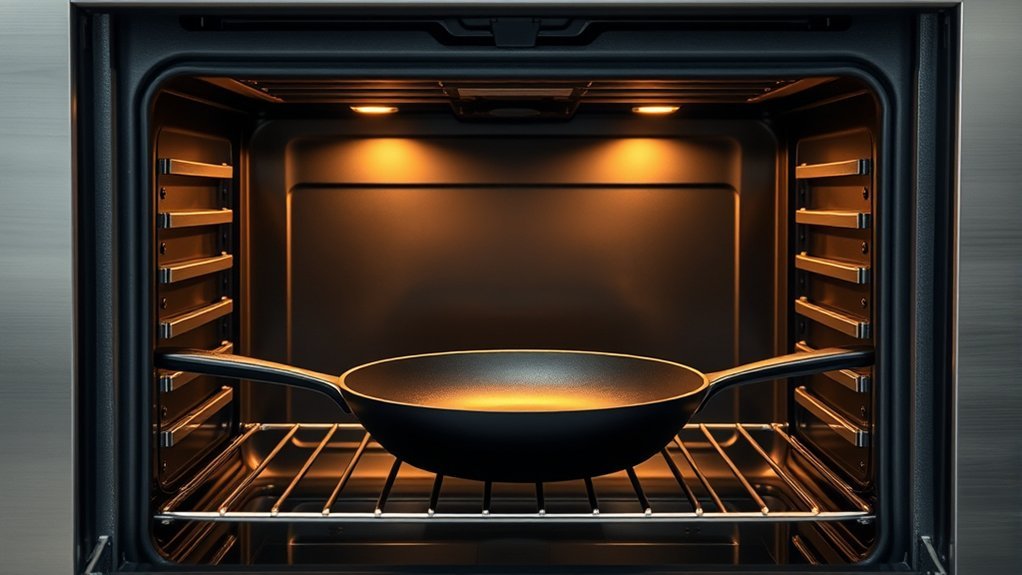
A nonstick pan can go in the oven only when the manufacturer says the specific pan is oven-safe at the temperature you plan to use. The coating is only one part of the decision: the handle, removable grip, lid, knob, and other attached components may have lower heat limits. Check the exact model rather than assuming all PTFE or ceramic pans share the same rating.
Quick Answer
Yes, many nonstick pans are oven-safe, but there is no universal temperature limit. Check the manufacturer’s rating for the exact model and use the lowest limit listed for the pan, handle, removable grip, lid, or knob. Avoid broiling unless the manufacturer specifically says the cookware is broiler-safe.
Key Takeaways
- Look for an oven-safe symbol or a published maximum temperature for your exact cookware model.
- Use the lowest temperature rating among the pan body, coating, handle, grip, lid, knob, and other attached parts.
- Do not assume PTFE always means 450°F or ceramic always means 600°F; current products vary substantially.
- Avoid broiler heat unless the manufacturer explicitly approves the exact pan for broiling.
- Do not preheat empty nonstick cookware over high heat, and ventilate the kitchen while cooking.
How to Tell If Your Nonstick Pan Is Oven Safe?
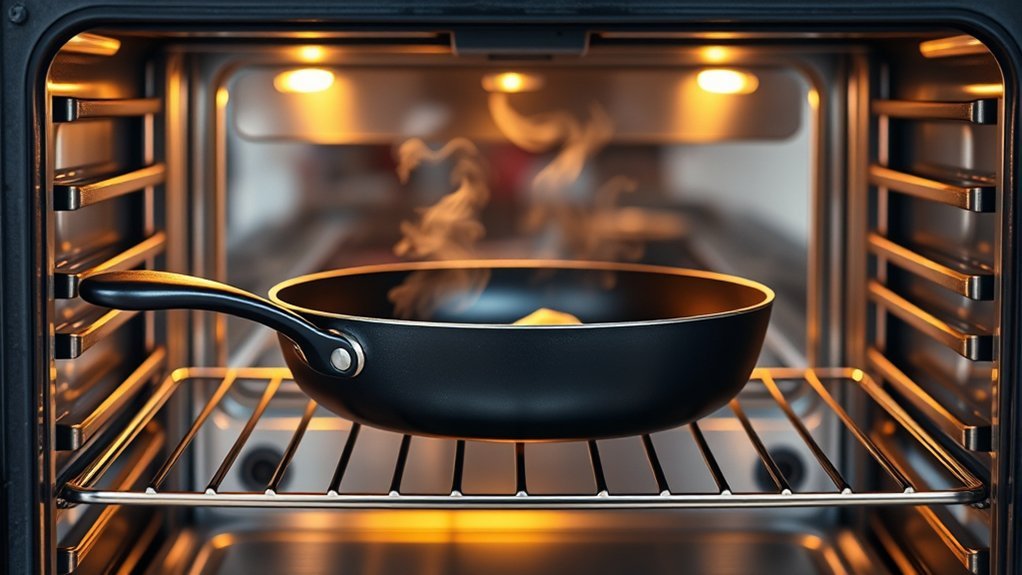
To determine whether a nonstick pan is oven-safe, start with the product label, stamp on the bottom, original packaging, care guide, or official product page. Look for an explicit oven-safe statement and a maximum temperature.
If the cookware itself has no clear marking, find its model number and search the manufacturer’s website. Do not rely on the brand name alone because different collections from the same company can have different heat limits.
At a Glance
| Time Required | About 2–5 minutes to verify the model and specifications |
| Difficulty | Easy |
| Tools Needed | Pan model number, packaging or manual, and the manufacturer’s official website |
| Cost | $0 |
Check every part that will enter the oven. A metal pan body may tolerate more heat than a silicone sleeve, plastic or phenolic handle, glass lid, or lid knob. For example, some Anolon Advanced Home nonstick cookware with silicone-and-stainless handles is rated to 400°F.
The safest rule is simple: the lowest-rated component sets the maximum oven temperature. If a pan is rated to 500°F but its lid is rated to 350°F, either stay at or below 350°F with the lid installed or remove the lid if the recipe allows.
There is no universal oven temperature for nonstick cookware. The lowest-rated component on your exact pan sets the limit.
Pro Tip: If you no longer have the packaging, search the model number stamped on the base or handle rather than searching only the brand name. If you still cannot verify an oven rating, treat the pan as stovetop-only.
PTFE vs. Ceramic: What Heat They Handle
PTFE and ceramic are common nonstick coating types, but coating type alone does not tell you the pan’s oven limit. Construction, handle design, lids, grips, and the manufacturer’s testing all affect the final rating.
Current manufacturer specifications illustrate the variation. All-Clad lists many of its nonstick collections as oven-safe to 500°F. Made In’s ProCoat Non Stick Frying Pan is also listed as heat-safe to 500°F.
Ceramic cookware varies too. The GreenPan Valencia Pro pan is rated to 600°F, while its glass lid is rated to 425°F. Other ceramic cookware can have lower limits, so 600°F should never be treated as a category-wide ceramic rating.
Note: PTFE belongs to the broader PFAS family, but that does not mean normal use of an approved nonstick coating automatically causes significant PFAS transfer to food. The U.S. FDA says approved polymerized PFAS coatings used on nonstick cookware contain a negligible amount of PFAS capable of migrating to food. Safe use still requires following the cookware maker’s heat limits.
Why Nonstick Pans Usually Should Skip the Broiler
A broiler exposes cookware to intense direct radiant heat from a nearby heating element. That is different from the surrounding heat of ordinary baking or roasting, so a pan that is oven-safe is not automatically broiler-safe.
For example, All-Clad states that several of its nonstick cookware collections should not be used under the broiler even though the pans are rated for normal oven use. By contrast, GreenPan specifically describes its Valencia Pro line as oven and broiler safe up to its published limit.
That is why the correct rule is not “all nonstick pans can never be broiled.” Instead, do not place a nonstick pan under a broiler unless the manufacturer explicitly says that exact model is broiler-safe.
Warning: Never assume an ordinary oven-safe rating also covers broiler use. If your recipe requires broiling and the pan is not explicitly approved for it, transfer the food to suitable broiler-safe cookware such as an appropriately rated stainless steel, cast iron, or carbon steel pan.
Safe Oven Temperatures for Nonstick Pans
The safest oven temperature for a nonstick pan is the manufacturer’s published limit for the exact cookware configuration you are using. Real products range considerably, so broad rules such as “PTFE is always 450°F” or “ceramic is always 600°F” are unreliable.
| Current Example | Published Oven Limit | Important Detail |
|---|---|---|
| Anolon Advanced Home nonstick sauté pan | 400°F | Uses silicone with stainless steel handles |
| All-Clad selected nonstick collections | 500°F | Several lines should not be used under the broiler; some glass lids have lower limits |
| Made In ProCoat Non Stick Frying Pan | 500°F | Use the model’s published heat specification |
| GreenPan Valencia Pro ceramic nonstick | 600°F for the pan | The covered frypan’s glass lid is rated to 425°F |
For general nonstick safety, Health Canada advises consumers not to use nonstick cookware or bakeware at high heat above 260°C/500°F and not to preheat empty nonstick cookware. That public-health guidance does not replace a lower limit specified by your cookware manufacturer.
Before moving a nonstick skillet into the oven:
- Confirm that the exact pan is oven-safe.
- Check the separate ratings for the handle, grip, lid, and lid knob.
- Use the lowest published temperature among all components that will enter the oven.
- Remove any detachable accessory that the manufacturer says must come off before oven use.
- Preheat the oven normally, but do not leave an empty nonstick pan heating unnecessarily.
- Use dry oven mitts when moving the pan; an oven-safe metal handle will still become dangerously hot.
- Ventilate the kitchen while cooking.
- After cooking, allow the cookware to cool normally rather than exposing a very hot pan or glass lid to cold water.
Also remove cookware stored inside an oven before starting a self-cleaning cycle. Self-cleaning temperatures are much higher than ordinary cooking temperatures and are not a substitute for the cookware manufacturer’s rated use.
Best One-Pan Meals for Oven-Safe Skillets
Oven-safe skillets are especially useful for recipes that begin on the stovetop and finish with gentle baking or roasting. Nonstick can simplify release and cleanup, while stainless steel, cast iron, or carbon steel may be preferable when a recipe requires more aggressive browning or broiler heat.
| Meal | Why It Works in an Oven-Safe Skillet |
|---|---|
| Skillet Tortellini with Sausage and Cherry Tomatoes | The sauce and pasta can cook together, followed by an oven finish if the recipe calls for one. |
| Skillet Beef Enchiladas | The filling can be assembled on the stovetop before the skillet goes into the oven to heat through. |
| Lemon-Braised Chicken Thighs with Chickpeas and Fennel | Chicken can be browned first and then gently finished in the oven with the braising ingredients. |
| Skillet Lasagna | Sauce, pasta, and cheese stay in one vessel from assembly through the oven finish. |
Pan-Seared Scallops with Sugar Snap Pea Slaw is another useful skillet meal, although it normally benefits from quick stovetop cooking rather than prolonged oven heat. The cookware should match the cooking method instead of sending every one-pan recipe into the oven simply because the skillet is oven-safe.
Frequently Asked Questions
How Do I Know if My Nonstick Pan Is Oven-Safe?
Check the bottom of the pan, packaging, manual, or official product page for an oven-safe statement and maximum temperature. Verify the exact model because different collections from the same brand may have different limits. Also check the handle, removable grip, lid, and knob. If you cannot verify a rating, keep the pan on the stovetop.
What Happens if I Put a Non-Stick Pan in the Oven?
If the pan is rated for the oven and you stay within its published limit, oven finishing can be perfectly appropriate. If the cookware is overheated or contains lower-rated components, the coating can be damaged and grips, handles, knobs, or lids may discolor, soften, warp, or fail. Health Canada advises against using nonstick cookware above 500°F and against preheating it empty.
Which Nonstick Pans Are Oven-Safe?
Only pans whose manufacturers explicitly approve oven use should be treated as oven-safe. Current examples include selected All-Clad nonstick collections and Made In ProCoat pans rated to 500°F, Anolon Advanced Home models rated to 400°F, and GreenPan Valencia Pro ceramic cookware rated up to 600°F for the pan. Always verify the exact model because lids and accessories may have lower limits.
What Happens if I Put a Non-Oven-Safe Pan in the Oven?
A non-oven-safe pan can be damaged by heat. Depending on its construction, handles or grips may soften, coatings may deteriorate, metal can warp, and a lid may be damaged by excessive heat or thermal shock. If accidental overheating causes visible warping, blistering, peeling, cracking, melted components, or a loose handle, stop using the cookware until the manufacturer confirms whether it remains safe.
Can I Put a Nonstick Pan Under the Broiler?
Only if the manufacturer specifically lists the exact model as broiler-safe. Ordinary oven approval does not automatically include broiler use because the broiler exposes cookware to intense direct radiant heat. If the specification does not mention broiling, use different broiler-safe cookware.
Can the Lid Go in the Oven With the Pan?
Not necessarily. A lid can have a lower heat rating than the pan itself because of its glass, knob, vent, gasket, or other components. For example, GreenPan lists its Valencia Pro pan at up to 600°F while the covered model’s glass lid is rated to 425°F. Check the lid specification separately.
Conclusion
A nonstick pan can safely move from the stovetop to the oven when the exact cookware model is approved for that use and every component stays within its published temperature limit. Do not rely on a universal PTFE or ceramic temperature rule. Check the pan, handle, removable grip, lid, and knob separately, avoid empty-pan overheating, and treat broiler use as a separate specification. If the manufacturer provides no clear oven rating, use different cookware rather than guessing.
Sources
- Health Canada — The Safe Use of Cookware and Bakeware — nonstick high-heat, empty-preheating, ventilation, and self-cleaning-oven guidance.
- U.S. Food and Drug Administration — Questions and Answers on PFAS in Food — current context on authorized PFAS food-contact applications and migration from polymerized nonstick coatings.
- All-Clad Product Support and FAQ — current oven, lid, and broiler limits for All-Clad cookware collections.
- GreenPan Valencia Pro Ceramic Nonstick Frypan — published 600°F pan and 425°F lid ratings and broiler compatibility.
- Made In ProCoat Non Stick Frying Pan — published 500°F heat rating.
- Anolon Advanced Home Nonstick Sauté Pan — published 400°F oven rating and handle construction.

4 thoughts on “Can You Put a Nonstick Pan in the Oven? Oven-Safe Temperatures & Tips”