
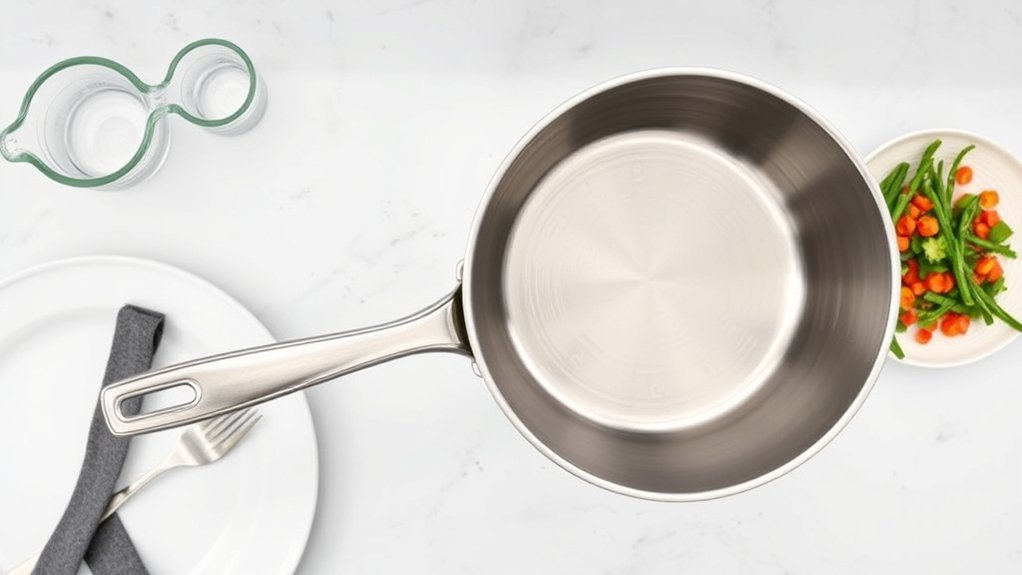
A 3 qt pan holds 3 US liquid quarts, equal to 12 cups, 96 fluid ounces, or about 2.84 liters. That capacity works well for sauces, grains, vegetables, reheating, and many small-to-medium batches. Physical size is less standardized: two 3-quart pans can have very different diameters and depths because 3 quarts describes volume, not shape.
Quick Answer
A 3 qt pan holds 12 US cups, 96 US fluid ounces, or roughly 2.84 liters. A 3-quart saucepan is usually a medium-size pot, but there is no universal diameter or height. Saucepan, saucier, sauté-pan, and baking-dish designs can all hold 3 quarts while having very different dimensions.
Key Takeaways
- 3 US quarts = 12 cups = 96 fl oz ≈ 2.84 L.
- Three quarts is a capacity rating, so diameter, depth, handle length, and total footprint vary by manufacturer and pan style.
- A 3-quart saucepan is useful for sauces, grains, vegetables, soups, leftovers, and many meals for roughly 2 to 4 people, depending on portion size.
- A 3-quart sauté pan is usually wider and shallower than a 3-quart saucepan, making it better for browning and evaporation.
- For induction, oven use, dishwasher cleaning, or high-temperature cooking, always check the specifications for the exact model.
What Does a 3 Qt Pan Hold?
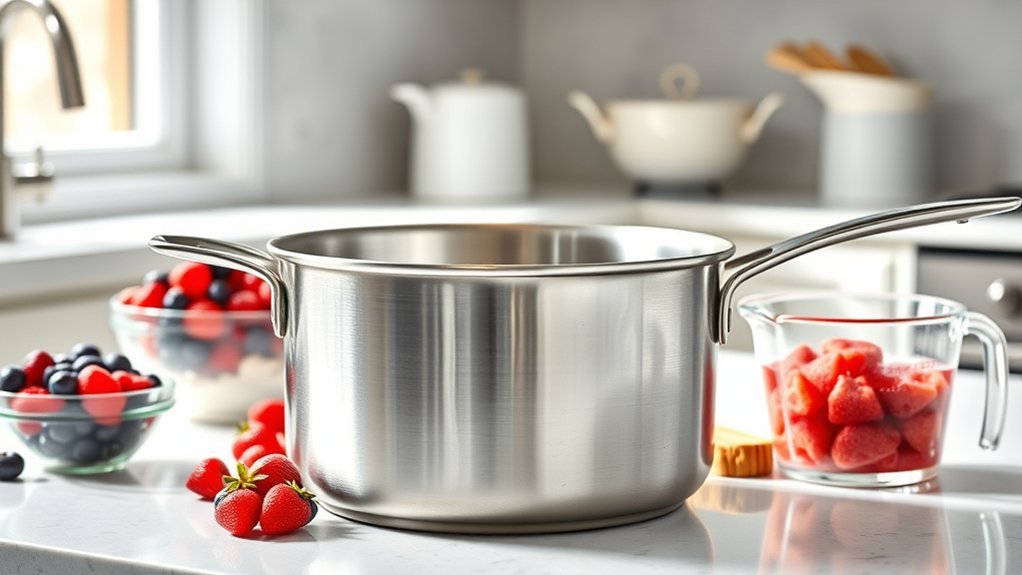
A 3-quart pan has a maximum nominal capacity of 12 US cups. The National Institute of Standards and Technology lists 1 US liquid quart as 4 cups, so the conversion is straightforward.
That volume makes a 3-quart saucepan useful for sauces, soup, rice, oatmeal, vegetables, grains, small stews, and reheating leftovers. It is commonly a practical size for one or two people and can handle many dishes for 2 to 4 people, although serving size depends on the recipe.
Do not assume all 12 cups are usable while cooking. Cookware capacity is generally a maximum volume, while boiling, stirring, foaming, and adding ingredients require headspace below the rim.
Note: This article uses US liquid quarts. Three US liquid quarts equal about 2.84 liters. Other measurement systems can define a quart differently.
A 3-quart pan therefore occupies a useful middle ground: larger than a small melting or reheating saucepan but easier to handle and store than a large stockpot.
3 Qt Pan Dimensions Explained
A 3 qt capacity does not determine one set of dimensions. Manufacturers can make a pan taller and narrower or wider and shallower while keeping the same volume.
Current product specifications illustrate the difference. Cuisinart lists one 3-quart saucepan at 15.7 inches long × 7.9 inches wide × 5.8 inches high overall, while All-Clad lists its D3 3-quart saucepan at 17.3 × 8.8 × 6.4 inches overall. These measurements include more than the interior cooking cavity, so they should not be treated as internal diameter and depth.
| Example | Listed Overall Dimensions | What It Shows |
|---|---|---|
| Cuisinart 3-qt saucepan | 15.7 × 7.9 × 5.8 in | Compact saucepan footprint |
| All-Clad D3 3-qt saucepan | 17.3 × 8.8 × 6.4 in | Longer and wider overall design |
| All-Clad D3 3-qt sauté pan | 20.8 × 11.4 × 5.3 in | Much wider cooking format |
Three quarts tells you how much a pan can hold; it does not tell you one universal diameter, depth, or handle length.
For storage or cooktop planning, use the manufacturer’s overall length, width, and height. For recipe performance, also consider the interior base diameter and wall shape.
3 Qt Pan in Inches
There is no single inch measurement for every 3-quart pan. Many 3-quart saucepans occupy a medium-size footprint, but a saucier, sauté pan, casserole, or baking dish can hold the same volume with a very different shape.
If you are replacing cookware, compare the exact manufacturer dimensions instead of shopping by capacity alone.
Diameter and Height
Diameter and height work together to produce volume. A relatively narrow 3-quart saucepan needs taller walls, while a wide sauté pan can reach the same capacity with shallower sides.
| Measure | What to Check | Why It Matters |
|---|---|---|
| Rim diameter | Inside or outside measurement | Affects opening size and lid fit |
| Base diameter | Flat area contacting the burner | Affects burner matching and browning area |
| Pan depth | Interior bottom to rim | Affects stirring room and boil-over resistance |
| Overall height | Including lid when specified | Important for cabinet storage |
The pan’s shape also affects how quickly liquids evaporate. A wider surface exposes more liquid to air, while taller saucepan walls help contain splashes and reduce the footprint on the cooktop.
Capacity in Cups
A 3-quart pan holds 12 US cups at its nominal full capacity. It is also equal to 96 US fluid ounces and approximately 2.84 liters.
| Capacity | Equivalent |
|---|---|
| 3 US quarts | 12 cups |
| 3 US quarts | 96 US fl oz |
| 3 US quarts | About 2.84 L |
| 3 US quarts | 3/4 US gallon |
These conversions describe total volume, not the amount you should necessarily cook at once.
Warning: Do not fill a saucepan to the rim when boiling pasta, grains, milk, soup, or other foods that can foam or splash. Leave enough headspace for stirring and expansion.
Handle and Lid Size
Handle and lid dimensions vary as much as the pan body. Current 3-quart saucepan examples have overall lengths of roughly 15.7 to 17.3 inches, showing why an assumed 14- or 15-inch length is unreliable.
- Lid fit: The lid should match the rim securely, but lid height and oven rating can differ from the pan itself.
- Handle design: Riveted or welded handles should feel stable when the pan is loaded.
- Overall length: Measure the pan with its handle when checking cabinet, drawer, or cooktop clearance.
Some metal handles are designed to stay cooler during stovetop use, but they are not guaranteed to remain cool. Handles can become hot during long cooking sessions and in the oven.
3 Qt Pan Vs 2 Qt and 4 Qt Sizes
Capacity differences are easy to compare because one US liquid quart equals four cups. A 3-quart pan has 50% more nominal capacity than a 2-quart pan and 25% less total capacity than a 4-quart pan. Looked at from the larger-pan direction, a 4-quart pan holds about 33% more than a 3-quart pan.
| Size | US Cups | Approx. Liters | Typical Role |
|---|---|---|---|
| 2 qt | 8 cups | 1.89 L | Sauces, reheating, small sides |
| 3 qt | 12 cups | 2.84 L | Everyday medium batches |
| 4 qt | 16 cups | 3.79 L | Larger meals and batch cooking |
Physical diameter does not increase in the same fixed proportion. A manufacturer may make its larger saucepan wider, taller, or both.
Is a 3 Qt Pan Big Enough for Families?
A 3-quart pan can be large enough for many meals for 2 to 4 people, particularly sauces, grains, vegetables, sides, smaller soups, and reheated dishes. However, household size alone is not a reliable way to choose cookware.
A family that cooks large pots of pasta or soup may quickly outgrow 3 quarts, while the same family may use a 3-quart saucepan every day for vegetables and side dishes.
Family Size Servings
A 3-quart pan can handle many moderate portions without occupying the space of a stockpot. Its strongest roles include:
- Cooking sauces, gravy, oatmeal, rice, or other grains.
- Heating soup or leftovers for a few servings.
- Preparing vegetables and side dishes while another pan handles the main course.
Rather than relying on a fixed “serves four” label, compare the volume of your usual recipes with the pan’s capacity and leave extra room for stirring.
Best For Small Batches
A 3-quart saucepan is particularly useful when a large stockpot would waste burner and storage space. The moderate capacity makes it suitable for small-batch soups, sauces, grains, reductions, vegetables, custards, and reheating.
Because it is easier to lift than a large stockpot when empty, many cooks also find this size convenient for frequent everyday use. Actual weight depends heavily on material and construction.
When It Feels Tight
A 3-quart pan can feel undersized when a recipe produces substantial foam, requires vigorous stirring, or includes ingredients that expand significantly.
- Large pasta batches need more water and headspace.
- Soups and stews intended for leftovers may exceed practical working capacity.
- Large pieces of meat or bulky vegetables may physically crowd the pan before its measured volume is reached.
When a recipe approaches the pan’s full 12-cup capacity, moving up to a 4-, 5-, or 6-quart vessel usually provides safer stirring and boil-over clearance.
Best Uses for a 3 Qt Pan
A 3 qt pan is a versatile medium-capacity piece of cookware. Its best uses depend on whether it is a saucepan, saucier, or sauté pan.
- Sauces and gravy: enough room for whisking and reducing without using an oversized pot.
- Rice and grains: useful for moderate batches when adequate headspace is maintained.
- Soup and stew: suitable for smaller batches rather than large family stockpot quantities.
- Vegetables: useful for simmering, blanching, or steaming with an appropriate insert.
- Reheating: a convenient size for leftover soup, pasta sauce, or cooked grains.
- Reductions: a wider 3-quart saucier or sauté pan provides more evaporation area.
- Browning: a wide 3-quart sauté pan offers more cooking surface than a narrow saucepan of the same capacity.
For boiling pasta, remember that the limiting factor is not only volume. Water, pasta expansion, and foaming require significant space above the food.
What Fits in a 3 Qt Pan?
A 3-quart pan can hold up to 12 cups by volume, but the amount of solid food that fits depends on its shape. Tall ingredients may not fit under the lid even when their measured volume is below three quarts.
- Pasta sauce, gravy, risotto, oatmeal, rice, and other grains fit naturally in a saucepan.
- Vegetables, soup, chili, curry, and smaller stews can be simmered with appropriate headspace.
- A wide sauté pan can handle shallow braises, sautéed vegetables, pan sauces, and modest one-pan meals.
Pan shape also changes cooking behavior. A wider base increases the area available for browning and evaporation, while a narrower saucepan concentrates the same volume into a smaller footprint.
For recipes close to 3 quarts in finished volume, use a larger pan so there is room to stir, simmer, and control foaming without overflow.
Pro Tip: If you are unsure whether a favorite recipe fits, measure its finished volume once with a marked container. That gives you a much better cookware-size guide than household size alone.
3 Qt Saucepans Vs Sauté Pans
Two pans can both hold 3 quarts yet behave very differently on the stove.
A 3-quart saucepan generally has a relatively narrow base and tall sides. This shape is useful for liquids, grains, simmering, boiling, and reducing splatter while stirring.
A 3-quart sauté pan uses a wider base and comparatively lower straight sides. That gives food more direct contact with the cooking surface and increases evaporation, which helps when browning, sautéing, searing, or reducing sauces.
For example, All-Clad currently lists its D3 3-quart saucepan at 8.8 inches wide overall, while its D3 3-quart sauté pan is 11.4 inches wide overall. Both carry the same capacity rating but have clearly different footprints.
| Feature | 3-Qt Saucepan | 3-Qt Sauté Pan |
|---|---|---|
| Shape | Narrower and taller | Wider and shallower |
| Best for | Liquids, grains, sauces | Browning, sautéing, shallow braising |
| Evaporation | Usually slower | Usually faster |
| Cooktop footprint | Smaller | Larger |
The right style depends more on the cooking method than on the shared 3-quart capacity.
How Materials Affect 3 Qt Pan Performance
Material and construction affect how quickly a 3-quart pan responds to heat, how evenly it heats, how much it weighs, what utensils it tolerates, and whether it works on induction.
Stainless steel is durable and commonly used as a cooking surface, but stainless steel alone is not an especially efficient heat conductor. Many higher-performance stainless pans therefore combine it with aluminum or copper layers.
Stainless Steel Heat Response
In clad cookware, a conductive core helps spread heat while stainless steel provides a durable cooking surface. All-Clad, for example, describes its D3 construction as stainless steel bonded around an aluminum core that delivers faster, more even heating.
This type of construction can work well for sauces and other foods where temperature control matters. However, the phrase “stainless-steel pan” alone does not tell you exactly how the cookware is built. Some pans are fully clad, some use a bonded disc on the base, and some use different combinations of metals.
Oven limits are also model-specific. One Cuisinart 3-quart saucepan is rated to 500°F, while All-Clad D3 cookware can be rated to 600°F. A glass lid may have a lower limit than the pan itself.
For cleaning, use the manufacturer’s care instructions. Non-abrasive cleaning is a safe default for polished stainless finishes. Metal utensils may leave cosmetic marks on uncoated stainless steel but are not universally prohibited; coated nonstick cookware requires different utensil care.
Core Layer Performance
In tri-ply stainless cookware, three bonded layers commonly combine a conductive metal such as aluminum with stainless-steel surfaces. The exact alloy grades, thicknesses, and layer arrangements depend on the manufacturer.
An aluminum core improves heat transfer compared with using stainless steel alone, helping reduce localized hot spots and improving temperature response.
Induction compatibility depends on the exterior or base being magnetic rather than on the 3-quart capacity. The U.S. Department of Energy advises that cookware with a flat bottom that a magnet sticks to will work with induction.
Note: Aluminum and copper cookware can work on induction when the manufacturer adds a compatible magnetic layer. Check the induction symbol or test the bottom with a magnet.
How to Measure a 3 Qt Pan or Confirm Its Capacity
If you already own a pan but do not know its size, measure both its physical dimensions and capacity.
- Measure the opening: Measure straight across the inside rim for the interior diameter.
- Measure the base: Measure the flat cooking surface separately because it can be much narrower than the rim.
- Measure depth: Measure vertically from the interior bottom to the rim.
- Measure overall length: Include the long handle when checking cabinet or stovetop clearance.
- Check capacity: Fill the cool, empty pan with measured water to determine approximately how much it holds to the rim.
Capacity measurement is especially useful when replacing older cookware whose model number or markings are no longer readable.
Warning: Measure capacity only with a cool pan. Never pour cold water into very hot cookware solely to measure or clean it, because sudden temperature change can damage or warp some pans.
How to Choose the Right 3 Qt Pan
Choosing the right 3 qt pan means looking beyond capacity. Start with the cooking methods you use most often.
- Choose the shape: Pick a saucepan for liquids and grains, a saucier for whisking and reductions, or a sauté pan when browning area matters.
- Check actual dimensions: Compare rim width, base size, overall handle length, and height with your burners and storage.
- Inspect construction: Fully clad or conductive-core cookware can provide more even heat than thin single-layer stainless steel.
- Check the lid: Look for a stable fit and verify the lid’s separate oven-temperature limit if applicable.
- Evaluate the handle: The handle should feel secure and balanced when the pan is full.
- Verify stove compatibility: For induction, look for the induction symbol or confirm that a magnet sticks firmly to the base.
- Check oven limits: Never assume every stainless pan is safe to the same temperature.
- Consider cleanup: Dishwasher-safe claims and utensil recommendations vary by coating and manufacturer.
A good 3-quart pan is therefore not simply one with the “right” diameter. The best choice combines suitable shape, useful cooking area, manageable weight, secure handling, and compatibility with your stove and cooking habits.
Frequently Asked Questions
What Does a 3 Qt Pan Look Like?
A 3 qt saucepan usually looks like a medium-size pot with relatively tall sides, a long handle, and a lid. A 3-quart sauté pan looks wider and shallower. Because three quarts specifies capacity rather than shape, there is no single appearance or diameter shared by every 3-quart pan.
How Big Is a 3 Qt Baking Pan?
A 3-quart baking dish can come in several shapes. For example, Pyrex currently sells a 3-quart Easy Grab rectangular baking dish measuring 9 × 13 inches. However, 9 × 13 inches does not automatically mean every baking pan holds 3 quarts because depth and wall shape also affect capacity.
Is a 3 Qt Sauté Pan Big Enough?
A 3 qt sauté pan is large enough for many everyday meals, vegetables, pan sauces, shallow braises, and smaller one-pan dishes. It may feel restrictive for large families, batch cooking, or recipes that require a lot of stirring room.
How Many Cups Are in a 3-Quart Pan?
Three US liquid quarts equal 12 US cups. The same capacity is 96 US fluid ounces or approximately 2.84 liters. During cooking, leave headspace rather than filling the pan completely to the rim.
Is a 3 Qt Pan the Same as a 9 × 13 Pan?
Not automatically. Some 9 × 13-inch baking dishes are rated at 3 quarts, including a current Pyrex model, but the capacity of any rectangular dish also depends on its depth and wall design. Check the manufacturer’s stated capacity before substituting bakeware.
How Many Liters Is a 3 Qt Pan?
Three US liquid quarts equal approximately 2.84 liters. For ordinary kitchen estimating, that is just under 3 liters.
Is a 3 Qt Saucepan Considered Medium Size?
A 3-quart saucepan is commonly treated as a medium everyday size because it sits between small 1- to 2-quart saucepans and larger 4-quart or stockpot-style cookware. Manufacturers do not use one universal small, medium, and large classification, however.
Conclusion
A 3 qt pan is best understood by its capacity first: 12 US cups, 96 fluid ounces, or about 2.84 liters. Its physical dimensions depend on the manufacturer and shape, so a saucepan can be relatively tall and narrow while a sauté pan or baking dish holding the same volume can be much wider. For most kitchens, 3 quarts is a versatile size for sauces, grains, vegetables, soup, reheating, and moderate batches. When choosing one, compare the actual dimensions, cooking-surface shape, handle and lid design, material, oven rating, and cooktop compatibility rather than relying on one supposed standard diameter.
Sources
- National Institute of Standards and Technology — Metric Kitchen: Cooking Measurement Equivalencies — US quart, cup, fluid-ounce, and metric capacity conversions.
- Cuisinart — 3 Quart Saucepan with Cover — current example of overall 3-quart saucepan dimensions and induction compatibility.
- All-Clad — D3 Stainless 3-Quart Sauce Pan — current saucepan dimensions and clad construction example.
- All-Clad — D3 Stainless 3-Quart Sauté Pan — example showing how a 3-quart sauté pan differs in footprint from a saucepan.
- U.S. Department of Energy — Making the Switch to Induction Stoves or Cooktops — induction cookware compatibility and magnet-test guidance.
- Pyrex — Easy Grab 3-Quart Glass Baking Dish — verified 9 × 13-inch, 3-quart baking-dish example.