
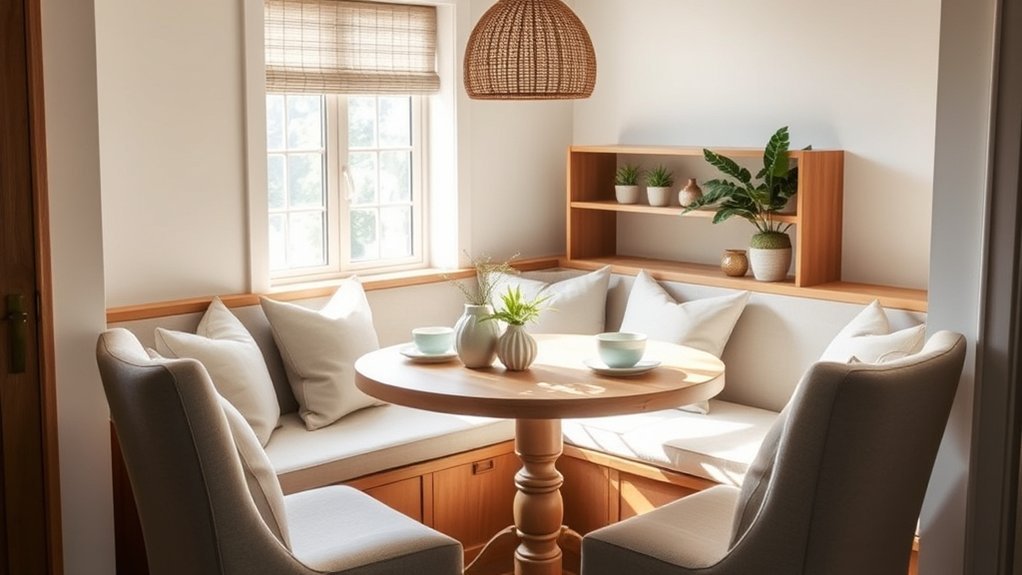
A breakfast nook is a compact, informal dining area near the kitchen, often placed beside a window or in an unused corner. With the right table, seating, clearances, lighting, and storage, even a small nook can handle breakfast, homework, coffee, crafts, or casual family meals without taking over the room.
Quick Answer
A comfortable breakfast nook usually combines a dining-height table with about 24 inches of table width per person, an approximately 18-inch finished banquette seat height, and enough knee and circulation space for people to sit and move comfortably. Built-in benches save floor space, while round or pedestal tables make tight layouts easier to use.
Key Takeaways
- Plan the nook around people first: roughly 24 inches of table edge per diner is a useful starting point.
- For a dining banquette, aim for a finished seat around 18 inches high and roughly 18 to 20 inches of usable seat depth.
- Fixed benches need less pull-out space than chairs, but the table still needs adequate knee room and an accessible path into the seat.
- Round, oval, pedestal, and drop-leaf tables are especially useful in compact breakfast nooks.
- A breakfast nook may improve usability and buyer appeal, but there is no universal percentage by which it increases home value.
What Is a Breakfast Nook?
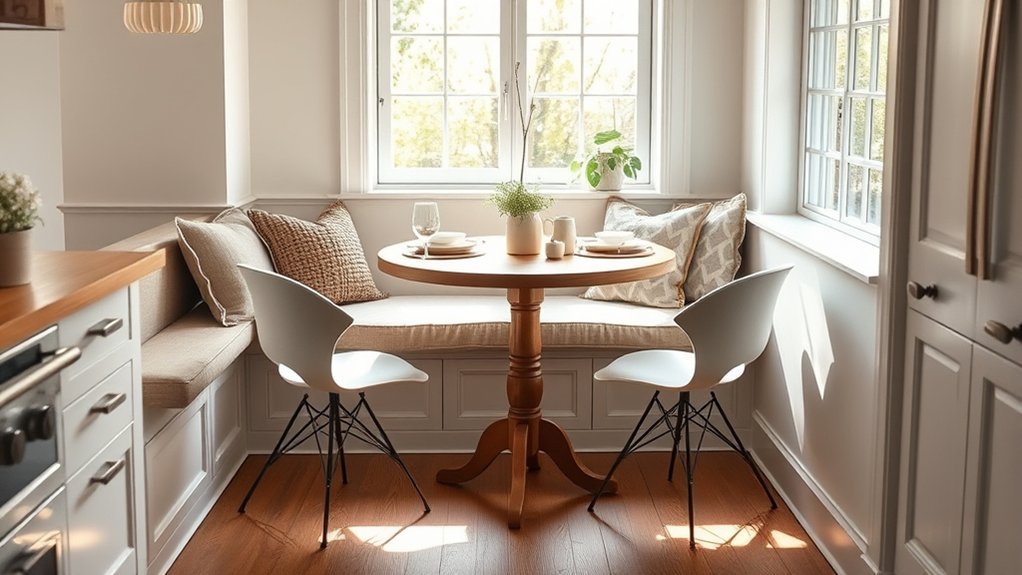
A breakfast nook is a compact, informal dining space usually located in or just off the kitchen. It is designed for everyday meals and activities rather than formal dining.
Many breakfast nooks use bench seating, a corner banquette, or a built-in seat to make better use of floor space. Others simply combine a small table with two or three lightweight chairs.
The best breakfast nook is not necessarily the largest one. Good proportions, comfortable seating, and easy circulation matter more than total square footage.
A nook beside a window can benefit from natural light, while a corner location can turn otherwise unused space into a functional dining area. Beyond meals, the same space can support homework, reading, laptop work, crafts, or family games.
Small nooks commonly serve two to four people, although larger L-shaped or U-shaped banquettes can accommodate more. The goal is to create a useful dining zone without making the kitchen feel crowded.
Breakfast Nook Sizes That Actually Fit
There is no single minimum breakfast nook size that works for every room. The required footprint depends on the table shape, number of diners, fixed versus movable seating, cushion thickness, table base, and how people enter and leave the seating area.
For planning purposes, the National Kitchen & Bath Association kitchen planning guidelines recommend about 24 inches of seating width per diner. At a 30-inch-high table or counter, NKBA also recommends approximately 18 inches of knee-space depth for each seated person.
| Element | Useful Starting Point | Planning Note |
| Width per diner | About 24 in. minimum | More width provides extra elbow room. |
| Finished banquette seat height | About 18 in. | Measure to the top of the compressed cushion, not just the wood platform. |
| Usable banquette seat depth | About 18–20 in. | Thick back cushions reduce usable depth. |
| Dining table height | About 28–30 in. | Check the table apron and base because they can reduce knee room. |
| Space around movable chairs | Roughly 30–36 in. where possible | More room may be needed where people regularly walk behind seated diners. |
Common Nook Dimensions
Round tables around 36 to 48 inches in diameter are common in small dining areas because they eliminate sharp corners and can make circulation easier. Smaller tables may work for two people, while larger tables require more surrounding room.
Rectangular tables work well along longer walls and with straight banquettes. A table around 60 inches long can comfortably serve a small family when the room has enough width, but table length alone does not determine capacity. Chair width, table legs, place settings, and access all matter.
For a built-in dining bench, an approximately 18-inch finished seat height is a useful target. The finished measurement includes the seat cushion. If a 3-inch cushion compresses during use, the wood platform may need to be lower so the occupied seat does not become uncomfortably tall.
Table and Seating Clearance
Table clearance is easier to plan when you separate four measurements: seat width, seat depth, knee space, and circulation space.
NKBA recommends at least 24 inches of width per diner at common kitchen seating surfaces. For a standard 30-inch-high eating surface, it recommends approximately 18 inches of knee-space depth. Taller counters require less horizontal knee depth because the seated position changes.
Movable chairs also need room to pull back. A freestanding dining table generally works best when there is roughly 30 to 36 inches between the table and nearby walls or obstacles, with additional clearance useful in a busy walkway.
Built-in benches do not need chair pull-out space behind them, which is one reason they work well in small kitchens. However, diners still need a practical route into the bench from one or both ends.
Pro Tip: Before ordering furniture or building a banquette, mark the table, bench, and chair footprints on the floor with painter’s tape. Pull out a real dining chair and walk around the mock layout. This quickly reveals clearance problems that are difficult to see on a floor plan.
Small-Space Fit Tips
Small breakfast nooks work best when every piece has a clear purpose. Start with the number of people who will use the nook most days rather than sizing the table for occasional large gatherings.
- Use a round or oval table to reduce hard corners in a tight circulation path.
- Consider a pedestal table so diners can slide along a banquette without working around four table legs.
- Choose a drop-leaf table if you occasionally need a larger surface.
- Use built-in bench storage for linens, serving pieces, or items that do not need to be accessed constantly.
- Choose lightweight chairs or stools when the layout needs to change regularly.
A compact nook feels comfortable when people can sit, stand, and pass through it without repeatedly moving furniture.
How to Measure a Breakfast Nook Before You Buy or Build
Start by measuring the full wall-to-wall width and depth of the available area. Then record anything that reduces usable space, including baseboards, window trim, radiators, HVAC vents, outlets, cabinet doors, appliance doors, and floor transitions.
Next, decide whether the seating will be fixed or movable. Draw the bench or chair depth first, then place the table relative to the seat. Confirm there is enough room for knees under the tabletop and enough access at the ends of a fixed bench.
Measure the table base as carefully as the tabletop. Four-legged tables can trap a diner’s legs against a banquette, while a well-positioned pedestal base usually leaves a clearer path.
For bay windows or angled walls, measure at several points rather than assuming the opening is square. Older houses in particular may have walls that vary slightly in width from top to bottom.
Warning: Before fastening a permanent banquette to a wall or floor, locate electrical wiring, plumbing, HVAC components, outlets, vents, and other service access. Do not permanently cover equipment that needs ventilation or future maintenance, and follow applicable local building requirements.
Best Breakfast Nook Layouts for Small Spaces
A well-planned breakfast nook can make an awkward kitchen corner much more useful. The best layout depends on the room shape and how often the seating needs to move.
An L-shaped banquette is one of the most space-efficient choices for a corner. It replaces the pull-out space required by several chairs and can provide storage underneath.
In an open-concept kitchen, a freestanding arrangement with a small round table and lightweight chairs keeps the room flexible and makes it easier to change the layout later.
A bay window can support a custom straight, angled, or curved bench. Measure the window area carefully and make sure cushions and backrests do not interfere with operable windows, hardware, or nearby vents.
Drop-leaf and oval tables are useful where circulation is limited. A table can remain compact for everyday meals and expand when guests need additional surface area.
The nook can also work beyond meals. A comfortable tabletop and good lighting make it useful for homework, drawing, laptop work, games, and crafts.
Choose the Right Seating, Table, and Storage
A successful breakfast nook coordinates seating, table geometry, and storage instead of choosing each item separately. A beautiful table can still fail if its legs prevent diners from entering a banquette, while a deep bench can become uncomfortable if thick cushions push people too far from the table.
Seating Options
Built-in benches make excellent use of corners and can hide storage underneath. A banquette also creates a clean visual boundary between the nook and the rest of the kitchen.
Traditional chairs provide more flexibility. They are easier to replace, move to another room, or remove when additional floor space is needed. Stools can keep sightlines open but usually offer less back support for long meals.
For dining comfort, a finished banquette seat around 18 inches high and approximately 18 to 20 inches deep is a useful starting point. Always account for cushion thickness and compression before finalizing the frame.
- Built-in benches maximize floor space and can provide hidden storage.
- Chairs are easiest to rearrange and replace.
- Stools work best where compact size matters more than long-term back support.
- A combination of a wall bench and movable chairs offers both efficiency and flexibility.
Table Shapes
Table shape determines how easily people enter the nook and how efficiently the tabletop uses available space.
A round table works especially well in compact corners because there are no projecting corners. It also makes conversation easy because diners face one another more directly.
A rectangular table fits naturally beside a straight banquette or along a long wall. It can provide more usable serving space, but corner legs may restrict access.
An oval table combines much of the usable surface of a rectangular table with softer ends. A drop-leaf table offers additional flexibility when the nook must serve both everyday meals and occasional guests.
For fixed banquettes, a central pedestal table is often worth considering because it removes outside corner legs that can obstruct entry.
Storage Solutions
Storage can make a breakfast nook more useful, but the access method matters.
- Under-bench drawers are convenient for frequently used items because cushions can stay in place.
- Lift-up lids maximize storage volume but may require removing cushions whenever the compartment is opened.
- Open cubbies work well with baskets and make children’s items easy to reach.
- Floating shelves can hold lightweight decor or dishes without using floor space.
- A slim sideboard works in larger nooks where additional serving and storage space is needed.
Store frequently used items where they can be reached without asking seated diners to move. Reserve harder-to-access bench compartments for seasonal linens or less frequently used supplies.
Pick Lighting and Decor for a Cozy Nook
A pendant can visually anchor a breakfast nook, while wall sconces are useful when the ceiling location or table position makes a pendant impractical.
Daylight from a nearby window can provide much of the daytime illumination. At night, bulbs around 2700K to 3000K produce the warm-white appearance described by ENERGY STAR lighting guidance.
Layered lighting provides more flexibility. Overhead light handles meals and cleanup, while a nearby sconce or other task light can make reading or homework easier.
Keep decor proportionate to the small area. One piece of artwork, a mirror, a few washable cushions, or several small plants can add personality without making the nook look crowded.
For upholstery, removable or wipeable fabrics are practical in a dining area where spills are likely. Avoid oversized cushions that reduce usable seat depth or push diners too far toward the table.
Plan for Accessibility and Long-Term Comfort
Accessibility requirements vary by building type and location, but established accessibility dimensions can provide useful reference points when designing for people with limited mobility.
The 2010 ADA Standards for Accessible Design specify dining surfaces between 28 and 34 inches high where covered by the standard, along with clear floor space and knee/toe clearance for a forward approach.
Note: Accessibility rules depend on the property and jurisdiction. For a private residential project, use published accessibility dimensions as helpful design references and confirm any legally required dimensions with the applicable local code or design professional.
Even when formal accessibility rules do not apply, leaving one side of the table open for a movable chair can make a breakfast nook easier to use for guests with different mobility needs.
Do Breakfast Nooks Add Home Value?
A well-designed breakfast nook can improve a kitchen’s usefulness and may make the home more appealing to some buyers, especially when it turns otherwise awkward space into practical seating.
However, there is no reliable universal percentage by which a breakfast nook increases home value. Claims that a nook automatically adds 5%, 10%, or another fixed amount should be treated cautiously.
Fannie Mae appraisal guidance explains that adjustments for property differences should reflect the market’s reaction and be supported by comparable-sale analysis. In practice, the value contribution of a breakfast nook therefore depends on the local market, home size, construction quality, and whether buyers in that area consider the feature desirable.
- A nook can make unused kitchen space more functional.
- Built-in seating may provide extra storage without adding another cabinet wall.
- A proportionate, well-finished nook can improve the kitchen’s presentation.
- An oversized or poorly placed nook can hurt circulation and may not add useful value.
If resale is the main goal, prioritize good workmanship, neutral finishes, comfortable proportions, and a layout that does not reduce access to cabinets, appliances, windows, or walkways.
Frequently Asked Questions
Is a Breakfast Nook Worth It?
Yes, a breakfast nook can be worthwhile when you have an underused corner and want casual seating without a full dining-room footprint. It is especially useful when a built-in bench can add storage or eliminate the pull-out space required by several chairs. The layout should still preserve comfortable circulation through the kitchen.
What’s Another Name for a Breakfast Nook?
Other common names for a breakfast nook include kitchen nook, eating nook, breakfast area, dining alcove, or banquette dining area. The exact term usually depends on whether the space is architectural, freestanding, or built around bench seating.
What Is a Nook in a Kitchen?
A kitchen nook is a small, defined area used for casual dining, coffee, homework, or similar everyday activities. It is commonly placed beside a window, against a wall, or in a corner and may use chairs, benches, or a built-in banquette.
How Much Does a Breakfast Nook Cost?
Cost varies widely. A simple freestanding table-and-bench set can cost a few hundred dollars, while custom built-in seating, upholstery, storage, electrical work, and finish carpentry can push the project into several thousand dollars. Current HomeAdvisor built-in seating cost data places installed breakfast nooks around $1,000 to $8,000 depending on materials, complexity, and storage features. Local labor rates can change the total substantially.
How Big Should a Breakfast Nook Be?
There is no universal minimum room size. Start with the number of diners, allow roughly 24 inches of table edge per person, then add the required seat depth, knee room, and circulation space. A fixed banquette generally requires less floor area than the same number of pull-out chairs.
How Much Clearance Should Be Around a Breakfast Nook Table?
With movable chairs, roughly 30 to 36 inches from the table edge to a wall or obstruction is a practical starting range, with additional room useful in busy walkways. A fixed banquette does not need chair pull-out space behind the seat, but diners still need sufficient knee room and a clear route into and out of the bench.
Conclusion
A breakfast nook can turn an awkward kitchen corner into one of the most frequently used places in the home. The best results come from measuring first, choosing a table that works with the seating, allowing enough knee and circulation space, and sizing a built-in bench around its finished cushions rather than the wood frame alone.
A slim banquette and compact round or pedestal table can make a small nook work for coffee, homework, everyday meals, and late-night snacks without crowding the kitchen. Add practical storage, comfortable lighting, and durable finishes, and the space becomes more than extra seating—it becomes a useful part of the daily routine.
Sources
- National Kitchen & Bath Association — Kitchen Planning Guidelines — seating width, knee space, and accessibility-minded kitchen seating dimensions.
- U.S. Department of Justice — 2010 ADA Standards for Accessible Design — accessible dining-surface height, clear floor space, and knee/toe clearance.
- ENERGY STAR — Downlight Key Product Criteria — correlated color temperature and warm-white lighting guidance.
- Fannie Mae — Adjustments to Comparable Sales — market-based appraisal adjustments and contributory value.
- HomeAdvisor — Built-In Seating Cost Guide — current consumer cost ranges for built-in benches and breakfast nooks.
- This Old House — Guide to Redesigning Your Kitchen — practical dining-table sizing and circulation guidance.