
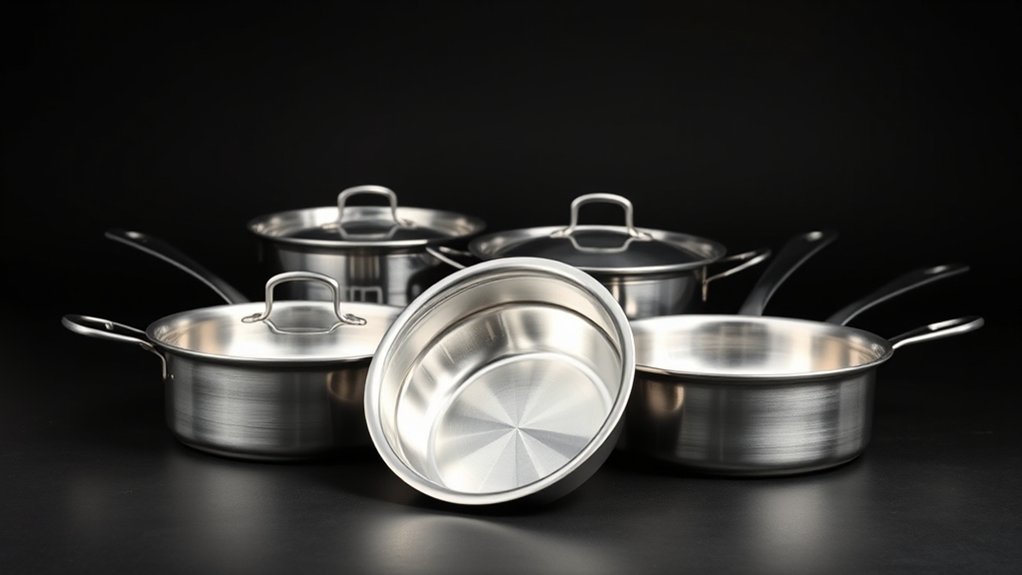
Many stainless steel pans contain aluminum, but the aluminum is usually hidden inside the cookware rather than exposed to food. It may run through the entire pan as a fully clad aluminum core or sit only in an encapsulated base. The aluminum helps spread heat more efficiently, while stainless steel provides a durable cooking surface. Construction varies by manufacturer, so the product specifications are the best way to know what is inside a particular pan.
Quick Answer
Yes, many stainless steel pans contain aluminum. In fully clad cookware, aluminum is bonded between stainless steel layers throughout the bottom and sidewalls. Other pans use aluminum only in the base. The aluminum normally does not touch food; it is used because it spreads heat much better than stainless steel alone.
Key Takeaways
- Many stainless steel pans use an aluminum core or aluminum base to improve heat distribution.
- In properly made clad cookware, the aluminum core is enclosed between metal layers and does not form the food-contact surface.
- Fully clad cookware carries the conductive layer through the sidewalls; disc- or encapsulated-base cookware concentrates it at the bottom.
- A magnet can provide clues about stainless steel construction, but it cannot reliably identify every stainless steel grade.
- Bare aluminum and a damaged exposed core are not the same thing. Check the manufacturer’s design before assuming visible aluminum indicates a defect.
Do Stainless Steel Pans Contain Aluminum?
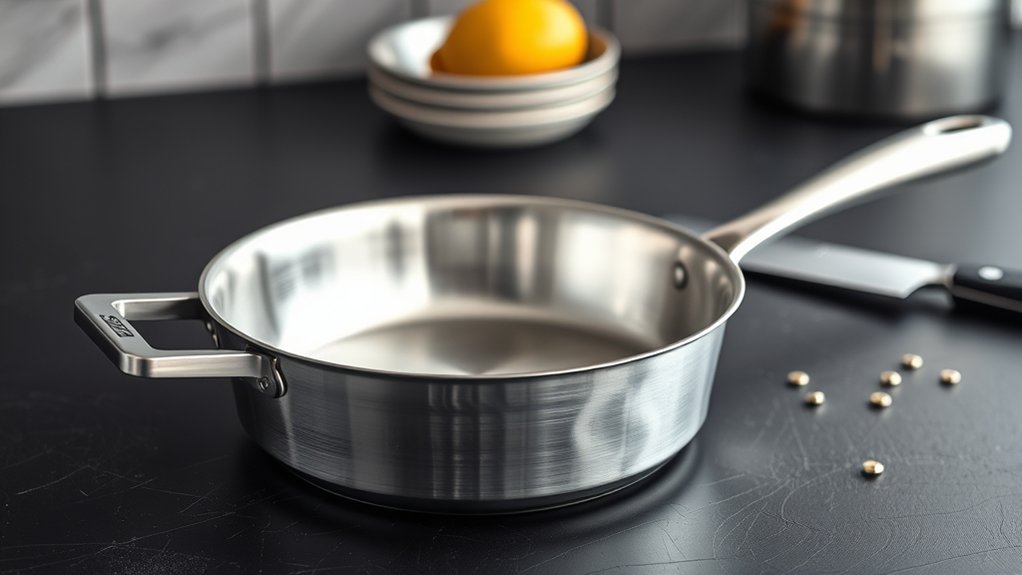
Many stainless steel pans contain aluminum, although the exact construction depends on the product. Manufacturers commonly combine the two metals because each performs a different job. Stainless steel provides a strong, corrosion-resistant cooking surface, while aluminum spreads heat quickly across the pan.
For example, All-Clad describes its D3 cookware as three bonded layers: a stainless steel exterior, an aluminum core, and a stainless steel interior. Other stainless cookware uses aluminum only in the base rather than throughout the sidewalls.
This means the label “stainless steel pan” describes the surfaces or main construction material, not necessarily every metal hidden inside the vessel. Copper and other conductive materials can also be used in multi-metal cookware.
Common Stainless Steel Pan Constructions
| Construction | Where the Conductive Metal Is | What It Means |
| Fully clad / tri-ply | Aluminum or another conductive layer extends through the bottom and sidewalls. | Helps distribute heat across more of the cooking vessel. |
| Encapsulated or disc base | Aluminum is concentrated in a bonded or enclosed base. | Improves heating across the bottom while keeping construction simpler and often less expensive. |
| Other multi-metal designs | May use copper, aluminum, or several different layers. | Performance depends on the actual layer materials, thickness, and placement rather than the number of plies alone. |
Why Stainless Steel Cookware Uses an Aluminum Core
Stainless steel is valued for durability, corrosion resistance, and a stable cooking surface, but it does not spread heat as efficiently as aluminum. An aluminum core helps solve that weakness.
In a fully clad pan, the conductive aluminum layer is bonded between stainless steel layers. The arrangement allows heat from the burner to spread through the pan more evenly instead of remaining concentrated over the heat source. All-Clad specifically describes its bonded stainless-and-aluminum construction as providing faster heating and more even heat distribution.
This combination is useful for tasks such as browning, sautéing, pan sauces, and simmering because temperature changes can spread more consistently across the cooking surface.
The stainless steel is mainly there for durability and the cooking surface; the hidden aluminum layer does much of the work of spreading heat.
Fully Clad vs. Encapsulated-Base Stainless Steel
Not every stainless steel pan with aluminum is fully clad. This is an important buying distinction.
Fully clad cookware carries bonded layers through the bottom and sidewalls. Encapsulated-base or disc-bottom cookware places the conductive aluminum mainly at the bottom. Both designs can improve heating compared with a thin stainless-only base, but they distribute heat differently.
Cuisinart’s cookware guide, for example, describes Chef’s Classic Stainless Steel as having an encapsulated aluminum base while MultiClad Pro uses a fully clad triple-ply aluminum-core construction.
Pro Tip: When comparing pans, look for wording such as “fully clad,” “tri-ply throughout,” or “rim-to-rim cladding.” If the description says “encapsulated base,” “bonded base,” or “impact-bonded base,” the conductive layer is usually concentrated at the bottom.
When Aluminum Is Exposed in Cookware
Exposed aluminum is not automatically a defect. Many pans are intentionally made from bare or anodized aluminum. The important question is whether the aluminum was designed to contact food or whether damage has exposed a layer that was originally supposed to remain enclosed.
According to Health Canada, worn or pitted aluminum cookware can transfer more material to food, and acidic or salty foods such as tomatoes and citrus can increase transfer. Its guidance recommends avoiding long cooking or storage of acidic or salty foods in bare aluminum cookware and following the manufacturer’s instructions.
That guidance should not be confused with an aluminum core sealed inside a stainless steel pan. In normal clad construction, food contacts the stainless interior rather than the aluminum layer.
A different concern applies if a bonded pan is visibly separating, cracking, bulging, or losing material from a normally sealed edge. Those signs can indicate physical damage or delamination. In that situation, stop using the pan until the manufacturer confirms whether the condition is normal for that model.
Caution: Do not assume every silver-colored layer at a pan’s rim is dangerous exposed aluminum. Some bonded cookware intentionally shows its layer structure at the edge. Physical separation, sharp gaps, flaking, or deformation are more meaningful signs of damage.
How to Tell Stainless Steel From Aluminum Pans
A magnet can help identify some cookware materials, but it is not a definitive stainless-steel test. Aluminum itself is not attracted to an ordinary magnet, while some stainless steels are strongly magnetic and others are weakly magnetic or effectively non-magnetic.
The British Stainless Steel Association explains that common 18/8-type austenitic stainless steel is normally only weakly attracted to a magnet. Stainless steel can also become more magnetic after forming or other processing.
Note: A magnet sticking strongly to the bottom of a pan may tell you more about an induction-compatible exterior layer than about the metal used on the cooking surface.
Use several checks together:
- Read the product specifications. This is the most reliable way to identify a clad core or encapsulated base.
- Check markings on the underside. Manufacturers may identify stainless grades, tri-ply construction, induction compatibility, or aluminum-core construction.
- Look at the rim or base. Some clad cookware visibly shows multiple bonded layers.
- Consider weight. Bare aluminum cookware is often lighter than similarly sized multi-layer stainless cookware, although thickness and design can change this.
- Use a magnet only as supporting evidence. A weak or absent magnetic response does not prove that an item is aluminum.
Visual shine, tapping sounds, or how cool the metal feels are too dependent on finish, thickness, temperature, and construction to serve as reliable identification tests by themselves.
What 18/10 Stainless Steel Means
The labels 18/10, 18/8, and 18/0 refer broadly to chromium and nickel content, not to a toxicity score.
The British Stainless Steel Association explains that 18/8 commonly refers to an approximately 18% chromium, 8% nickel stainless steel associated with grade 304. The term 18/10 is also widely used for similar stainless products. It should not be treated as proof that a pan is “surgical grade” or inherently safer than every other stainless formulation.
Nickel improves properties such as corrosion resistance and helps stabilize austenitic stainless steel, but it matters to people with nickel sensitivity. Health Canada specifically advises people who are allergic to nickel not to use cookware containing nickel.
Stainless Steel, Aluminum, and Food Safety
Neither “stainless steel” nor “aluminum” by itself tells you whether a pan is appropriate for every person and every cooking method. Construction, surface condition, food type, cooking time, and individual sensitivities all matter.
Stainless steel is highly corrosion-resistant, but it is not completely inert. A 2013 study indexed by the U.S. National Library of Medicine found that nickel and chromium migration into tomato sauce varied with stainless grade, cooking time, and previous use. A later study published in 2017 also found higher release with acidic conditions and unused pots, but reported that the amounts released in its tested conditions remained below known allergy-triggering thresholds.
These findings are most relevant to people with metal sensitivities and to unusually long contact with acidic foods. They do not mean that ordinary stainless steel cookware should be described as toxic.
Bare aluminum presents a different situation. Health Canada notes that aluminum transfer can increase when cookware is worn or pitted and when it is used with acidic or salty foods. An aluminum core completely enclosed within stainless layers does not directly contact food during normal use.
Choose Fully-Clad Stainless Steel Cookware
Fully clad stainless steel cookware is a strong option when you want the durability of stainless steel and more even heat distribution from a conductive core. In common tri-ply construction, the aluminum layer extends through the bottom and sidewalls between stainless steel layers.
The main advantage is cooking performance rather than a blanket health claim. Full cladding can spread heat beyond the center of the pan, which is useful for sautéing, sauces, braising, and recipes that use the sidewalls as well as the base.
Disc-bottom cookware can still work well, particularly for stockpots and other vessels where most heating happens through the base. It is often less expensive than fully clad cookware.
Before buying, compare:
- whether the pan is fully clad or base-clad;
- the cooking-surface material;
- induction compatibility if needed;
- oven-temperature limits;
- weight and handle comfort;
- manufacturer care instructions; and
- whether you have a known nickel sensitivity.
Construction is more informative than marketing phrases such as “professional,” “premium,” or “surgical grade.”
Frequently Asked Questions
How Do I Tell if My Pan Is Stainless Steel or Aluminum?
Start with the manufacturer’s specifications or markings on the pan. Aluminum is not attracted to a normal magnet, but stainless steel is more complicated: ferritic stainless is magnetic, while common austenitic grades such as 304 may show little magnetic attraction. Weight, visible layers, and product documentation are therefore more reliable when used together.
What Is the Least Toxic Stainless Steel Cookware?
There is no recognized stainless-steel grade officially classified as the single “least toxic” cookware. Good-quality cookware from a reputable manufacturer should be used according to its instructions. Labels such as 18/10 describe alloy composition rather than a toxicity rating. People with a diagnosed nickel allergy should consider nickel content because many common stainless grades contain nickel.
What Is Healthier to Cook With, Aluminum or Stainless Steel?
Neither material can be declared universally healthier for everyone. Stainless steel is corrosion-resistant and works well with many foods, while bare aluminum transfers heat efficiently but can transfer more aluminum when worn or used for long periods with acidic or salty foods. People with nickel allergy may also need to avoid some stainless cookware. Use condition, construction, food type, and personal sensitivities to guide the choice.
What’s the Downside of Stainless Steel Cookware?
Stainless steel can stick if temperature and oil are not managed well, and high-quality clad pans can be heavier and more expensive than basic aluminum cookware. Thin stainless cookware may also heat unevenly. Nickel-containing grades can be unsuitable for people with nickel allergy, and stainless cookware can release small amounts of nickel or chromium under some cooking conditions.
Does the Aluminum Core in Stainless Steel Cookware Touch Food?
Normally, no. In properly manufactured clad stainless cookware, the aluminum core is bonded between other metal layers. Food contacts the stainless steel interior. The same principle applies to many encapsulated-base pans, where aluminum is enclosed within the bottom assembly.
Does a Magnet Prove a Pan Is Stainless Steel?
No. A strong magnetic response is common in some stainless grades, especially ferritic stainless used on induction-compatible exteriors, but many austenitic stainless steels are only weakly magnetic. A magnet is useful as one clue, not as a definitive material test.
Conclusion
Many stainless steel pans contain aluminum, but the aluminum usually serves as a hidden heat-conducting layer rather than the cooking surface. Fully clad pans carry that layer through the bottom and sidewalls, while other stainless cookware uses an aluminum disc or encapsulated base. Neither construction should be judged by appearance alone. Check the manufacturer’s specifications, consider your cooking needs and any metal sensitivities, and treat actual separation or damage differently from a normal visible layer at the edge of a bonded pan.
Sources
- Health Canada — The Safe Use of Cookware and Bakeware — guidance on aluminum food contact, stainless steel, nickel allergy, and cookware care.
- All-Clad — How Fully Bonded Cookware Is Made — manufacturer documentation for stainless-aluminum-stainless bonded construction.
- Cuisinart — Cookware Guide — examples of encapsulated aluminum-base and fully clad aluminum-core stainless cookware.
- British Stainless Steel Association — 18/8, 18/10 and 18/0 Stainless Steel Grades — chromium/nickel terminology and magnetic characteristics.
- U.S. National Library of Medicine / PubMed — Stainless Steel Leaches Nickel and Chromium Into Foods During Cooking — research on the effects of stainless grade, cooking time, and repeated use.
- U.S. National Library of Medicine / PubMed — Release of Nickel and Chromium During Cooking in 18/10 Stainless Steel Pots — research using common foods and cooking conditions.

2 thoughts on “Do All Stainless Steel Pans Have Aluminum? Materials & Construction”