
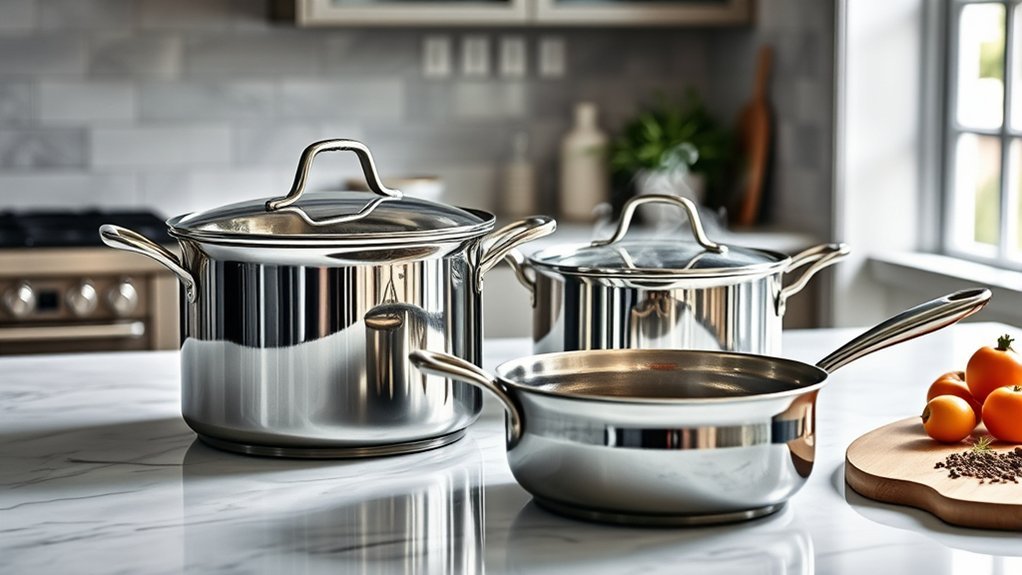
Good stainless steel cookware should be judged by its construction, heat behavior, compatibility, comfort, and the pieces you will actually use. Look beyond the number of layers or pieces on the box. A well-made skillet, saucepan, sauté pan, and stockpot with conductive aluminum or copper inside the structure can cover most everyday cooking while lasting for years.
Quick Answer
Choose stainless steel cookware with an aluminum or copper heat-conducting layer, a flat and stable base, comfortable handles, and pieces you will use regularly. Fully clad tri-ply is a strong all-around choice. For induction, confirm that a magnet sticks firmly to the base, and always check the manufacturer’s oven-temperature limits.
Key Takeaways
- Construction matters more than ply count alone. Check the core metal, thickness, bonding, weight, and whether the conductive layer extends up the sides.
- 18/10 stainless is common for cooking surfaces because it combines chromium and nickel for corrosion resistance, but it is not automatically the best choice for every person.
- Induction cookware needs a magnetic base. A simple magnet test is a useful first check.
- Count actual pots and pans, not just the advertised set-piece number, because lids and accessories are often counted separately.
- Oven limits vary widely by product, especially when glass lids, silicone parts, or special finishes are included.
Why Stainless Steel Cookware Is Worth It
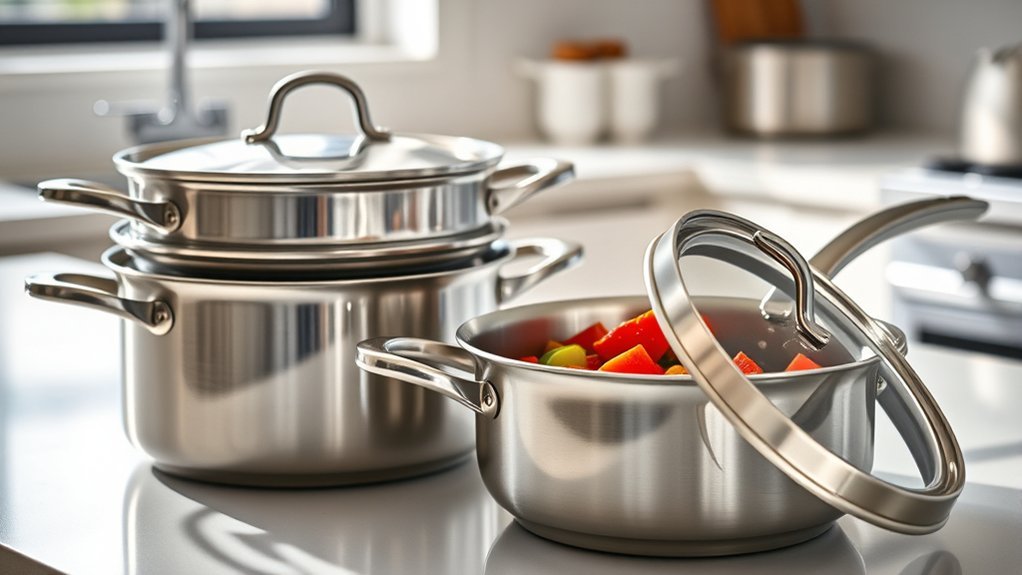
Stainless steel cookware offers an excellent combination of durability, corrosion resistance, and versatility. It does not have a disposable nonstick coating, and a quality pan can tolerate years of searing, sautéing, simmering, deglazing, and oven use when it is handled according to the manufacturer’s instructions.
Grade 304 stainless steel is widely used for cooking utensils. It contains roughly 18% chromium and about 10% nickel, which is why cookware may be described as 18/10 stainless steel. The chromium helps form a corrosion-resistant surface, while nickel contributes to the alloy’s stability and corrosion resistance. World Stainless describes grade 304 as a common material for cooking utensils.
The cooking surface is only part of the story: the aluminum or copper inside a clad pan does most of the work of spreading heat quickly and evenly.
Stainless steel is also commonly described as nonreactive in normal culinary use, making it suitable for tomatoes, wine sauces, citrus, and other acidic foods. However, “nonreactive” does not mean that absolutely no metal can migrate into food. Laboratory and cooking studies have measured nickel and chromium release under some acidic and prolonged cooking conditions, especially with newer cookware.
Warning: People with diagnosed nickel sensitivity should not assume that 18/10 cookware is automatically the safest choice for them. Discuss significant nickel-avoidance needs with a qualified clinician. Research on stainless cookware shows that metal release varies with alloy, food acidity, cooking time, and cookware age.
The stainless cooking surface itself can tolerate high cooking temperatures, but the maximum safe oven temperature of a finished pan depends on its handles, lids, coatings, bonding, and other components. Always use the rating supplied for the exact product.
Choose the Right Construction
Construction is one of the most important buying criteria. Stainless steel conducts heat relatively poorly by itself, so quality cookware usually combines it with a more conductive metal such as aluminum or copper.
Fully Clad Vs Disc-Bottom Cookware
Fully clad cookware bonds the conductive layer between stainless steel layers across the base and up the sidewalls. This can improve heat spread around the entire vessel and is especially useful for skillets, sauté pans, and saucepans where food contacts both the bottom and sides.
Impact-bonded or encapsulated-base cookware concentrates its aluminum or copper in a disc at the bottom. This design can work very well for boiling, stockpots, and many everyday tasks, and it often costs less. However, the sidewalls do not receive the same conductive layer as a fully clad pan.
Neither design should be judged by a label alone. Look at the pan’s total weight, flatness, handle attachment, wall thickness, warranty, and real-world fit for the task.
Tri-Ply Vs 5-Ply
Tri-ply cookware typically combines a stainless cooking surface, a conductive aluminum or copper layer, and a stainless exterior. It is popular because it can balance even heating, moderate weight, durability, and price.
Five-ply cookware adds more bonded layers, but extra layers do not automatically make a pan better. A five-ply pan may be heavier or designed to moderate temperature changes, while a good tri-ply pan may heat faster and feel easier to handle. The thickness and material of each layer matter more than the number printed on the package.
| Feature | Tri-Ply | Five-Ply |
|---|---|---|
| Typical feel | Often lighter | Often heavier |
| Heat response | Can respond quickly | Depends on layer materials and thickness |
| Cost | Usually lower | Usually higher |
| Best buying rule | Compare the whole construction, not ply count alone. | |
Clad Core Construction
A clad core pairs stainless steel with a more conductive metal, most commonly aluminum. Copper may also be used because it responds quickly to temperature changes, although it usually raises the price substantially.
Good bonding matters because the pan needs to remain flat and transfer heat consistently. A heavier pan can feel stable on the burner, but excessive weight may be uncomfortable when the vessel is full. Try to balance thermal mass with practical handling.
18/10, 18/8, and 18/0 Stainless Steel
The numbers commonly used in cookware marketing refer approximately to chromium and nickel content. For example, 18/10 indicates roughly 18% chromium and 10% nickel. Type 304 stainless may be marketed as 18/8 or 18/10 depending on the exact composition and manufacturer terminology.
18/0 stainless contains chromium but little or no nickel and is commonly used where magnetism or lower nickel content is desirable. It may not match the corrosion resistance of a well-made 18/10 cooking surface in every kitchen environment, but alloy grade alone does not tell you how evenly a pan will heat. Heat performance mainly depends on the conductive core and overall construction.
Pick the Pieces You’ll Use Most
The most practical cookware set is the one that contains pans you will actually use. A skillet, saucepan, sauté pan, and stockpot cover most everyday tasks without filling the cabinet with duplicates.
| Piece | Main Uses | What to Check |
|---|---|---|
| Skillet | Searing, sautéing, frying | Broad cooking area and flared sides for easier tossing and pouring |
| Saucepan | Sauces, grains, reheating, small batches | Comfortable long handle and useful capacity |
| Sauté pan | Braising, pan sauces, shallow frying | Helper handle and tight-fitting lid |
| Stockpot | Soups, pasta, stock, batch cooking | Secure side handles and enough capacity without excessive weight |
Do Not Judge a Set by Piece Count Alone
A “10-piece” set does not usually contain 10 pots and pans. Manufacturers commonly count lids, inserts, utensils, and accessories as individual pieces. Read the complete set list and count the actual cooking vessels before comparing value.
Also consider whether you need two similar saucepans, multiple skillets, or a very large stockpot. Buying fewer useful pieces can be better value than buying a large set filled with sizes you rarely use.
Match Your Cookware to Your Cooktop
Cooktop compatibility should be confirmed before purchase. Gas, radiant electric, and ceramic cooktops can work with many cookware materials, but induction requires a magnetic cooking vessel.
Induction Compatibility
Induction works with cookware that has enough ferromagnetic material in the base. GE Appliances recommends the simple magnet test: if a magnet sticks firmly to the bottom, the pan is a strong candidate for induction use.
Pro Tip: Bring a small magnet when shopping in person. A stainless-looking pan may still fail on induction because some stainless alloys are not sufficiently magnetic.
For best results, match the magnetic base of the cookware reasonably closely to the induction element. A much smaller pan may receive reduced power, while an oversized pan is heated mainly over the active coil area.
Oven and Hob Fit
Flat-bottomed cookware provides stable contact on smooth electric, ceramic, and induction surfaces. Gas is more forgiving of slight irregularities, but a stable base is still important for safe handling.
| Check | Why It Matters |
|---|---|
| Flat base | Improves stability and contact on smooth cooktops |
| Magnetic base | Required for induction |
| Pan and lid oven ratings | Prevents damage from exceeding manufacturer limits |
| Flared rim | Helps reduce drips when pouring |
Note: Never assume every stainless pan is oven-safe to the same temperature. For example, All-Clad D3 Everyday cookware is rated to 600°F, while the Williams Sonoma Thermo-Clad Copper set is rated to 450°F and its lids to 375°F.
Compare Heat Performance and Durability
Good stainless cookware combines a durable steel surface with a conductive core. Aluminum spreads heat much faster than stainless steel, helping reduce hot spots and making a clad pan easier to control.
Copper is even more responsive to temperature changes, which can be useful for precise sauces and other techniques, but copper cookware is usually more expensive and may require more care.
Do not use weight alone as a quality test. A pan should feel solid and remain flat, but it should also be comfortable enough to lift safely when full. Construction quality, bonding, handle attachment, and warranty matter as much as mass.
Warping risk also depends on how the pan is used. One common cause is thermal shock, such as putting a very hot pan under cold water. Allow cookware to cool before washing.
Look for Helpful Design Features
Small design details can make a noticeable difference in everyday use.
- Comfortable handles: The handle should feel secure when the pan is empty and when it is loaded with food.
- Helper handles: Especially useful on sauté pans and stockpots that become heavy when full.
- Flared rims: Help with drip-controlled pouring and make it easier to slide food from a skillet.
- Tight-fitting lids: Reduce evaporation during simmering, braising, and steaming.
- Measurement markings: Useful in saucepans and stockpots when recipes require measured liquids.
- Rivets or welded handles: Both can work well when properly engineered. Check for movement, awkward edges, and difficult-to-clean areas.
Before buying a large set, lift the skillet and saucepan in person if possible. A handle that looks attractive online may feel uncomfortable once the vessel is full.
How to Cook With Stainless Steel Without Excessive Sticking
Stainless steel is not a nonstick surface, and that is not necessarily a defect. The surface is excellent for browning because food proteins can initially bond to the metal and then release as they cook.
For many foods, preheat the pan over low to medium heat, add an appropriate amount of cooking fat, and then add dry food. Avoid starting every recipe over maximum heat. Excessive heat can burn oil, discolor the pan, and make sticking worse.
When searing meat, give it time before trying to turn it. Properly browned food often releases more easily once a crust has formed. The browned residue left behind can then be deglazed with stock, wine, or another liquid to make a pan sauce.
How to Clean Stainless Steel Cookware
Allow a hot pan to cool before washing it. Sudden temperature changes can distort cookware, so do not put a very hot stainless pan directly under cold water.
For routine cleaning, warm soapy water and a sponge or soft cloth are usually enough. Soaking can loosen stuck food. Follow the manufacturer’s care instructions because some stainless cookware is dishwasher-safe while other brands recommend hand washing.
For rainbow discoloration or mineral residue, white vinegar is commonly recommended by cookware manufacturers. All-Clad, for example, advises vinegar for blue or rainbow discoloration and a diluted vinegar solution for cloudy hard-water spots.
A nonabrasive stainless cookware cleanser can help remove stubborn burnt-on residue. Avoid oven cleaner, chlorine bleach, steel wool, or harsh scouring products unless the cookware manufacturer specifically says they are safe.
Dry cookware after washing if you want to minimize water spots. Cosmetic discoloration normally does not mean a stainless pan has lost its ability to cook properly.
Check Warranty and Care Requirements
A long warranty can add value, but read what it actually covers. Most cookware warranties protect against manufacturing defects rather than overheating, thermal shock, misuse, stains, or normal cosmetic wear.
Also check whether the manufacturer recommends hand washing, allows dishwasher use, permits metal utensils, and places different heat limits on lids and pans. Those details can matter more in daily use than an extra layer of metal.
Stainless Steel Cookware Sets by Budget: Current Examples
The products below are examples at different price points rather than a laboratory-tested ranking. Prices were checked on September 17, 2026 and can change.
| Set | Price Checked | Construction / Strength | Important Limitation |
|---|---|---|---|
| Goldilocks 7-Piece Cookware Set | $215 | Fully clad tri-ply; 304 stainless interior, aluminum core, magnetic stainless exterior; induction-compatible | Smaller set with four cooking vessels and three lids |
| Cuisinart Professional Series 11-Piece Set | $279.95 | Stainless construction with PowerBond impact-bonded aluminum base; induction-compatible; oven-safe to 500°F | Not fully clad up the sides; one included 8-inch skillet has a ceramic nonstick surface |
| GreenPan Reserve Pro Uncoated Stainless Steel 12-Piece Set | $499.99 | Tri-ply stainless with aluminum core; induction-compatible; cookware rated to 600°F | Some of the advertised 12 pieces are utensils/accessories rather than additional pans; lids have a lower heat limit |
| All-Clad D3 Everyday 10-Piece Set | $749.99 | Fully bonded tri-ply with aluminum core; induction-compatible; oven and broiler safe to 600°F | Higher purchase price; manufacturer specifies hand washing |
| Williams Sonoma Signature Thermo-Clad Copper 10-Piece Set | $899.97 clearance | 1.2 mm copper with 18/10 stainless-steel lining for very responsive stovetop heat control | Not induction-compatible; cookware rated to 450°F and lids to 375°F |
The lowest price is not automatically the best value, and the highest price does not guarantee that a set fits your kitchen. Compare the number of useful vessels, construction, cooktop compatibility, weight, warranty, and heat limits before choosing.
Frequently Asked Questions
What should I look for when buying a stainless steel pan?
Look for a conductive aluminum or copper layer, solid bonding, a flat base, comfortable handles, useful size, and compatibility with your cooktop. Fully clad tri-ply is a strong general-purpose construction. Also check the pan’s weight, oven rating, warranty, and whether the base is magnetic if you use induction.
Which is healthier, 18/0 or 18/10 stainless steel?
Neither grade should be called universally healthier. 18/10 contains nickel and generally provides strong corrosion resistance, while 18/0 contains little or no nickel. For most users, quality stainless cookware is a practical food-contact material. People with diagnosed nickel sensitivity may have different needs and should follow appropriate medical guidance.
How can I tell whether stainless steel cookware is good quality?
Check how the pan is constructed rather than relying on its shine or brand name. Good signs include a conductive core, even bonding, a flat base, secure handles, useful weight, clear material specifications, realistic oven limits, and a meaningful warranty. Reviews can help identify long-term problems such as warping or loose handles.
How do I pick a good stainless steel cookware set?
Start with the pieces you use most, then compare construction, cooktop compatibility, handle comfort, lid quality, oven limits, and warranty. Do not compare sets by advertised piece count alone because lids and accessories often count as separate pieces.
Is five-ply stainless steel always better than tri-ply?
No. Five-ply adds layers, but the number of layers does not reveal their thickness, materials, or total mass. A well-designed tri-ply pan can heat evenly, respond quickly, and weigh less. Compare the complete construction rather than assuming a higher ply count guarantees better performance.
Does all stainless steel cookware work on induction?
No. Induction requires a magnetic base. Many stainless cookware lines include a magnetic exterior layer, but some stainless alloys are not sufficiently magnetic. Check the manufacturer’s induction label or test the base with a magnet before buying.
Conclusion
Choosing stainless steel cookware is a long-term purchase, but the decision does not need to be complicated. Start with construction and useful pieces, then confirm cooktop compatibility, handle comfort, oven limits, warranty, and price. Fully clad tri-ply cookware is a dependable starting point for many kitchens, but a well-made disc-bottom pan or heavier multi-ply design may suit other budgets and cooking styles.
Do not assume that more layers, more pieces, a higher price, or an 18/10 label automatically guarantees better cooking. The best choice is the cookware whose materials, geometry, weight, and features match the way you actually cook.
Sources
- World Stainless — Stainless Steel for Hygiene — grade 304 composition and use in cooking utensils.
- GE Appliances — Induction Cooking — magnetic cookware requirements and magnet test.
- PubMed — Stainless steel leaches nickel and chromium into foods during cooking — research on metal release under acidic and prolonged cooking conditions.
- All-Clad D3 Everyday 10-Piece Set — construction, induction compatibility, oven rating, care guidance, and current price.
- Cuisinart Professional Series 11-Piece Set — impact-bonded construction, set contents, induction compatibility, oven rating, and current price.
- Williams Sonoma Signature Thermo-Clad Copper Set — copper construction, oven limits, cooktop compatibility, and current price.