
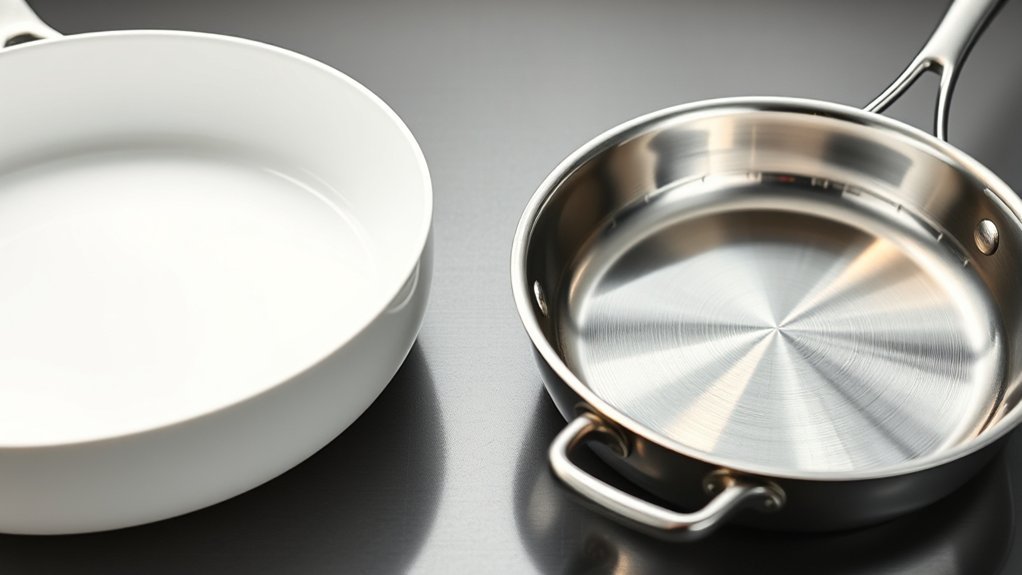
Ceramic and stainless steel cookware solve different kitchen problems. Ceramic-coated pans make eggs, pancakes, fish, and other delicate foods easier to release with little added fat, while stainless steel is better suited to browning, searing, deglazing, pan sauces, and long-term use. The right choice depends less on which material is “healthier” and more on how you cook, how much maintenance you accept, and how long you expect the cookware to last.
Quick Answer
Stainless steel is generally the stronger all-purpose choice for durability, browning, high-heat cooking, and long service life. Ceramic-coated cookware is easier for eggs, pancakes, fish, and other foods that benefit from a slick surface. Many kitchens work best with stainless steel for everyday cooking plus one ceramic nonstick skillet for delicate foods.
Key Takeaways
- Ceramic-coated cookware wins on easy food release, especially for eggs, pancakes, fish, and other delicate foods.
- Stainless steel wins on durability and versatility because it has no nonstick coating that gradually loses its release properties.
- Good stainless cookware often uses an aluminum or copper core to spread heat; stainless steel alone is not an especially efficient heat conductor.
- Ceramic nonstick coatings generally benefit from low-to-medium heat, soft utensils, and gentle cleaning.
- Oven, dishwasher, broiler, and induction compatibility vary by product, so check the manufacturer’s instructions rather than relying on material alone.
- Neither material is universally the “healthiest.” Buy reputable food-contact cookware and use it according to its care instructions.
Ceramic vs Stainless Steel: Which Is Better?
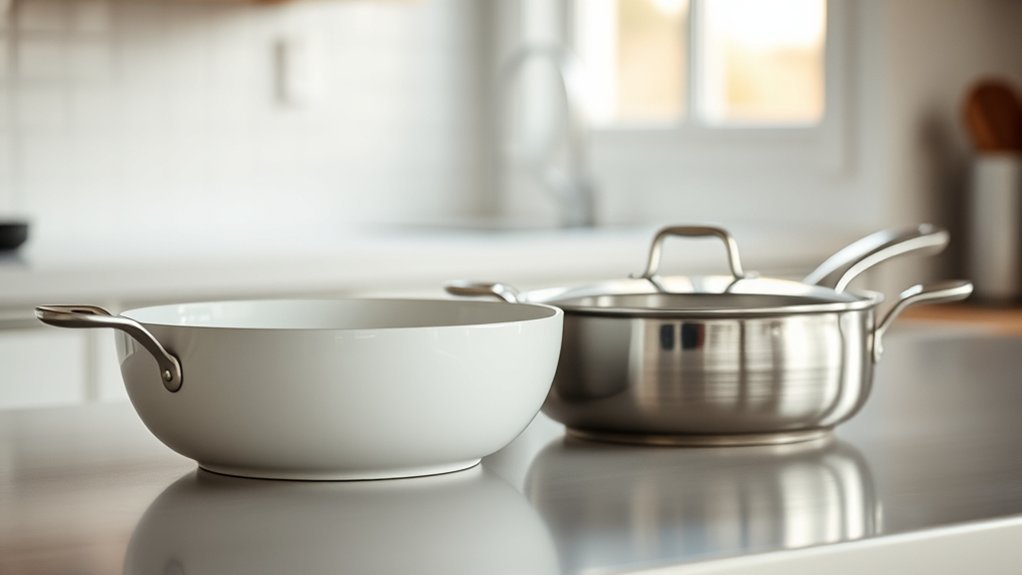
For most cooks who want one material to handle the widest range of recipes, stainless steel is the more versatile long-term option. It can brown meat, develop fond for sauces, sauté vegetables, boil pasta, braise, and move into the oven when the particular pan and handles are rated for it.
Ceramic-coated cookware has a different strength. Its smooth cooking surface offers easier initial release, so it is convenient for eggs, pancakes, fish, and similar foods that tend to stick to bare stainless steel.
The tradeoff is that a ceramic nonstick surface is a wear component. Its release performance can gradually decline with repeated heating, abrasion, cooking residue, and everyday use. Uncoated stainless steel does not depend on a nonstick coating, so a well-built pan can remain useful for many years if it is not badly warped or physically damaged.
| Factor | Ceramic-Coated Cookware | Stainless Steel Cookware |
|---|---|---|
| Food release | Very easy when the coating is performing well | Technique-dependent |
| Best uses | Eggs, pancakes, fish, gentle sautéing | Searing, browning, sauces, sautéing, boiling, braising |
| Heat approach | Usually low to medium for coating longevity | Broader range, but excessive heat is rarely necessary |
| Durability | Limited by coating wear | Potentially very long service life |
| Learning curve | Low | Higher for foods prone to sticking |
| Induction | Only if the pan has an induction-compatible magnetic base | Only if the exterior/base is magnetic |
| Best overall fit | Easy-release specialist pan | Long-term everyday cookware |
What “Ceramic Cookware” Usually Means
Most cookware marketed as ceramic nonstick is not a solid piece of fired ceramic. It is usually a metal pan—commonly aluminum—with a ceramic-style nonstick coating applied to the cooking surface. Formulations and substrates differ by manufacturer.
That distinction matters because the metal body largely determines the pan’s weight and heat response, while the coating determines food release and many of the care requirements.
Solid ceramic cookware, ceramic bakeware, enameled cast iron, and ceramic-coated aluminum are different product categories. This comparison focuses on the ceramic-coated stovetop cookware commonly sold as an alternative to conventional nonstick pans.
Ceramic Cookware Pros and Cons
The main advantage of ceramic-coated cookware is immediate nonstick convenience. A pan in good condition can release eggs, fish, pancakes, and soft vegetables with little resistance and relatively little added oil.
Cleanup can also be simple when food has not been burned onto the surface. Major ceramic cookware manufacturers commonly recommend low-to-medium heat, soft utensils, and gentle washing to preserve coating performance.
There are tradeoffs. Unlike an uncoated stainless cooking surface, the ceramic nonstick layer gradually changes with use. High heat, abrasive cleaners, cooking sprays that leave residue, metal utensils, stacking without protection, and thermal shock can shorten useful nonstick performance.
- Pros: easy food release, simple cooking for delicate foods, relatively low oil requirement, and a short learning curve.
- Cons: coating performance declines with wear, care is more restrictive, and high-heat cooking is usually discouraged.
Warning: Do not assume every ceramic-coated pan can tolerate the same heat. Follow the manufacturer’s burner and oven limits, and avoid leaving an empty coated pan over strong heat unless its instructions specifically allow it.
Stainless Steel Cookware Pros and Cons
Stainless steel cookware is valued for durability, browning ability, and versatility. Because the cooking surface is not a sacrificial nonstick coating, ordinary wear does not cause the same gradual loss of nonstick performance seen with coated pans.
The main disadvantage is that bare stainless steel is not inherently nonstick. Eggs, fish, lean proteins, and starchy foods can grab the surface if the pan is too cold, too hot, insufficiently lubricated, or disturbed before the food has browned enough to release.
Construction also matters. Stainless steel is durable and corrosion-resistant, but it is not an especially effective heat conductor by itself. Better pans commonly sandwich aluminum or copper between stainless layers or attach a conductive disc to the base.
Heat Control Challenges
Successful stainless cooking requires more attention to preheating and burner control than ceramic nonstick. That does not mean the burner should automatically be turned to maximum.
For many tasks, moderate heat is enough. Preheat the pan gradually, add a thin film of suitable cooking fat, add the food, and allow proteins to brown before trying to move them. Once a good crust develops, meat often releases more readily on its own.
Pro Tip: If food repeatedly burns before it releases from stainless steel, reducing the burner is often more useful than adding dramatically more oil. A well-preheated pan plus a light coating of fat is usually enough for many foods.
Durability and Longevity
A well-made stainless pan can remain functional for many years because there is no nonstick layer that must remain slick. Rivets, handles, warping, severe pitting, or physical damage can still limit service life, so construction quality matters.
Fully clad stainless cookware is especially useful when the conductive core extends up the sides of the pan. Disc-bottom designs concentrate the conductive layer at the base and can still work well for stockpots, saucepans, and boiling tasks.
Premium stainless cookware may also carry long warranties, although warranty length should not be confused with a guaranteed service life.
Cleaning and Maintenance
Stainless steel is generally tolerant of more intensive cleaning than ceramic nonstick, but “stainless” does not mean indestructible.
Warm water, dish soap, and a sponge are enough for routine cleaning. For stuck food, soaking or simmering water in the pan can loosen residue. A stainless-steel cleaner or baking-soda method can help with stubborn browned deposits, while diluted vinegar can help remove cloudy mineral marks.
Dishwasher instructions vary. Some stainless cookware is dishwasher compatible, while other manufacturers recommend or require hand washing to preserve the finish and construction. The same product-specific rule applies to abrasive pads and metal utensils.
How They Perform in the Pan
Ceramic and stainless cookware feel very different during actual cooking.
A ceramic-coated skillet gives the cook a larger margin for error with sticky foods. Eggs and pancakes normally release with less technique, and cleanup is often quick while the coating remains in good condition.
Stainless steel provides less automatic release, but it offers an advantage when sticking is intentional. Proteins can leave browned bits called fond on the pan surface. Those browned bits can be dissolved with stock, wine, water, or another liquid to build a pan sauce.
For searing, browning, and repeated sautéing, a well-constructed clad stainless pan is usually the more capable tool. For a soft omelet or fragile fish fillet, ceramic nonstick is usually easier.
Ceramic vs Stainless Steel Non-Stick Performance
For pure food-release performance, ceramic-coated cookware has the advantage when its surface is new and functioning well. Stainless steel can release food cleanly, but it relies on technique rather than a permanently slick surface.
Food Release Ease
Eggs, pancakes, soft fish, and similar foods are where ceramic nonstick earns its place in a kitchen. Less force is required to turn or lift them, reducing the chance that delicate foods will tear.
With stainless steel, food release improves when three things are controlled: pan temperature, cooking fat, and timing. Trying to move a protein immediately after it touches the pan commonly makes sticking worse.
As ceramic coatings age, their release characteristics can gradually change. This does not mean every pan fails on a fixed calendar. Frequency of use, heat, cleaning, utensils, formulation, and storage all affect useful coating life.
Oil and Heat Needs
Ceramic cookware normally needs only a small amount of oil or butter for many dishes. Stainless steel also does not necessarily require a large amount of fat; a thin, even film may be enough when preheating and temperature are correct.
The larger difference is heat tolerance. Ceramic nonstick manufacturers commonly recommend low-to-medium burner settings to protect coating performance. Uncoated stainless cookware generally offers a wider operating range, although extreme heat is rarely necessary for routine cooking.
Always follow the specific pan’s maximum oven temperature. Handle materials, lids, bonding methods, and coatings can reduce the usable temperature even when the main body of the pan could tolerate more.
Delicate Food Cooking
Ceramic nonstick is usually easier for foods that are fragile, low in fat, or prone to sticking. Examples include:
- Eggs and omelets
- Pancakes and crepes
- Delicate fish fillets
- Soft vegetables
- Reheating foods that would otherwise adhere to bare metal
Stainless steel can cook many of the same foods, but technique matters more. If effortless release is a daily priority, keeping one coated skillet alongside a stainless set is often more practical than forcing one cookware material to perform every job.
Durability and Lifespan
Durability is one of the clearest differences between ceramic nonstick and uncoated stainless steel.
The useful life of ceramic cookware is limited mainly by its nonstick coating, while the useful life of stainless steel is limited more by the pan’s physical construction and condition.
A ceramic pan can remain physically intact after its slick release has declined. That is why “lifespan” is difficult to express as one universal number: some owners use a coated skillet occasionally, while others heat it every morning.
Signs that ceramic nonstick performance is deteriorating include:
- Food begins sticking even with proper heat and a small amount of oil.
- A coating that once cleaned easily repeatedly holds residue.
- There is substantial visible coating damage or peeling.
- The manufacturer recommends replacement because of the condition of the surface.
- The pan itself has warped or become unstable on the cooktop.
Stainless cookware can also be damaged. Serious warping, loose handles, deep pitting, or compromised bonding can justify replacement. Cosmetic rainbow discoloration or ordinary surface scratches, however, do not automatically mean a stainless pan is unusable.
Cleaning and Daily Care
Ceramic-coated cookware deserves gentler treatment because preserving the cooking surface is part of preserving its performance.
- Use soft sponges or cloths unless the manufacturer allows something more abrasive.
- Wood, silicone, or nylon utensils are generally the safest choices for the coating.
- Let a hot pan cool before washing it to reduce thermal shock.
- Avoid overheating and burned-on oil residue.
- Hand washing often helps preserve coated cookware even when a particular model is labeled dishwasher safe.
Stainless steel is more forgiving but should still be cleaned according to its manufacturer’s instructions. Some premium stainless lines now specify hand washing, so dishwasher safety should not be assumed solely from the material.
For stainless discoloration, treat the problem rather than attacking the pan with the harshest abrasive available. White mineral deposits can respond to diluted vinegar, while stuck-on food can often be loosened with water, baking soda, soaking, or a cleaner formulated for stainless cookware.
Are Ceramic and Stainless Steel Safe?
Both reputable ceramic-coated and stainless steel cookware can be appropriate for normal food preparation when they are manufactured for food contact and used according to their instructions. The more useful safety question is whether a particular product is well made, undamaged, suitable for the intended temperature, and used correctly.
The U.S. Food and Drug Administration treats cookware and cooking surfaces as part of the broader category of materials that can come into contact with food. Buying from a reputable manufacturer with clear material disclosures and care instructions is therefore more useful than relying on marketing words such as “non-toxic” alone.
Stainless Steel and Metal Migration
Stainless steel is corrosion-resistant, but it should not be described as completely incapable of releasing metals. Peer-reviewed studies have measured nickel and chromium migration from stainless cookware, with results influenced by alloy, food acidity, cooking duration, and whether the cookware was new.
One study using 18/10 grade 316 cookware found greater release with acidic conditions and unused pans, while measured amounts in its cooking experiments remained below known allergy-triggering thresholds. Results from different studies and cooking conditions vary, so they should not be turned into an absolute “zero leaching” or “unsafe” claim.
Note: People with diagnosed nickel sensitivity who have been told to limit dietary nickel should discuss their individual cookware concerns with a qualified healthcare professional rather than assuming every stainless-steel grade behaves identically.
Ceramic Coating Safety
Modern ceramic nonstick cookware is commonly marketed as a PTFE-free alternative to conventional fluoropolymer nonstick cookware. However, formulations differ, so material claims should be checked for the specific brand and product.
“PFOA-free” also needs context. PFOA manufacture and import were phased out in the United States through the EPA’s 2010/2015 stewardship program. That means a PFOA-free statement by itself does not tell you everything about a pan’s formulation or overall quality.
Visible ceramic coating wear is best treated primarily as a performance and product-condition issue. Follow the manufacturer’s guidance on continued use or replacement rather than assuming every scratch has the same significance across all coatings.
Induction, Oven, and Cooktop Compatibility
Neither “ceramic” nor “stainless steel” automatically guarantees compatibility with every cooktop.
Induction cooking requires a magnetic base. Many stainless pans use a magnetic exterior layer and work on induction, but some stainless alloys are not sufficiently magnetic on their own. Ceramic-coated aluminum cookware needs a compatible magnetic plate or base to work on induction.
A quick preliminary check is whether a magnet strongly attaches to the bottom of the pan, although the manufacturer’s induction symbol or specifications provide the better answer.
Oven and broiler limits also vary. Fully bonded stainless products can sometimes tolerate very high oven temperatures, while coated pans commonly have lower recommended limits. Glass lids, silicone grips, removable handles, and other components may have their own lower temperature ratings.
Never assume a pan is broiler safe simply because it is oven safe.
Which Cookware Is Better Value?
Value depends on purchase price, construction, how often the cookware is used, and how soon its performance requires replacement.
Ceramic cookware can offer good value when easy release is the main goal. Stainless steel can provide stronger long-term value when one well-built pan handles many techniques for many years.
Upfront Cost Differences
There is no reliable universal rule that ceramic cookware costs one amount while stainless steel costs another. Both categories range from inexpensive pans to premium sets.
A fair comparison should match like with like:
- Single skillet versus single skillet
- Comparable diameter and capacity
- Similar number of pieces in a set
- Clad construction versus basic construction
- Comparable warranty and brand tier
A low-priced ceramic skillet may cost less than premium fully clad stainless steel, but premium ceramic sets can also cost more than entry-level stainless cookware.
Long-Term Replacement Costs
Replacement frequency is where stainless steel often gains an economic advantage. Because an uncoated stainless cooking surface does not depend on nonstick performance, gradual loss of slickness is not a reason to replace it.
Ceramic nonstick eventually becomes less convenient if its coating no longer releases food as expected. How quickly that happens varies substantially with the product and how it is treated.
For someone who uses nonstick only for breakfast, owning one ceramic skillet and replacing it when necessary may be more economical than buying a complete coated set. For someone who wants one cookware system for years of varied cooking, stainless steel can make more financial sense.
Which Cookware Matches Your Cooking Style?
Choose according to the meals you actually make rather than treating one material as universally superior.
| Cooking Priority | Better Fit | Why |
|---|---|---|
| Eggs and pancakes | Ceramic | Easy release with little technique |
| Searing steak or chops | Stainless steel | Better suited to browning and fond development |
| Pan sauces | Stainless steel | Allows fond to form and be deglazed |
| Delicate fish | Ceramic | Lower risk of tearing during release |
| Long-term everyday use | Stainless steel | No nonstick coating to wear out |
| Lowest learning curve | Ceramic | More forgiving food release |
If you regularly make a wide variety of meals, a mixed setup is practical: use stainless steel for most cooking and keep a smaller ceramic-coated skillet for eggs and other delicate foods.
What to Look for Before Buying
Material name alone does not tell you whether a pan is well designed. Check the complete specification before buying.
- Construction: For stainless cookware, look for a substantial aluminum or copper core, either fully clad or in a well-made base.
- Induction compatibility: Confirm it explicitly if you use an induction cooktop.
- Oven rating: Check the complete pan, handle, and lid temperature limits.
- Broiler rating: Do not assume oven-safe cookware is also broiler safe.
- Care instructions: Check whether hand washing is recommended and which utensils are allowed.
- Coating disclosure: With ceramic nonstick, read the manufacturer’s material and coating information rather than relying only on front-of-box marketing.
- Warranty: Check whether the coating has a different warranty period from the pan body.
- Weight and handles: A pan that is uncomfortable to lift will be frustrating regardless of its material.
- Flatness: A stable, flat base matters particularly on glass and induction cooktops.
- Actual cooking needs: Buy pieces you will use instead of choosing a large set solely because it contains more items.
Frequently Asked Questions
Which Is Better for Your Health, Ceramic or Stainless Steel?
There is no universally healthiest choice between the two. Reputable ceramic-coated and stainless cookware can both be suitable for food preparation when used as directed. Stainless steel may release small amounts of nickel and chromium under some cooking conditions, which can matter to people with specific nickel sensitivity. Ceramic coatings require appropriate heat and care to preserve their condition and performance.
What Is the Downside of Ceramic Cookware?
The main downside is that the nonstick coating is a wear surface. Its easy-release performance can decline with repeated use, overheating, abrasive cleaning, residue buildup, or unsuitable utensils. Ceramic cookware therefore requires gentler treatment than uncoated stainless steel and usually will not provide the same long-term cooking-surface durability.
What Is the Healthiest Cookware You Can Use?
No single cookware material is the healthiest for every person or cooking method. Stainless steel, ceramic-coated cookware, cast iron, carbon steel, and other food-contact materials each have different benefits and limitations. Choose reputable cookware intended for food use, follow its temperature and care instructions, and consider individual issues such as a diagnosed metal sensitivity when relevant.
Is It Better to Drink Out of Stainless Steel or Ceramic?
Both food-grade stainless steel and properly manufactured ceramic drinkware can work well. Stainless steel is resistant to breakage and is commonly used in insulated travel bottles, while ceramic mugs are rigid, nonmetallic, and popular for home use. Insulation comes from vessel design—such as double-wall vacuum construction—not simply from stainless steel itself.
Can Ceramic Cookware Go in the Oven?
Many ceramic-coated pans are oven safe, but the maximum temperature varies by coating, handle, lid, and construction. Check the manufacturer’s specification for the exact model. Oven-safe does not automatically mean broiler-safe.
Can You Use Metal Utensils on Ceramic or Stainless Steel?
Soft wood, silicone, or nylon utensils are generally the safest option for ceramic nonstick because metal can scratch or wear the coating. Bare stainless steel is more tolerant, but manufacturer recommendations still vary, and sharp metal tools can scratch the finish. Follow the care instructions for the specific pan.
Conclusion
Ceramic and stainless steel cookware excel at different jobs. Ceramic-coated cookware provides easier food release and a gentler learning curve for eggs, pancakes, fish, and other delicate foods. Stainless steel provides greater long-term versatility for browning, searing, sauces, boiling, sautéing, and repeated everyday use.
If you want one cookware material to form the foundation of a kitchen, well-constructed stainless steel is usually the more durable option. If easy nonstick cooking is a high priority, a ceramic-coated skillet can complement it well. Comparing construction, induction compatibility, oven limits, care instructions, coating information, and warranty terms is more useful than choosing on material name alone.
Sources
- U.S. Food and Drug Administration — Food Packaging & Other Substances That Come in Contact With Food — explains FDA’s food-contact framework, including cookware and food-preparation surfaces.
- PubMed — Stainless Steel Leaches Nickel and Chromium Into Foods During Cooking — supports the discussion of how cookware grade, cooking duration, and repeated use can affect metal migration.
- PubMed — Release of Nickel and Chromium in Common Foods During Cooking in 18/10 Stainless Steel Pots — supports the more nuanced discussion of acidic foods, new cookware, and measured exposure.
- GreenPan — Care & Use — supports low-to-medium heat and gentle utensil recommendations for ceramic nonstick cookware.
- All-Clad — Use and Care Guide — supports product-specific guidance for stainless and ceramic cookware cleaning, heat, and utensil use.
- U.S. Environmental Protection Agency — 2010/2015 PFOA Stewardship Program — provides context for modern PFOA-free cookware claims.

1 thought on “Is Ceramic or Stainless Steel Better? Key Differences, Pros & Cons”