
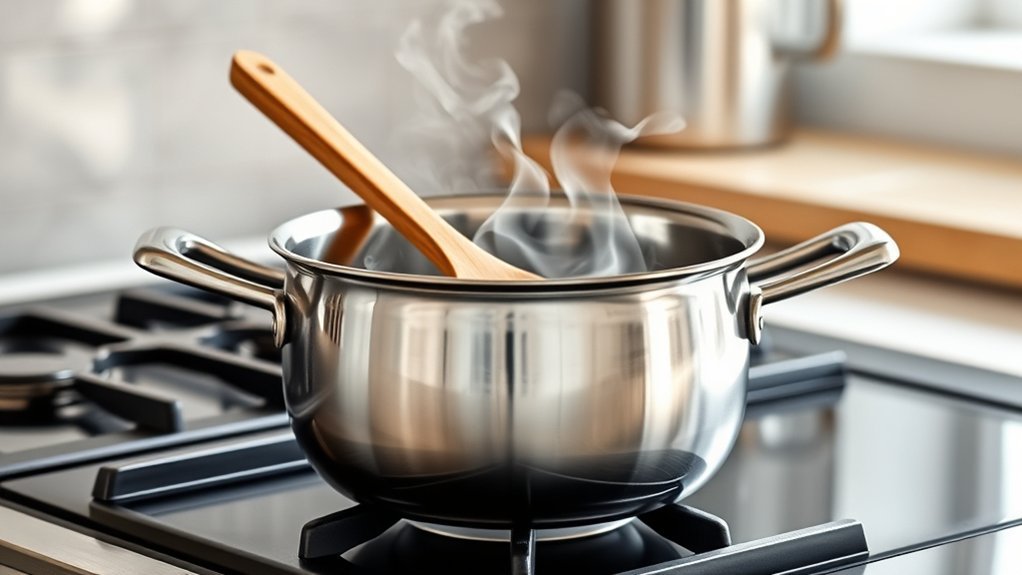
A saucepot is a deep cooking pot designed for sauces, soups, stews, grains, braises, and other foods that need steady simmering. A traditional saucepot has a broad base, relatively tall sides, a lid, and two short side or loop handles. It is generally shorter and wider than a stockpot, giving you easier access for stirring while still providing enough depth for liquid-based cooking.
Quick Answer
A saucepot is a wide, deep pot commonly fitted with two side handles and a lid. It works well for simmering sauces, soups, stews, grains, pasta, and braised foods. Unlike a saucepan, it is normally easier to lift with two hands, while its shorter, wider proportions distinguish it from a tall stockpot.
Key Takeaways
- Saucepots are suited to simmering, soups, stews, grains, braises, sauces, and other medium-to-large liquid-based dishes.
- A conventional saucepot has two short side handles; a saucepan usually has one long handle.
- Saucepots are generally shorter and wider than stockpots, making stirring and reduction easier.
- There is no single universal saucepot capacity range, so choose size by the amount of food you normally cook.
- Material matters, but construction matters too. A well-made clad or heavy-base pot can spread heat more evenly and reduce hot spots.
What Is a Saucepot?
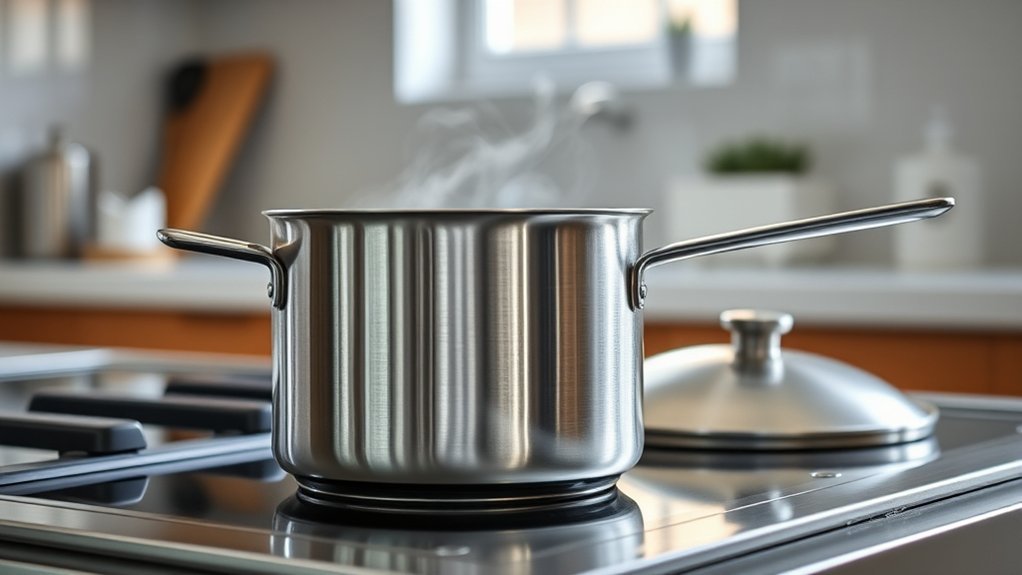
A saucepot is a versatile cooking vessel used for sauces, soups, stews, grains, braises, and other dishes that benefit from steady simmering. Its broad bottom provides useful cooking surface, while its higher sides contain liquid and reduce splashing during stirring.
According to Vollrath’s cookware style guide, a conventional saucepot has a wide bottom, two loop handles, and a shorter, wider form than a stockpot. That shape makes it easier to work over the pot while still providing enough depth for soups, sauces, and slow-cooked dishes.
A fitted lid can slow evaporation and retain heat and moisture. Removing the lid allows more evaporation when you want to reduce a sauce or concentrate a stew.
Capacity is not standardized across every manufacturer. Some home saucepots are moderate in size, while restaurant and commercial versions can be much larger. For that reason, it is more useful to choose a pot according to the amount you cook than to treat one narrow quart range as the definition of a saucepot.
Saucepot capacity varies widely by brand, but the useful distinction is its broad cooking surface, deeper sides, lid, and two-handled design.
The result is a practical pot for recipes that need both capacity and easy access for stirring, checking texture, and controlling evaporation.
Saucepot vs. Saucepan
A saucepot and a saucepan overlap in what they can cook, but their shapes and handles make them better suited to different jobs.
| Feature | Saucepot | Saucepan |
| Handles | Usually two short side or loop handles | Usually one long handle; larger models may add a helper handle |
| Typical role | Medium or larger batches, soups, stews, braises, grains, sauces | Smaller sauces, reheating, reductions, grains, custards |
| Handling | Two-handed lifting works well when the pot is full | Long handle makes a smaller pan easy to move and pour |
A saucepan is commonly smaller and easier to maneuver one-handed. For example, Vollrath’s professional saucepans use a long handle and are designed for soups, sauces, and other liquid foods.
A saucepot becomes more convenient as volume and weight increase because two side handles let you lift the vessel with both hands. The difference is therefore not simply “small versus large”; handle layout and proportions matter too.
How a Saucepot Is Shaped
A conventional saucepot has a round body, flat base, relatively tall sides, and two short handles. Its width provides enough surface area for stirring and evaporation without making the pot as shallow as a sauté pan.
A fitted lid helps control moisture. Keep it on when you want to retain liquid during simmering or braising; remove or partially uncover it when a dish needs to reduce.
The broad base also makes ingredients easier to reach with a spoon or whisk. Compared with a stockpot, a saucepot is generally shorter and wider. Compared with a saucepan, it is commonly designed for two-handed lifting rather than one-handed pouring.
Pro Tip: When comparing products online, look at the actual diameter, depth, capacity, lid, and handle arrangement instead of relying only on the product name. Manufacturers sometimes use terms such as saucepot, soup pot, and sauce/stock pot differently.
Common Saucepot Sizes and Materials
Saucepots are available in many capacities and materials. There is no industry-wide rule that limits a saucepot to one narrow quart range.
For example, professional product lines include saucepots well above the capacities commonly used in a small household kitchen. Home cooks should therefore choose based on batch size, burner size, storage space, and how heavy the pot will become when full.
Common materials include stainless steel, aluminum, clad combinations of metals, nonstick-coated metal, copper-lined or copper-clad constructions, and enameled cast iron.
Common Size Ranges
Rather than relying on a supposed standard size, match capacity to the food you actually prepare.
- Smaller capacity: useful for side dishes, grains, smaller soups, reheating, and modest amounts of sauce.
- Medium capacity: useful for family soups, stews, pasta sauce, braises, beans, and everyday batch cooking.
- Larger capacity: useful for bigger households, entertaining, meal prep, or recipes containing a large amount of liquid.
- Commercial capacity: restaurant saucepots can be considerably larger than ordinary home cookware.
Also consider weight. Several quarts of soup or water add substantial weight before the cookware itself is counted, which is one reason two sturdy side handles are useful.
The best saucepot size is the smallest capacity that comfortably holds your normal batch with enough headroom for safe stirring and simmering.
Popular Material Choices
Material affects weight, heat response, durability, and maintenance, but construction is equally important. A stainless steel pot with an aluminum core, for example, behaves differently from a thin single-layer stainless steel pot.
- Stainless steel: durable, corrosion-resistant, and suitable for many foods. Clad models often combine stainless steel with a heat-conductive aluminum or copper layer.
- Aluminum: lightweight and a good heat conductor. Follow the manufacturer’s care instructions, especially if the surface becomes badly worn or pitted.
- Enameled cast iron: heavy and slower to respond, but it retains heat well and works especially well for braising and long simmering.
- Copper: responds quickly to heat changes but normally needs a food-safe lining for cooking.
- Nonstick-coated cookware: can simplify cleanup for sticky foods but should be used within the manufacturer’s heat and utensil limits.
A good example of construction affecting performance is Tramontina’s tri-ply stainless steel saucepot, which uses an aluminum core to help distribute heat.
Note: Cooktop compatibility depends on the complete construction, not simply the word “stainless” or “aluminum.” For induction, confirm that the manufacturer specifically lists the pot as induction-compatible.
Best Uses for a Saucepot
A saucepot is particularly useful when a recipe needs more capacity than a small saucepan but frequent access for stirring is still important.
The combination of a broad base and higher sides works across several cooking methods, from gentle simmering to braising under a lid.
Tall sides help contain splatter, while a broad cooking surface gives you room to stir and lets you control evaporation by adjusting the lid and heat.
Useful saucepot jobs include:
- Making soups, chili, curries, and stews
- Cooking tomato, meat, cream, and other sauces
- Simmering beans and lentils
- Cooking rice and other grains
- Braising meat or vegetables with a lid
- Boiling smaller batches of pasta or vegetables
- Preparing custards, puddings, or other mixtures when the pot’s material and heat control are suitable
- Reheating larger portions of liquid-based food
For reduction, leave enough open surface area for steam to escape and use moderate heat. For dishes that should retain moisture, use the lid and lower the heat once the liquid reaches the desired simmer.
When to Use a Stock Pot Instead
Choose a stockpot when volume and liquid retention matter more than easy access to a broad cooking surface. Stockpots are typically taller relative to their diameter than saucepots.
That taller shape is useful for stocks, broth, large soup batches, pasta, blanching vegetables, seafood boils, and other high-volume jobs. Stockpot capacities can extend far beyond 8 or 12 quarts, especially in commercial cookware.
Vollrath describes a stockpot as having a smaller diameter and taller profile than a saucepot, a shape intended to preserve liquid during long cooking. A saucepot, by comparison, is shorter and wider, making it easier to stir and work over.
Use a stockpot when you need maximum liquid capacity. Use a saucepot when you want a compromise between capacity, surface area, access, and two-handed handling.
How to Keep a Saucepot From Sticking
Sticking depends on the food, cookware surface, temperature, fat, and cooking technique. A stainless steel saucepot needs different handling from a nonstick or enameled pot.
For many foods, moderate heat, sufficient liquid or cooking fat, and regular stirring are more effective than simply turning the burner higher.
Choose The Right Heat
Start with the heat level recommended for the cookware and recipe. Thick sauces, dairy mixtures, grains, and foods containing sugar can scorch on the bottom if heat is excessive or they are left unstirred.
- Use low to medium heat for delicate sauces and thick mixtures.
- Add oil or butter when the recipe benefits from it.
- Stir the bottom and corners regularly when cooking thick food.
- Use utensils that are appropriate for the cooking surface.
- Reduce the burner once a strong boil is no longer needed.
Stainless steel can be preheated when appropriate for the food being cooked, but the correct technique varies by recipe. Do not apply the same preheating method to every cookware surface.
Warning: Do not overheat an empty nonstick saucepot. Health Canada advises against preheating empty nonstick cookware and recommends following the manufacturer’s temperature and use instructions.
Prevent Food Sticking
For stainless steel, use an appropriate heat level and enough oil, butter, water, stock, or sauce for the recipe. For thicker foods, scrape the base gently and frequently with a suitable spoon or spatula.
A nonstick surface can reduce sticking, but it still requires proper care. Avoid abrasive cleaning and any utensil the manufacturer says may damage the coating.
For enameled cast iron, moderate heat is usually sufficient because the heavy cookware stores heat efficiently. Bare seasoned cast iron has different care requirements and should be maintained according to the manufacturer’s instructions.
If a saucepot repeatedly scorches food in the same location, the problem may be uneven cookware construction, an oversized burner, excessive heat, or a damaged base rather than the recipe itself.
Best Saucepot Alternatives for Small Kitchens
A few well-chosen cookware pieces can replace a dedicated saucepot when kitchen space is limited.
A saucepan is the closest compact substitute for smaller batches. A sauté pan offers more surface area for browning and reduction, while a Dutch oven provides excellent depth and heat retention for soups, stews, and braises.
A stockpot makes more sense when capacity is the priority. A deep skillet or sauté pan can work for dishes that need a broad surface and only moderate liquid. A pressure cooker can handle many soups, beans, stews, and braises more quickly, although it cooks by a different method.
- Saucepan: best compact substitute for smaller liquid-based dishes
- Stockpot: best when large liquid capacity matters most
- Sauté pan: useful for browning, reducing, frying, and shallow braising
- Dutch oven: excellent for stews, braises, soups, and stovetop-to-oven cooking
- Pressure cooker: useful for faster beans, soups, stocks, and tougher cuts
How to Choose a Saucepot for Your Kitchen
Start with capacity. Choose a pot large enough for your normal batch while leaving room to stir without spilling. Buying a much larger pot than you need adds weight and storage bulk.
Next, look at construction. A heavy or well-clad base can improve heat distribution and reduce concentrated hot spots. Fully clad cookware can spread conductive material up the sidewalls as well.
For sauces and other foods that scorch easily, good heat distribution and controllable burner temperature matter more than choosing cookware by material name alone.
Check the lid. It should sit securely enough to retain moisture when needed, but remember that no ordinary saucepot lid is pressure-tight unless the product is specifically designed as a pressure cooker.
Inspect the handles as well. They should feel secure and provide enough clearance for a safe grip. Two sturdy side handles are especially useful once the pot contains several quarts of liquid.
Check Cooktop and Oven Compatibility
Do not assume every metal pot works on every cooktop. Gas and conventional electric ranges accept most ordinary cookware, while induction requires a compatible magnetic base or exterior layer.
If you plan to move the saucepot from stovetop to oven, check the manufacturer’s maximum oven temperature for the pot, handles, lid, knobs, and coating. The lowest-rated component determines the practical limit.
Choose a Material for the Food You Cook
Stainless steel is a versatile general-purpose choice. Clad stainless can add more responsive heat distribution. Aluminum is light and conductive. Enameled cast iron is heavier but retains heat well. Nonstick cookware can simplify low-stick cooking and cleanup when used within its rated temperature range.
If you regularly cook acidic sauces, check the manufacturer’s guidance for reactive materials such as uncoated aluminum, bare cast iron, or unlined copper.
Saucepot Care and Cleaning
Let the pot cool enough to handle safely before cleaning unless its manufacturer gives different instructions. Sudden temperature changes can damage or distort some cookware.
- Use non-abrasive cleaning on coated and polished surfaces unless the manufacturer permits stronger methods.
- Soak stubborn cooked-on food instead of immediately attacking it with a harsh abrasive.
- Keep the outside bottom reasonably clean so residue does not burn onto the cooktop.
- Check handles periodically for looseness or damage.
- Do not continue using cookware with a severely warped base or damaged components that affect safe handling.
- Follow material-specific care instructions supplied with the cookware.
Health Canada’s cookware guidance notes that care and food-contact considerations differ among aluminum, copper, stainless steel, cast iron, ceramic, enamel, and nonstick cookware.
Frequently Asked Questions
What Is the Main Difference Between a Saucepot and a Saucepan?
A saucepot commonly has two short side handles and is designed for two-handed lifting, while a saucepan usually has one long handle and is convenient for smaller quantities and pouring. Both can cook sauces, soups, grains, and other liquid-based foods, so their uses overlap.
Which Pans to Stay Away From?
Avoid cookware that is badly damaged, unstable, severely warped, not intended for food use, or subject to an active safety warning or recall. Material alone is not enough to judge safety. The FDA has warned about certain specific imported aluminum, brass, and alloy cookware that may leach lead, while Health Canada gives separate use and care guidance for aluminum, copper, stainless steel, nonstick, ceramic, and other cookware.
What Is a Saucepot Used For?
A saucepot is used for simmering soups, sauces, stews, curries, beans, grains, braises, and similar dishes. It can also boil vegetables or modest batches of pasta. Its broad base makes stirring easy, while its higher sides contain liquid and splatter.
What Does a Saucepan Look Like?
A saucepan is usually a round, relatively deep pan with a flat base, upright or slightly flared sides, and one long handle. Many include a lid, and larger versions may have a helper handle opposite the main handle.
Is a Saucepot the Same as a Stockpot?
No. The categories overlap, but a conventional saucepot is shorter and wider, while a stockpot is taller relative to its diameter. Saucepot proportions make stirring and reduction easier; stockpot proportions favor large volumes of liquid and long simmering.
What Size Saucepot Should I Buy?
Choose a capacity that holds your normal batch with room left for stirring and simmering. Smaller pots work for side dishes and modest batches, while larger pots suit family soups, stews, meal prep, and entertaining. Because saucepot sizing is not standardized, compare actual capacity and dimensions before buying.
Can a Saucepot Be Used on an Induction Cooktop?
Yes, if that specific saucepot has an induction-compatible magnetic base or exterior. Stainless steel cookware is not automatically induction-compatible, and ordinary aluminum or copper needs a suitable magnetic layer. Check the manufacturer’s compatibility information before buying.
Sources
- Vollrath Cookware Style Guide — saucepot, saucepan, and stockpot shapes and intended uses.
- Tramontina 6-Quart Tri-Ply Clad Sauce Pot — example of clad stainless steel and aluminum-core saucepot construction.
- Health Canada: The Safe Use of Cookware and Bakeware — material-specific care and safety guidance.
- U.S. FDA Cookware Lead Warning — current warning covering certain imported cookware that may leach lead.
- U.S. FDA: Questions and Answers on PFAS in Food — current information on authorized PFAS-related food-contact applications, including nonstick cookware coatings.
Conclusion
A saucepot fills the space between a small saucepan and a tall stockpot. Its broad base, deeper sides, lid, and two-handled design make it useful for sauces, soups, stews, grains, braises, and everyday batch cooking. Instead of choosing by a supposed standard quart range, match the capacity to your normal meals and compare the actual dimensions, construction, handles, cooktop compatibility, and care requirements. A well-chosen saucepot can then become one of the most versatile pieces of cookware in the kitchen.