
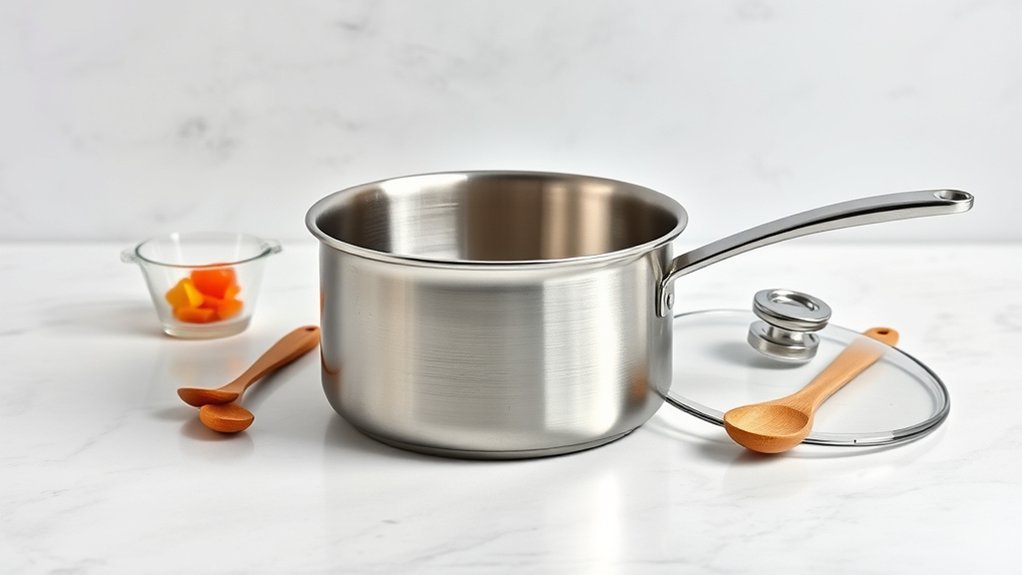
A medium saucepan usually means a long-handled pan with a capacity of about 2 to 3 quarts (roughly 1.9 to 2.8 liters). That size works well for sauces, rice, grains, vegetables, eggs, reheating, and modest batches of soup. Physical dimensions vary by brand and shape, so capacity is more reliable than diameter when identifying or choosing a medium saucepan.
Quick Answer
A medium saucepan is generally a 2- to 3-quart pan. Many models are roughly 7 to 8 inches across, but there is no universal diameter or height. For recipes, capacity is the better guide. A 2-quart pan favors smaller batches, while a 3-quart pan gives more room for grains, soups, pasta, and sauces.
Key Takeaways
- 2 to 3 quarts is the most common range for a medium saucepan.
- “Medium” is not a standardized cookware measurement, so dimensions vary by manufacturer.
- A 3-quart saucepan is often the more versatile choice when you want extra room to stir or prevent boil-over.
- Construction, lid fit, handle comfort, cooktop compatibility, and usable base diameter matter as much as nominal capacity.
What Size Is a Medium Saucepan?
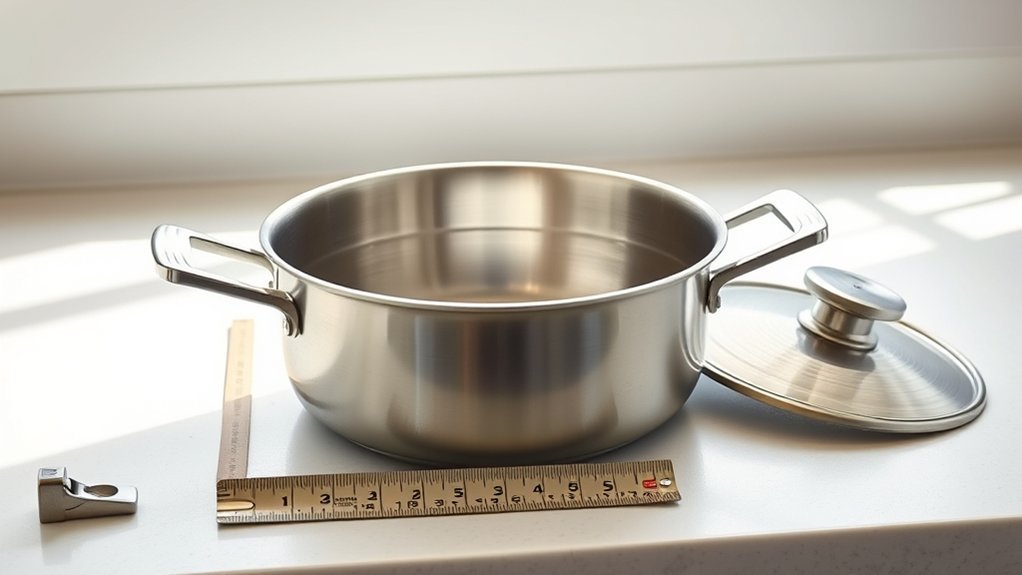
A medium saucepan commonly holds 2 to 3 U.S. liquid quarts. That equals approximately 1.9 to 2.8 liters. The National Institute of Standards and Technology lists one U.S. liquid quart as approximately 0.946 liter.
There is no single mandatory diameter or height for cookware labeled “medium.” Current 2- and 3-quart saucepans from different manufacturers have different proportions, so the capacity stamped on the pan or listed by the manufacturer is more dependable than an outside measurement.
As a practical rule, a 2-quart saucepan is useful for smaller portions, reheating, rice, oatmeal, sauces, and a few eggs. A 3-quart saucepan provides more working room for grains, vegetables, small soups, and foods that foam or expand during cooking.
Note: Cookware capacity describes how much the vessel can hold, not how much you should normally cook in it. Leave headroom when boiling pasta, grains, milk, soup, or other foods that can foam or expand.
Is “Medium Saucepan” a Standard Size?
No. Medium saucepan is a useful kitchen convention rather than a regulated dimensional standard. Manufacturers may classify similar capacities differently, and two pans with the same quart rating can have different diameters, depths, wall shapes, lids, and base sizes.
For example, Made In’s 2-quart Stainless Clad Saucepan is listed at about 7 inches in total diameter and 4 inches deep. A current ZWILLING Spirit 3-quart saucepan lists a 7.87-inch upper diameter. These real-world examples show why a rigid “medium equals exactly X inches” rule is unreliable.
If a recipe simply says to use a “medium saucepan,” a 2- to 3-quart pan is normally a sensible starting point unless the recipe provides a more specific capacity.
Medium Saucepan Dimensions and Capacity
Capacity is the most useful measurement for a medium saucepan. A typical range is 2 to 3 quarts, but the outside dimensions can change substantially according to the pan’s design.
When comparing specifications, check what each measurement actually describes:
- Capacity: the nominal volume of the vessel, usually listed in quarts or liters.
- Upper diameter: the distance across the top rim.
- Cooking-surface diameter: the flatter interior area where food directly contacts the bottom.
- Base diameter: the exterior bottom that contacts the burner or cooktop.
- Depth: the interior or body height of the pan.
- Overall height: may include the lid or lid handle, depending on the manufacturer’s specification method.
This distinction explains why two 3-quart pans can hold similar volumes while looking noticeably different. A narrower pan may be deeper, while a wider pan may have lower sides.
For identifying a saucepan, trust its stated capacity first. Diameter and height are secondary because pan proportions vary by manufacturer and design.
What You Can Cook in a Medium Saucepan
A 2- to 3-quart saucepan covers many everyday stovetop jobs without the bulk of a stockpot or large saucepan.
- Sauces and gravy: enough room for stirring, simmering, and controlled reduction.
- Rice and grains: useful for modest batches when paired with a well-fitting lid.
- Vegetables: suitable for boiling or, with the appropriate insert, steaming smaller quantities.
- Eggs: deep enough to cover several eggs with water without using an oversized pot.
- Soup: practical for a few bowls rather than a large family batch.
- Oatmeal and porridge: a 2- or 3-quart pan provides useful stirring room.
- Reheating: convenient for leftover soup, sauce, vegetables, or other moist foods.
- Small pasta batches: possible in a 3-quart pan, although larger quantities need more water and therefore a larger pot.
Serving counts should be treated as estimates rather than fixed rules. Two quarts of sauce, cooked rice, soup, and boiling water represent very different quantities of finished food.
Pro Tip: When choosing between 2 and 3 quarts, pick the 3-quart size if you frequently cook foods that foam, expand, or require vigorous stirring. The extra headroom can reduce splashing and boil-over without making the pan dramatically harder to handle.
Saucepan vs. Saucier
A traditional saucepan generally has relatively straight sides and a defined transition between the bottom and sidewall. A saucier usually has more rounded interior corners, which makes whisking and stirring sauces easier because ingredients are less likely to collect in a sharp corner.
Both can handle sauces, grains, reheating, and similar tasks, but the rounded profile of a saucier is especially useful for reductions, custards, and whisked sauces. Capacity should still be compared directly rather than assuming that a 3-quart saucier and 3-quart saucepan have the same physical dimensions.
How Medium Saucepan Sizes Compare
A medium saucepan commonly sits between compact 1- to 1.5-quart pans and larger pans around 4 quarts or more. These labels are approximate because manufacturers do not follow one universal small/medium/large classification.
The practical difference is working room. A smaller saucepan is convenient for melting, reheating, or one-person portions. A 2- to 3-quart saucepan handles a broader range of daily cooking. A 4-quart pan gives more capacity for soups, larger portions, and foods that need extra headroom.
Medium Vs Small Saucepans
Compared with a small saucepan, a medium saucepan offers more room for stirring and expansion. A 1- to 1.5-quart pan is convenient for butter, syrup, one serving of oatmeal, a small sauce, or reheating a modest amount of food.
- Small saucepan: commonly around 1 to 1.5 quarts; compact and quick to handle.
- Medium saucepan: commonly around 2 to 3 quarts; more versatile for grains, sauces, vegetables, eggs, and modest soups.
If cabinet space is limited and you want one saucepan for many jobs, the medium range is usually more flexible than a very small pan.
Medium Vs Large Saucepans
A larger saucepan provides more headroom and batch capacity, but it also occupies more burner, cabinet, and sink space. The following comparison is a practical guide rather than an industry standard.
| Size | Common Capacity | Typical Uses |
|---|---|---|
| Small | About 1–1.5 qt | Melting, reheating, small sauces, single portions |
| Medium | About 2–3 qt | Sauces, grains, eggs, vegetables, modest soups |
| Large | About 4 qt and up | Larger batches, more pasta water, soups, family portions |
Best Materials for a Medium Saucepan
The best saucepan material depends on how you cook. Material alone does not tell the full story because construction, thickness, coatings, and the base design can significantly affect heating and handling.
Stainless Steel
Stainless steel is durable, nonreactive for ordinary cooking, and widely used in everyday saucepans. However, stainless steel itself is not an especially fast heat conductor. Better-performing stainless cookware often surrounds or combines the steel with a more conductive metal.
For example, the ZWILLING Spirit 3-Ply saucepan uses an aluminum core within its stainless construction, while Cuisinart’s 3-quart saucepan uses an aluminum-encapsulated base to spread heat.
Nonstick
Nonstick saucepans can be convenient for sticky foods and easier release. They are useful for foods such as oatmeal, certain sauces, and other preparations that tend to cling to an uncoated surface.
Coating type, maximum temperature, utensil restrictions, dishwasher guidance, and expected lifespan vary by product, so follow the manufacturer’s care instructions rather than applying one rule to every nonstick pan.
Enameled Cast Iron
Enameled cast iron is heavier than most stainless or aluminum saucepans but holds heat well once hot. A current Le Creuset 2.25-quart Signature Saucepan, for example, uses enameled cast iron and is sized for small-batch stovetop cooking.
The extra weight can be a disadvantage if you frequently lift the saucepan one-handed or pour directly from it.
Aluminum
Aluminum is lightweight and conducts heat efficiently. It is commonly used as a core inside stainless cookware as well as in coated cookware. Bare, coated, anodized, and clad aluminum products have different care requirements, so the construction matters more than the word “aluminum” alone.
Copper
Copper responds quickly to temperature changes and is valued when precise heat control matters. Many modern copper pans pair copper with a stainless cooking surface. Copper cookware is generally more expensive and may require more exterior care than basic stainless cookware.
Medium Saucepan Size Chart by Quart
The following chart is a practical way to compare saucepan capacities. Size labels are approximate, so check the manufacturer’s listed capacity before buying.
| Capacity | Approx. Liters | Common Size Label | Useful For |
|---|---|---|---|
| 1–1.5 qt | 0.95–1.4 L | Small | Melting, small sauces, one-person portions |
| 2 qt | 1.9 L | Medium | Rice, oatmeal, sauces, reheating, eggs |
| 2.5 qt | 2.4 L | Medium | Grains, vegetables, sauces, small soups |
| 3 qt | 2.8 L | Medium / all-purpose | Larger sauces, grains, vegetables, small pasta batches, soups |
| 4 qt | 3.8 L | Large | Larger batches, soups, pasta, family cooking |
Medium Quart Ranges
A 2-quart saucepan is at the smaller end of the medium range. It is compact, easy to store, and useful when you usually cook modest quantities.
A 2.5-quart saucepan splits the difference and offers slightly more headroom without becoming bulky.
A 3-quart saucepan is a common all-purpose choice because it gives more space for stirring, expansion, and simmering while remaining manageable for everyday cooking.
Common Dimensions Chart
Physical dimensions should be treated as examples, not fixed definitions. Current manufacturer specifications illustrate the variation:
| Example | Capacity | Listed Diameter / Width | Why It Matters |
|---|---|---|---|
| Made In Stainless Clad Saucepan | 2 qt | About 7 in. | Shows a compact medium-size design. |
| Le Creuset Signature Saucepan | 2.25 qt | About 7.1 in. interior | Different material and shape, similar capacity class. |
| ZWILLING Spirit 3-Ply Saucepan | 3 qt | 7.87 in. upper diameter | Shows why a universal 8–9 in. rule is unnecessary. |
How to Choose the Right Medium Saucepan
Start with capacity. Choose 2 quarts if you usually cook smaller amounts and value compact storage. Choose around 3 quarts if you want a more versatile saucepan with extra room for stirring and expanding foods.
Then compare the following features:
- Construction: fully clad stainless cookware spreads its conductive layer through the body, while other designs concentrate a conductive disc or encapsulated layer at the base.
- Lid fit: a well-fitting lid helps control evaporation when cooking rice, grains, vegetables, and other covered foods.
- Handle: look for a secure handle that feels balanced when the pan contains food or water.
- Pouring rim: a flared or shaped rim can make sauces and liquids easier to pour cleanly.
- Interior markings: measurement marks can be convenient for water, broth, and other liquids.
- Weight: heavier cookware may retain heat well but can be harder to lift and pour.
- Oven compatibility: check the manufacturer’s temperature limit for the pan, handle, lid, and knob rather than assuming every component has the same rating.
- Cleaning requirements: dishwasher, detergent, utensil, and scrubbing recommendations vary by material and coating.
Check Cooktop Compatibility
Gas and conventional electric burners accept a broad range of cookware, but induction cooktops require a compatible magnetic base. Stainless steel is not automatically induction-compatible simply because it is stainless.
Whirlpool’s induction cookware guidance recommends ferromagnetic cookware such as cast iron, enameled steel, and stainless steel specifically designed for induction. A simple magnet test can help: if a magnet sticks firmly to the bottom, the pan is generally suitable for induction.
Also compare the base diameter with your burner or induction zone. The top rim can be noticeably wider than the part of the pan that actually contacts or interacts with the cooking surface.
Frequently Asked Questions
Is 2 Quarts a Medium Saucepan?
Yes. A 2-quart saucepan is commonly considered medium, although it sits at the smaller end of the usual 2- to 3-quart medium range. It works especially well for sauces, rice, oatmeal, eggs, reheating, and modest side dishes.
Is a 3 Quart Pan Medium or Large?
A 3-quart saucepan is commonly treated as medium or all-purpose. Size labels are not standardized, so a manufacturer may describe its range differently. For recipe use, the 3-quart capacity is more meaningful than whether the manufacturer calls it medium or large.
How Do I Know What Size My Saucepan Is?
First check the bottom, packaging, or manufacturer’s markings for a quart or liter capacity. If no capacity is shown, fill the saucepan with measured water to determine approximately how much it holds. Measure the top diameter and depth separately if you also need physical dimensions.
What Does a Medium-Sized Saucepan Look Like?
A medium saucepan is usually a relatively deep cooking vessel with one long handle and often a fitted lid. Most hold about 2 to 3 quarts. Exact width and height vary, so two medium saucepans may look different even when their capacities are similar.
Is a 2.5 Quart Saucepan Medium?
Yes. A 2.5-quart saucepan falls squarely within the commonly used 2- to 3-quart medium range and provides a useful compromise between the compact handling of a 2-quart pan and the extra headroom of a 3-quart pan.
Can I Tell Saucepan Capacity From Its Diameter?
Not reliably. Capacity depends on both diameter and depth, and saucepan shapes differ by manufacturer. A wide, shallow saucepan and a narrower, deeper saucepan can hold similar volumes. Check the stated quart or liter capacity whenever possible.
Conclusion
A medium saucepan is generally a 2- to 3-quart pan, but its exact diameter and height are not standardized. A 2-quart model is convenient for smaller batches, while a 3-quart saucepan offers more headroom and is often the more versatile all-purpose choice. When buying one, compare capacity first, then consider construction, base size, lid fit, handle comfort, cooktop compatibility, and care requirements.
Sources
- GreenPan — What Is a Medium Saucepan? — supports the common 2- to 3-quart size convention.
- National Institute of Standards and Technology — Unit Conversion Factors — supports U.S. liquid quart-to-liter conversion.
- Made In — 2 QT Stainless Clad Saucepan — current 2-quart dimensions and clad-construction example.
- ZWILLING — Spirit 3-Ply 3 QT Saucepan — current 3-quart dimensions and aluminum-core tri-ply construction.
- Le Creuset — 2.25 QT Signature Saucepan — enameled cast-iron dimensions, capacity, and heat-retention example.
- Whirlpool — Induction Compatible Cookware — induction-material requirements and magnet-test guidance.
