
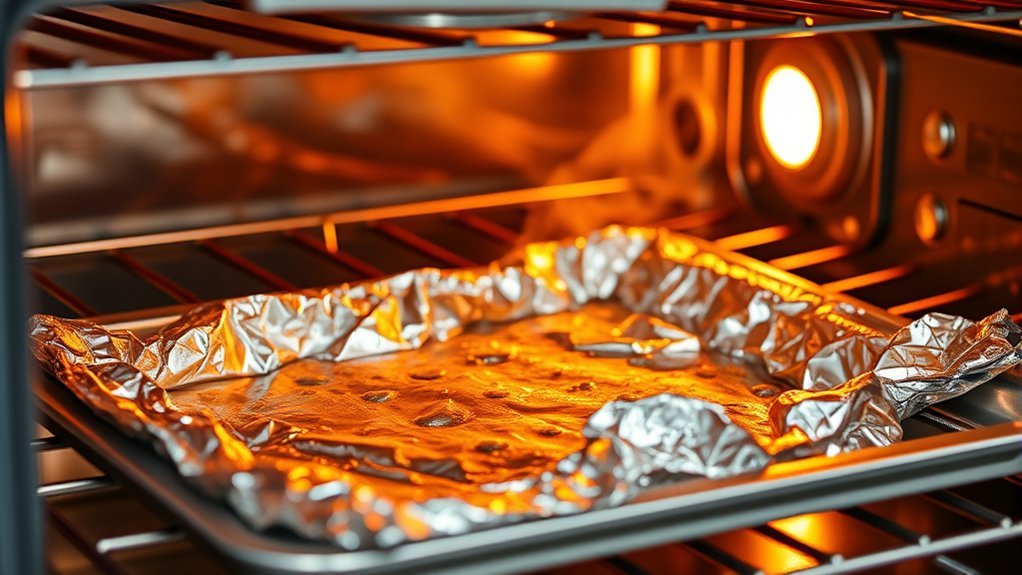
Yes, aluminum foil can be used under a broiler when it is secured to a broiler-safe pan, kept away from the heating element, and used in a way that does not block airflow or grease drainage. Heavy-duty foil is the better choice for broiler pans. The safest setup still depends on your oven manual, pan design, food, and rack position.
Quick Answer
Yes. Aluminum foil can be used under a broiler when your oven and foil manufacturer allow it. Secure heavy-duty foil to a broiler-safe metal pan, keep it away from the heating element, and preserve drainage holes if you line a broiler grid. Never line the oven floor or block vents.
Key Takeaways
- Heavy-duty aluminum foil is suitable for lining many broiler pans, but your oven manual takes priority.
- Keep foil tight and away from the heating element; never use it to line the oven floor or block vents.
- Do not block a broiler pan’s drainage. Some manufacturers allow slitted foil over the grid, while others recommend leaving the grid uncovered.
- Do not use parchment or wax paper under a broiler, and do not assume glass or nonstick cookware is broiler-safe.
- For meat, poultry, and fish, use a food thermometer rather than judging doneness from surface browning.
At a Glance
| Time Required | About 5 minutes to set up, plus the recipe’s broiling time |
| Difficulty | Easy, but constant monitoring is required |
| Tools Needed | Broiler-safe metal pan or cast iron skillet, heavy-duty foil, tongs, oven mitts, and a food thermometer for meat or poultry |
| Cost | Usually only the cost of a sheet of foil if you already own suitable cookware |
Warning: Never let loose foil touch the broiler element, never line the oven floor with foil, and never block vents or grease-drainage openings. Broilers produce intense direct heat, so stay nearby throughout cooking.
Can You Broil With Aluminum Foil?
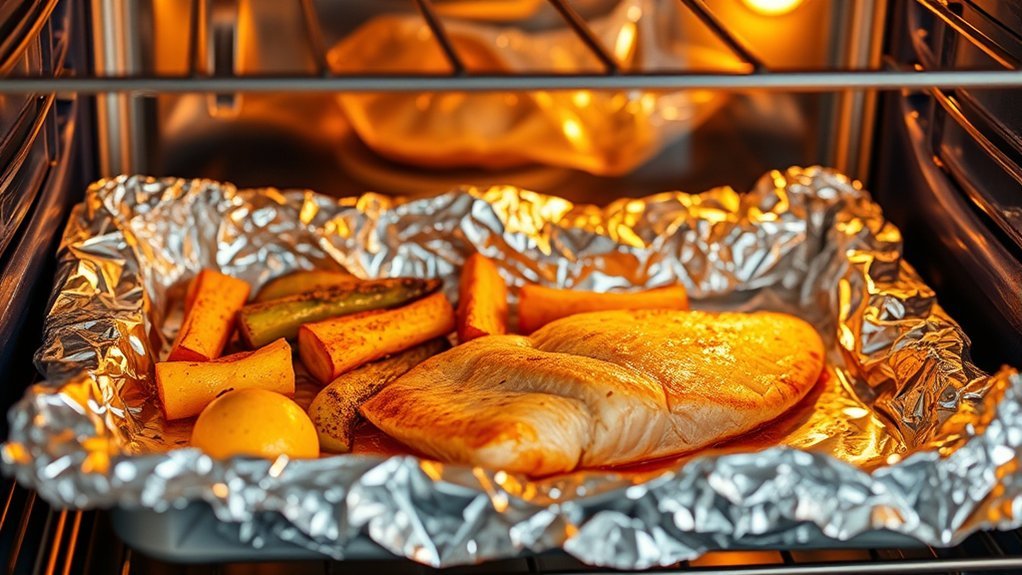
Yes, aluminum foil can be used under many household broilers when it is handled correctly. Aluminum’s melting point is far above normal household broiler temperatures, and Whirlpool notes that residential broilers commonly operate around 500°F to 550°F. That makes foil useful as a liner, but heat tolerance alone does not make every foil setup safe.
The main concerns are foil placement, drainage, airflow, grease, and cookware compatibility. Foil should fit tightly against the pan so it cannot lift toward the heating element. Never use foil as an oven-floor liner or to cover an entire rack, because that can interfere with heat flow and damage the appliance.
Reynolds recommends heavy-duty foil for higher-heat tasks such as lining broiler pans. If your broiler pan has a perforated or slotted top, follow your oven manufacturer’s instructions: some designs allow tightly fitted foil with matching drainage openings, while others advise lining only the lower drip pan.
Heavy-duty disposable aluminum pans may be useful for oven cooking, but oven-safe does not automatically mean broiler-safe. Use a disposable pan under the broiler only when its manufacturer specifically permits that use, and support flexible pans on a sturdy broiler-safe sheet pan when appropriate.
How to Use Aluminum Foil Under the Broiler
Using aluminum foil under a broiler is simple when the setup matches the oven and pan. The safest method is to start with the appliance manual, use sturdy metal cookware, and keep foil flat, secure, and clear of the heat source.
- Check the oven manual first. Confirm the recommended rack position, whether the door stays open or closed during broiling, and whether foil may cover any part of the broiler grid.
- Choose broiler-safe cookware. A broiler pan, shallow heavy metal pan, or cast iron skillet is usually a better choice than glass, thin disposable bakeware, or cookware with plastic, wood, or silicone parts.
- Fit the foil tightly. Line the lower pan or permitted surface without leaving loose edges that can rise toward the element.
- Preserve drainage. If your manufacturer’s instructions permit foil over a slotted broiler grid, cut matching openings so grease can drain. If the manual says not to cover the grid, leave it uncovered.
- Position and monitor the food. Rack distance depends on the food and appliance. Move thicker foods farther from the element and watch continuously because broiling can brown food very quickly.
Do not assume one fixed rack distance works for every dish. Whirlpool’s broiling guidance uses different rack positions depending on thickness and browning needs, which is why the recipe and appliance manual should control placement.
Pro Tip: For the simplest cleanup, line the lower drip pan with heavy-duty foil and leave the broiler grid uncovered when your appliance manual recommends that arrangement. This keeps grease drainage open and avoids having to cut matching slits.
Does the Shiny or Dull Side of Foil Matter?
For ordinary aluminum foil, the shiny and dull sides are mainly a result of manufacturing and are not a meaningful safety issue for broiling. With nonstick foil, however, follow the package directions because the coated side is intended to face the food.
Best Pans for Broiling With Aluminum Foil
Broiling with aluminum foil works best when the pan underneath is stable under intense direct heat. A purpose-built broiler pan is an excellent choice because its upper grid holds food above drippings while the lower pan catches fat and juices.
Heavy stainless-steel sheet pans and cast iron skillets can also work well when their manufacturers permit broiler use. A shallow metal pan is generally preferable to a deep vessel because it keeps food closer to the heat and makes browning easier to control.
The safest broiling setup is not simply “foil plus high heat.” It is broiler-safe cookware, secure foil, open drainage, correct rack placement, and constant supervision.
Disposable aluminum pans need more caution. If the package only says oven-safe, do not assume it is suitable inches from a broiler element. Use it under a broiler only when the product maker explicitly allows broiling, and support flexible pans when removing hot food.
Do not assume glass or nonstick cookware can go under the broiler. Many oven-safe products have lower limits for direct radiant heat. When in doubt, use uncoated metal or cast iron and follow the cookware manufacturer’s instructions.
When Aluminum Foil Becomes Unsafe Under the Broiler
Aluminum foil becomes a problem under the broiler when it is loose, blocks drainage or airflow, touches the heating element, traps large amounts of grease, or is used in a way the appliance manufacturer prohibits. The risk is usually about how the foil is used, not the fact that it is aluminum.
Food contact also matters. Research shows that aluminum can migrate from foil into food and that migration varies with factors such as food composition, acidity, salt, temperature, and contact time. That does not justify a simple “unsafe above 400°F” rule; the evidence is more nuanced.
Heat Limit Risks
Household broilers commonly operate around 500°F to 550°F, while aluminum melts at a much higher temperature. Even so, foil can still contribute to problems if it touches very hot surfaces or elements, reflects heat where the appliance was not designed for it, or traps grease.
- Keep aluminum foil tight against the pan and away from the heating element.
- Never line the oven floor or cover vents with foil.
- Do not cover an entire oven rack with foil.
- Preserve grease drainage in broiler pans.
- Use disposable pans only when the maker permits broiler use.
The oven manual is more important than a generic temperature limit because broiler design, element location, rack spacing, and door instructions vary by model.
Food Type Hazards
Acidic and salty foods can increase aluminum migration during cooking, especially with longer contact and higher heat. A 2020 study of beef, chicken, and fish cooked in aluminum foil found measurable aluminum transfer and noted that food composition and seasonings affected the amount released. The study supports limiting unnecessary prolonged contact when acidity, salt, and heat are combined.
That finding should not be turned into an unsupported single-temperature cutoff. If you want to minimize aluminum contact, especially with acidic or heavily salted foods, use broiler-safe stainless steel or cast iron instead of wrapping the food in foil.
Cheese, sugary glazes, herbs, and oily foods need close attention for a different reason: they can scorch, smoke, or flare quickly under direct heat. For fatty meat, trim excessive surface fat and use a draining broiler pan when possible.
Chilled meat does not need to be fully brought to room temperature before broiling. Keep perishable food refrigerated until preparation, then use cooking time, rack position, and a thermometer to ensure the center reaches a safe temperature.
Pan And Foil Safety
Heavy-duty foil is a good broiler-pan liner when the oven and pan manufacturers allow it, but the pan and foil must work as one safe system.
- Use a broiler-safe metal pan or cast iron skillet.
- Keep foil secure and below the heating element.
- Do not block slots, holes, or vents needed for drainage and airflow.
- Keep loose foil edges from lifting during cooking.
- Use oven mitts and support flexible disposable pans when removing them.
For acidic or salty foods, reducing direct foil contact is a reasonable way to reduce aluminum migration without making exaggerated claims about occasional foil use.
Foods That Need Extra Broiling Care
Some foods brown much faster than they cook through. Broiling works best for thinner foods, finishing already-cooked dishes, and quickly browning surfaces. Thick cuts may need to be baked or roasted first and finished under the broiler so the exterior does not burn before the center is safe.
| Food | Care needed |
|---|---|
| Chilled meats | Keep refrigerated until prep; adjust rack position and verify doneness with a thermometer |
| Large or thick cuts | Move farther from the element or cook through with bake/roast before broiling to finish |
| Cheese | Use short broiling times and monitor continuously |
| Oily or fatty foods | Use drainage, trim excess fat, and watch for smoke or flare-ups |
| Sugary glazes | Apply late or use lower/shorter broiling because sugar burns quickly |
Food-Safety Temperatures for Broiled Meat and Fish
Surface color is not a reliable food-safety test. Use a food thermometer and follow USDA safe-handling and minimum-temperature guidance.
| Food | Minimum internal temperature |
|---|---|
| Beef, pork, veal, and lamb steaks, chops, and roasts | 145°F (62.8°C), then rest at least 3 minutes |
| Ground beef, pork, veal, and lamb | 160°F (71.1°C) |
| Poultry, including ground poultry | 165°F (73.9°C) |
| Fish and shellfish | 145°F (62.8°C) |
| Leftovers and casseroles | 165°F (73.9°C) |
Can You Use Disposable Aluminum Pans for Broiling?
Disposable aluminum pans can be convenient, but they should not be treated as automatically broiler-safe simply because they are aluminum. Packaging may say oven-safe without approving close exposure to a broiler element.
For broiling, use a disposable pan only when its manufacturer specifically allows broiler use. Thickness and stability matter because a flexible pan can buckle or spill when loaded with hot food.
- Check the package or manufacturer’s instructions for broiler approval.
- Prefer a sturdy, heavy-gauge pan rather than a flimsy tray.
- Support the pan on a broiler-safe metal sheet when appropriate.
- Keep it at the rack position specified by the appliance manual or recipe.
- Use both hands and oven mitts when removing a flexible hot pan.
If the product has no broiler guidance, a sturdy broiler pan, stainless-steel sheet pan, or cast iron skillet is the safer default.
Broiling Mistakes That Can Cause Fires
Broiling fires usually involve overheated grease, food placed too close to the element, blocked drainage, flammable materials, or unattended cooking. Foil can add risk when it is loose or used to trap drippings rather than channel them into a pan.
Broiling demands close supervision. The U.S. Fire Administration advises staying in the kitchen when broiling because high heat can turn smoke or grease into a fire quickly.
Foil Placement Hazards
Foil should never touch the broiler’s heating element. Keep it tightly fitted to the permitted pan surface and make sure grease has a path to drain.
- Do not leave loose foil corners that can lift toward the element.
- Do not line the oven floor or cover vents.
- Do not seal a broiler grid if doing so blocks drainage.
- Do not use foil as a substitute for a pan.
- Do not leave the broiler unattended.
Correct placement supports airflow, reduces pooling grease, and lets the broiler work as designed.
Unsafe Broiling Materials
Do not put a material under the broiler merely because it is oven-safe. Direct radiant heat can be much harsher than ordinary baking.
Parchment and wax paper should not be used under a broiler. Whirlpool’s guidance also warns against parchment for intense radiant cooking such as broiling. Glass cookware should be avoided unless the manufacturer specifically says it is broiler-safe, and cookware with plastic, wood, or rubber parts should stay out of the broiler.
Nonstick cookware also needs manufacturer-specific approval. Rather than relying on a universal temperature threshold, check the pan’s care instructions; if broiler use is not explicitly allowed, choose uncoated metal or cast iron.
Silicone baking mats are for baking within their rated temperature range, not for close exposure to a broiler element unless the manufacturer expressly allows it.
What to Do if a Broiler or Oven Fire Starts
If food or grease catches fire inside the oven, U.S. Fire Administration guidance is to turn off the oven and keep the door closed. If flames escape the oven or the fire does not go out, leave the home and call the local emergency number from outside.
Warning: Do not open the oven door repeatedly to inspect a fire; opening the door can supply oxygen and expose you to flames. Turn off the heat, keep the door closed, and get out if the fire is not contained.
Using Aluminum Foil in the Oven vs. Under the Broiler
Aluminum foil can be useful in both ordinary baking and broiling, but the heat pattern is different. Baking surrounds food with hot air, while broiling exposes one side to intense direct radiant heat. That makes placement and supervision more important under the broiler.
Under the broiler, aluminum foil is generally safe when the appliance permits it, but direct heat demands secure placement, open drainage, and close monitoring.
- Use heavy-duty foil for broiler-pan lining when practical.
- Keep foil tight and away from the heating element.
- Do not line the oven floor or block vents.
- Preserve grease drainage through or around the broiler grid.
- Follow the appliance manual for rack position and door position.
Loose foil that is harmless during a low-temperature bake can become a bigger problem under direct broiler heat. The same is true of pans, handles, liners, and coatings that are rated for ordinary oven use but not broiling.
Safer Alternatives to Aluminum Foil for Broiling
If you prefer not to use foil, the simplest alternative is often to broil directly on cookware designed for the job. Stainless steel broiler pans, heavy uncoated sheet pans, and cast iron tolerate direct heat well when their manufacturers approve broiler use.
Ceramic or enameled cookware should only be used if the maker specifically labels it broiler-safe. Do not assume ordinary glass bakeware is suitable for direct broiler heat.
Parchment paper, wax paper, and typical silicone baking mats are not safer broiler substitutes. Parchment is useful for baking, but not under a broiler. If the goal is easier cleanup rather than avoiding aluminum itself, using a purpose-built broiler pan and soaking it after cooking is a straightforward option.
For acidic or salty foods where you want to minimize aluminum contact, uncoated stainless steel or cast iron is usually the most practical broiler-safe alternative.
Broiling Cleanup Tips That Save Time
A careful broiling setup can reduce cleanup without creating new heat or airflow problems. The best approach is to catch drippings in the pan rather than cover large oven surfaces with foil.
- Line the lower broiler pan with heavy-duty foil when the appliance manufacturer permits it.
- Leave the grid open, or cut matching drainage openings only if your manual allows foil over the grid.
- Remove food from the hot pan promptly to prevent residue from baking on as the pan cools.
- Let the pan cool before handling or discarding foil.
- Soak baked-on residue in warm, soapy water instead of scraping aggressively.
- Never line the oven floor with foil to catch drips.
This method keeps cleanup manageable while preserving the airflow and drainage the broiler needs.
Frequently Asked Questions
Is Grilling With Aluminum Foil Safe?
Yes, food-grade aluminum foil is commonly used on grills when the grill and foil manufacturer allow it. Keep foil secure, avoid blocking needed airflow, and do not let it contact flames in a way that creates unstable burning grease. For acidic or heavily salted foods, reducing long, hot foil contact can also reduce aluminum migration.
How Do I Broil if I Don’t Have a Broiler?
A normal high-temperature Bake setting does not truly reproduce broiling because broiling uses concentrated direct radiant heat. For browning, you can use a very hot oven with the rack high in the cavity, a countertop appliance with a broil or grill function, or a hot skillet when the recipe allows. Expect different timing and results.
Is Aluminum Foil Safe at 425°F?
Yes, food-grade aluminum foil is generally suitable for ordinary oven cooking at 425°F when used according to the foil and appliance instructions. Do not use it to line the oven floor, block vents, or cover an entire rack. Acidic and salty foods can increase aluminum migration during prolonged contact.
What Should You Not Broil?
Do not broil parchment or wax paper, cookware with plastic or wooden parts, or glass and nonstick cookware unless their manufacturers specifically approve broiler use. Very fatty foods, sugary toppings, and thick cuts also need extra care because they can flare, scorch, or brown before the center is cooked.
Can Aluminum Foil Touch the Broiler Element?
No. Keep foil below and clear of the broiler element. Secure loose edges so they cannot lift toward the heat source, and follow the rack-spacing instructions in your oven manual.
Can You Use Parchment Paper Under the Broiler?
No. Parchment paper is designed for baking within its rated temperature range, not for intense direct broiler heat. Use a broiler-safe metal pan or, when permitted by the appliance manufacturer, securely fitted aluminum foil instead.
Conclusion
Aluminum foil can be used under a broiler when the oven manufacturer allows it and the foil is secured to broiler-safe cookware. Heavy-duty foil is a practical choice for lining a broiler pan, but it should never touch the element, line the oven floor, block vents, or trap grease by sealing drainage openings.
Use a sturdy metal pan or cast iron, follow the appliance manual for rack and door position, and monitor food continuously. Avoid parchment under the broiler, do not assume glass or nonstick cookware is broiler-safe, and use a food thermometer for meat, poultry, and fish. If you are concerned about aluminum contact with acidic or salty foods, broiler-safe stainless steel or cast iron is an easy alternative.
Sources
- Reynolds Brands — Cooking With Aluminum Foil — supports heavy-duty foil use for broiler pans and cautions against lining the oven floor.
- Whirlpool — Can You Put Aluminum Foil in the Oven? — supports broiler temperature context, drainage slits, airflow cautions, and the warning against parchment under broilers.
- Whirlpool — What Is a Broiler? — supports cookware selection, variable rack placement, direct-heat broiling, and thermometer use.
- USDA FSIS — Keep Food Safe: Food Safety Basics — supports safe internal temperatures and refrigeration guidance.
- U.S. Fire Administration — Cooking Fire Safety — supports close supervision and oven-fire response.
- Fermo et al., 2020 — Quantification of Aluminum Leached Into Foods Baked Using Aluminum Foil — supports the discussion of aluminum migration and the effects of food composition and cooking conditions.

2 thoughts on “Can You Broil With Aluminum Foil? What You Need to Know”