
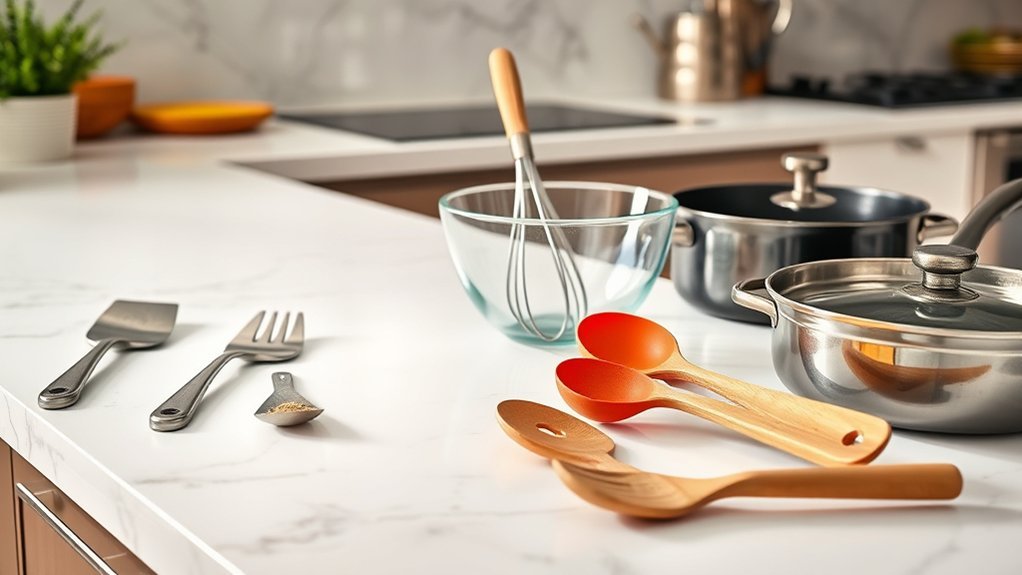
The safest cooking utensils are usually well-made tools designed for food contact and matched to the cookware and task. Food-grade silicone and wood are especially useful with nonstick and enameled surfaces, while stainless steel is durable for uncoated stainless steel and cast iron. Bamboo and titanium can also be practical choices. Material matters, but so do the utensil’s temperature rating, condition, construction, and care.
Quick Answer
For most kitchens, the safest cooking utensils are high-quality silicone, stainless steel, and smooth wood or bamboo used with the right cookware. Choose utensils made for food contact, stay within the manufacturer’s heat limit, avoid badly damaged tools, and use non-scratching utensils on coated pans.
Key Takeaways
- Silicone and wood are practical choices for nonstick, ceramic-coated, and enameled cookware because they are less likely to scratch the surface.
- Stainless steel is strong and heat-resistant but is best reserved for cookware that can tolerate metal utensils.
- No silicone temperature limit applies to every product; follow the manufacturer’s stated maximum temperature.
- Research has found flame retardants in some black plastic utensils, but black color alone does not prove that a particular utensil is contaminated.
- Replace utensils that are cracked, melted, sticky, deeply scratched, splintering, chipped, or otherwise difficult to clean.
What Are the Safest Cooking Utensils?
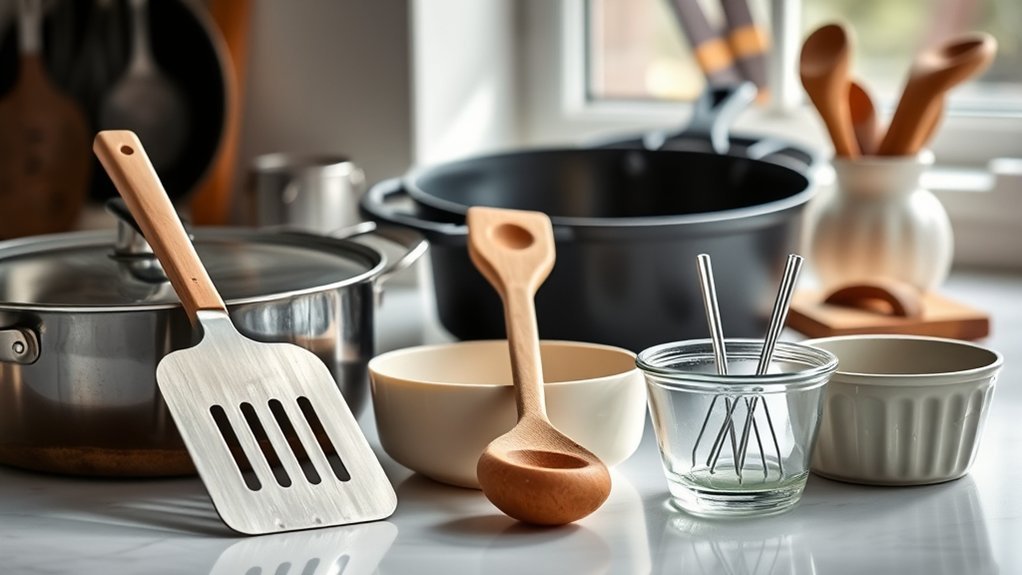
The safest cooking utensils are generally made from stable, durable materials intended for repeated food contact. The U.S. Food and Drug Administration regulates food-contact substances according to their intended uses and evaluates potential migration into food rather than giving every retail utensil material a blanket “FDA-approved” label. FDA guidance on food-contact substances explains this regulatory approach.
For home cooking, silicone, stainless steel, wood, bamboo, and titanium can all be appropriate when the finished utensil is well made and used as directed. The best material depends heavily on the pan. Soft silicone or smooth wood is usually better for coated cookware, while stainless steel provides more leverage for uncoated steel and cast iron.
Wooden and bamboo utensils are also practical low-plastic choices. They should have smooth surfaces, sound construction, and finishes intended for food contact. Although wood is sometimes described as naturally antimicrobial, that should never replace normal washing, drying, and replacement of damaged tools.
Note: “Non-toxic” is useful consumer shorthand, but no utensil material needs to be treated as absolutely risk-free under every possible condition. Product quality, temperature, wear, coatings, food chemistry, and individual sensitivities all matter.
Best Utensils by Cookware Type
Matching the utensil to the cookware is more useful than trying to choose one material for every job. The FDA Food Code specifically states that cookware with certain nonstick coatings should be used with nonscoring or nonscratching utensils. FDA Food Code guidance also recognizes appropriate uses of hard, close-grained wood in food-contact utensils.
| Cookware type | Recommended utensil |
|---|---|
| Nonstick cookware | Silicone, smooth wood, or bamboo |
| Ceramic-coated cookware | Silicone, smooth wood, or bamboo |
| Enameled cast iron | Silicone or smooth wood |
| Uncoated stainless steel | Stainless steel, silicone, or wood |
| Bare cast iron | Stainless steel or wood |
| Serving and mixing | Wood, bamboo, silicone, or stainless steel |
Silicone is especially useful for coated cookware because it is flexible and unlikely to score the cooking surface during normal use. Titanium utensils can also be corrosion-resistant and durable, but their suitability for a delicate pan still depends on edge shape and the cookware manufacturer’s instructions.
Stainless steel utensils suit uncoated pans and cast iron where strength, scraping ability, and high-heat performance matter. Wood and bamboo work well across many surfaces because they are comparatively gentle. The practical goal is to protect both the food-contact surface and the utensil rather than forcing one material to perform every task.
Pro Tip: If you own several cookware types, a mixed utensil kit is usually more useful than an all-metal or all-silicone set. Keep silicone or wood for coated pans and at least one sturdy stainless steel turner or spoon for uncoated cookware.
Are Silicone Utensils the Best Choice?
Silicone utensils are often a safe and practical choice, especially for nonstick, ceramic-coated, and enameled cookware. Good silicone tools are flexible, non-scratching, easy to clean, and available in one-piece designs that reduce seams where food can collect.
However, silicone is not automatically superior simply because a product is labeled “platinum-cured.” Platinum curing is a manufacturing method. A more useful buying standard is whether the finished product is intended for food contact, comes from a traceable manufacturer, has a clearly stated heat limit, and remains intact during use.
Silicone also has limits. It provides less scraping force than metal, can be cut by sharp edges, may retain odors in some products, and is not readily biodegradable. Lower-quality tools may also contain internal cores, seams, or fillers that are not obvious from appearance alone.
Silicone Safety Basics
High-quality silicone is valued because it is flexible and performs well across common cooking temperatures, but there is no single universal maximum temperature for all silicone utensils. Heat resistance depends on the exact formulation and construction.
For that reason, follow the temperature limit printed by the manufacturer. Do not assume that every silicone utensil can safely withstand 500°F or 600°F simply because another brand advertises that range.
Silicone tools should also be kept away from direct burner flames, exposed heating elements, and prolonged contact with extremely hot empty cookware unless the manufacturer specifically allows it.
Inspect silicone periodically. A utensil that becomes sticky, badly cut, cracked, permanently distorted, or starts shedding material should be replaced rather than kept in service.
Platinum Silicone Benefits
Platinum-cured silicone is popular in premium kitchen tools because the platinum-catalyzed curing process can produce durable silicone products with consistent performance. Many well-known utensil manufacturers use this construction for spatulas, spoons, ladles, and turners.
Still, the phrase “platinum-cured” should not be treated as a stand-alone safety certification. The finished product’s formulation, food-contact suitability, internal reinforcement, heat rating, and manufacturing quality are more important than the curing label alone.
One-piece silicone designs can be particularly convenient because they minimize joints and crevices. Many products are also dishwasher-safe, although the manufacturer’s care instructions should control because handles, internal cores, or decorative components may differ.
When Silicone Falls Short
Even a good silicone utensil is not ideal for every task. Flexible silicone provides less leverage than metal for hard scraping, lifting heavy food, smashing, or working a heavily browned fond from an uncoated pan.
Repeated cutting against sharp pan edges can damage silicone, and direct contact with a burner or heating element can exceed its intended temperature. A tool that has become gummy, torn, cracked, or badly warped should be retired.
Environmental considerations also matter. Silicone is durable and reusable, but conventional recycling options remain limited and the material is not biodegradable. Long service life is therefore one of the best ways to reduce waste.
Best Utensils for Nonstick Pans
For nonstick pans, high-quality silicone, wood, and bamboo are usually the most practical choices because they minimize scratching. The goal is to protect the coating from scoring and premature wear.
Silicone is especially convenient for flipping, stirring, scraping bowls, and working around curved pan edges. Instead of relying on a universal 425°F, 500°F, or 600°F claim, check the actual temperature rating for the utensil you own.
The safest utensil is not simply the one made from the “best” material; it is the one whose surface, construction, heat rating, and condition fit the cookware and cooking task.
Wooden utensils are another dependable choice for stirring, sautéing, and scraping food gently from nonstick surfaces. Smooth bamboo can perform similarly.
Metal utensils should generally be avoided on conventional coated nonstick cookware unless the cookware manufacturer specifically states that metal utensils are acceptable. Even when the coating is marketed as durable, repeated scraping can reduce surface life.
Warning: Stop using any utensil that is melting, shedding, splintering, exposing an internal core, or leaving fragments in food. Damage and deterioration matter more than whether a material originally had a “safe” reputation.
Best Wooden Cooking Utensils
Wooden cooking utensils are useful because they are gentle on cookware, comfortable to hold, resistant to melting, and available without plastic. Close-grained hardwoods such as maple, beech, and cherry are commonly used for spoons, spatulas, and other kitchen tools.
Their safety and longevity depend heavily on construction and care. Choose smooth utensils without deep cracks, rough splinters, peeling finishes, or hard-to-clean glued seams in the food-contact area.
The FDA Food Code permits hard maple or equivalently hard, close-grained wood for specified food-contact utensils in commercial settings, supporting the practical use of suitable wood when it is kept in good condition.
Wood Benefits
Wood offers a useful balance of durability, low heat conduction, and cookware protection. Unlike metal, a wooden spoon does not quickly become hot throughout its handle, and unlike soft plastic, it will not melt against the side of a hot pot.
Wood is sometimes described as naturally antimicrobial, and research on wood surfaces has explored that property. In the kitchen, however, users should not rely on the material itself to control contamination. Proper washing and thorough drying remain essential.
Wood can also be biodegradable at the end of its life when it is untreated or finished with suitable natural products and contains no synthetic coatings or mixed-material components.
Care And Maintenance
Safe performance from wooden utensils depends on routine care. Hand-wash them with warm water and dish soap, rinse them, and dry them promptly. Long soaking can encourage swelling, splitting, or warping, while repeated dishwasher cycles can be hard on many wooden tools.
The USDA recommends cleaning food-contact utensils with warm, soapy water and provides additional sanitizing guidance when needed. USDA food-contact cleaning guidance is especially useful after tools touch raw meat, poultry, seafood, or eggs.
Periodically condition unfinished wooden utensils with a product specifically labeled as food-safe for wooden kitchenware, such as food-grade mineral oil or a suitable wood-conditioning wax. Do not assume that every furniture oil, stain, varnish, or woodworking finish is appropriate for direct food contact.
| Task | Practice |
|---|---|
| Wash | Warm water and dish soap; hand-washing is safest for most wood |
| Moisture | Avoid long soaking; dry promptly |
| Condition | Use a food-safe wood-conditioning product as needed |
| Odor control | Wash thoroughly; replace tools that retain contamination or cannot be cleaned |
| Replace | Retire deeply cracked, splintering, moldy, or badly worn pieces |
Top Wood Picks
For buyers who prefer wood, the most important qualities are smooth construction, a comfortable shape, sturdy hardwood, and an appropriate food-contact finish. A useful starter set should include at least a stirring spoon and a flat or angled spatula.
Jonathan’s Spoons currently offers several Essentials sets made around handcrafted wooden kitchen tools, while Bambu sells multiple cooking-utensil sets made from bamboo. These are examples of the kinds of products available rather than proof that one brand is inherently safer than every alternative.
Regardless of brand, inspect the finish, check care instructions, and choose shapes that fit the way you cook. With proper washing, drying, and conditioning, good wooden utensils can remain useful for years.
Best Stainless Steel Cooking Utensils
High-quality stainless steel cooking utensils are a dependable choice for kitchens that need strength, heat resistance, scraping ability, and long service life. They work especially well with uncoated stainless steel pans, carbon steel, and bare cast iron.
Stainless steel is corrosion-resistant, but describing it as completely nonreactive or incapable of releasing metals goes too far. Research on stainless steel cookware has measured nickel and chromium release under some conditions, particularly with acidic foods, longer cooking times, new cookware, and certain alloys. A study of common cooking conditions using 18/10 grade 316 stainless steel found measured release below known allergy-triggering thresholds in its experiments for most subjects, while noting that highly sensitive individuals may differ. The study is available through PubMed.
Those cookware studies involve much more food-contact area and contact time than a spoon or turner normally has, so they should not be directly interpreted as evidence that stainless steel utensils create the same exposure. They do show why “zero leaching” is not an appropriate blanket claim.
18/10 stainless steel is widely used in kitchenware, but the nickel in that alloy means it is not automatically the preferred choice for every person with a diagnosed nickel sensitivity. Anyone with a significant nickel-related medical concern should follow advice from their clinician rather than relying on a utensil-material ranking.
Brands such as All-Clad, Zwilling, and Victorinox offer stainless-steel kitchen tools, but brand name alone does not determine safety or performance. Look at the actual construction, edges, handle design, material description, and cookware compatibility.
What About Titanium, Nylon, and Composite Utensils?
Titanium is lightweight, corrosion-resistant, and often used in specialized or outdoor cookware and utensils. A smooth titanium tool can be practical, but hard metal edges may still scratch delicate cookware. It should therefore be chosen by task rather than treated as automatically safer than silicone, wood, or stainless steel.
Nylon utensils are common because they are lightweight and inexpensive. Food-contact nylon can be suitable when used within the manufacturer’s temperature limit, but nylon generally should not be left against a very hot pan, burner, or heating element. Replace it if the edge melts, curls, becomes rough, or deforms.
Composite utensils vary widely. Some combine silicone exteriors with nylon or metal cores, while others use fiber-reinforced plastics or mixed materials. Construction matters because seams and exposed internal components can become cleaning or durability problems after wear.
For any synthetic utensil, the most useful questions are simple: Is it intended for food contact? What is the manufacturer’s maximum temperature? Is the food-contact surface intact? Can it be cleaned thoroughly?
What Materials Should You Avoid?
Rather than labeling every utensil of one material as dangerous, it is more accurate to avoid damaged, poorly identified, unsuitable, or overheated products.
Black plastic deserves special discussion. Studies have found brominated flame retardants in some black plastic kitchen utensils, and a 2018 experiment documented transfer from selected contaminated utensils into hot cooking oil. That study is indexed by PubMed.
A separate 2024 U.S. study also detected flame retardants in selected black plastic household items. However, the paper later received corrections, including a 2025 correction that substantially lowered an estimated BDE-209 exposure from contaminated kitchen utensils. The authors also clarified that the study was designed to investigate the presence of flame retardants, not to determine whether black plastic created an unacceptable exposure level. The 2025 corrigendum is available from Chemosphere.
| Material or condition | Practical concern |
|---|---|
| Old or unknown-origin black plastic | Some tested products have contained flame retardants; replacement is a reasonable precaution |
| Melted or warped nylon/plastic | Heat damage means the utensil is no longer in its intended condition |
| Sticky, cracked silicone | Surface deterioration makes replacement sensible |
| Splintered or moldy wood | Damage creates hard-to-clean surfaces |
| Chipped or peeling coatings | Exposed substrate and loose fragments indicate the tool should be retired |
Research on plastic chemistry also needs context. A 2025 Nature analysis catalogued 16,325 known plastic chemicals and identified more than 4,200 as chemicals of concern. The PlastChem analysis describes the broad universe of chemicals that may be intentionally used or unintentionally present across plastics. It does not mean that one kitchen utensil contains thousands of chemicals or that a quarter of every utensil’s ingredients are hazardous.
If reducing plastic contact is a personal priority, switching frequently heated tools to stainless steel, wood, bamboo, or suitable silicone is a straightforward precaution without making unsupported claims about every plastic product.
How Do You Choose Safe Cooking Utensils?
A short buying checklist is more reliable than labels such as “premium,” “eco,” or “non-toxic.” Look for products that clearly identify what they are made from and how they should be used.
- Food-contact suitability: Buy utensils sold specifically for cooking or food preparation from a traceable manufacturer.
- Temperature limit: Check the stated maximum temperature for silicone, nylon, and other synthetic materials.
- Cookware compatibility: Use nonscratching tools on coated and enameled cookware.
- Simple construction: One-piece designs or well-sealed joints are easier to inspect and clean.
- Smooth surfaces: Avoid rough edges, splinters, cracks, peeling coatings, and deep grooves.
- Care instructions: Follow the maker’s dishwasher, hand-washing, and conditioning directions.
- Personal sensitivities: Consider nickel or other known allergies when selecting metal kitchenware.
How Do You Care for Safe Utensils?
Proper care helps cooking utensils stay hygienic and last longer. Care depends on the material, so the manufacturer’s directions should come first.
Stainless steel is generally easy to wash with dish soap and water, and many stainless tools are dishwasher-safe. Silicone is also frequently dishwasher-safe, but not every mixed-material product has the same care instructions.
Wooden and bamboo utensils usually benefit from prompt hand-washing and thorough drying. Avoid leaving them soaking in a sink for long periods. Condition unfinished wood when it begins to look dry, using an appropriate food-safe product.
Food safety matters regardless of material. After utensils contact raw meat, poultry, seafood, or eggs, wash them before using them on cooked or ready-to-eat food. Where sanitizing is appropriate, follow USDA guidance and product-label directions.
- Wash food residue off utensils promptly.
- Keep silicone and nylon within their stated heat limits.
- Dry wooden and bamboo utensils thoroughly.
- Condition unfinished wood when needed.
- Do not use the same unwashed utensil for raw and cooked food.
- Replace damaged tools that cannot be cleaned reliably.
Which Utensils Should You Buy First?
A practical starter kit does not need to contain a dozen nearly identical tools. Start with utensils that cover different cooking jobs and cookware surfaces.
| Utensil | Why it matters |
|---|---|
| Silicone turner or spoonula | Useful for nonstick, ceramic-coated, and enameled cookware |
| Wooden spoon | Gentle, sturdy, and useful for stirring and scraping |
| Stainless steel tongs | Excellent for gripping, turning, and serving |
| Thin turner or fish spatula | Slides under delicate foods easily; choose metal or coated-pan-safe material to match cookware |
| Ladle | Useful for soups, sauces, stews, and serving |
The OXO Good Grips 3-Piece Silicone Utensil Set is one current example of a compact silicone starter set. GIR’s Ultimate Tool Set is another silicone-focused option, while Jonathan’s Spoons sells wooden Essentials sets and Bambu offers bamboo cooking-utensil sets.
These brand examples should not be treated as medical or safety endorsements. The better approach is to compare the materials, temperature ratings, construction, shapes, and care instructions with the cookware you actually own.
Frequently Asked Questions
What Are the Safest Cooking Utensils for Health?
High-quality silicone, stainless steel, smooth wood, bamboo, and titanium can all be suitable cooking-utensil materials. The safest choice depends on cookware compatibility, food-contact suitability, temperature limits, condition, and personal sensitivities. Replace tools that are melting, cracked, sticky, splintered, or otherwise deteriorating.
What Are the Best Non-Toxic Cooking Utensils?
For most home kitchens, silicone or wood works well with coated pans, while stainless steel is excellent for uncoated stainless steel and cast iron. Rather than relying only on the term “non-toxic,” check that the utensil is intended for food contact, has a clear heat rating where relevant, and remains in good condition.
Which Is Safer, Silicone or Stainless Steel?
Neither material is universally safer. Silicone is usually the better choice for nonstick and enameled cookware because it is less likely to scratch the surface. Stainless steel provides greater strength and heat resistance for uncoated cookware. Product quality, temperature, condition, and cookware compatibility matter more than choosing one material for every task.
What Cookware Is 100% Non-Toxic?
No cookware material needs to be described as literally 100% non-toxic under every condition. Stainless steel, cast iron, glass, and properly made ceramic cookware are common choices for people trying to minimize unnecessary coatings or plastic contact, but each material still has its own care requirements, limitations, and possible sensitivities.
Are Black Plastic Cooking Utensils Unsafe?
Studies have found flame retardants in some black plastic kitchen utensils, particularly where recycled electronic plastics may have entered consumer-product streams. However, black color alone does not prove that every utensil is contaminated. Replacing old, damaged, unknown-origin, or frequently heated plastic tools is a reasonable precaution if you prefer to reduce uncertainty.
Sources
- U.S. Food and Drug Administration — Food-Contact Substances — explains how substances intended to contact food are regulated and evaluated.
- FDA Food Code 2022 — supports food-contact material, wood-utensil, and nonscratching nonstick-use guidance.
- USDA Food Safety and Inspection Service — Cleaning and Sanitizing Food-Contact Utensils — supports cleaning and cross-contamination guidance.
- Guarneri et al. — Nickel and Chromium Release From 18/10 Stainless Steel — supports the discussion of stainless-steel metal release and nickel sensitivity.
- Kuang et al. — Brominated Flame Retardants in Black Plastic Kitchen Utensils and 2025 Chemosphere corrigendum to related black-plastic exposure research — support the balanced discussion of black plastic.
- Nature — Mapping the Chemical Complexity of Plastics — supports the broader plastic-chemical inventory and chemicals-of-concern figures.
Conclusion
The safest cooking utensils are not defined by one perfect material. Silicone and wood are practical for coated cookware, stainless steel is durable for uncoated pans, and bamboo or titanium can serve useful roles when well made. More important than marketing labels is choosing a utensil designed for food contact, matching it to the cookware, respecting its heat limit, cleaning it properly, and replacing it when damage appears. A small mixed set of well-chosen tools is usually safer, more useful, and longer-lasting than relying on one material for every cooking job.

3 thoughts on “What Are the Safest Cooking Utensils? Best Utensils & What to Avoid”