
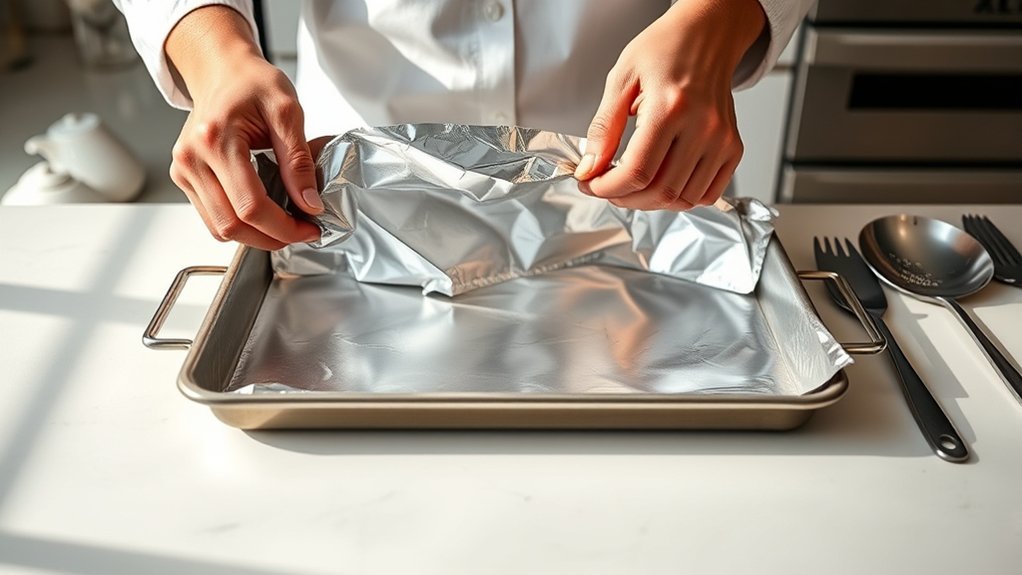
Kitchen foil is a versatile tool for wrapping, covering, lining pans, grilling, baking, storing, and freezing food, but the safest method depends on the appliance and the food. Standard and heavy-duty foil work similarly, with heavy-duty foil offering extra tear resistance. For ordinary foil, the shiny and dull sides perform the same. The biggest rules are to keep foil off the oven floor, follow the appliance manual for microwaves and air fryers, and use another material when highly acidic or salty foods may react with the foil.
Quick Answer
Use kitchen foil for wrapping food, covering dishes, lining pans, making packets, grilling, and freezer storage. Either side of standard foil can face the food. Never line the oven floor, and only use foil in a microwave or air fryer when the appliance manufacturer allows it and the foil is positioned exactly as directed.
Key Takeaways
- Standard and heavy-duty aluminum foil can be used with either the shiny or dull side facing the food.
- Non-stick foil is different: place food on the coated side identified by the manufacturer.
- Do not line the bottom of an oven with foil or fully cover an oven rack because trapped heat and blocked airflow can damage the appliance and create hazards.
- Microwave and air-fryer rules vary by model, so the appliance manual takes priority over general advice.
- Highly acidic, spicy, or salty foods can pit or discolor foil and increase aluminum transfer, so parchment, glass, or another nonreactive barrier is often a better choice.
- Clean foil may be recyclable where local programs accept it; remove food residue before recycling.
At a Glance
| Time Required | Usually under 1 minute to cut, shape, or secure the foil; cooking time depends on the recipe. |
| Difficulty | Easy, with extra care required around heating elements and in microwaves. |
| Tools Needed | Aluminum foil, scissors or the box cutter edge, an appropriate pan or dish, and a food thermometer for meat, poultry, or fish. |
| Cost | Low; the amount used per task is usually a small portion of a household roll. |
What Is Kitchen Foil Used For?
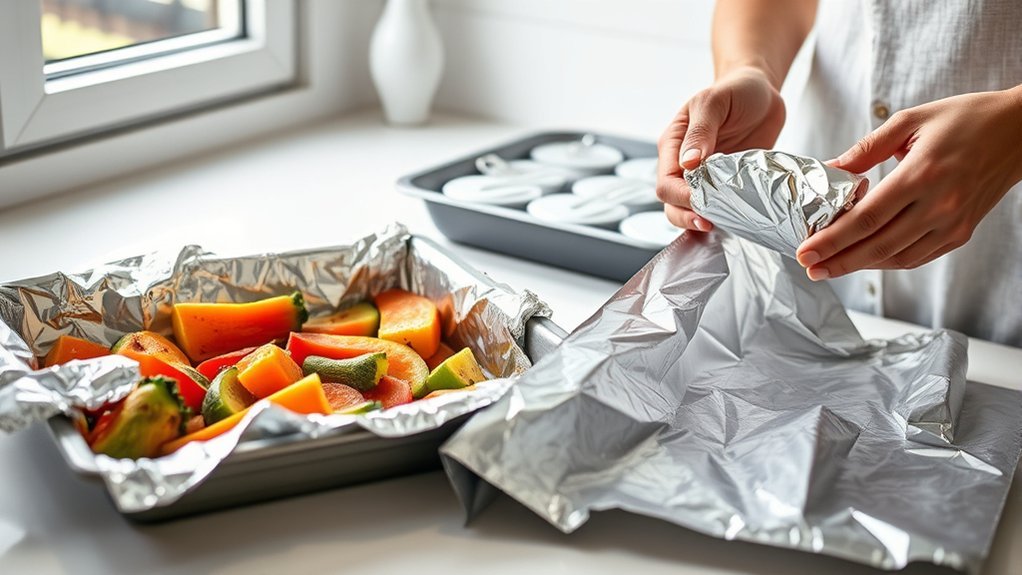
Kitchen foil, usually made of aluminum, is used to wrap and cover food, protect pans, make cooking packets, shield parts of food from excessive browning, and package foods for refrigeration or freezing. Its main advantages are that it is easy to shape, moisture-resistant, and able to tolerate normal oven and grill temperatures when used correctly.
For cooking, foil can line a baking sheet, cover a casserole, tent food that is browning too quickly, or form a sealed packet around meat, fish, or vegetables. Covering food with foil can reduce moisture loss, while leaving food uncovered generally allows more browning and crisping.
Heavy-duty foil is useful when extra strength is needed, such as for larger packets, freezer wrapping, or grill use. Standard foil is better suited to lighter wrapping, small packets, and routine pan lining. Manufacturer guidance from Reynolds Brands confirms that heavy-duty foil is thicker and more durable, while ordinary foil remains suitable for many everyday kitchen jobs.
For sticky or cheesy dishes, a non-stick foil can reduce adhesion. Standard foil is not automatically non-stick, so lightly greasing it or choosing parchment paper may give better release for cookies, delicate fish, and other foods that tend to stick.
Kitchen foil is most useful when it matches the job: standard foil for light wrapping, heavy-duty foil for extra strength, and non-stick foil for foods that tend to cling.
Foil can also be shaped into small dividers, tents, or supports for light kitchen tasks. Avoid using improvised foil shapes as unsupported containers for heavy foods or large amounts of liquid; place them on a stable pan instead.
How to Choose the Right Foil
Choosing the right foil starts with the task rather than the appearance of the roll. Standard foil handles light wrapping, covering, small oven packets, and routine pan lining. Heavy-duty foil offers extra resistance to tearing and is better for larger packets, freezer protection, and grill work where the foil may be moved or handled with tongs.
Non-stick foil is useful for cheese, glazed foods, fish, and other sticky ingredients. The coated side is product-specific, so follow the package directions. Reynolds, for example, identifies the dull side of its non-stick foil as the food-contact side.
Roll width is mainly a convenience choice. Narrower rolls suit everyday dishes, while wider rolls can cover large sheet pans or oversized foods with fewer seams. Sizes vary by brand, so choose a roll wide enough for the pan or packet you use most often.
For appliance safety, the label on the foil is only part of the answer. The oven, microwave, air fryer, toaster oven, or grill manual controls what is allowed in that appliance. Some air-fryer manufacturers permit carefully secured foil, while others tell users not to line the basket.
Recycling can also matter. The U.S. Environmental Protection Agency notes that aluminum foil can be recycled, but local programs differ and food residue should be removed first.
Should You Use the Shiny or Dull Side?
For standard and heavy-duty aluminum foil, the shiny and dull sides perform the same in normal cooking. The different finishes come from the manufacturing process, not from separate cooking functions. Either side can face the food without meaningfully changing cooking time, heat transfer, moisture retention, or flavor.
Non-stick foil is the exception because one side has a coating designed for food contact. Check the package for the correct side.
Shiny Vs. Dull Side
With ordinary foil, there is no practical “hot side” or “cold side.” Reynolds states that both sides of its standard and heavy-duty foil are interchangeable. The shiny side does not produce a dependable crisping or browning advantage in normal kitchen use.
That means food placement is a matter of convenience unless the foil is a specialty product. If you are using standard foil to cover a dish, line a pan, or make a packet, choose whichever orientation is easiest.
Note: The shiny/dull rule changes for coated products. If the package identifies a non-stick side, that side should face the food even though ordinary foil has interchangeable sides.
Nonstick Side Exceptions
Non-stick foil has a food-safe coating on one side. For Reynolds non-stick foil, the coated side is the dull or flat side and is marked for easy identification. Other brands may use different markings, so the package instructions are the safest guide.
| Foil type | Food placement | Best use |
|---|---|---|
| Standard foil | Either side | Wrapping, covering, lining, packets |
| Heavy-duty foil | Either side | Large packets, freezer wrapping, grill use |
| Non-stick foil | Manufacturer-specified coated side | Sticky, glazed, cheesy, or delicate foods |
| Shiny side of standard foil | Either inward or outward | No special cooking advantage |
| Dull side of standard foil | Either inward or outward | No special cooking advantage |
For highly acidic foods such as tomatoes, citrus, or vinegar-heavy sauces, parchment paper or a glass or ceramic container is often a better choice for long cooking or storage. Acidic, spicy, and salty foods can cause pitting or discoloration of foil and may increase aluminum transfer into food.
How to Use Kitchen Foil in the Oven
Aluminum foil can be used in a conventional oven to wrap food, cover dishes, line pans, and make packets, but it should not be used to line the oven floor. GE Appliances warns that foil on an oven bottom can trap heat, melt, damage the appliance, disrupt airflow, and create a shock or fire hazard. In gas ovens, covering slots or passages can also interfere with combustion airflow.
Warning: Never cover the oven floor, vents, heating elements, or an entire oven rack with foil. If you want to catch drips, use a pan or follow your oven manufacturer’s instructions for placing foil on a lower rack with room for air to circulate.
For a covered dish, crimp foil around the rim so it stays in place. For a packet, leave a little headspace for steam and expanding juices, then seal the edges firmly enough to contain moisture. If a recipe calls for browning, uncover the food near the end of cooking.
Use heavy-duty foil when a packet is large or likely to be moved during cooking. Do not assume the shiny side should face the food; either side of standard foil works.
There is also no universal rule that household foil becomes unsafe above 400°F. Temperature limits depend on the specific foil product, coating, appliance, and cooking method, so follow the product label and appliance manual instead of relying on a single blanket temperature.
How to Use Kitchen Foil in an Air Fryer
Whether foil is allowed in an air fryer depends on the model. Some manufacturers permit a small, secured piece of foil or a foil-lined tray, while others advise against lining the basket because it interferes with airflow. Check the manual for your exact air fryer first.
For example, Whirlpool advises against using foil in its countertop air fryers and instead discusses foil use with ranges that have an Air Fry mode. Other manufacturers may allow foil with specific placement rules.
If your model allows foil, keep it below the food, secure it so the fan cannot lift it, and keep it away from the heating element. Do not use a loose empty sheet during preheating. Avoid blocking all of the basket’s holes because an air fryer depends on rapid hot-air circulation for even cooking and crisping.
Leave open space around the food rather than forcing foil against the basket walls. When crispness matters, cooking directly on the basket often works better than lining the entire surface.
Pro Tip: If the goal is easier cleanup rather than wrapping food, use only the smallest amount of foil your manual permits. More exposed basket area usually means better airflow and better browning.
Can You Use Kitchen Foil in the Microwave?
The safest default is to avoid metal in a microwave unless the microwave manufacturer specifically allows it. The U.S. Food and Drug Administration says metal pans and aluminum foil generally should not be used because they can reflect microwave energy, heat food unevenly, and potentially damage the oven.
However, the USDA Food Safety and Inspection Service explains that some microwave manufacturers allow small amounts of smooth foil to shield parts of food from overcooking. When the appliance manual permits this use, USDA guidance says to use new, smooth foil, cover no more than one-quarter of the food, keep it at least 1 inch from the oven walls, and stop immediately if arcing occurs.
- Read the microwave manual before using any foil.
- If foil shielding is allowed, use only a small, smooth piece.
- Shape the foil closely to the food so no sharp edges stick out.
- Keep the foil at least 1 inch from the microwave walls and away from metal shelves or turntables.
- If sparks or arcing appear, stop the microwave immediately and remove the foil.
Never microwave food completely wrapped in foil. Microwaves cannot effectively reach food that is fully shielded by metal.
When to Skip Kitchen Foil
Skip aluminum foil when it could interfere with the appliance, react with the food, or create a contamination problem. Acidic, spicy, and salty foods can cause pitting or discoloration and may increase aluminum transfer, especially with longer contact and heat. That does not mean every brief contact is automatically unsafe, but another barrier is often the better choice for flavor, appearance, and food quality.
| Situation | Better action |
|---|---|
| Microwave use not allowed by the manual | Use microwave-safe glass, ceramic, paper, or approved plastic instead |
| Air fryer where foil blocks airflow or is prohibited | Cook directly in the basket or use a manufacturer-approved accessory |
| Foil contacting raw meat or poultry juices | Discard it after use; do not reuse it for cooked or ready-to-eat food |
| Highly acidic or salty food for long cooking or storage | Use parchment, glass, ceramic, or another nonreactive container |
| Oven-floor lining or fully covered rack | Use a pan for drips and keep vents and airflow paths open |
Foil that touched raw meat, poultry, seafood, or their juices should be treated as contaminated. Do not turn it into a serving liner for cooked food. This avoids cross-contamination.
Best Kitchen Foil Uses for Cooking
Used correctly, kitchen foil is most valuable when it controls moisture, protects food, or makes cleanup easier without blocking necessary airflow.
- Cover casseroles and baked dishes: Foil reduces moisture loss and prevents the top from browning too quickly. Remove it near the end if the surface needs color or crispness.
- Make oven or grill packets: Wrap vegetables, fish, or other foods with seasonings and a little headspace so steam and juices can circulate inside the packet.
- Tent roasting meat or poultry: A loose foil tent can protect the surface from excessive browning while the interior finishes cooking.
- Line pans: Foil can catch drips and simplify cleanup. For sticky foods, grease standard foil or use non-stick foil.
- Use heavy-duty foil for grilling: Stronger foil is less likely to tear when packets or foods are moved on grill grates. Follow the foil and grill manufacturer’s directions rather than placing ordinary foil over uncontrolled open flame.
- Wrap foods for freezer storage: Heavy-duty foil can add protection against moisture loss and freezer burn when wrapped tightly around appropriate foods.
When cooking meat, poultry, or fish in foil, use doneness—not the foil—as the safety guide. FoodSafety.gov recommends checking safe minimum internal temperatures with a food thermometer.
Aluminum Foil vs. Parchment Paper
Foil and parchment paper overlap, but they are not interchangeable in every task. Foil is stronger, holds a crimped shape, works well for packets and grill use, and can shield food from direct heat. Parchment paper offers a naturally non-stick surface and is often better for cookies, delicate baked goods, and highly acidic foods.
| Task | Better choice | Why |
|---|---|---|
| High-heat grill packet | Foil | Stronger and easier to crimp around food |
| Cookies or delicate baked goods | Parchment | Better non-stick release and even baking surface |
| Tomato, citrus, or vinegar-heavy dish | Parchment, glass, or ceramic | Avoids direct reaction with aluminum |
| Covering a casserole | Foil | Crimps around the rim and reduces moisture loss |
| Freezer wrapping | Heavy-duty foil | Provides a durable moisture and vapor barrier |
Do not substitute wax paper for parchment paper in an oven. Wax paper is not designed for high-temperature baking.
Using Kitchen Foil for Storage and Freezing
For short-term refrigerator storage, foil can cover a dish or wrap foods that do not react strongly with aluminum. Press the foil around the container rim or food to reduce air exposure, and refrigerate perishable foods promptly.
For freezing, heavy-duty foil is more resistant to tearing and can be wrapped tightly around food. For better protection, remove excess air and use a second barrier when the food will be frozen for a long time.
Avoid long storage of acidic or very salty foods directly against aluminum foil. A glass container with a lid, parchment barrier, or freezer-safe bag can reduce reaction and preserve flavor.
Do not reuse foil that has held raw meat or poultry juices for cooked food. If a clean piece of foil is reused for a non-food-contact task, inspect it for holes and damage first.
Kitchen Foil Tips for Safer Cooking
Safe use of kitchen foil comes down to three things: keep it away from places where it can block airflow or touch heating elements, match the foil to the food, and follow the appliance manual when metal use is restricted.
Foil Safety Basics
- Do not line the oven floor or completely cover an oven rack with foil.
- Use standard or heavy-duty foil with either side facing the food; follow package directions for non-stick foil.
- Check the appliance manual before placing foil in a microwave, air fryer, toaster oven, or other compact appliance.
- Keep loose foil away from fans and heating elements, especially in convection appliances.
- Use another material for long contact with highly acidic, spicy, or salty foods.
- Discard foil contaminated by raw meat or poultry juices instead of reusing it for ready-to-eat food.
These habits reduce arcing, heat damage, blocked airflow, cross-contamination, and avoidable food-quality problems.
Oven And Microwave Use
In a conventional oven, foil is useful for wrapping, covering, tenting, and pan lining. Keep vents and heating elements clear, and never use foil as a blanket over the entire oven floor or rack.
Microwave use requires more caution. The FDA’s general guidance is to avoid aluminum foil unless the appliance instructions allow it, while USDA guidance describes limited shielding with smooth foil in compatible microwaves. The manufacturer’s manual is the deciding source for your model.
If your microwave allows shielding, use no more than one-quarter coverage, maintain at least 1 inch of clearance from the walls, and stop immediately if arcing occurs.
Foods To Avoid
Certain foods are better kept away from prolonged direct contact with aluminum foil because they can react with the metal and affect flavor, appearance, or the foil itself.
- Highly acidic foods: tomatoes, citrus, vinegar-heavy sauces, and similar foods can contribute to pitting and discoloration.
- Very salty or strongly spiced foods: long contact can also promote reactions with the foil.
- Foods cooked in an appliance that prohibits foil: the appliance manufacturer’s restrictions take priority.
- Ready-to-eat foods placed on foil that touched raw meat or poultry: use a fresh surface to prevent cross-contamination.
There is no reliable universal 400°F cutoff that applies to all household foil. Use the product’s stated temperature range and the appliance instructions instead.
Frequently Asked Questions
What Is the Correct Way to Use Kitchen Foil?
Use foil according to the job: wrap or cover food, line a pan without blocking airflow, choose heavy-duty foil when extra strength is needed, and follow the appliance manual for microwaves and air fryers. Keep foil off the oven floor and use another material for prolonged contact with highly acidic or salty foods.
What Side of the Aluminum Foil Should Touch the Food?
Either side of standard or heavy-duty aluminum foil can touch the food. The shiny and dull finishes come from manufacturing and do not create a meaningful cooking difference. For non-stick foil, use the coated side identified on the package; Reynolds specifies the dull side for its non-stick product.
What Are Common Mistakes to Avoid When Using Aluminium Foil in the Oven?
Common mistakes include lining the oven floor, covering vents or an entire rack, allowing loose foil to touch a heating element, assuming the shiny side cooks better, and placing highly acidic foods directly on foil for long periods. Use a pan to catch drips and follow the oven manual for placement limits.
What Is the Difference Between Wrapping Foil and Kitchen Foil?
There is no universal industry rule that makes “wrapping foil” and “kitchen foil” two separate materials. Both terms usually refer to household aluminum foil. The more useful distinction is the product grade: standard foil for lighter tasks, heavy-duty foil for extra strength, and coated non-stick foil for easier food release.
Can You Put Aluminum Foil in an Air Fryer?
Only if the manufacturer of your exact air fryer allows it. If permitted, keep the foil secured under food, away from the heating element, and positioned so it does not block the airflow needed for cooking. Some manufacturers prohibit basket lining, so the manual is the final authority.
Can Aluminum Foil Be Recycled?
Yes, aluminum foil can be recycled where local recycling programs accept it. Remove food residue first and check your local rules, because accepted materials and preparation requirements vary by community.
Conclusion
Kitchen foil is safe and useful when it is matched to the food, appliance, and cooking method. Standard foil works on either side, heavy-duty foil adds strength, and non-stick foil helps with sticky foods when the coated side faces the food. The biggest safety rules are simple: do not line the oven floor, do not block airflow or heating elements, and do not put foil in a microwave or air fryer unless the manufacturer allows it. For acidic or salty foods, parchment, glass, or ceramic can be the cleaner choice. Used with those limits in mind, foil remains a practical tool for cooking, covering, grilling, freezing, and cleanup.
Sources
- USDA Food Safety and Inspection Service: Cooking with Microwave Ovens — microwave foil shielding, clearance, and arcing guidance.
- GE Appliances: Using Aluminum Foil or Silicone Liners — oven-floor, rack, airflow, and heat-trapping cautions.
- Reynolds Brands: Aluminum Foil Guide — shiny versus dull sides, foil types, non-stick side, and household use.
- Whirlpool: Using Aluminum Foil in an Air Fryer — model-specific air-fryer and range Air Fry guidance.
- FoodSafety.gov: Safe Minimum Internal Temperatures — food-thermometer and doneness guidance for meat, poultry, seafood, and leftovers.
- U.S. Environmental Protection Agency: How Do I Recycle Common Recyclables? — foil recycling and food-residue guidance.
