
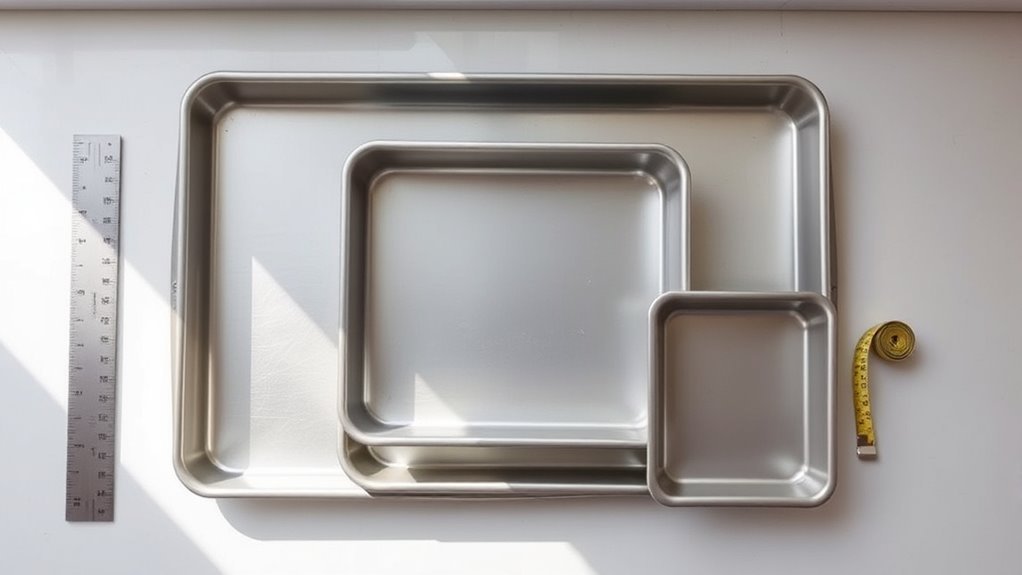
About 80% of home ovens fit a half-sheet pan, the most common baking sheet size you’ll encounter. You’ll see why that 18 x 13-inch tray is so useful for cookies, roasting, and everyday baking—and when you might prefer a full, quarter, or mini sheet instead. Keep this guide handy to figure out how many cookies or mini loaves fit each size, how rims and materials change performance, and which pan suits your needs.
Quick Answer: What Is a Standard Baking Sheet?
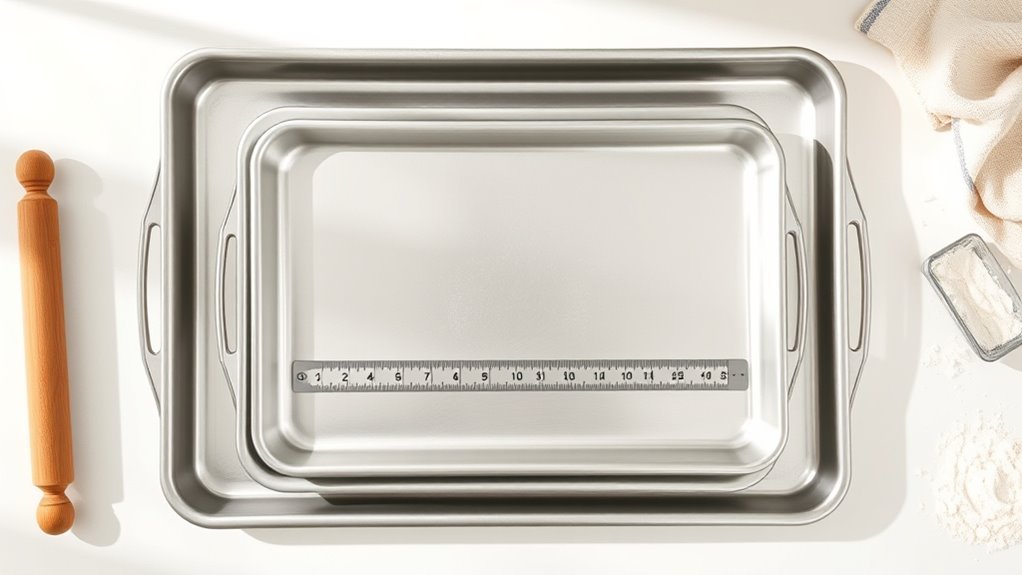
A standard baking sheet, often called a half sheet, measures about 18 x 13 inches and fits most home ovens, so you’ll reach for it for cookies, roasted vegetables, and sheet-pan dinners.
When you’re deciding on baking sheet size, that half-sheet gives you a versatile workhorse: it holds multiple batches, fits standard racks, and balances capacity with maneuverability.
You’ll notice edge styles matter—rimmed sides keep juices contained for roasting, while flat edges let air circulate for crisp cookies—so pick the edge type that frees your cooking goals.
Remember larger full sheets exist for commercial-scale work and smaller quarter sheets suit compact tasks, but the half sheet is the liberating default that keeps your options open without crowding the oven.
Choose the right dimension to match your recipe and oven space, and you’ll gain control over timing, capacity, and results without unnecessary compromise.
Standard Baking Sheet Sizes (Full, Half, Quarter, Mini)
You’ll want to know the common dimensions so you can match recipes and oven space: a full sheet is 26 x 18 inches, a half is 18 x 13, and a quarter is about 13 x 9.5.
For very small portions or individual servings, mini (eighth) sheets run about 9.5 x 6.5 inches.
Also note specialty sizes like the 15 x 10-inch jelly roll pan for thin cakes and rolled desserts.
Full, Half, Quarter Dimensions
Choose the right sheet size and you’ll streamline prep and baking—full sheets (26 x 18 in.) handle large batches and commercial work, half sheets (18 x 13 in.) are the most versatile for home kitchens, quarters (13 x 9.5 in.) suit smaller portions, and minis (about 9.5 x 6.5 in.) are great for individual treats.
When you pick baking sheets, think capacity and oven fit. Full sheets free you from batch juggling but need a commercial oven or space; half sheets balance volume and storage, so they’re the go-to for liberated home bakers.
Quarter pans let you test recipes or serve fewer people without waste. Minis are handy for personal portions.
Note: jelly roll pans (15 x 10 in.) exist for thin cakes and cookies.
Mini And Specialty Sizes
When space or portion control matters, mini and specialty sheets give you options tailored to specific tasks. You’ll reach for mini baking sheets (9.5 x 6.5 in) for singular portions, crisping, or quick reheats. Quarter sheets (13 x 9.5 in) handle small batches; half sheets (18 x 13 in) suit most home projects. Specialty pans like a 15 x 10 in jelly roll pan exist for thin cakes and rolls. Choose sizes that free you from oversized equipment and let you bake intentionally.
| Size | Dimensions (in) | Best for |
|---|---|---|
| Mini | 9.5 x 6.5 | Individual portions |
| Quarter | 13 x 9.5 | Small batches |
| Jelly roll | 15 x 10 | Rolled cakes |
How Many Mini Loaf Pans, Cookies, or Loaves Fit Each Size
Now let’s look at how many mini loaves, cookies, or full loaves you can fit on each sheet size so you can plan batches efficiently.
A half sheet (18×13″) usually holds about 12–15 mini loaf pans or 18–24 cookies.
A full sheet (26×18″) fits roughly 24 mini loaves or multiple cookie batches.
A quarter sheet (13×9.5″) works for about 3 mini loaves or a small cookie batch.
Always measure your pan dimensions and leave space for even heat circulation to maximize capacity and consistent baking.
Mini Loaves Per Sheet
A standard half sheet (18 x 13 inches) usually fits up to 15 mini loaf pans, while a quarter sheet (13 x 9.5 inches) holds about 4–5 and a full sheet (26 x 18 inches) can accommodate as many as 30 if your pans are small enough; cookies on rimless sheets will fit similarly depending on spacing. You’ll choose a baking pan size to match batch goals and freedom in the kitchen. Space mini loaves about 1 inch apart for even heat and steady rise. Below is a quick capacity reference to help you plan larger runs or pared-down, liberating bakes.
| Sheet Size | Typical Count | Spacing |
|---|---|---|
| Quarter | 4–5 | 1″ |
| Half | 12–15 | 1″ |
| Full | 25–30 | 1″ |
Cookies Per Pan
You’ve planned how many mini loaves fit on each sheet, so let’s look at cookies and other pans to match your batch size.
Use a full baking sheet (26 x 18 in.) when you want maximum output — it can hold up to 24 mini loaf pans or double the cookie capacity of smaller sheets.
A standard half baking sheet (18 x 13 in.) balances space and maneuverability, fitting about 12–15 mini loaves or around 12–15 standard cookies with proper spacing.
A quarter baking sheet (13 x 9.5 in.) is great for small runs — roughly four mini loaves or a modest dozen cookies.
Eighth sheets (9.5 x 6.5 in.) hold 1–2 mini loaves.
A jelly roll pan (15 x 10 in.) fits about six mini loaves.
Loaves Per Oven
Counting how many mini loaf pans, cookies, or full loaves will fit in your oven starts with the sheet size you choose.
Choose a quarter baking sheet (13 x 9.5 in) and you’ll fit 3–4 mini loaf pans or about 12 cookies — a freeing way to bake small batches.
A standard half baking sheet (18 x 13 in) typically holds up to 12 mini loaf pans, giving you reliable capacity for regular runs.
If you need big output, a full-size baking sheet (26 x 18 in) fits roughly 24 mini loaf pans.
Eighth sheets (9.5 x 6.5 in) work for 1–2 mini loaves or about six cookies.
Remember cookie sheets match cookie counts but won’t hold loaves or liquids.
How Rimmed vs. Flat Sheets Change Usable Capacity and Results
Because rims contain juices and raise the sheet’s walls, rimmed pans let you load more food without spills, which is ideal for sheet-pan dinners or roasting vegetables that release liquid.
You’ll find rimmed sheets (often 18 x 13 inches for a half sheet) can hold sauces and juices, so you can roast, braise, or toss without worrying about overflow.
Flat cookie sheets, by contrast, improve air circulation and deliver more even browning and crisp edges, but they can’t catch drips or hold liquids.
Choosing rimmed vs. flat affects usable capacity and results: rims increase volume and let you pile ingredients higher; flats favor surface contact and faster evaporation, boosting crispiness.
Rimmed pans also retain heat differently, which can change cooking times and browning, so expect slight adjustments.
Use rimmed sheets for anything saucy or high-volume; use flat sheets when you want maximum airflow and the crispiest finish.
Trust your intent and let the right sheet free your cooking.
Choosing a Sheet Size for Cookies, Roasting, and Bread
Whether you’re baking cookies, roasting a weeknight vegetable tray, or shaping loafs of sourdough, picking the right sheet size makes a big difference in capacity, heat distribution, and final texture.
Choose a quarter baking sheet (13 x 9.5 in) when you want small batches or quick breads—it’s efficient and conserves oven space.
A half baking sheet (18 x 13 in) is your everyday workhorse for cookie sheets, roasted vegetables, and sheet-pan dinners; it balances capacity with maneuverability.
Go full size (26 x 18 in) only when you need to produce large batches or run multiple trays—commercial kitchens rely on this for volume.
For sourdough and larger loaves, consider half or full hotel pans; their depth and surface area help dough spread evenly and bake with consistent crusts.
Always pick a baking sheet that frees you to work at the scale you want while maintaining proper airflow and even heat, so your results stay reliable and empowering.
Oven-Fit Checklist: Measure Your Oven and Clearance Tips
Measure your oven’s interior width and depth so you know which baking sheet sizes will actually fit between the racks. Allow extra clearance for the rack supports and room for air to circulate around the pan.
Also check door clearance and sheet height to make sure tall pans or rising loaves won’t hit the top or door.
Measure Oven Interior Width
Start by using a tape measure to record the oven’s interior width from wall to wall so you know which pans will fit without rubbing the sides. Measure straight across, note obstructions like racks or heating elements, and compare that number to a Half Sheet Pan (typically 18 x 13 inches).
Don’t forget depth and height—some pans need extra airflow. If you plan to bake multiple pans, measure the combined width plus spacing for circulation.
- Feel empowered knowing your pans will fit
- Enjoy the freedom to choose bold recipes
- Avoid frustration from stuck or warped sheets
- Gain confidence in stacking or spacing pans
- Celebrate predictable, even baking results
These steps free you to bake without limits.
Allow Clearance For Racks
Now that you’ve checked the oven’s width, make certain the racks and door give your baking sheets room to breathe. Measure interior height and allow at least 1 inch of rack clearance above the sheet for proper airflow and even heat. Check door clearance so sheets slide in and out without scraping. If you’ll use multiple sheets, verify vertical spacing to avoid crowding and lost convection. Standard half (18×13″) and full (26×18″) sizes must fit with clearance.
| Item | Measurement to Check | Why it Matters |
|---|---|---|
| Rack clearance | +1″ above sheet | Guarantees circulation |
| Door clearance | Enough to insert/remove | Prevents damage |
| Multiple sheets | Total vertical space | Avoids uneven baking |
How Material Affects Heat and Which Sizes Pair Best
Because different metals move heat at different rates, the material of your baking sheet directly shapes browning, cooking time, and the risk of warping.
You’ll choose aluminum when you want quick, even heat and reliable browning across an 18 x 13-inch standard baking sheet; it’s ideal for cookies and roasted vegetables.
Pick stainless steel if you prioritize longevity and resistance to warping, especially for frequent use.
For smaller batch baking or limited oven space, a quarter sheet (13 x 9.5 inches) paired with a lighter sheet keeps weight manageable and prevents distortion.
When scaling up, use heavier gauge aluminum for larger batches to maintain even heat and structural integrity.
Match material to size: lightweight metal for small trays, heavier gauges for full-size sheets.
That lets you reclaim control in the kitchen, bake confidently, and resist mediocre results.
- You’ll love the even browning aluminum delivers.
- You’ll trust stainless steel’s sturdiness.
- You’ll feel empowered choosing right-sized pans.
- You’ll avoid frustration from warped trays.
- You’ll bake with freedom and precision.
Buying Tips: Durability, Coatings, and Non‑Toxic Options
When you’re shopping for baking sheets, focus on durability, the type of coating, and whether materials are free of harmful chemicals so you get reliable performance and safer food.
Choose a half-sheet (18 x 13 inches) for home ovens and look at core material: aluminum heats fast and evenly, stainless resists rust and warping.
Choose a half-sheet (18 x 13″) for home ovens; aluminum heats fast, stainless resists rust and warping.
Inspect construction for thickness and reinforced rims so the pan won’t bend under high heat.
Prioritize non-toxic coatings—ceramic options avoid PTFE, PFOA, and PFAS and give peace of mind while you bake.
If you prefer uncoated metal, season or use parchment to prevent sticking.
Read reviews; trusted names like Nordic Ware and HONGBAKE often score well, and niche labels such as Baker’s Naturals may offer eco-minded choices that align with liberated living.
Compare warranties, avoid pans that advertise dubious “nonstick” chemicals, and pick a sheet that balances longevity, safety, and your baking style.
Sizing Conversions, Storage Tips, and When to Upgrade
If you’re juggling recipes or limited oven space, understanding sheet sizes and how they nest will save time and hassle: a standard half sheet (18 x 13 in.) handles most home baking, a full sheet (26 x 18 in.) gives you commercial-scale capacity, and a quarter sheet (13 x 9.5 in.) slips into a half sheet for smaller batches.
When converting sizes, plan yields and rack positions so your baking sheet fits without crowding. Store sheets vertically in a cabinet or slot organizer to reclaim space; always dry them thoroughly to avoid warping and corrosion.
Consider upgrading when thin pans warp, heat unevenly, or limit your batch size. Moving up to commercial-grade aluminum or heavier gauge construction improves heat distribution and durability, so you bake with confidence, not compromise.
- Reclaim kitchen freedom with neat storage
- Feel empowered by predictable conversions
- Ditch warped pans for steady results
- Trust heavier gauges for consistent baking
- Bake bigger, liberate your time
Summary Quick-Reference: Sizes, Uses, and Buying Checklist
Start with the basics: know the common sizes and how you’ll use them—quarter (13 x 9.5 in.) for small batches, half (18 x 13 in.) as your everyday workhorse, full (26 x 18 in.) for commercial or large-volume baking, and jelly roll pans (about 15 x 10 in.) for thin, rollable cakes—then match sheets to oven space and typical recipes so you don’t end up with a pan that won’t fit or won’t hold enough.
Use this quick-reference to simplify choices: pick a half baking sheet if you want versatility; choose a quarter for singles or testing; go full only if you bake in bulk or have a commercial oven; use a jelly roll pan for sponge cakes and roulades.
Buying checklist: measure oven interior, decide whether you need rimmed or rimless, prefer heavy-gauge metal for even heat, check nonstick coating durability, and consider stackable storage.
With these clear steps, you’ll select a baking sheet that fits your freedom to create without clutter or compromise.
Frequently Asked Questions
What Size Baking Sheets Do Bakeries Use?
Bakeries typically use full-size baking sheets (26 x 18 inches) for large batches, though you’ll also see half (18 x 13) and quarter (13 x 9.5) pans.
You’ll choose heavy-duty Baking Sheet Materials like aluminum or stainless steel to endure frequent use and give even heat.
Pick sizes that match oven capacity and workflow so you can streamline production, free your time, and bake more creatively and efficiently.
What Is the Difference Between a Baking Sheet and a Cookie Sheet?
What’s the real difference then? You’ll spot it: baking sheets (Baking Sheet Types) have raised edges to hold juices and bigger dishes, while cookie sheets are flat with minimal rims for airflow.
You’ll use a baking sheet for roasting, sheet-pan meals, and anything saucy, and a cookie sheet for crisp, evenly baked cookies.
Choose the tool that frees your cooking—edges when you need containment, flat when you want breathability.
Is a 9×13 Pan a Cookie Sheet?
No — a 9×13 pan isn’t a cookie sheet. You’ll find it’s a deeper baking pan with higher sides, ideal for casseroles, brownies, and dishes needing containment.
If you crave Pan Versatility, you can still adapt it for sheets or roasting, but don’t expect the thin, rimless design of cookie sheets that boosts airflow for cookies.
Choose the right tool and you’ll bake with more freedom and better results.
What Is Considered a Full-Size Baking Sheet?
A full-size baking sheet is 26 x 18 inches.
Picture a wide sail catching heat as you bake; that spacious surface frees you to cook for many.
You’ll find Baking Sheet Materials like aluminum, aluminized steel, and stainless offering different weights, heat response, and durability.
You’ll want raised edges to hold juices, and to guarantee your oven can fit the pan so your culinary freedom isn’t confined.
Conclusion
You’ll reach for a half sheet — roughly 18 x 13 inches — when you want reliable capacity without a wrestling match with your oven; it’s both workhorse and everyday companion. Smaller quarter sheets feel snug and efficient for intimate batches, while full sheets are sprawling stadiums for holiday feasts. Consider rims, material, and heat response to match scale with outcome. Pick the size that balances space, handling, and the kind of kitchen theater you want to create.
