
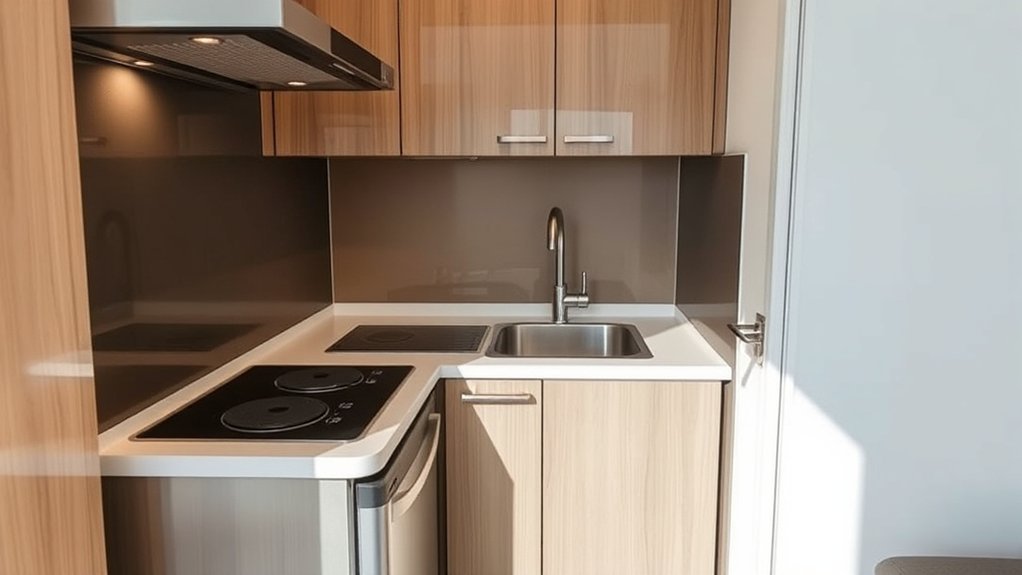
A kitchenette may have a stove or cooktop, but it is not guaranteed. Many include a compact electric or induction cooktop, while others provide only a microwave, mini-fridge, sink, or small countertop appliances. The exact setup depends on the building, hotel, apartment, local rules, and available utilities.
Quick Answer
Kitchenettes do not always have a stove. Many have a one- or two-burner cooktop, hot plate, or induction unit, but some hotel and apartment kitchenettes rely on a microwave and refrigerator instead. If a stovetop matters to you, check the exact appliance list before booking, renting, or buying.
Key Takeaways
- A kitchenette can have a cooktop, but the term does not guarantee one.
- Common appliances include a mini-fridge, microwave, sink, and compact cooking appliance.
- Some jurisdictions define kitchenettes differently, so there is no single nationwide size or appliance standard.
- Portable and built-in cooktops can have very different electrical and installation requirements.
- For hotels and rentals, always confirm whether the room includes an actual stovetop, oven, cookware, and sink.
What Is a Kitchenette?
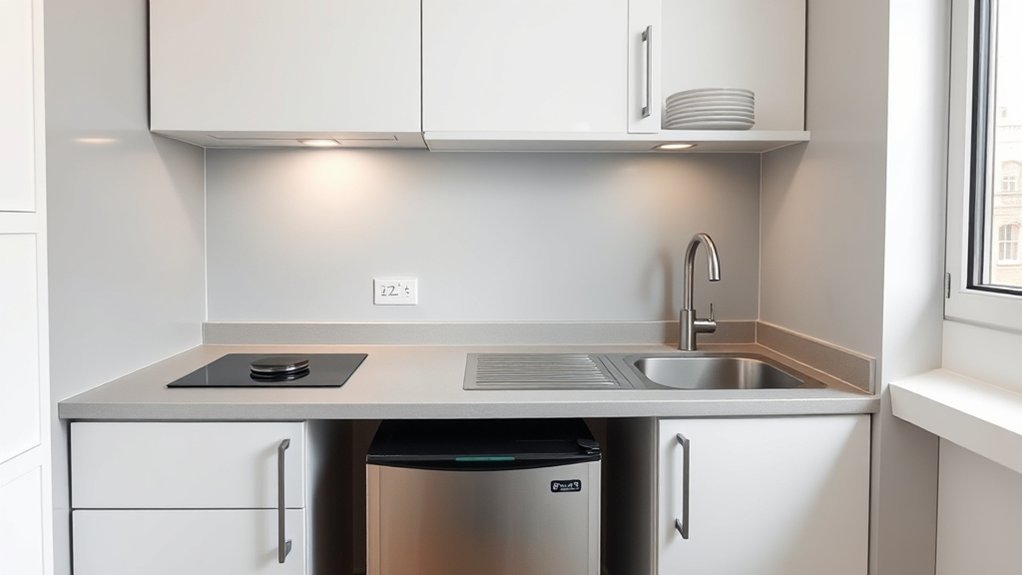
A kitchenette is a small food-preparation area with fewer appliances, less counter space, and less storage than a full kitchen. You commonly find kitchenettes in studio apartments, hotel rooms, dorm-style housing, guest suites, offices, RVs, and accessory living spaces.
There is no single nationwide U.S. definition that sets one required size or appliance list. For example, the 2022 New York City Building Code defines a kitchenette as a cooking or food-warming space with less than 80 square feet of floor area. By contrast, the 2025 California Building Code uses a broader functional definition for a kitchen or kitchenette.
Note: The often-repeated “under 80 square feet” rule is not a universal definition. It applies in some codes, including New York City’s, while other jurisdictions use different standards.
A typical kitchenette may include a mini-fridge, microwave, sink, cabinets, and a small cooktop. Other versions may have no cooktop at all. The goal is to provide useful food storage and preparation in a compact footprint.
Do Kitchenettes Have Stoves?
Some kitchenettes have a stove or cooktop, and some do not. A compact one- or two-burner electric or induction cooktop is common where regular stovetop cooking is expected. Other kitchenettes, especially in hotels or offices, may offer only a microwave and refrigerator.
It also helps to separate several terms:
- Range: a cooktop and oven combined in one appliance.
- Cooktop: burners installed on a counter, without an oven below.
- Hot plate or portable burner: a small plug-in cooking appliance that sits on the counter.
- Oven: an enclosed appliance for baking, roasting, or broiling.
Because a full range uses more room, many kitchenettes use a cooktop instead. Some add a countertop convection or toaster oven when baking capability is needed.
“Kitchenette” describes a compact food-preparation area; it does not promise a specific stove, oven, or appliance package.
Hotel listings demonstrate the variation. Marriott notes that its in-room kitchen amenities vary by brand and property and describes kitchenettes as more limited than full kitchens. For that reason, travelers should check the room’s exact appliance list instead of relying only on the word “kitchenette.”
What Comes in a Kitchenette?
A kitchenette generally contains enough equipment for food storage, drinks, reheating, and at least some meal preparation. The exact package can range from a mini-fridge and microwave to a small but capable cooking station with a sink and cooktop.
Core Kitchenette Appliances
Common kitchenette appliances and fixtures include:
- A compact or under-counter refrigerator
- A microwave
- A sink and faucet
- A one- or two-burner cooktop or portable cooking unit
- Basic cabinets or shelving
- A small section of counter space
Some better-equipped kitchenettes also have a toaster oven, convection oven, narrow dishwasher, coffee maker, or full-size refrigerator. These extras are useful but should not be assumed from the word “kitchenette” alone.
Stove and Sink Setup
Where a kitchenette has a cooking surface, a compact electric or induction cooktop is a common choice. It may be built into the counter or supplied as a portable appliance.
A nearby sink makes food preparation and cleanup much easier, but even a sink is not guaranteed in every hotel or workplace kitchenette. The amount of counter space between the sink and cooking area also varies considerably.
Warning: Do not assume every electric cooktop can be plugged into a normal receptacle. Portable models may use standard household outlets, while many built-in electric and induction cooktops require dedicated 208/240-volt electrical service. Follow the appliance installation instructions and applicable local electrical code.
Compact Storage Options
Storage is usually one of the biggest differences between a kitchenette and a full kitchen. A kitchenette may have only a few cabinets, shelves, or drawers, so every section needs to work hard.
Useful space-saving options include:
- Wall-mounted or open shelves
- Pull-out cabinet organizers
- Hooks or magnetic utensil storage
- Rolling carts
- Stackable cookware
- Compact appliances that can be stored when not in use
A rolling cart can be especially useful because it provides extra preparation space without permanently taking over the room.
How Big Is a Kitchenette?
Kitchenettes are smaller than full kitchens, but there is no universal size. Some occupy a short section of one wall, while others fill a corner or alcove. Local building codes may also define the term differently.
| Feature | What to Expect |
|---|---|
| Overall size | Compact; varies widely by building and jurisdiction |
| Counter space | Usually limited compared with a full kitchen |
| Storage | A small number of cabinets, drawers, or shelves |
| Placement | Commonly along one wall, in an alcove, or in a corner |
New York City is one example of a jurisdiction with a specific threshold: its building code defines a kitchenette as a cooking or food-warming space under 80 square feet. That figure should not be treated as a universal standard elsewhere.
Kitchenette Cooktop Types
Where a kitchenette includes stovetop cooking, electric coil, radiant electric, and induction units are common options. Gas may be possible in some buildings, but it requires suitable fuel service, ventilation, and code compliance.
Cooktop Types Explained
Electric coil cooktops use exposed heating elements. They are simple and can work with most flat-bottom cookware.
Radiant electric cooktops place the heating elements beneath a smooth glass-ceramic surface. They offer a flat work surface that is easier to wipe clean than exposed coils.
Induction cooktops create heat in compatible magnetic cookware rather than heating a conventional resistance element. The U.S. Department of Energy reports that induction can be more energy-efficient than conventional smooth-top electric cooking and can heat cookware quickly.
Induction requires compatible cookware. A simple check is whether a magnet sticks firmly to the bottom of the pan.
Electric And Induction Options
Electric and induction cooktops are well suited to compact spaces because they are available in small configurations and do not require a gas line.
Induction provides fast response and keeps the surrounding cooking surface cooler than conventional resistance elements because energy is transferred directly to compatible cookware. Conventional electric models can be less expensive to purchase and accept a broader range of cookware.
The electrical supply is an important part of the choice. A countertop portable unit may operate from a standard receptacle, while a larger built-in cooktop may need a dedicated higher-voltage circuit. For example, Frigidaire’s cooktop guidance specifies 208/240-volt connections for its electric and induction cooktops.
Built-In Cooking Features
A built-in cooktop can make a kitchenette look cleaner and preserve a fixed cooking zone, but installation requires more planning than placing a portable burner on the counter.
Features vary by model and may include:
- Hot-surface or power-on indicators
- Control locks
- Automatic pan detection on induction models
- Timers
- Multiple power levels
- Automatic shutoff functions
Never assume a built-in appliance can simply be added to an existing counter. Check cutout dimensions, clearances, electrical requirements, ventilation rules, and local permit requirements before installation.
Can You Cook Full Meals in a Kitchenette?
Yes, many kitchenettes can handle complete meals, especially when they have a cooktop, microwave, and enough preparation space. The main limitations are usually the number of burners, counter area, ventilation, storage, and whether an oven is available.
Typical kitchenette-friendly meals include:
- Pasta, rice, or noodles
- Soups and stews
- Sautéed vegetables
- Eggs and breakfast foods
- One-pan or one-pot meals
- Microwave meals and reheated leftovers
- Baked foods when a countertop or built-in oven is available
Cooking becomes harder when a recipe needs several burners, a large oven, extensive chopping space, or many pots at the same time. Planning one-pot meals and cleaning as you cook can make a small kitchenette much easier to use.
Pro Tip: In a two-burner kitchenette, plan the meal around one main pan and one pot. This leaves room to work and reduces the pile of cookware waiting for limited sink space.
Where Are Kitchenettes Common?
Kitchenettes are useful anywhere people need food storage or light cooking without dedicating a full room to a kitchen. Common locations include:
- Studio and efficiency apartments
- Hotels and extended-stay properties
- Guest suites and in-law suites
- Accessory dwelling units
- Dormitory-style housing where cooking is permitted
- Offices and staff rooms
- RVs and other compact living spaces
- Finished basements and bonus rooms
Hotel kitchenettes deserve special attention because the appliance list can change from one property or room type to another. One room may have a stovetop, refrigerator, sink, dishwasher, and cookware, while another property’s “kitchenette” may consist mainly of a microwave and mini-fridge.
If you are choosing a hotel specifically so you can cook, confirm whether the listing says stovetop, cooktop, or range. Do not assume “kitchenette” alone guarantees one.
How to Choose a Kitchenette for Your Space
Selecting the right kitchenette starts with the available room and the type of cooking you actually plan to do.
- Measure the space. Check width, depth, doors, walkways, and appliance clearances.
- Choose the cooking level. Decide whether you need only a microwave, a portable burner, a built-in cooktop, or an oven as well.
- Plan refrigeration. Choose capacity based on how much fresh and frozen food you normally store.
- Check utilities. Confirm plumbing, receptacles, circuit capacity, voltage, ventilation, and any gas connection before buying appliances.
- Protect preparation space. Avoid filling every inch of the counter with permanent appliances.
- Add useful storage. Shelves, drawers, organizers, and a rolling cart can make a small layout much more practical.
- Check local requirements. Building, fire, electrical, plumbing, accessibility, rental, and HOA rules can affect what you may install.
For a secondary kitchenette that will mainly handle drinks and snacks, a refrigerator, sink, and microwave may be enough. For everyday meal preparation, a cooktop and more counter space become much more valuable.
Ventilation, Electrical, and Fire Safety
A small cooking area still needs the same basic safety habits as a large kitchen. Compact layouts can actually make clearance more important because towels, paper products, curtains, and other combustible items may sit closer to the cooking surface.
The U.S. Fire Administration identifies cooking as the leading cause of home fires and recommends staying in the kitchen when frying, boiling, grilling, or broiling food.
- Keep combustible items away from burners.
- Turn pot handles toward the back of the cooking surface.
- Do not leave high-heat cooking unattended.
- Use appliances only on circuits and outlets permitted by their instructions.
- Do not run cooking appliances from unsuitable extension cords.
- Provide the ventilation required by the appliance and applicable local code.
- Keep smoke alarms working and follow local fire-safety requirements.
Warning: If a pan of oil or grease catches fire, do not throw water on it. Turn off the burner if you can do so safely and cover the pan with a lid or baking sheet. If the fire is spreading or you are unsure what to do, leave the area and call emergency services.
Kitchenette vs. Full Kitchen Costs
A kitchenette is often cheaper to build than a full kitchen because it normally uses fewer cabinets, less counter material, and fewer or smaller appliances. However, there is no reliable universal price range.
The total cost depends heavily on:
- Whether new plumbing is required
- Electrical-panel and circuit upgrades
- Cabinet quality
- Countertop material
- Refrigerator, cooktop, microwave, oven, or dishwasher choices
- Ventilation work
- Permits and inspections
- Local labor costs
- Whether walls or flooring must be changed
A simple kitchenette added beside existing plumbing can cost far less than one built in a room with no water, drain, or adequate electrical service. For the same reason, it is misleading to assign one fixed resale-value percentage to every kitchenette project.
Energy use also depends on the actual appliances rather than size alone. When choosing a compact refrigerator, compare its labeled annual energy consumption instead of assuming every mini-fridge is automatically cheaper to operate. ENERGY STAR maintains efficiency criteria for compact refrigerators as well as full-size models.
Frequently Asked Questions
What Is Normally Included in a Kitchenette?
A kitchenette commonly includes a refrigerator or mini-fridge, microwave, limited counter space, and some storage. Many also have a sink and a compact cooktop, but neither the appliance list nor the size is universal. Hotels, apartments, offices, and local building codes may all use the term differently.
Can You Cook in a Kitchenette?
Yes. A kitchenette with a cooktop can handle boiling, simmering, sautéing, and many one-pot meals. A kitchenette without a cooktop is more limited, although a microwave, toaster oven, or other permitted countertop appliance may still provide useful cooking options.
What Is a Kitchen With No Stove Called?
There is no universal name based only on whether a stove is present. A compact area without a stove may still be marketed as a kitchenette, while some spaces are better described as a wet bar, beverage center, pantry, or food-preparation area. Local building-code definitions may differ from everyday real-estate or hotel terminology.
Do Kitchenettes Have an Oven?
Some do, but many do not. A kitchenette may use a countertop toaster or convection oven instead of a conventional full-size oven. If baking or roasting matters to you, confirm the appliance list rather than assuming an oven is included.
Do Hotel Kitchenettes Always Have a Stove?
No. Some hotel kitchenettes have a stovetop, while others provide only a mini-fridge, microwave, sink, or coffee-making equipment. Check the specific room description or contact the property if you need to cook on a burner.
Does a Kitchenette Need a Stove to Qualify as a Kitchenette?
Not under every definition. Building codes and everyday hospitality or real-estate terminology differ. Some jurisdictions define kitchenettes by size or cooking function, while hotels may use the term for compact food-preparation areas with limited appliances.
Conclusion
A kitchenette may have a stove or cooktop, but it does not have to. Compact electric and induction cooktops are common in kitchenettes designed for regular meal preparation, while other setups rely on a microwave, refrigerator, sink, and small countertop appliances.
The safest approach is to judge a kitchenette by its actual equipment rather than its label. Before booking a hotel, renting a unit, or building one at home, check the cooktop, oven, refrigerator, sink, electrical service, ventilation, storage, and local installation requirements. That gives you a much clearer picture of what you will actually be able to cook.
Sources
- 2022 New York City Building Code — Definitions — supports the New York City definition of a kitchenette as a cooking or food-warming space under 80 square feet.
- 2025 California Building Code — Definitions — demonstrates that other jurisdictions define kitchens and kitchenettes differently.
- U.S. Department of Energy — Making the Switch to Induction Stoves or Cooktops — supports induction efficiency, cookware, and heating information.
- U.S. Fire Administration — Cooking Fire Safety — supports cooking-fire prevention and unattended-cooking guidance.
- ENERGY STAR — Refrigerators & Freezers Key Product Criteria — supports efficiency guidance for compact refrigerators.
- Marriott Bonvoy — Hotels With Kitchens & Kitchenettes — supports the point that hotel kitchen and kitchenette amenities vary by property and room type.