
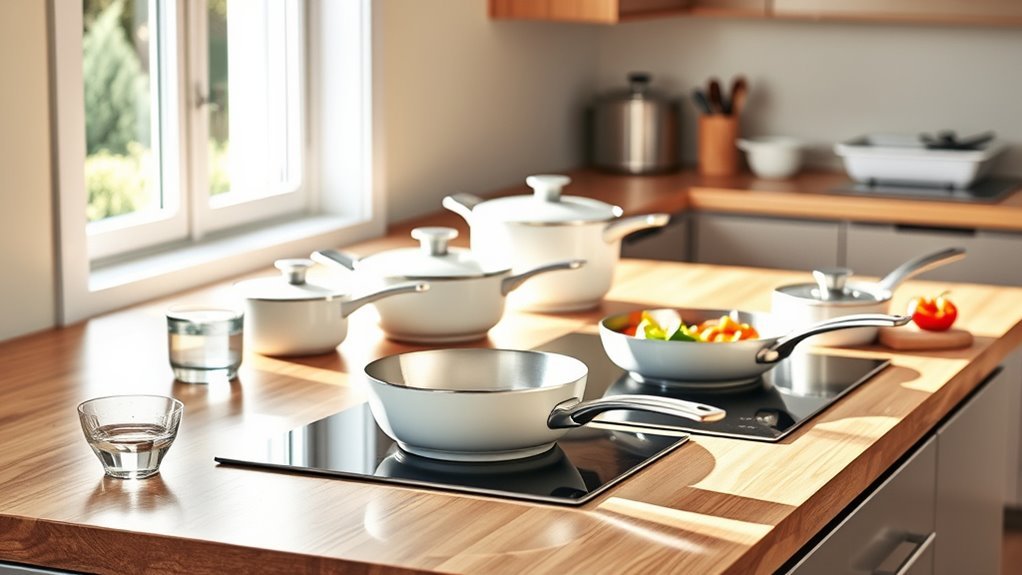
If you care about nonstick safety, you’ll want clear facts on T‑fal’s ceramic line: what materials and coatings they use, whether they avoid PTFE and PFOA, and how they test for heavy metals. You’ll also need to know how the aluminum core and scratch‑resistant surface affect heat, longevity, and failure modes, plus practical care steps to minimize risk—so keep going to see which models and practices make the most sense for your kitchen.
Is T‑Fal Ceramic Cookware Safe to Use?
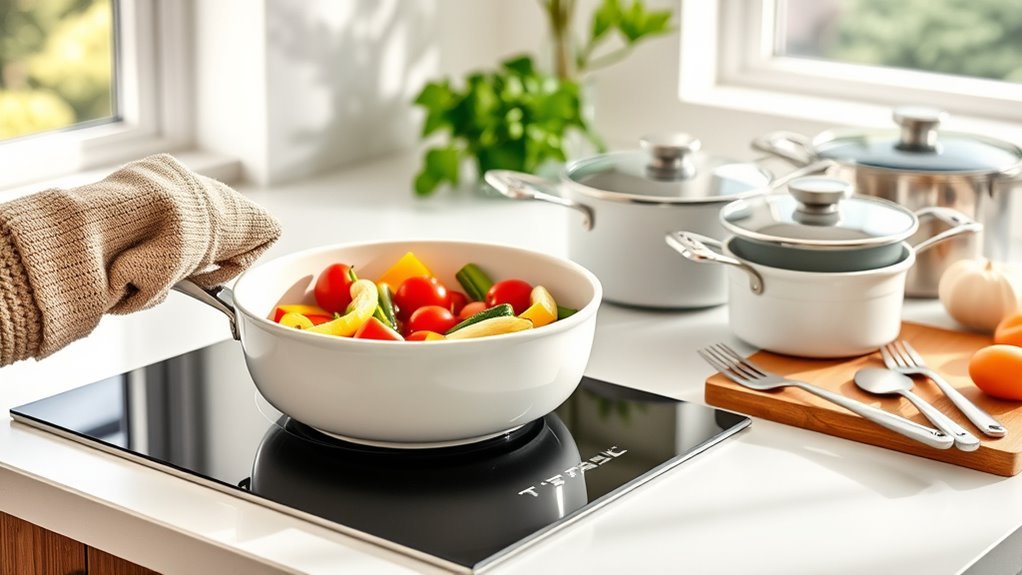
Wondering whether T‑fal’s ceramic line is safe for everyday cooking? You can rely on a Ceramic Nonstick Cookware Set that’s PTFE-free, which means it avoids traditional nonstick chemicals linked to toxin concerns. That absence reduces your exposure to those compounds during normal use.
The ceramic coating gives a durable nonstick surface so you can cook with little to no oil, supporting healthier meals and greater control over what you eat. T‑fal’s use of 100% recycled aluminum also aligns with eco-conscious choices, letting you choose cookware that reflects liberation from wasteful manufacturing.
Practically, the set is oven safe to 350°F (175°C), expanding techniques you can employ, though it won’t work on induction cooktops. Dishwasher cleaning is permitted, but hand washing will better preserve the nonstick performance over time.
Taken together, the evidence indicates the Ceramic Nonstick Cookware Set is a safe, pragmatic option when you follow recommended temperature and care guidelines.
Materials and Coatings: What’s Inside T‑Fal Ceramic?
When you inspect T‑fal’s ceramic line, you’ll find a hard, inorganic ceramic-based nonstick layer designed to reduce sticking without PTFE or PFOA.
The pans use lightweight aluminum cores for rapid, even heat distribution and include Thermo-Spot indicators for consistent preheating.
Although the coating is marketed as scratch-resistant and dishwasher-safe, hand washing is recommended to preserve the nonstick surface and lifespan.
Ceramic Nonstick Composition
A closer look at T‑fal’s ceramic nonstick reveals a PTFE- and PFOA‑free coating applied over a 100% recycled aluminum body, so you get nonstick performance without traditional perfluorinated chemicals and with a lighter, more sustainable base metal. You’ll find the ceramic nonstick composition is scratch-resistant and engineered for reliable food release, helping you cook with less oil and clean with less effort. The Thermo-Spot guides you to ideal heat, reducing mistakes and waste. Oven-safe to 350°F (175°C), it broadens technique without compromising the coating, though it won’t work on induction. Below is a concise comparison to clarify core properties.
| Feature | Benefit |
|---|---|
| Recycled aluminum body | Lighter, eco-friendly heat conductor |
| Ceramic nonstick | Durable, scratch-resistant surface |
| Thermo-Spot | Visual heat control for safer cooking |
PTFE And PFOA Status
Building on the composition and performance features, you should know T‑fal’s ceramic line completely omits PTFE and PFOA from its coating formulation.
You get a PTFE-free, PFOA-free surface that sidesteps polytetrafluoroethylene and perfluorooctanoic acid—chemicals tied to health and environmental concerns.
The ceramic coating provides nonstick performance while meeting contemporary safety standards, so you can cook without those legacy fluorinated substances.
It’s scratch-resistant and promotes even heat distribution, reducing hotspots and minimizing the need for excess oil.
For seekers of practical liberation from toxic-chemical uncertainty, this choice aligns with eco-conscious values and safer daily use.
The evidence supports that T‑fal’s ceramic option offers a cleaner nonstick alternative without sacrificing functionality.
Base And Core Materials
Think of the cookware’s core as the engine: T‑fal builds its ceramic line on bodies made from 100% recycled aluminum, which delivers reliable, even heat distribution while lowering environmental impact. You get a lightweight, responsive base that moves heat efficiently and supports liberation from heavy, wasteful pans. The genuine ceramic coating is PTFE/Teflon‑free, scratch‑resistant, and rated oven‑safe to 350°F (175°C). Thermo‑Spot Technology® signals when the pan reaches ideal temperature, so you won’t guess.
| Feature | Benefit | Note |
|---|---|---|
| Recycled aluminum body | Even heat, lighter weight | Eco-forward |
| Ceramic coating | Nonstick, no PTFE/Teflon | Durable, scratch‑resistant |
| Oven safety | Versatile cooking | Up to 350°F |
| Thermo‑Spot | Preheat indicator | Consistent results |
This core and base design is methodical, evidence‑based, and built for practical freedom.
Chemical Safety: PTFE, PFOA, and Heavy Metals?
You can be reassured that T-fal’s ceramic line is PTFE- and PFOA-free, removing two common chemical concerns associated with traditional nonstick pans.
Because the company uses recycled aluminum and a stable ceramic coating rated to 350°F, the risk of heavy-metal exposure and heat-related off-gassing is low when you follow use instructions.
We’ll now examine the evidence on ceramic coating composition, temperature limits, and test results for metal leaching.
PTFE And PFOA Status
While evaluating chemical safety, note that T-fal’s ceramic cookware is formulated without PTFE and PFOA and is tested to be free of heavy metals, so you won’t be exposed to those common nonstick concerns during normal use.
You’ll find the coating explicitly PTFE-free, PFOA-free, so the nonstick performance doesn’t rely on those fluorinated chemistries. This matters if you’re choosing cookware to reduce long-term chemical burdens and environmental impact.
T-fal states their ceramic finish achieves release and durability through inorganic materials and controlled manufacturing, not legacy perfluorinated compounds.
The company subjects products to health-and-safety testing protocols; you can consequently select these pans with reasonable confidence that they avoid PTFE and PFOA-related risks under normal cooking conditions.
Heavy Metals Risk
Because T-fal’s ceramic finish is formulated without PTFE or PFOA and has been tested for metal leaching, you can reasonably expect minimal heavy-metal exposure during normal cooking.
Tests show the ceramic surface doesn’t leach heavy metals into food, so you can cook without fearing contaminant transfer from the coating.
The cookware’s PFOA-free, PTFE-free composition and 100% recycled aluminum body further reduce chemical concerns compared with some alternatives.
You should still follow manufacturer care instructions—avoid aggressive scrubbing or damage that could expose underlying metal.
Ceramic Coating Safety
Having established that T-fal’s ceramic finish limits heavy-metal exposure, let’s examine the coating itself for chemical safety regarding PTFE, PFOA, and related concerns.
You’ll find T-fal ceramic cookware is PTFE-free, so it avoids traditional nonstick chemicals like PFOA linked to health worries.
The ceramic coating safety profile rests on a non-toxic inorganic layer that provides a durable, scratch-resistant surface, reducing risk of chemical leaching during normal use.
Because the pans use 100% recycled aluminum bodies and limit oven use to 350°F, you’ll maintain safe cooking temperatures that align with the coating’s specifications.
In short, the evidence indicates ceramic coating safety here is strong: non-PTFE, PFOA-free, and designed for practical, lower-risk cooking.
Performance & Durability: Nonstick Life and Failure Modes
When you evaluate T-fal’s ceramic cookware for real-world performance, focus on how its genuine ceramic nonstick and heavy-gauge aluminum base interact over time: the ceramic delivers immediate low‑oil release and resists scratches better than many soft coatings, while the thick aluminum promotes even heating that reduces localized wear from repeated high‑heat use.
Focus on T-fal’s genuine ceramic nonstick and heavy-gauge aluminum for immediate release, scratch resistance, and even heating.
You’ll judge nonstick life by gradual changes: manufacturers and user reports show good initial release and a typical service span of a few years before staining or reduced slickness appears.
Because the cookware is PTFE-free, chemical breakdown at moderate temps is less of a concern, but the 350°F (175°C) oven limit and sensitivity to higher temperatures create a thermal ceiling that can accelerate wear if ignored.
Failure modes are physical abrasion, surface staining, and heat-induced dulling of release rather than sudden coating delamination.
Measure longevity empirically: track cook surface appearance, cook times, and oil needs to decide when performance no longer meets your standards.
How to Avoid Problems: Use and Care Tips for Longevity
If you want your T-fal ceramic cookware to keep performing, follow a few targeted care steps that address the main wear mechanisms: avoid metal utensils and use silicone, wood, or plastic to prevent scratches; keep stovetop temperatures moderate (remember the 350°F oven ceiling) to limit heat‑induced dulling; wash by hand with mild detergent rather than running the dishwasher to preserve the coating and finish; store pans so they don’t rub against heavy items or stack directly on each other; and inspect surfaces regularly for staining, abrasion, or loss of release so you can replace pieces before performance or safety is compromised.
Be deliberate: always choose soft utensils to protect the ceramic layer and preserve nonstick properties. Cook at medium heat and preheat briefly; prolonged high heat accelerates coating breakdown.
Clean immediately after use with a soft sponge and mild detergent; avoid abrasive pads and harsh detergents. Store with protective padding or hang cookware to eliminate contact abrasion.
Inspect rims and cooking surfaces periodically; visible wear, chipping, or persistent staining signals replacement. These steps reduce failure risk and keep your cookware reliable while you reclaim control of your kitchen.
T‑Fal Initiatives vs. Other Ceramic and Nonstick Options
Now that you’ve got care and use down, compare what T‑Fal Initiatives offers against other ceramic and nonstick options so you can match product features to your cooking habits.
T-fal Initiatives uses a PTFE-free, genuine ceramic nonstick surface that reduces health risks linked to traditional coatings. Its scratch-resistant finish supports low‑oil cooking and, because the pans are made from 100% recycled aluminum, the line scores as eco-friendly in materials and manufacturing.
Weigh that against competitors that offer larger sets or higher oven safe temps.
- Safety: PTFE-free ceramic reduces chemical exposure; monitor max temp for safety.
- Materials: recycled-aluminum build is lighter and greener than many rivals.
- Cooking methods: good for everyday sautéing and low-heat searing; avoid very high-temperature techniques.
- Value: balanced quality and affordability versus brands with bigger sets or higher oven tolerance.
Match choice to your priorities: liberation from toxic coatings, ecological impact, and the specific cooking methods you use.
Who Should Buy T‑Fal Ceramic, and Which Models to Choose
Who benefits most from T‑Fal’s Initiatives Ceramic line? You do if you prioritize PTFE-free cooking, want to use minimal oil, and value a reasonably priced set that covers everyday needs.
T-fal ceramic cookware suits health-conscious cooks who want reliable, scratch-resistant surfaces and even heat distribution for sautéing and frying.
Choose the 16-piece Initiatives Ceramic Cookware Set if you need versatility: multiple pans and lids let you handle diverse recipes without piecing together pieces.
Opt for individual pieces only if your kitchen already covers basics.
Keep in mind stove compatibility and oven limits: these pieces work on gas and electric ranges but aren’t induction-ready, and they’re oven-safe to 350°F (175°C).
If you demand high-heat roasting or induction use, look elsewhere.
For liberation-seeking cooks who want safer nonstick, practical performance, and sensible cost, T-fal’s ceramic line is a methodical, evidence-backed choice.
Frequently Asked Questions
Which Is Better, Tefal or Ceramic?
Tefal often wins for durability and cooking precision, but ceramic beats it if you want PTFE-free materials comparison and perceived eco-friendliness.
You’ll trade Thermo-Spot precision and higher heat tolerance for a safer, lower-heat ceramic surface that can stain and wear faster.
Choose Tefal if you need longevity and performance; pick ceramic if you prioritize chemical-free cookware and a greener ethos.
Decide based on your cooking habits and values.
What’s the Downside of Ceramic Cookware?
Like a painted shield that chips, the downside of ceramic cookware is clear: Durability Concerns—its coating can wear, stain, and lose nonstick performance.
You’ll notice slower heat-up, lower oven limits (around 350°F/175°C), and no induction compatibility, which restricts high-heat techniques.
You’ll need gentler care and more frequent replacement than with hard-anodized or PTFE-coated pans, but you’ll gain a cleaner, chemical-free surface if you accept those trade-offs.
What Are People Saying About the T-Fal Ceramic Non-Stick Pan?
People say the T-fal Ceramic Non-Stick Pan earns strong User Reviews for performance and ease.
You’ll find praise for cooking with little oil, reliable food release, effortless cleanup, and dishwasher safety. Many note Thermo-Spot Technology® helps preheat accurately.
A few users mention staining or slower heat-up, but overall feedback leans positive.
You’ll feel empowered choosing a pan that supports healthier, more liberated cooking without sacrificing convenience.
Why Can’t You Use Olive Oil on Ceramic Pans?
Like a match flirting with kindling, you shouldn’t use olive oil on ceramic pans because its low smoke point undermines Oil Stability and the coating.
You’ll overheat oil during searing, producing smoke, sticky residues, and degraded nonstick performance. Use olive oil only for low-heat cooking or finishing to preserve flavor.
For high-heat tasks, choose higher-smoke-point oils (avocado, canola) to protect the ceramic surface and extend its lifespan.
Conclusion
You can feel confident using T‑Fal ceramic cookware: it’s PTFE‑ and PFOA‑free, tested for heavy metals, and built on a lightweight aluminum core for even heating. Studies show ceramic coatings can lose effectiveness after about 2–4 years with typical use, so follow care guidelines—no metal utensils, avoid high heat, hand wash—to maximize lifespan. If you want non‑toxic, practical cookware for everyday cooking, T‑Fal is a methodical, evidence‑based choice.