
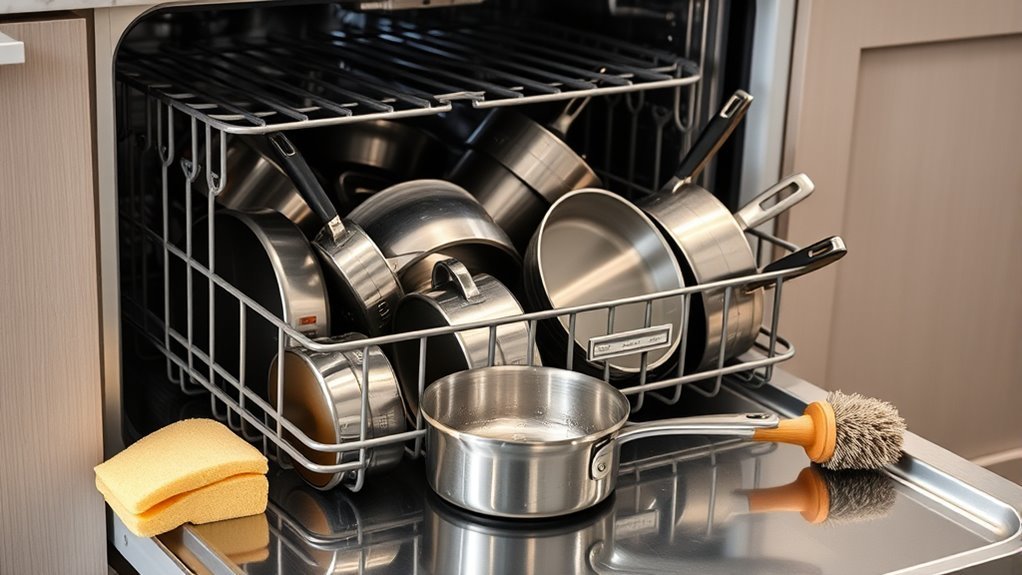
Can saucepans go in the dishwasher? Often yes, but only if the maker says so for that exact pan. A saucepan is more than one piece of metal. The body, coating, handle, lid and rivets each react differently to heat and detergent, so the weakest part decides the answer.
This page focuses on saucepans specifically. For general rules covering every pot and pan, read our main guide to the dishwasher and cookware.
Quick answer by saucepan material
| Saucepan type | Dishwasher? | Main risk |
|---|---|---|
| Stainless steel (plain or clad) | Usually yes, if listed as dishwasher safe | Dull, spotted finish; clad rims can corrode over time |
| Hard anodized aluminum | Check the care guide; often hand wash | Detergent can damage uncoated anodized exteriors |
| Nonstick (PTFE) | Only if the maker allows it; hand wash is safer | Coating wears faster; warranty can be voided |
| Ceramic nonstick | Some makers, such as Caraway, say hand wash only | Coating loses slickness faster |
| Enameled steel or cast iron | Often hand wash | Chipped enamel, dull finish |
| Copper or uncoated aluminum | No | Tarnish, staining, pitting |
Why a saucepan is more fragile than it looks
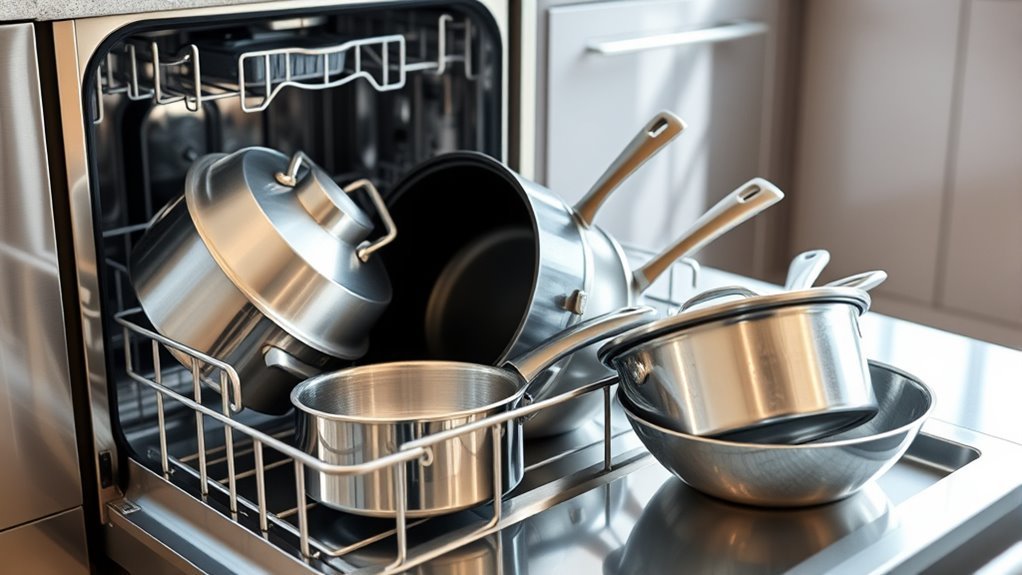
A saucepan is deep and narrow, with a long handle and often a lid. That shape creates several problems in a dishwasher.
- Handles: Plastic or phenolic handles can crack, loosen or fade after many hot cycles. Riveted metal handles cope better than glued or screwed-on handles.
- Lids: Glass lids with metal rims usually survive, but plastic knobs and silicone rims may warp or loosen.
- Water pooling: A narrow saucepan can trap water and detergent inside, leaving residue.
- Rim edges: On clad pans, repeated detergent exposure can attack the aluminum core that shows at the rim.
Saucepans by coating: what to know
Stainless steel saucepans
Stainless is the best candidate for the dishwasher. Many brands list their stainless saucepans as dishwasher safe while still recommending hand washing for the best finish. Brand rules differ, so check the maker. We cover this in detail in can stainless steel go in the dishwasher.
Hard anodized aluminum saucepans
Hard anodized pans have a dark, hardened aluminum surface. Cookware maker Meyer notes that uncoated hard anodized cookware should not go in the dishwasher unless the care guide says it is safe, because dishwasher chemicals can damage the exterior. Some nonstick-coated hard anodized lines are dishwasher safe on both sides, so read the guide for your exact line.
Nonstick saucepans
Nonstick pans are the most common source of confusion. A T-fal care guide, for example, says most of its nonstick pieces are dishwasher safe but still recommends hand washing, and warns against dishwasher tablets. Other brands, such as Made In, state that dishwasher use voids the nonstick warranty. For a full breakdown, see can you put nonstick cookware in the dishwasher.
How to load a saucepan if it is dishwasher safe
- Scrape out food and rinse off sauce residue, especially milk or starch.
- Place the pan upside down or tilted on the bottom or top rack so water drains out.
- Keep it away from other metal items to avoid scratches and contact stains.
- Put glass lids on the top rack with space around them.
- Use the normal or gentle cycle and a mild detergent. Skip tablets and heavy-duty formulas for coated pans.
- Remove the pan when the cycle ends and towel dry it to prevent spots.
When to hand wash instead
- The pan has a plastic, wood or glued-on handle.
- It is nonstick or ceramic-coated and the care guide says hand wash.
- It has an uncoated aluminum or copper exterior.
- You can see chips in an enamel or coating.
- There is no care guidance at all.
Hand washing takes about two minutes: let the pan cool, wash with warm water, mild soap and a soft sponge, then dry. Soak burnt-on food rather than scrubbing it.
Signs the dishwasher is hurting your saucepan
- Dull, cloudy or white-spotted stainless steel.
- Nonstick food release getting worse or the coating looking scratched, flaking or peeling.
- A loose handle or rivets that wobble.
- Dark, chalky patches on anodized or aluminum surfaces.
If a nonstick coating is flaking or deeply scratched, consider replacing the pan. Using a damaged coated pan is generally not recommended by manufacturers.
Frequently Asked Questions
Can stainless steel saucepans go in the dishwasher?
Usually yes, if the maker lists the pan as dishwasher safe. Plain stainless and most clad stainless saucepans handle a cycle, but harsh detergent can dull the finish and spot the metal over time. Hand washing keeps them looking newer for longer.
Can a nonstick saucepan go in the dishwasher?
Only if the manufacturer’s care guide says so for that exact pan. Many brands recommend hand washing nonstick saucepans, and some void the warranty for dishwasher use. Detergent and heat wear down coatings, so hand washing is the safer choice.
Are hard anodized saucepans dishwasher safe?
Not always. Dishwasher detergent can damage the anodized surface of pans with an uncoated aluminum exterior, and some makers specifically say to wash them by hand. Check the care guide for your line before using the dishwasher.
Can saucepan lids go in the dishwasher?
Glass lids are usually fine on the top rack if the brand allows it, but silicone-rimmed or plastic-knob lids may warp or loosen. If the lid has a plastic or phenolic knob, hand washing is the safer choice.
How can I tell if my saucepan is dishwasher safe?
Look for a dishwasher-safe symbol or wording on the base, packaging or care card, or check the maker’s website for your exact product line. If you find no guidance, assume it is hand wash only.
Related guides
- Can you put pots and pans in the dishwasher?
- Are Made In pans dishwasher safe?
- How to use a steamer saucepan
Bottom line
A saucepan is dishwasher safe only if every part of it is, and only if the manufacturer says so. Stainless steel is the safest bet, while nonstick, hard anodized, copper and wood-handled pans do better by hand.
