
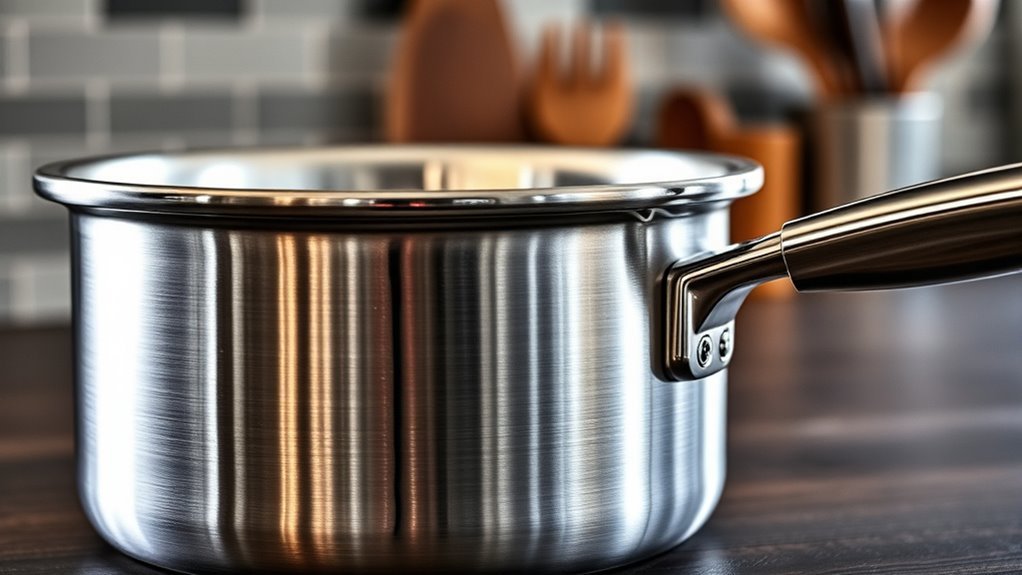
You might not know that most Cuisinart stainless cookware uses an 18/10 stainless outer layer bonded to an aluminum core in a tri‑ply package, which directly affects heat transfer and corrosion resistance. You’ll see how each layer — and even trim metals — change performance, safety, and induction compatibility. Keep going to learn which tests, care steps, and warnings actually matter when you pick or use Cuisinart stainless pots and pans.
What “Cuisinart Stainless Steel” Means (Materials & Tri‑Ply Layers)
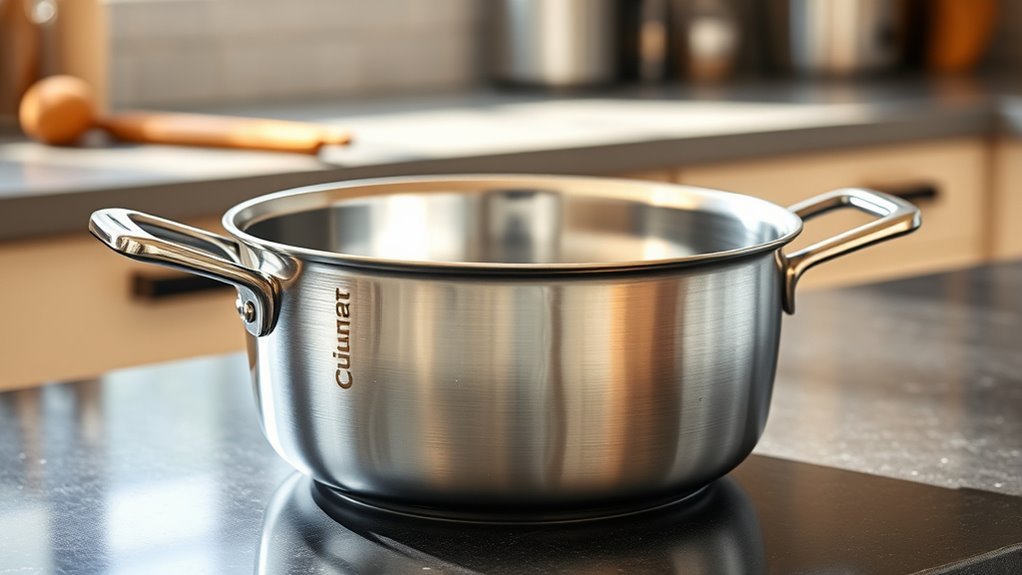
One clear way to understand “Cuisinart stainless steel” is to break it down by material and construction: the cookware uses 18/10 stainless steel (18% chromium, 10% nickel) for corrosion resistance and a neutral, non‑reactive cooking surface, while a tri‑ply build sandwiches an aluminum core between stainless layers to deliver even heat.
The outer layer is magnetic so the pans work on induction, and Cuisinart’s Heat Surround design extends that even heating up the sides as well as the base.
A magnetic exterior enables induction cooking, while Heat Surround ensures even heat up the sides and base
You’ll value that stainless steel composition because it provides durability and chemical inertness, so acidic ingredients won’t alter flavor or leach metals.
The tri‑ply arrangement optimizes thermal conduction and mechanical strength without compromising surface neutrality.
Heat Surround and magnetic exterior give you predictable temperature control across stovetops, including induction.
For someone seeking culinary freedom, this means reliable performance, minimal maintenance, and technical transparency: you get cookware engineered to perform without dictating how you cook.
How Cuisinart Tri‑Ply Cookware Is Built and Why That Matters
You’ll find Cuisinart Tri‑Ply cookware built with an aluminum core sandwiched between two 18/10 stainless steel layers, a configuration chosen for its thermal conductivity and structural resilience.
That tri‑ply makeup delivers rapid, even lateral heat transfer, reducing thermal gradients that create hot spots.
With this construction and Heat Surround engineering, you get precise temperature control across the cooking surface for consistent results.
Tri‑Ply Layer Makeup
Think of Cuisinart’s Tri‑Ply as an engineered sandwich: an 18/10 stainless steel interior for corrosion resistance and a polished cooking surface, a thick aluminum core for rapid, uniform heat conduction and retention, and an outer stainless layer that provides durability, aesthetic finish, and induction compatibility.
You’ll find the 18/10 stainless steel inner layer resists pitting and reacts minimally with food, preserving flavors and enabling rigorous cleaning. The aluminum core is bonded metallurgically to transfer energy efficiently to the cooking plane, minimizing thermal gradients.
The exterior stainless steel completes the structural laminate, allows magnetism for induction, and endures handling and oven temperatures up to 500°F. This construction gives you a versatile, resilient tool that frees your cooking from limitations.
Heat Distribution Benefits
Having established the tri‑ply laminate and material roles, let’s examine how that construction governs heat behavior at the cooking surface. You’ll find Cuisinart’s aluminum core delivers rapid, uniform heat distribution, minimizing hot spots and enabling precise control. Heat Surround technology amplifies lateral transfer so the entire surface maintains consistent temperature, improving flavor retention and repeatability. The stainless outer layers provide durability and induction compatibility while the core responds quickly to setpoint changes, aiding technique-driven cooks seeking liberation from uneven results.
| Component | Function | Benefit |
|---|---|---|
| Aluminum core | High conductivity | Fast, even heat distribution |
| Stainless exterior | Structural support | Durability, induction-ready |
| Heat Surround | Lateral transfer | Uniform cooking surface |
| Response | Thermal agility | Precise temperature control |
| Result | System synergy | Consistent, reliable performance |
Which Metals Are in Each Layer: 18/10 Stainless, Aluminum Core, Trims
One clear way to understand Cuisinart’s layered build is to parse each material by function: you see 18/10 stainless steel as the external workhorse, providing corrosion resistance (18% chromium) and stability/shine (10% nickel). The multi-layer assembly pairs that exterior with a high-conductivity core to free your cooking from uneven heat.
- Exterior and cooking surfaces: 18/10 stainless steel — durable, nonreactive, aesthetic consistency.
- Core layer: aluminum — primary thermal conductor, spreads heat rapidly to eliminate hot spots.
- Base construction: stainless-aluminum-stainless sandwich — engineered for uniform temperature and induction compatibility.
- Trims and handles: stainless steel — structurally secure, withstands high temps, visually unified with cookware body.
You’ll appreciate that each metal is chosen for a distinct technical role: stainless for protection and form, aluminum for thermal liberation.
This concise metallurgy yields strength, predictable thermal response, and stove-top versatility without compromising your agency in the kitchen.
Is Cuisinart Stainless Steel Safe to Cook With? Quick Answer
After outlining the layered metals, it’s helpful to assess their safety in everyday cooking: Cuisinart uses 18/10 stainless steel for contact surfaces, a specification that yields strong corrosion resistance and nonreactivity with most foods, so you won’t get flavor changes or harmful fumes from coatings.
You can consequently rely on stainless steel for direct heat work, deglazing, acidic sauces and high-heat searing without transfer of coatings or off-gassing.
Technically, 18/10 stainless steel combines chromium for passivation and nickel for ductility and corrosion resistance; that alloy balance gives predictable behavior under thermal cycling and chemical exposure.
Because Cuisinart omits polymeric nonstick layers, there’s no coating degradation pathway to monitor.
Because Cuisinart uses no polymer nonstick coating, there’s no degradation pathway to worry about.
You should follow the manufacturer’s cleaning and maintenance guidelines to preserve the passive oxide layer and minimize surface damage.
With proper care, the material performs as a durable, nonreactive cooking surface that supports culinary freedom while maintaining food safety and long-term structural integrity.
When Stainless Steel Can Pose Risks (Leaching, Scratches, Nickel Allergy)
Although stainless steel is broadly inert, damaged or heavily abraded surfaces can alter its corrosion resistance and allow trace metals—most notably nickel and iron—to leach into food under certain conditions.
You should recognize that leaching risk rises when the passive chromium oxide layer is compromised by scratches or aggressive scrubbing. That degradation isn’t catastrophic but it matters for sensitive individuals.
- Inspect cookware regularly for scratches that penetrate finish and raise leaching potential.
- Avoid abrasive cleaners and metal scouring pads that mechanically remove protective oxide.
- Prefer gentle detergents and nonmetallic utensils to preserve surface integrity.
- If you have a nickel allergy, minimize contact time with acidic foods that can increase metal migration.
You’ll gain control by practicing preventive maintenance: gentle cleaning, immediate repair or replacement of compromised pots, and mindful food choices.
These steps reduce leaching and protect health while preserving your culinary freedom.
How to Test and Verify Real Stainless Steel Cookware at Home
Start by performing a magnet test: hold a small magnet to the cookware and note that true high-grade stainless steel like 18/10 will show little to no attraction.
Then inspect the surface for a clean, shiny finish without rust or pitting and perform a gentle scratch check to see if the finish resists abrasion.
Combine these observations with weight and construction cues to confirm authenticity before relying on the piece for regular cooking.
Magnet Test
Curious whether your cookware is genuine stainless steel? You can perform a simple magnet test to verify material and quality.
Hold a small magnet to the base and sides: stainless variants are weakly magnetic or non-magnetic; a firm attraction indicates alternate metal or low-grade steel. Combine this with tactile and visual cues to reach a decisive conclusion.
- If magnet barely attracts, you likely have true stainless or austenitic grade.
- Strong sticking suggests ferritic steel, carbon steel, or plated components.
- Lightweight, flimsy feel often correlates with inferior materials despite surface shine.
- Multi-layered, heavier construction usually aligns with authentic stainless and even heat distribution.
Use these measurements to reclaim control over purchases and kitchen reliability.
Visual And Scratch Check
Visual inspection and a controlled scratch test give you rapid, evidence-based cues about whether cookware is true stainless steel.
You should first inspect finish and edges: high-quality stainless steel presents a uniform, clean shine with no rust spots or pitting.
Check seams and rivets for multi-layered construction cues—visible layering or stamped specs often indicate clad cores for even heat.
Perform a light, controlled scratch with a coin or knife in an inconspicuous area; authentic stainless steel will resist flaking and won’t show significant discoloration or substrate exposure.
Use a magnet as a complementary test, since genuine stainless steel is weakly magnetic or non-magnetic.
If doubt remains, liberate yourself by confirming manufacturer markings—look for 18/10 or explicit material specifications.
Everyday Care to Minimize Wear, Leaching, and Keep Performance
Protect your Cuisinart 18/10 stainless cookware by washing it promptly with warm water and mild soap, preheating pans before adding oil to reduce sticking, and using nylon utensils to avoid surface scratches that can accelerate wear and potential leaching. For streaks or mineral buildup, run a diluted vinegar solution and rinse thoroughly, but never use steel wool or harsh cleaners that compromise the passive, non-reactive chromium-oxide layer.
You’ll extend service life and maintain food safety by adopting measured everyday care for stainless steel cookware. Treat surface integrity as a liberation strategy: preserving the chromium-oxide barrier prevents metal migration and keeps flavors pure. Implement routines that are simple, repeatable, and evidence-based.
- Wash promptly with mild detergent and warm water to remove residues.
- Preheat pans briefly, then add oil to minimize adhesion and wear.
- Use nylon or silicone tools to eliminate abrasive contact.
- Remove mineral stains with a diluted vinegar soak; always rinse and dry.
These steps reduce mechanical and chemical degradation, guarantee consistent thermal performance, and uphold cookware hygiene without compromising your autonomy in the kitchen.
Compatibility and Cooking Tips: Stovetops, Oven Limits, Heat Settings
How will your Cuisinart stainless cookware perform across different heat sources and temperatures? You’ll find it compatible with all stovetops, including induction, so you can switch ranges without compromise.
The tri-ply construction yields rapid, even heat distribution; still, you should favor low to medium settings to avoid overheating and distortion.
Preheat pans before adding oil: this minimizes sticking and creates consistent searing across the cooking surface. Use sealed, dripless rims when transferring liquids to reduce waste and maintain a controlled station.
For oven finishing, pots and pans tolerate up to 500°F (260°C); lids are rated to 450°F (232°C), letting you braise or roast within safe material limits.
Calibrate your technique to the cookware’s thermal response—raise heat gradually, monitor conduction, and rely on residual heat rather than constant high flame.
These measures protect finish and performance while freeing you to cook decisively and creatively across stovetops and ovens.
Buying Checklist: Construction, Features, Warranty, and Red Flags
When evaluating Cuisinart stainless cookware, focus first on construction—confirm 18/10 stainless steel and true triple-ply cladding for corrosion resistance, structural rigidity, and consistent thermal conduction—then verify practical features like sealed, dripless rims and oven-safe lids, and review the lifetime limited warranty for scope and exclusions.
Avoid lightweight, flimsy pieces that signal substandard materials or shortcuts in layering, as these will underperform and may deform under heat.
You’ll want a checklist to judge value and avoid purchase regret. Prioritize verified material specs, tested layering, and documented warranties. Inspect joins, handle rivets, and rim seals; weigh pieces to detect skimping. Seek clear warranty terms and registered-product protection.
- Confirm 18/10 stainless steel composition and origin
- Verify true triple-ply construction and full-clad layering
- Check for sealed, dripless rims and oven-safe components
- Review lifetime limited warranty specifics and exclusions
These criteria empower you to reject compromises and choose stainless steel cookware that delivers durable, liberating performance.
Frequently Asked Questions
What Is the Cuisinart Controversy?
The Cuisinart controversy centers on product performance and safety: you’re seeing complaints about nickel leaching, durability failures, and service shortcomings, plus a notable Cuisinart Lawsuit claiming cookware didn’t perform as advertised.
You’ll want transparent materials data, reliable layering and construction, and stronger warranty enforcement.
You’ll demand accountability, technical remediation, and fair remediation for affected consumers so your kitchen tools don’t undermine your autonomy or health.
Is the Cuisinart Stainless Steel Non-Toxic?
Yes — you’re cooking with largely non-toxic stainless steel.
Like bright steel beside calm water, Cuisinart Safety relies on 18/10 stainless steel that’s non‑reactive and free of Teflon coatings, so no toxic fumes or coating wear.
You’ll avoid metal leaching in normal use, though scratched surfaces and nickel sensitivity can pose risks.
Clean with mild soap and warm water to preserve integrity and maintain a liberated, safe kitchen practice.
How to Tell if Cookware Is Aluminum or Stainless Steel?
You can tell by a few tests: use a magnet (aluminum won’t attract; most stainless sometimes will), inspect weight and finish (stainless is heavier, shinier; aluminum lighter, duller), and feel heat response (aluminum heats faster).
Check for layered construction—tri‑ply stainless indicates higher Cookware Durability.
Also look for corrosion signs (aluminum may oxidize).
These technical checks free you to choose durable, reliable cookware confidently.
What Is the Least Toxic Stainless Steel Cookware?
The least toxic stainless steel cookware is 18/10 grade; you’ll choose it for Cookware Safety. It’s corrosion-resistant, nonreactive with acids, and avoids coatings that off-gas.
You’ll prefer multi-layer clad construction with an 18/10 cooking surface and an aluminum or copper core for even heat.
If you’re nickel-sensitive, you’ll seek higher chromium, lower-nickel options or 18/0 alternatives to reduce metal leaching and maximize culinary freedom.
Conclusion
You’ve seen that Cuisinart’s “stainless steel” means 18/10 stainless shells bonded to an aluminum core in a tri‑ply assembly, engineered for even heat and induction compatibility. The construction minimizes hot spots and resists corrosion, though nickel content and surface damage can increase leaching risks. Test magnetism, weight, and markings to verify authenticity, and use moderate heat and proper care to preserve performance. That technical balance makes it a reliable, high‑performance cookware choice.

