
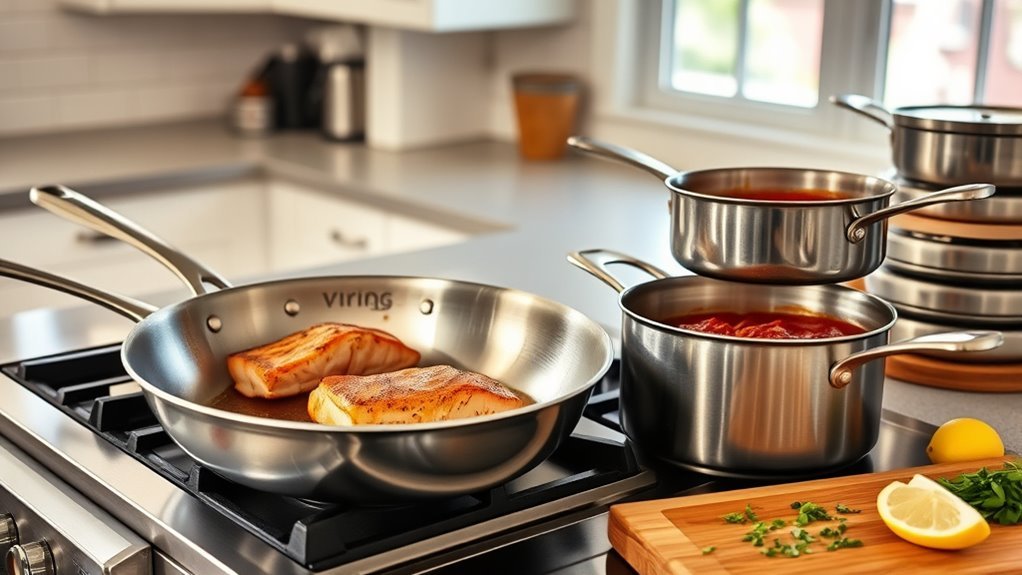
Is Viking stainless steel cookware worth its premium price? This Viking stainless steel cookware review looks at its 3-ply construction, cooking performance, durability, and everyday drawbacks. You’ll learn how it handles searing, induction cooking, oven use, and cleaning, plus how it compares with other popular stainless steel brands.
Quick Answer
Viking stainless steel cookware is worth buying if you cook often and want responsive heat control, durable construction, and excellent versatility. Its uncoated 3-ply pans work on induction and are oven-safe to 600°F without lids. However, the higher price, exposed rivets, and stainless steel learning curve make it less appealing for budget-focused or convenience-first cooks.
Last checked: November 14, 2026. Prices and key specifications were verified against official manufacturer sources.
Key Takeaways
- Viking’s 3-ply cookware uses an aluminum core between stainless steel layers for quick, even heating.
- The Professional 5-Ply line offers a different construction with greater emphasis on heat stability.
- The 600°F rating applies to suitable uncoated pans, not automatically to glass lids.
- Viking cookware is dishwasher-safe in its standard stainless lines, but hand washing helps preserve the polished finish.
- The limited lifetime warranty covers qualifying defects, not normal wear, stains, or damage from overheating.
Quick Verdict: Viking Stainless Steel Cookware Review
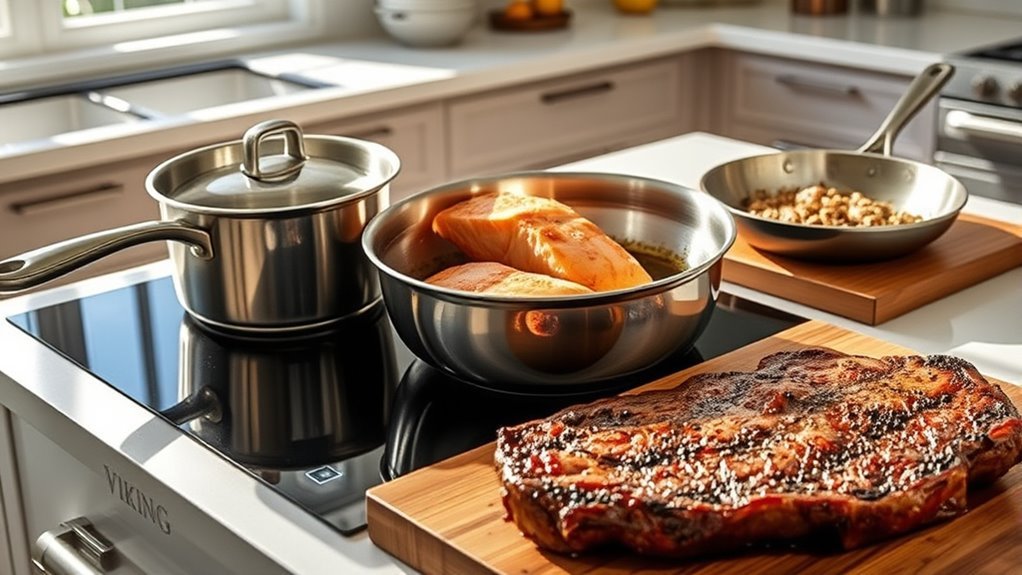
Viking’s 3-ply stainless steel cookware is a strong choice for serious home cooking. It gives you good temperature response, a coating-free cooking surface, and the flexibility to move between different cooking methods.
The main strengths are even heat distribution, versatile stovetop compatibility, and sturdy construction. These features make Viking useful for searing meat, sautéing vegetables, simmering sauces, and preparing meals that finish in the oven.
The drawbacks matter too. Stainless steel requires better temperature control than nonstick cookware, and Viking’s polished surfaces need occasional cleaning to remove stains.
Its handles are shaped for a comfortable grip, although they can become hot during long cooking sessions. The visible stainless steel rivets add strength but create small areas where food can collect.
Buy Viking if: You want long-lasting stainless steel cookware, cook frequently, and enjoy learning techniques that improve browning and heat control.
Consider passing if: You mainly cook delicate foods, want effortless cleanup, or prefer a lower-cost set for occasional meals.
Viking is best viewed as a long-term kitchen investment rather than a shortcut to better cooking. Its advantages become more useful as your technique improves.
What Viking’s 3-Ply Construction Delivers: Heat, Durability, and Safety
Viking 3-ply stainless steel cookware uses three bonded metal layers. The combination helps distribute heat across the cooking surface while keeping the pan durable and suitable for everyday use.
The construction includes:
- Stainless steel interior: A durable, non-reactive cooking surface suitable for acidic ingredients.
- Aluminum core: Transfers heat across the bottom and up the sides of the cookware.
- Magnetic stainless steel exterior: Supports induction cooking while protecting the aluminum core.
This full-clad design is more useful than a thin, single-layer stainless steel pan because aluminum transfers heat much more efficiently than stainless steel alone.
For example, when you add vegetables to a hot sauté pan, the aluminum layer helps spread heat across the surface. That makes temperature control more predictable during cooking.
Viking’s standard uncoated 3-ply cookware contains no PTFE, PFOA, or PFAS-based nonstick coating. The stainless steel interior also handles acidic foods, including tomato sauces and dishes prepared with vinegar.
The manufacturer describes the construction, material layers, compatibility, and oven limits on its Viking 3-Ply Stainless Steel 10-Piece cookware page.
The polished finish gives the cookware a professional appearance. However, scratches, water spots, and heat discoloration can become visible with regular use.
Another useful feature is the flared pouring rim on many Viking pieces. It helps direct sauces and other liquids when transferring them from a pan.
Some sets also include measurement markings inside the saucepans. These reduce the need to measure every cooking liquid separately.
Viking’s stainless cookware is designed for durability, but its coating-free surface does not mean it will behave like a nonstick pan. Proper preheating and sufficient cooking fat remain important.
Viking Cookware Performance: Searing, Induction, and Oven Use
Viking stainless steel cookware is particularly useful for browning meat, preparing sauces, and moving dishes from the stovetop to the oven. Its aluminum core helps spread heat, while its stainless surface allows browned food to develop.
Independent testing provides some support for its performance claims. Consumer Reports’ Viking Tri-Ply evaluation describes its cooking evenness and heating speed as excellent, with good sauce-simmering performance.
How Well Does Viking Sear Meat?
Viking 3-ply stainless steel cookware is well suited to searing steak, chicken, and other proteins. Its responsive heating makes it easier to adjust the temperature as food cooks.
To improve searing results:
- Pat the meat dry to remove excess surface moisture.
- Preheat the pan gradually over medium heat.
- Add enough suitable cooking oil to coat the surface.
- Place the meat in the pan without overcrowding it.
- Allow a crust to form before attempting to turn the meat.
When the surface browns properly, food often releases more easily. Turning meat too early can tear the crust and leave food stuck to the pan.
The browned bits remaining after searing can also improve sauces. Add stock, wine, or another suitable liquid to loosen these flavorful deposits, a technique called deglazing.
Does Viking Work on Induction Cooktops?
Yes. Viking’s standard 3-ply and Professional 5-Ply stainless steel cookware work on induction, gas, electric, ceramic, and halogen cooktops.
The magnetic stainless steel exterior allows the pan to interact with an induction cooktop’s magnetic field.
For effective heating, choose a burner that closely matches the pan’s base. Avoid allowing a gas flame to extend around the sides.
Induction cooking can heat cookware quickly, so moderate power settings usually provide better control than starting at maximum power.
Can Viking Stainless Steel Cookware Go in the Oven?
Yes. Viking rates its suitable uncoated 3-ply stainless steel pans for oven and broiler use up to 600°F without lids.
This allows you to sear a steak on the stove and finish it in the oven. It also works well for braising, roasting, and preparing dishes that need both stovetop and oven heat.
However, the pan and lid may have different temperature limits.
Warning: Do not assume a glass lid is safe at the pan’s 600°F limit. Viking’s glass-lid ratings vary, and its 13-piece product page contains conflicting 350°F and 400°F statements. Follow the instructions for your exact lid, remove lids before broiling, and use oven protection when handling hot cookware.
The Viking 13-Piece Stainless Steel Set illustrates why identifying the exact cookware model matters.
How Quickly Does Viking Heat and Boil Water?
Viking’s aluminum core transfers heat efficiently, helping its pots warm quickly and distribute heat across their cooking surfaces.
That makes the cookware useful for boiling pasta, preparing soup, and reducing sauces. However, the actual heating time depends on the pan size, burner output, water volume, and starting temperature.
For most frying and sautéing tasks, medium heat offers better control than prolonged high heat. Higher settings are more appropriate when bringing water to a boil.
Viking vs. Other Cookware Brands: Which Sets Should You Buy?
Viking competes with several established stainless steel cookware manufacturers. The best choice depends on the construction, included pieces, temperature limits, handle design, and actual selling price.
Viking’s 3-ply cookware offers strong everyday versatility, while alternatives may provide different manufacturing origins, handle attachments, or oven limits.
| Brand and Collection | How It Compares With Viking |
|---|---|
| Viking 3-Ply Stainless Steel | Responsive aluminum-core construction, induction compatibility, and a 600°F oven rating for uncoated pans without lids. A strong all-purpose option. |
| All-Clad D3 | Also uses fully clad 3-ply construction and supports induction and 600°F oven use. Its D3 cookware is made in the United States and is hand-wash-only. |
| Cuisinart MultiClad Pro | Offers triple-ply construction and induction compatibility, with a 500°F oven rating. An alternative when cost is a major consideration. |
| Tramontina Tri-Ply Clad | Provides fully clad stainless construction and induction compatibility. The referenced glass-lid collection has a lower 350°F oven limit. |
| Made In Stainless Clad | Uses five bonded metal layers, is made in Italy, and offers induction compatibility. Its Stainless Clad cookware has an 800°F oven rating. |
| Demeyere Industry 5 | Uses 5-ply construction with strong heat stability and welded handles that eliminate interior rivets. The referenced saucier is oven-safe to 500°F. |
All-Clad D3 is a particularly close comparison because both collections use three bonded layers. Choosing between them often comes down to handle comfort, set contents, manufacturing preference, and price.
Demeyere offers another design advantage: welded handles make the interior easier to clean because there are no exposed handle rivets.
However, the number of metal layers alone does not prove that a pan will cook better. The thickness, metal composition, and construction matter too.
Viking 3-Ply vs. Professional 5-Ply: Which Is Better?
Choose Viking 3-Ply if you want a responsive everyday pan for frying, sautéing, and preparing sauces. Consider Professional 5-Ply if you prefer its additional aluminum layers and greater emphasis on heat stability.
The main differences are:
- 3-Ply: Three bonded layers with an aluminum core, suited to versatile everyday cooking.
- Professional 5-Ply: Five bonded layers, including a three-layer aluminum core, designed for more stable heating.
- Manufacturing: Viking lists its current standard 3-ply set as imported, while Professional 5-Ply is made in the United States with globally sourced materials.
- Long-term value: Both are durable stainless steel options. More layers do not automatically guarantee a longer lifespan.
Viking describes these details on its Professional 5-Ply 10-Piece cookware page.
How Much Does Viking Stainless Steel Cookware Cost?
Viking cookware occupies the premium end of the stainless steel market. Prices change by collection, set size, and retailer promotions.
On November 14, 2026, the official Viking store listed these examples:
- 3-Ply 10-Piece Set with Metal Lids: $399.99 promotional price, reduced from $799.99.
- 3-Ply 13-Piece Set with Glass Lids: $699.99.
- Professional 5-Ply 10-Piece Set: $919.99 promotional price, reduced from $1,149.99.
These prices are snapshots, not permanent price guarantees.
The original article’s broader set-price range was approximately $259.99 to $1,599.99. Actual pricing depends on which collection and number of pieces you select.
Before choosing a large set, compare the individual pieces you will use regularly.
A practical starter collection usually includes a frying pan, a saucepan, and a stockpot. A sauté pan adds value if you often prepare sauces or cook larger quantities.
A larger set is worthwhile only if its extra pieces serve a purpose in your kitchen.
Viking Stainless Steel Cookware Pros and Cons
Viking stainless steel cookware combines attractive design with durable construction and versatile cooking performance. Its main disadvantages are price, cleaning requirements, and the technique needed to prevent sticking.
Advantages
- Even heating: The aluminum core distributes heat more effectively than a single thin layer of stainless steel.
- Versatility: Suitable for induction, gas, electric, and other supported cooktops.
- High oven tolerance: Standard uncoated stainless steel pans support oven use up to 600°F without lids.
- Durable cooking surface: Stainless steel has no nonstick coating that gradually loses its food-release properties.
- Comfortable handles: The riveted handles are shaped for balance and secure handling.
- Non-reactive interior: Suitable for tomato sauces, vinegar-based recipes, and other acidic foods.
Disadvantages
- Premium pricing: Large stainless steel sets require a significant upfront investment.
- Food sticking: Eggs, fish, and delicate foods need proper heat and oil control.
- Visible discoloration: Rainbow marks, water spots, and cooking residue can develop over time.
- Exposed rivets: Food can collect around the handle attachments and require extra cleaning.
- Visible branding: The larger exterior logos and handle plates add surfaces where residue may collect.
- Hot handles: Stay-cool designs reduce heat transfer during normal cooking but do not eliminate the risk of burns.
The main trade-off is convenience versus control. Viking gives you a durable surface for different techniques, but it needs more attention than coated nonstick cookware.
Its polished appearance also requires some upkeep. Stainless steel cleaner can help remove stubborn stains, although minor discoloration usually does not affect cooking performance.
Who Should Buy Viking Cookware?
Viking is best for home cooks who regularly prepare meals and want reliable stainless steel cookware for several cooking methods. Its strengths become most useful when you frequently sear, sauté, simmer, or finish dishes in the oven.
You are a good match for Viking if you:
- Cook several times a week and want cookware built for regular use.
- Prepare steaks, chicken, vegetables, and sauces that benefit from careful heat control.
- Use an induction cooktop or may switch to one later.
- Prefer a stainless steel surface without a nonstick coating.
- Want cookware suitable for acidic dishes.
- Are comfortable cleaning and maintaining polished stainless steel.
Viking is less suitable if you mainly want a pan for eggs, delicate fish, or very quick meals with minimal cleanup.
It may also be unnecessary if you cook only occasionally and already own reliable stainless steel pans.
If you are buying your first serious cookware set, consider beginning with Viking 3-Ply rather than paying more for Professional 5-Ply.
That lets you learn stainless steel cooking techniques before deciding whether a more expensive collection offers enough extra value.
Does Viking’s Lifetime Warranty Make It a Better Investment?
Viking provides a limited lifetime warranty against qualifying manufacturing and material defects under normal household use.
However, this warranty has important conditions.
According to the official Viking cookware warranty policy, coverage applies to the original purchaser in the United States and Canada, with proof of purchase.
Normal scratches, stains, discoloration, accidental damage, overheating damage, and thermal shock are excluded. Glass components are also excluded from the warranty.
The manufacturer may repair or replace qualifying defective cookware. The owner is responsible for warranty return shipping costs.
Therefore, the warranty adds protection against defects but does not guarantee replacement for every problem that develops during ownership.
How to Care for Viking Stainless Steel Cookware
Proper cleaning and heat control help Viking cookware retain its appearance and cooking performance. Most everyday problems involve food sticking, heat stains, or residue left after cooking.
Stainless steel is durable, but extreme heat and sudden temperature changes can still damage it.
Preventing Food From Sticking
Food usually sticks to stainless steel because of incorrect preheating, insufficient oil, or attempting to move food before it releases naturally.
You can reduce sticking with a consistent cooking routine.
- Start with a clean pan. Remove food residue and wash the cooking surface before use.
- Preheat gradually. Use medium heat rather than placing an empty pan over an extremely hot burner.
- Add suitable cooking fat. Use enough oil or butter to cover the area where food will cook.
- Control the temperature. If the oil starts smoking heavily, reduce the heat before adding food.
- Allow food to release. Wait for meat to brown before turning it instead of forcing it away from the surface.
- Adjust for delicate foods. Eggs and fish may need lower heat, more fat, and gentler handling.
Some Viking care instructions recommend lightly conditioning new stainless steel pans with oil. This can be followed where the specific product manual recommends it.
However, stainless steel does not develop the same durable seasoning layer as cast iron or carbon steel. Initial oil conditioning is not a substitute for correct cooking technique.
Pro Tip: For better browning, leave enough space between pieces of meat. Overcrowding releases moisture and lowers the pan’s surface temperature, making steaming more likely than searing.
Removing Heat Discoloration
Rainbow-colored marks on stainless steel often develop after exposure to heat. These marks usually affect the appearance rather than the cooking performance.
You can remove many stains using a gentle cleaning method.
- Allow the pan to cool naturally.
- Wash it with warm water and dish soap.
- For rainbow marks, try wiping the affected area with a soft cloth and a little white vinegar.
- For stubborn residue, use a stainless steel cleaner such as Bar Keepers Friend according to its instructions.
- Rinse thoroughly and dry with a soft towel.
A baking soda paste may also help remove light residue without aggressive scrubbing.
For difficult stuck-on food, soak the cookware in warm soapy water before cleaning.
Avoid steel wool and harsh scouring pads because they can scratch the polished finish.
Do not use cleaners containing chlorine bleach, and never place a very hot pan directly into cold water.
Sudden cooling can cause thermal shock and may contribute to warping.
Dishwasher Safety, Utensils, and Long-Term Maintenance
Viking lists its standard stainless steel cookware and compatible lids as dishwasher-safe. However, the manufacturer recommends hand washing to maintain the polished appearance.
For everyday care, wash with mild dish soap, rinse thoroughly, and dry the cookware after cleaning.
Metal utensils can be used on Viking’s uncoated stainless steel surfaces, although they may leave cosmetic scratches. Wooden or silicone utensils are useful when you want to protect the finish.
Discoloration does not automatically mean the pan is damaged. However, severe warping, loose handles, or separated metal layers deserve attention.
If those problems occur under normal household use, review the product’s warranty conditions.
With sensible care, Viking stainless steel cookware can remain useful for many years.
Frequently Asked Questions
What Is a Good Brand for Stainless Steel Pans?
Viking is a good stainless steel cookware brand if you value even heating, induction use, and sturdy riveted handles. Its 3-ply pans have an aluminum core and a coating-free cooking surface. They take more practice to prevent sticking than a nonstick pan, and their limited lifetime warranty has exclusions.
Is Viking Stainless as Good as All-Clad?
Viking 3-ply and All-Clad D3 both use fully clad stainless steel with an aluminum core and work on induction. Both list 600°F oven limits for their uncoated cookware. All-Clad D3 is made in the United States; Viking’s current 3-ply set is listed as imported. Neither is automatically better for every cook.
Which Is Better, Viking or Cuisinart?
Viking is the better fit if you prefer its handles, a 600°F pan rating, and the pieces in its sets. Cuisinart MultiClad Pro also has triple-ply construction and induction compatibility, with a 500°F oven rating. Compare the actual pan sizes and price before choosing.
Is Viking Better Than GreenPan?
Viking is better suited to cooks who want a coating-free stainless surface for browning, deglazing, and repeated high-heat use. GreenPan focuses on ceramic nonstick and easier food release. Some GreenPan lines are also rated to 600°F, so the blanket claim that Viking always handles higher heat is incorrect.
Is Viking 3-Ply Stainless Steel Dishwasher-Safe?
Yes. Viking lists its standard 3-ply stainless steel cookware as dishwasher-safe, but recommends hand washing to protect the polished finish. Let the pan cool, use warm soapy water, and dry it promptly. Avoid steel wool and aggressive cleaning pads that can scratch the surface.
Can Viking Stainless Steel Pans Go in the Oven With Lids?
Viking 3-ply stainless steel pans are rated to 600°F without lids. The limit for a lid depends on its material and the exact set; the manufacturer’s 13-piece glass-lid page gives conflicting limits in separate sections. Check the instructions for your specific lid and remove it before broiling.
Conclusion
Viking 3-ply stainless steel cookware is worth considering if you value responsive heating, durability, and versatile cooking. It works well for cooks who enjoy browning, searing, and preparing dishes without relying on a nonstick coating.
A restaurant study reportedly found 3-ply pans reach even temperatures 30% faster than single-layer pans, although the original claim lacks an identifiable study reference. The stronger reasons to choose Viking are its verified construction, induction compatibility, and oven capabilities.
For most serious home cooks, start by comparing Viking’s 3-ply pieces with the cookware you already own. Choose the set that includes the pans you will use regularly, and account for the maintenance that comes with stainless steel.
Sources
- Viking 3-Ply 10-Piece Cookware Set: Construction, induction compatibility, oven safety, cleaning, and pricing.
- Viking 3-Ply 13-Piece Cookware Set: Set contents, pricing, glass-lid limits, and care information.
- Viking Professional 5-Ply Cookware Set: Five-layer construction, manufacturing origin, oven rating, and pricing.
- Viking Limited Lifetime Warranty: Coverage conditions, geographic restrictions, exclusions, and warranty claims.
- Consumer Reports: Viking Tri-Ply Stainless Steel: Independent cooking evenness, heating speed, and simmering evaluations.
- All-Clad D3 Stainless Steel: Tri-ply construction, manufacturing, induction compatibility, and oven safety.
- Cuisinart MultiClad Pro: Triple-ply construction, induction use, and oven temperature rating.
- Tramontina Tri-Ply Clad: Cookware materials, induction compatibility, and oven temperature rating.
- Made In Stainless Clad Cookware: Five-ply construction, manufacturing origin, and oven capabilities.
- Demeyere Industry 5: Five-ply construction, welded handles, induction compatibility, and oven safety.
- GreenPan Valencia Pro: Ceramic nonstick construction, oven temperature rating, and cooking-surface differences.
