
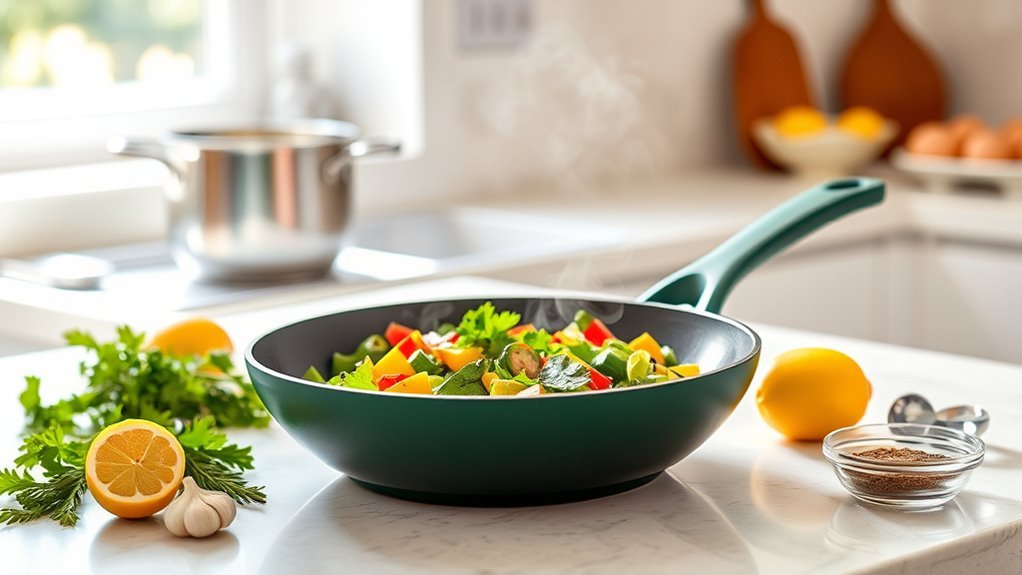
You want cookware that’s genuinely safer, but GreenPan’s Thermolon coating raises mixed signals: company claims no PFAS, PTFE or PFOA, limited independent testing and a lawsuit have prompted questions, and some users report peeling or fumes under heavy use. I’ll walk you through the materials, safety data, durability issues, and practical checks so you can decide whether GreenPan fits your kitchen and risk tolerance.
Quick Answer: Is GreenPan Non‑Toxic?
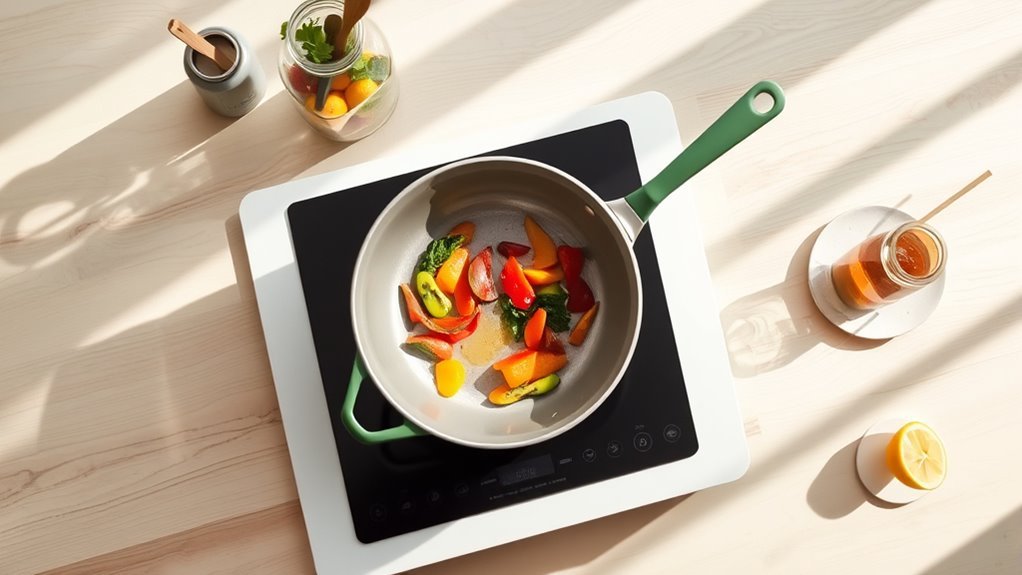
Wondering if GreenPan is truly non‑toxic? You’ll find a mixed but cautious picture.
GreenPan markets Thermolon as a non-toxic cookware solution and promotes PFAS-free cookware credentials, claiming absence of PTFE, PFOA, PFAS, and heavy metals. That’s promising for people craving safer kitchen tools and liberation from persistent chemical worries.
GreenPan touts Thermolon as non-toxic, PFAS- and heavy metal-free — appealing for those seeking safer, worry-free cookware.
Yet legal challenges and independent testing have introduced doubt: some labs detected concerning compounds in Thermolon, and transparency about third-party testing has been questioned.
Customer experiences vary—some praise performance, others report early coating breakdown that could affect long-term safety.
GreenPan’s Organic Authority Approved Seal suggests commitment to cleaner production, but seals don’t replace rigorous independent verification.
What Is Thermolon™ : And Is It Safe?
You’re looking at Thermolon™ as GreenPan’s ceramic non-stick alternative, so start by noting its claimed composition—PFAS-, PTFE-, and PFOA-free, made from “natural” materials—while recognizing independent tests have questioned those claims.
Check what third‑party testing and certifications actually cover and whether full reports are available to verify safety.
Finally, consider the degradation risk at high heat: manufacturers report stability up to ~850°F, but evidence of coating breakdown under real cooking conditions remains a concern.
Thermolon™ Composition Explained
Thermolon™ is GreenPan’s silica-based ceramic nonstick coating that’s applied to aluminum cookware and promoted as free of PFAS, PTFE, and PFOA; the company says it produces a durable, easy-to-clean surface and holds certifications from NSF® and ASI. You’ll find Thermolon in GreenPan cookware marketed among non-toxic cookware brands, but composition claims rest on a silica-based gel ceramic coating rather than fluoropolymers. Critics note limited third party data and past legal disputes, raising cautious questions about long-term exposure and PFAS chemicals. You should expect transparency: independent testing and full ingredient disclosure would liberate consumer choice. Below is a simple comparison to clarify core points.
| Feature | Note |
|---|---|
| Base material | Silica-based gel |
| Substrate | Aluminum |
| Fluoropolymers | Claimed absent |
| Certifications | Company-stated (NSF®, ASI) |
| Third-party data | Limited |
Safety Testing And Certifications
Having covered what Thermolon™ is made of, let’s look at how GreenPan proves its safety claims. You’ll see the brand touts safety testing and third-party certifications — NSF® ceramic nonstick and ASI — and markets Thermolon™ coating as non-toxic ceramic cookware free of PFAS, PTFE, and PFOA.
That’s promising, but independent tests and legal challenges have raised concerns about undisclosed substances and overstated benefits.
GreenPan says it runs rigorous in-house and third-party testing, yet transparency about detailed results is limited.
If you want liberation from harmful chemicals, you should demand clearer evidence: full test reports, scope of third-party certifications, and answers about contested findings.
Until then, view claims cautiously and weigh available proof before trusting safety assertions.
Degradation Risks At High Temperatures
Because ceramic coatings can break down under sustained high heat, you should be cautious about Thermolon™’s performance at extreme temperatures. Thermolon is marketed as non-toxic and free of PFAS/PTFE/PFOA, yet independent testing shows ceramic surfaces can suffer degradation when exposed repeatedly to high temperatures, reducing non-stick function and possibly producing fumes. That raises safety questions about chemical leaching and long-term exposure.
| Concern | Evidence |
|---|---|
| Heat tolerance | Rated up to 850°F, but real-world degradation occurs below max |
| Degradation signs | Loss of non-stick, discoloration, user-reported fumes |
Until GreenPan provides transparent long-term studies, you should limit repeated high-temperature use to reduce degradation and potential safety risks.
Independent Testing & Certifications: What the Data Actually Shows
How do GreenPan’s certifications and outside tests actually back up its “non-toxic” marketing? You should note that GreenPan highlights NSF® and ASI certifications to support safety, but independent testing and transparency gaps complicate the picture.
Third‑party marks signal basic standards, yet they don’t replace publicly available lab reports that directly address non-toxic claims.
You’ll find critics pointing out that GreenPan markets Thermolon™ as free from PFAS, PTFE, PFOA, and heavy metals while independent testing has raised questions about material safety.
Competitors publish lab data to substantiate their assertions; GreenPan’s limited disclosure fuels consumer skepticism.
You’ll want clear, accessible test results to judge risk and assert liberation from opaque marketing.
Until GreenPan releases thorough independent testing tied to its certifications, you should treat broad “completely toxin‑free” statements cautiously and demand transparency that truly verifies safety.
The 2019 Lawsuit Explained: Marketing Claims vs. Evidence
The questions around GreenPan’s certifications and lack of public lab reports set the stage for legal scrutiny in 2019, when a class‑action suit accused the company of overstating Thermolon™’s safety and environmental benefits.
You should know the suit targeted marketing claims that presented Thermolon as completely toxin‑free and uniquely eco‑safe, and it questioned whether GreenPan’s non‑stick coatings truly delivered those health benefits.
The case was dismissed, but dismissal didn’t resolve the underlying evidence gap.
You’ll weigh three core takeaways:
- The lawsuit challenged marketing claims versus substantiating data.
- No public third‑party reports were produced to dispel doubts.
- Dismissal left consumer skepticism intact.
You can push for transparency: demand accessible lab reports and independent verification of safety.
Stay cautious—legal outcomes don’t equal scientific vindication.
If you want liberation from opaque marketing, insist on evidence, reproducible testing, and clearer safety disclosures about GreenPan and Thermolon non‑stick coatings.
GreenPan Performance & Durability: Peeling, Fumes, Wear
You’ll want to weigh reports of peeling and flaking against manufacturer claims, since many users report visible degradation of the Thermolon surface after limited use.
Independent tests also note that overheating—particularly above about 500°F—can produce concerning fumes and odors, so caution with high-heat cooking is warranted.
While newer lines like Reserve Pro 9G claim improved durability, mixed user experiences mean you should monitor for wear and avoid sustained high temperatures.
Peeling And Flaking
Although GreenPan markets Thermolon™ as a durable, non-toxic ceramic coating, some users report peeling and flaking after prolonged use or high-heat cooking. Independent tests have shown coating degradation that can expose the underlying aluminum.
You should know peeling and flaking affect durability and non-stick performance, prompting safety questions and demands for transparency.
Evidence-focused points to evaluate:
- Independent tests: show coating wear and aluminum exposure over time.
- User reports: describe reduced non-stick performance and visible flakes.
- Manufacturer gaps: limited independent longevity data and inconsistent public testing.
You deserve cookware that supports freedom from hidden risks.
Be cautious: avoid high heat, follow care guidelines, inspect pans regularly, and weigh warranty options.
If Thermolon™ shows wear, discontinue use and seek replacement or refund.
Fumes And Odors
Peeling and flaking not only shorten a pan’s life but can also change how it behaves when heated, so fumes and odors become the next safety concern to check. You should know Thermolon is marketed as non-toxic, PFAS/PTFE/PFOA-free, yet independent testing and user reports raise health concerns when cookware exceeds ~500°F. Smells, visible fumes, or rapid surface degradation suggest stress or damage. You can protect your freedom to choose safer cookware by avoiding high heat, using correct utensils, and replacing pans that peel.
| Issue | What to watch for | Action |
|---|---|---|
| fumes | smoke or chemical odors | lower heat |
| odors | persistent smells | stop use |
| durability | flaking | replace |
GreenPan vs. Safer Alternatives: Cast Iron, Stainless, Carbon Steel, Other Ceramics
When you compare GreenPan’s ceramic nonstick to uncoated options like cast iron, stainless steel, and carbon steel, the trade-offs are clear: you’ll balance ease-of-use against transparency and long-term safety.
GreenPan markets Thermolon as PFAS-, PTFE-, and PFOA-free, but independent testing and ingredient transparency have been uneven, so treat “non-toxic” claims cautiously. Uncoated metal pans avoid chemical coatings and last decades if you care for them.
- Cast iron — rugged, chemical-free when seasoned, excellent heat retention; demands maintenance but rewards you with durability.
- Stainless steel — inert, low-chemical risk, great for deglazing and high-heat techniques; won’t develop a nonstick surface.
- Carbon steel — lighter than cast iron, seasons to nonstick, versatile for searing and high-heat work.
Other ceramic cookware brands emphasize independent lab testing and clearer sourcing, which may better align with your desire for safer, liberating choices in the kitchen.
How to Buy and Use GreenPan Safely (Checks, Care, Questions to Ask)
How will you know a GreenPan is truly non-toxic and will last? Check labels for PFAS-free, PTFE-free, and PFOA-free claims to confirm non-toxic standards before buying.
Look for PFAS-free, PTFE-free, and PFOA-free labels to ensure a genuinely non-toxic GreenPan.
Ask the seller which ceramic coating they use and request manufacturer care instructions; different collections have distinct limits.
Inspect pans on delivery for scratches or uneven surfaces that can undermine non-stick performance and overall cookware safety.
When cooking, stick to medium or low heat—high temperatures can degrade ceramic coating and release particles or reduce effectiveness.
Hand-wash with non-abrasive sponges and avoid metal utensils to preserve the finish and extend lifespan.
Regularly recheck for wear; once the surface shows consistent abrasion, replace the pan to maintain safety and performance.
Who This Guide Is For and How to Use It
Who’s this guide for, and what should you expect from it?
You’re a consumer demanding clarity about GreenPan and other cookware — whether its non-toxic claims hold up, what materials are used, and what safety evidence exists.
This guide gives cautious, evidence-focused context so you can act with informed freedom.
Use this guide to:
- Compare advertised claims with independent lab testing and legal scrutiny of Thermolon™.
- Weigh user reports on durability and non-stick performance against documented materials and safety data.
- Ask targeted questions about transparency, testing, and competitor disclosures (e.g., Caraway, Alva).
You’ll get summarized facts, links to tests, and practical checks to apply when buying or using cookware.
The goal isn’t to tell you what to buy but to equip you to demand transparency, interpret safety evidence, and choose cookware that aligns with your health and liberation priorities.
Frequently Asked Questions
Why Is Greenpan Being Sued?
They’re being sued because plaintiffs challenged GreenPan’s product claims, alleging misleading marketing and potential health implications from the Thermolon™ coating.
You’ll want lawsuit details showing accusations about consumer safety and lack of independent testing, which critics say harmed brand reputation.
You should consider cookware alternatives while following evidence; the suit was dismissed but highlights ongoing scrutiny, so stay cautious and demand transparency and verified safety data before you buy.
Why Can’t You Use Olive Oil on Greenpan?
You shouldn’t use olive oil on GreenPan for high-heat cooking because its low smoke point makes olive oil smoke, causing cooking temperature concerns and degrading the ceramic non-stick benefits.
You’ll protect oil compatibility and seasoning cookware by choosing higher-smoke oils like avocado or canola.
That keeps food flavor impact cleaner and frees you from burnt tastes and residue buildup, so your cookware lasts and your meals stay true.
What Is the Least Toxic Type of Cookware?
The least toxic type is uncoated cookware like stainless steel and cast iron.
You’ll favor stainless steel safety for low leaching and easy maintenance, and cast iron durability for longevity and iron enrichment.
Consider ceramic cookware benefits cautiously—some sol-gel layers can leach unless independently tested.
For nonstick alternatives, choose enameled cast iron or high-quality stainless steel.
Prioritize eco friendly materials and review a heat resistance comparison before you commit.
What Are the Common Complaints About Greenpan?
You’ll mostly hear complaints about durability concerns and poor non stick performance, with users saying coating degrades fast.
People compare Price comparison unfavorably to alternatives, noting weaker heat distribution and inconsistent cooking.
Many cite Warranty issues and slow, unhelpful Customer service when filing claims.
Evidence is mixed, so you should remain cautious: weigh reported failures against positive experiences and push for clear policies and reliable testing before buying.
Conclusion
GreenPan’s Thermolon coating reduces some chemical worries by avoiding PFAS, PTFE, and PFOA, but independent testing and legal challenges show limits to those claims. You’ll get lower chemical risk than some nonstick pans, yet real-world wear, peeling, and high-heat degradation remain concerns—so should you treat it like any nonstick: inspect, avoid overheating, and replace if damaged? Be cautious, follow care guidelines, and consider alternatives for long-term durability.

