
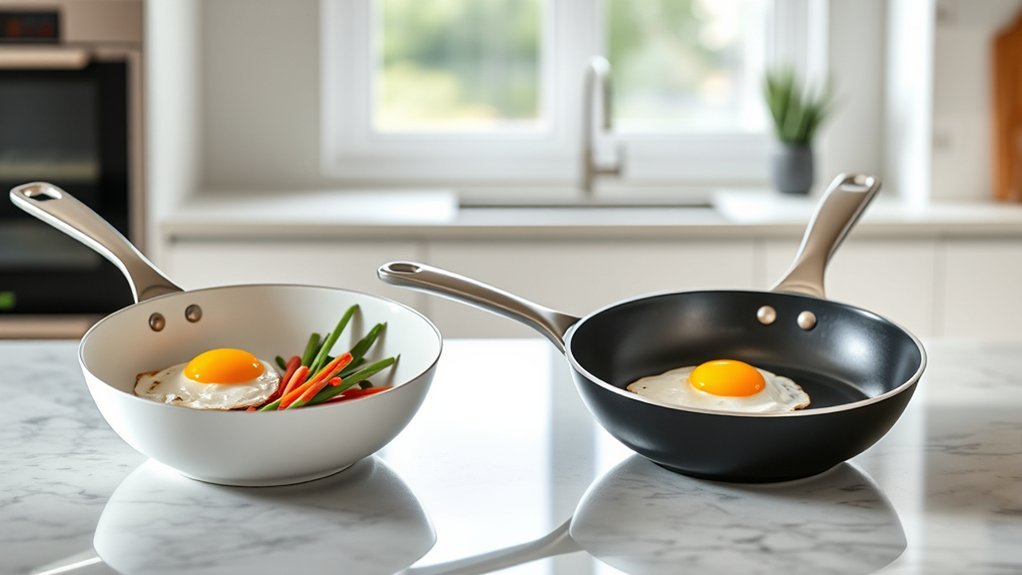
Ceramic cookware is not automatically better than traditional nonstick cookware. Ceramic-coated pans appeal to cooks who specifically want a PTFE-free surface, while PTFE nonstick usually provides longer-lasting food release when it is used and cared for correctly. Safety also needs context: current regulatory guidance does not consider properly used PTFE cookware inherently unsafe. The better choice depends on your heat habits, maintenance preferences, budget, and how long you expect the nonstick performance to last.
Quick Answer
Ceramic cookware is a good choice if you specifically want a PTFE-free nonstick coating, but it is not automatically safer or more durable. Quality PTFE nonstick generally keeps its easy-release performance longer. Whichever type you choose, low-to-medium stovetop heat, gentle cleaning, and avoiding severe overheating help the coating last.
Key Takeaways
- Ceramic-coated cookware usually uses an inorganic sol-gel nonstick coating and many brands make it without PTFE or other intentionally added PFAS.
- Traditional nonstick commonly uses PTFE, which generally maintains nonstick performance longer than ceramic coatings when cared for properly.
- Current FDA guidance says authorized polymerized PFAS coatings used on nonstick cookware have negligible migration into food.
- Neither type should be treated as high-heat searing cookware simply because its oven-safe rating is high.
- For either coating, following the manufacturer’s heat, utensil, cleaning, and oven-temperature instructions matters more than marketing labels.
What Is Ceramic Cookware?
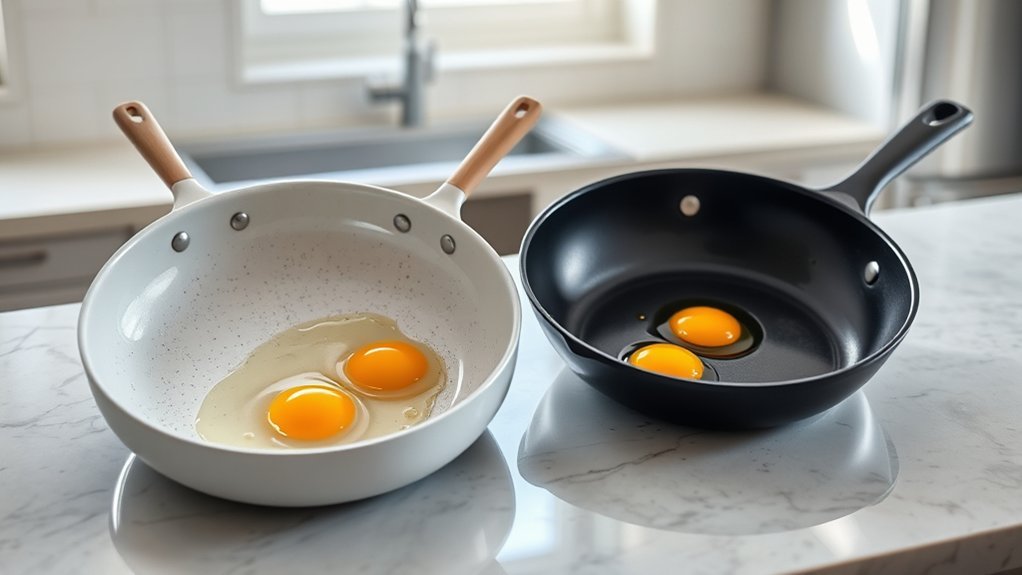
In this comparison, ceramic cookware means metal cookware covered with a ceramic-style nonstick coating. It should not be confused with cookware made entirely from ceramic.
Most ceramic nonstick coatings are inorganic sol-gel coatings. Their exact formulations vary by manufacturer, so it is more accurate to describe them as ceramic-based or silica-rich coatings than to assume that every pan contains the same ingredients.
Many ceramic-coated pans are marketed as PTFE-free or PFAS-free. Check the manufacturer’s specifications if avoiding those materials is important to you because coating formulations differ among brands.
Fresh ceramic coatings can provide excellent food release for eggs, fish, pancakes, vegetables, and other foods that benefit from a slick cooking surface. Ceramic cookware is also available in many colors and finishes.
Ceramic nonstick can provide excellent initial food release, but coating care and cooking temperature have a major effect on how long that performance lasts.
The main trade-off is durability. Ceramic nonstick performance can decline as the surface experiences repeated heating, cleaning, abrasion, and residue buildup. A 2025 study comparing sol-gel ceramic coatings with PTFE found that the tested PTFE coatings performed better in maintaining nonstick durability under cooking conditions.
What Is Traditional Nonstick Cookware?
Traditional nonstick cookware usually refers to pans with a polytetrafluoroethylene (PTFE) coating. Teflon is a well-known brand associated with fluoropolymer technology, although not every PTFE pan uses Teflon-branded coating.
PTFE has a very low-friction surface, which makes it particularly useful for eggs, crepes, fish, pancakes, and other foods that can stick to bare metal. It also makes cleanup easier and allows many foods to be cooked with relatively little added fat.
PTFE, PFOA, and PFAS are related terms but they are not interchangeable:
- PTFE is the fluoropolymer commonly used to create traditional nonstick cooking surfaces.
- PFOA is a different chemical that was historically associated with production of some fluoropolymers. The U.S. EPA’s PFOA Stewardship Program asked participating major manufacturers to work toward eliminating PFOA and related chemicals from emissions and products by 2015.
- PFAS is a broad class of fluorinated chemicals. Saying that cookware is “PFOA-free” does not by itself mean it is PTFE-free or PFAS-free.
According to the U.S. Food and Drug Administration, PFAS molecules used for authorized nonstick cookware applications are highly polymerized and tightly bound to the cookware. FDA says studies show negligible amounts from these coatings are capable of migrating into food.
Warning: Do not leave an empty PTFE-coated pan over high heat. Germany’s Federal Institute for Risk Assessment says severe overheating around 360°C (680°F) and above can decompose PTFE and release hazardous gases. Use the manufacturer’s temperature limits and avoid unnecessary empty-pan preheating.
PTFE pans also benefit from gentle utensils and non-abrasive cleaning. Scratching, overheating, and repeated harsh treatment can reduce their useful life even if the coating is designed for everyday cooking.
Ceramic vs. Nonstick: Key Differences
Both cookware types are designed to reduce sticking, but they achieve that goal with different coating technologies. Those differences affect initial food release, long-term durability, maintenance, material preferences, and heat management.
| Factor | Ceramic-Coated | Traditional PTFE Nonstick |
| Coating | Usually an inorganic sol-gel ceramic-style coating | PTFE fluoropolymer coating |
| PTFE | Many brands are PTFE-free; verify the product | Normally contains PTFE |
| Initial release | Often excellent when new | Excellent |
| Long-term release | May decline sooner depending on coating and care | Generally more durable when used correctly |
| Best burner heat | Usually low to medium; follow manufacturer guidance | Low to medium for most nonstick cooking |
| Cleaning | Gentle cleaning helps preserve release | Easy to clean; gentle washing extends coating life |
| Typical strength | PTFE-free options and broad color/design choices | Longer-lasting nonstick performance |
Induction compatibility is not determined by the nonstick coating. It depends on whether the pan’s base contains an induction-compatible magnetic material.
Is Ceramic Cookware Safer?
Ceramic cookware is not automatically safer than traditional nonstick cookware. It does offer a meaningful material difference for buyers who specifically want to avoid PTFE: many ceramic-coated products are manufactured without PTFE or intentionally added PFAS.
That does not mean correctly used PTFE cookware is considered unsafe. The FDA currently says authorized polymerized PFAS coatings used in nonstick pots and pans have negligible migration into food, while the German Federal Institute for Risk Assessment says adverse health effects are not expected when PTFE cookware is used as intended.
The most important PTFE safety precaution is avoiding severe overheating, particularly with an empty pan. With ceramic cookware, the priority is choosing a reputable product and following its use and care instructions.
Note: “PFOA-free,” “PTFE-free,” and “PFAS-free” are different claims. Read the manufacturer’s exact wording instead of treating them as synonyms.
How Do Ceramic and Nonstick Pans Perform?
Both can perform very well when new. Ceramic-coated pans often have an impressively slick initial surface, while a quality PTFE pan offers similarly easy food release.
The larger difference appears over time. A 2025 comparative study reported that the tested PTFE coatings outperformed the tested sol-gel ceramic coatings in maintaining nonstick performance during cooking-related durability testing.
That does not establish a fixed lifespan for every ceramic pan. Coating formulation, cooking frequency, burner temperature, oils, cleaning habits, dishwasher use, utensils, and storage can all affect how quickly food begins to stick.
- Both work especially well for eggs, pancakes, delicate fish, and other low-stick tasks.
- Ceramic release can gradually decline as the coating wears or develops baked-on residue.
- Quality PTFE generally keeps its low-friction release longer under comparable gentle use.
- Neither coating needs aggressive high heat for most everyday meals.
Note: An oven-safe rating is not the same thing as a recommended stovetop setting. For example, Caraway lists some ceramic cookware as oven-safe to 550°F while still instructing users to cook on low to medium burner heat.
Which Pan Is Easier to Maintain?
Both cookware types are easy to clean compared with bare stainless steel, but traditional PTFE nonstick usually provides more forgiving long-term release.
For ceramic cookware, gentle treatment becomes especially important as the coating ages. Some manufacturers recommend hand washing even when other ceramic products are labeled dishwasher-safe.
Good habits for either coating include:
- Use low to medium burner heat for normal nonstick cooking.
- Do not leave an empty pan heating unnecessarily.
- Use silicone, nylon, or wooden utensils when possible.
- Let a hot pan cool before exposing it to much colder water.
- Clean with a soft sponge rather than steel wool or abrasive pads.
- Protect the cooking surface if pans are stacked in storage.
Some individual products are specifically rated for metal utensils or dishwasher cleaning. Those manufacturer claims take priority for that model, although gentler treatment can still reduce unnecessary surface wear.
Pro Tip: If a ceramic pan starts sticking, first remove any invisible grease or carbonized oil film with the cleaning method approved by its manufacturer. A dirty cooking surface can feel worn out even before the coating itself has reached the end of its life.
How Long Does Each Pan Last?
There is no reliable universal rule that a ceramic pan lasts one year or that every PTFE pan lasts a specific number of years.
Traditional PTFE nonstick generally has the advantage in maintaining nonstick performance. Controlled research published in 2025 found better durability from the tested PTFE coatings than the tested ceramic sol-gel alternatives.
Ceramic cookware may lose some of its easy-release behavior sooner, especially if it is repeatedly overheated, scrubbed aggressively, exposed to harsh dishwasher cycles against manufacturer guidance, or allowed to develop cooked-on oil residue.
Signs that it may be time to replace a coated pan include:
- The coating is peeling, flaking, or separating from the pan.
- Deep scratches expose the underlying pan material.
- The pan has warped enough that it heats or sits unevenly.
- Food sticks badly despite proper cleaning and appropriate cooking technique.
- The manufacturer specifically recommends replacement after the type of damage present.
Minor cosmetic discoloration is not automatically the same as coating failure. Check the manufacturer’s care instructions before discarding an otherwise serviceable pan.
Best Ceramic Nonstick Pans
The following products are useful examples of current ceramic-coated options, but they should not be treated as an independent laboratory ranking. Prices shown were listed by the manufacturers in September 2026 and can change.
The Caraway 10.5-inch Fry Pan is currently listed at about $125. Caraway describes it as a PTFE-free ceramic-coated pan and recommends low-to-medium stovetop heat. It is also listed as oven-safe to 550°F. See the Caraway Fry Pan specifications.
Kyocera currently lists an 8-inch Ceramic PFAS-Free Nonstick Fry Pan at about $58 and a 10-inch version at about $68. The manufacturer lists the cookware as PTFE- and PFOA-free, induction compatible, hand-wash only, and oven-safe up to 400°F. See Kyocera’s ceramic cookware range.
Le Creuset Essential Non-stick Ceramic Fry Pans are currently listed at roughly $108 to $155 depending on size. Le Creuset says this line is made without PFAS, is compatible with induction and other common cooktops, and is oven-safe to 550°F. The manufacturer also describes the coating as metal-utensil and dishwasher safe, although it recommends hand washing to help prolong performance. See the Le Creuset product specifications.
When comparing ceramic pans, look beyond marketing terms. Check the coating claim, pan material, induction compatibility, oven rating, recommended burner heat, cleaning instructions, warranty, size, and replacement cost.
Which Pan Is Right for You?
Choosing between ceramic and traditional nonstick cookware depends less on which material is universally “better” and more on the characteristics you value.
Choose ceramic-coated cookware when a verified PTFE-free surface is an important purchasing requirement and you are comfortable using moderate heat and gentle care. Choose quality PTFE nonstick when maintaining easy food release for as long as practical is the higher priority.
Cooking Style Needs
Both coatings work well for eggs, fish, pancakes, reheating, and other foods that benefit from easy release.
Ceramic-coated cookware is particularly appealing when you want a PTFE-free nonstick pan. Traditional PTFE cookware is useful when you value consistently low friction and easy cleanup over a longer period.
Neither is the ideal first choice for repeated ripping-hot searing. Stainless steel, cast iron, or carbon steel is usually better suited to cooking techniques that intentionally require very high pan temperatures.
- Eggs and pancakes: either ceramic or PTFE nonstick.
- Delicate fish: either type works well.
- Low-to-medium heat sautéing: either type.
- Repeated high-temperature searing: consider uncoated stainless, cast iron, or carbon steel instead.
Budget And Longevity
Prices overlap considerably. Some ceramic-coated pans are inexpensive, while premium ceramic products can cost well over $100. PTFE pans also range from budget models to premium cookware.
Sticker price is therefore less useful than cost per year of acceptable performance. Because ceramic nonstick may lose its release properties sooner than quality PTFE under comparable use, a cheaper ceramic pan is not necessarily the lower-cost long-term option.
At the same time, buyers who specifically value a PTFE-free coating may reasonably accept a different replacement cycle. The important point is to understand the trade-off before buying.
Best Uses By Pan
Ceramic-coated cookware works well for moderate-temperature meals where easy release matters, including eggs, vegetables, fish, quesadillas, pancakes, and gentle sautés.
Traditional PTFE nonstick is similarly useful for delicate foods and usually offers a stronger record for maintaining slick release over repeated use.
If you routinely cook steaks or other foods at very high temperatures, neither nonstick coating should automatically replace cookware designed for high-heat browning.
Also check cooktop compatibility separately. A ceramic or PTFE pan will only work on induction when its base is designed for induction cooking.
Frequently Asked Questions
Is Ceramic Coating Healthier Than Non-Stick?
Ceramic coating is not proven to be universally healthier than PTFE nonstick. It can be preferable if you specifically want cookware made without PTFE or intentionally added PFAS. Current FDA guidance says authorized polymerized PFAS coatings used on nonstick cookware have negligible migration into food, and BfR says PTFE cookware is not expected to cause adverse health effects when used as intended.
What’s the Downside of Ceramic Cookware?
The main downside is that ceramic nonstick performance can decline sooner than quality PTFE coating. Overheating, abrasive cleaning, cooked-on oil residue, unsuitable utensils, and rough storage can accelerate that loss of release. Ceramic-coated pans can still work very well, but they reward careful temperature control and cleaning.
What Is the Healthiest Cookware You Can Use?
There is no single cookware material that is healthiest for everyone. Stainless steel, cast iron, carbon steel, ceramic-coated cookware, and properly used PTFE nonstick can all have appropriate uses. Choose reputable cookware intended for food contact, keep it in good condition, and follow its temperature and care instructions.
Do Professional Chefs Use Ceramic Pans?
Ceramic-coated pans can be used in professional kitchens, particularly for foods that benefit from nonstick release, but there is no universal professional preference. Commercial cooks also rely heavily on stainless steel, carbon steel, cast iron, and conventional nonstick because different materials suit different techniques and workloads.
Is PFOA-Free the Same as PTFE-Free?
No. PFOA and PTFE are different substances. A traditional nonstick pan can be advertised as PFOA-free while still using PTFE as its cooking surface. If avoiding PTFE is important to you, look specifically for a PTFE-free claim rather than relying only on “PFOA-free” wording.
Should You Replace a Scratched Ceramic or Nonstick Pan?
Light cosmetic marks do not always require immediate replacement, but peeling, flaking, deep gouges, exposed base material, severe warping, or major loss of cooking performance are good reasons to check the manufacturer’s replacement guidance. Avoid continuing to use cookware with a visibly failing coating.
Conclusion
Ceramic and traditional nonstick cookware solve the same problem in different ways. Ceramic-coated pans are attractive when you specifically want a PTFE-free cooking surface, and they can provide excellent food release when new. Quality PTFE cookware generally has the advantage in maintaining nonstick performance over time.
Safety is more nuanced than simply calling one material “toxic” and the other “healthy.” FDA says authorized polymerized PFAS nonstick coatings show negligible migration into food, while BfR says PTFE cookware is not expected to cause adverse health effects when used as intended. Severe overheating of an empty PTFE pan should still be avoided.
For either type, use sensible burner temperatures, follow the manufacturer’s instructions, clean the surface gently, and replace cookware when the coating is visibly failing. Ceramic is the more direct choice for buyers prioritizing a verified PTFE-free coating; traditional PTFE nonstick is generally the stronger choice when long-lasting release and easy cleanup are the main priorities.
Sources
- U.S. Food and Drug Administration — Authorized Uses of PFAS in Food Contact Applications — supports current information about authorized nonstick cookware coatings and migration into food.
- German Federal Institute for Risk Assessment — PTFE Non-stick Cookware FAQ — supports intended-use safety and severe-overheating guidance.
- U.S. Environmental Protection Agency — 2010/2015 PFOA Stewardship Program — supports the historical PFOA phaseout context.
- Research in Engineering, 2025 — Sol-gel Ceramic Non-stick Coatings vs. PTFE — supports the comparison of nonstick durability between tested ceramic and PTFE coatings.
- Caraway — Ceramic-Coated Cookware Care & Cleaning — supports low-to-medium stovetop heat and ceramic care guidance.
- Le Creuset — Essential Non-stick Ceramic Fry Pan — supports current ceramic cookware specifications, temperature rating, and cleaning guidance.
