
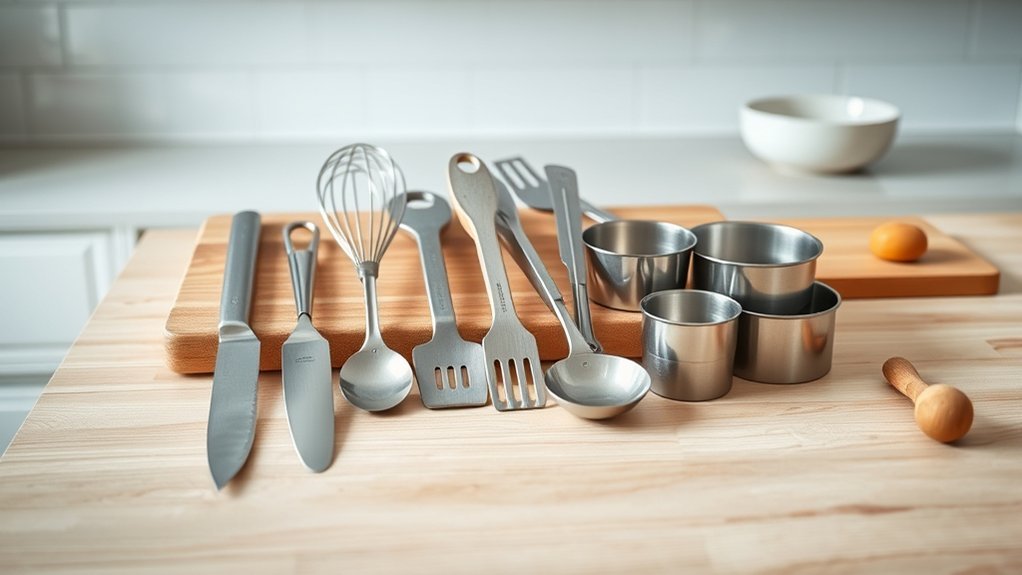
Must-have cooking utensils start with tools that cover the jobs you perform every day: cutting, measuring, stirring, turning, draining, checking temperature, and cooking with controlled heat. A chef’s knife, cutting board, measuring tools, wooden spoon, whisk, silicone spatula, tongs, kitchen shears, and food thermometer form a practical core. Add a frying pan, saucepan, stock pot, baking sheet, and a few baking tools as your cooking needs expand.
Quick Answer
The most useful cooking utensils are a chef’s knife, cutting board, measuring cups and spoons, kitchen scale, wooden spoon, whisk, silicone spatula, tongs, kitchen shears, peeler, colander, and food thermometer. Pair them with a frying pan, saucepan, stock pot, baking sheet, and mixing bowls to handle most everyday recipes.
Key Takeaways
- Start with versatile tools you will use several times a week instead of buying a large matching utensil set.
- A chef’s knife, stable cutting board, measuring tools, tongs, spatula, wooden spoon, whisk, and food thermometer cover most basic prep and cooking jobs.
- For cookware, a skillet or frying pan, saucepan, stock pot or Dutch oven, and rimmed baking sheet handle a wide range of meals.
- Choose materials according to the cookware and heat level: stainless steel for strength, wood for gentle stirring, and appropriately rated silicone for coated pans.
- Good maintenance and food-safety habits matter as much as the number of utensils you own.
What Are the Must-Have Cooking Utensils?
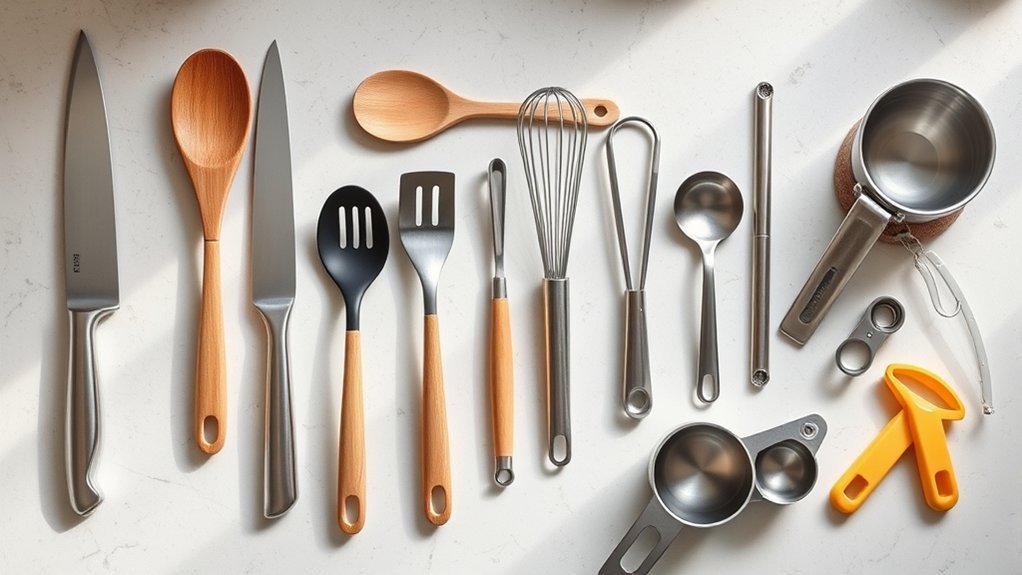
The must-have cooking utensils begin with a chef’s knife. A comfortable, sharp chef’s knife handles most slicing, dicing, mincing, and chopping without requiring a large knife block.
A sturdy cutting board gives the knife a stable work surface. Choose a board that is large enough for the food you normally prepare and that stays secure on the counter. Wood and nonporous materials can both work well when they are cleaned and maintained correctly.
For measuring, keep dry measuring cups, measuring spoons, and a liquid measuring cup. A digital kitchen scale is especially useful for baking and other recipes where repeatable measurements matter.
A wooden spoon, whisk, heat-rated silicone spatula, and set of tongs handle stirring, mixing, scraping, flipping, tossing, and serving. Kitchen shears help with herbs, packaging, parchment, and selected poultry-preparation jobs.
A food thermometer also deserves a place in the basic kit. It does something visual inspection cannot reliably do: confirm that foods such as meat and poultry have reached an appropriate internal temperature.
A practical starter set therefore focuses on versatility rather than quantity. Ten dependable tools that cover different jobs usually offer more value than a drawer full of single-purpose gadgets.
Must-Have Utensils for Prep Work
Prep work depends on a few reliable tools: a sharp chef’s knife, a stable cutting board, accurate measuring equipment, a vegetable peeler, kitchen shears, and one or two mixing bowls.
A quality knife handles most chopping, slicing, and dicing. A peeler makes quick work of carrots, potatoes, apples, and similar produce, while shears are convenient for herbs and packages. Measuring tools keep recipes consistent before ingredients ever reach the stove.
Knife Basics
You do not need a large knife set to begin. An 8-inch chef’s knife is a common all-purpose choice because it is long enough for larger vegetables yet manageable for everyday work. Choose a blade and handle that feel balanced and controllable in your hand.
A paring knife, usually around 3 to 4 inches long, is useful for peeling, trimming, coring, and other detailed cuts. A serrated bread knife works well on crusty bread, soft tomatoes, and other foods that are easily crushed by downward pressure.
A honing rod can help realign the edge of many conventional knives between sharpenings, but honing and sharpening are not the same process. Sharpening actually removes a small amount of material to restore the cutting edge. Follow the knife maker’s care recommendations because very hard or specialized blades may require different maintenance.
- A chef’s knife covers most general cutting jobs.
- A paring knife handles small, detailed work.
- A serrated knife handles bread and delicate-skinned foods.
- Safe storage in a block, sheath, rack, or suitable drawer organizer protects both the blade and your hands.
Pro Tip: A sharp knife is easier to control than a badly dull one because you need less force to make the cut. Keep fingertips tucked away from the blade and use a stable cutting surface that does not slide.
Cutting Boards
Cutting boards create the main prep surface for safe, efficient food preparation. Wood, plastic, bamboo, and other nonporous boards each have advantages, so material alone does not determine whether a board is suitable.
The USDA Food Safety and Inspection Service recommends considering one cutting board for fresh produce and bread and another for raw meat, poultry, and seafood. This helps reduce the chance that bacteria from raw animal foods will reach foods that may be eaten without further cooking.
There is no universal rule that a cutting board must be at least 1 inch thick. More important considerations are stability, usable surface area, construction quality, ease of cleaning, and whether the board has become deeply worn or difficult to clean.
Wash cutting boards after use according to their material and manufacturer instructions. Many nonporous boards can go in a dishwasher, while some wood products require hand washing. Replace any board that develops excessive wear or deep, hard-to-clean grooves.
Warning: Do not place cooked or ready-to-eat food on an unwashed board, plate, or utensil that previously held raw meat, poultry, seafood, or their juices. Wash food-contact surfaces thoroughly before reusing them.
Measuring Tools
Accurate measuring tools make recipes easier to repeat. A useful set includes dry measuring cups, measuring spoons, a clear liquid measuring cup, and a digital kitchen scale.
Dry measuring cups are designed to be filled and leveled for ingredients such as flour or sugar. Liquid measuring cups normally have a pouring spout and markings that can be read while the cup sits on a level surface.
For baking, a digital kitchen scale often provides better repeatability than measuring every ingredient by volume. The U.S. National Institute of Standards and Technology recommends measuring ingredients by mass when improved recipe accuracy is the goal.
- Use dry cups for dry ingredients when the recipe specifies volume.
- Use a liquid measuring vessel for water, milk, oil, and similar liquids.
- Read a liquid measurement on a level surface.
- Use a scale when a recipe supplies weights in grams or ounces.
For repeatable baking, measuring by weight can reduce the variation that occurs when ingredients such as flour are packed differently into a cup.
Essential Cookware for Everyday Cooking
Everyday cooking becomes easier with a small group of versatile pots and pans. A frying pan or skillet handles eggs, vegetables, proteins, and quick sautés. A saucepan covers sauces, grains, oatmeal, and smaller batches of soup.
A stock pot, Dutch oven, or other large pot provides enough capacity for pasta, stocks, stews, beans, and batch cooking. A rimmed baking sheet adds roasting and baking capability without taking up much storage space.
An oven-safe casserole or baking dish is useful for casseroles, baked pasta, roasted dishes, and desserts. Do not assume that an oven-safe glass or ceramic dish can be placed directly on a stovetop burner; only use cookware on heat sources specifically approved by its manufacturer.
Core Pots and Pans
Core cookware should match the way you actually cook. A nonstick frying pan is convenient for eggs, pancakes, delicate fish, and other foods that benefit from easy release. A stainless steel skillet is another versatile option for browning, sautéing, pan sauces, and higher-heat cooking.
A medium saucepan handles sauces, grains, vegetables, and smaller portions. A large stock pot or Dutch oven adds capacity for pasta, soup, chili, stew, and batch cooking. Cast iron can provide excellent heat retention for browning, frying, and oven cooking when its weight and maintenance requirements suit the cook.
- Frying pan or skillet: sautéing, eggs, proteins, and vegetables.
- Saucepan: sauces, grains, smaller soups, and reheating.
- Stock pot or Dutch oven: pasta, stocks, stews, and larger batches.
- Rimmed baking sheet: roasting, baking, toasting, and catching drips beneath other bakeware.
- Optional sauté pan: useful when you want a broad cooking surface with taller sides.
Note: Check cooktop compatibility before buying cookware. Induction cooktops generally require a magnetic base, and not every handle, lid, coating, or baking dish is rated for oven use.
Versatile Bakeware Essentials
Versatile bakeware covers common baking and roasting jobs without filling the kitchen with specialized pans.
A rimmed baking sheet handles cookies, vegetables, sheet-pan meals, toasted nuts, and many other jobs. Whether it is coated or uncoated, follow its temperature and utensil-care instructions to protect the surface.
A 9-by-13-inch baking dish works for casseroles, brownies, baked pasta, fruit desserts, and many family-style dishes. Glass, ceramic, and metal versions behave differently under heat, so use each according to its manufacturer instructions.
A muffin tin is useful for muffins, cupcakes, egg cups, and individually portioned foods. A loaf pan covers quick breads and loaf cakes, while two round cake pans are useful if layered cakes are part of your normal baking.
If you rarely bake cakes, you do not need every pan immediately. Start with a baking sheet and multipurpose baking dish, then add specialty pans when your recipes justify them.
Must-Have Utensils for Baking at Home
For home baking, measurement and mixing tools matter more than a large collection of gadgets. A digital kitchen scale, measuring cups, measuring spoons, mixing bowls, whisk, silicone spatula, and baking sheet cover a wide range of recipes.
Mixing bowls in several sizes make it easier to keep wet and dry ingredients organized. A silicone spatula scrapes batter and dough from a bowl with little waste and can be useful for folding delicate mixtures.
A whisk blends dry ingredients, emulsifies dressings, mixes batters, and incorporates air into eggs or cream. A sturdy baking sheet provides a flat surface for cookies, biscuits, pastries, and roasting.
- Weigh ingredients when the recipe provides weights.
- Keep wet and dry ingredients separate until the recipe tells you to combine them.
- Use a spatula to scrape the bowl thoroughly.
- Use parchment or another recipe-appropriate liner when cleaner release is needed.
These tools have different jobs from a frying pan or saucepan, but together they create a compact baking setup that can handle most beginner and intermediate recipes.
Time-Saving Kitchen Tools
Some kitchen tools save time because they remove repetitive prep rather than because they promise a fixed percentage of faster cooking.
A chef’s knife remains the foundation because a sharp, comfortable blade makes routine chopping efficient. For larger batches, a food processor can quickly chop, slice, shred, puree, or mix selected doughs, although setup and cleanup mean it is not always faster for small jobs.
Kitchen shears can cut herbs, trim food, snip parchment, and open food packaging. A vegetable peeler removes thin skins quickly, while a box grater or Microplane-style grater handles cheese, vegetables, citrus zest, garlic, and spices depending on the grating surface.
Tongs save time when turning meat, tossing vegetables, serving pasta, or moving hot foods. A colander or fine-mesh strainer makes draining pasta, rinsing grains, and washing produce easier.
Measuring tools can also save time by reducing mistakes. Instead of trying to correct an overly salty, wet, or dry mixture later, measure accurately at the start.
Kitchen Safety Tools That Deserve a Place
A useful kitchen is not only efficient; it also makes safe cooking easier. An instant-read food thermometer is one of the most important additions because appearance and color alone do not reliably prove that meat or poultry is safely cooked.
USDA guidance lists minimum internal temperatures of 165°F (73.9°C) for poultry, 160°F (71.1°C) for ground meats, and 145°F (62.8°C) plus a three-minute rest for whole cuts of beef, pork, veal, and lamb.
Other practical safety items include dry oven mitts or heat-resistant gloves appropriate for hot cookware, stable trivets for hot pans, and a fire extinguisher suitable for the kitchen. Handles should remain secure, and damaged utensils that expose loose pieces, melted plastic, or badly deteriorated coatings should be replaced.
Thermometer probes should be cleaned after use, especially after they contact raw foods. Check the thermometer manufacturer’s instructions for washing, calibration, placement, and whether the unit can remain in food during cooking.
How to Choose Cooking Utensils That Last
Durable cooking utensils depend on material, construction, intended use, and care. Stainless steel is strong and well suited to many high-use tools. Wood is gentle on cookware and comfortable for stirring. Silicone can work well with coated cookware when it is food-grade and used within its stated temperature limit.
Do not assume every utensil marketed as silicone, nylon, plastic, wood, or stainless steel has identical heat resistance or dishwasher compatibility. Check the product’s temperature rating and care instructions.
- Select sturdy tools with secure handles and joints.
- Choose a comfortable grip and weight.
- Prefer multipurpose tools when storage space is limited.
- Check heat limits before using utensils in hot pans.
- Confirm dishwasher compatibility instead of assuming it.
- Replace cracked, melted, deeply gouged, or otherwise damaged food-contact tools.
Stainless steel tools are durable but may scratch some coated cookware. Wood is nonabrasive but should be washed and dried properly. Silicone is flexible and gentle on cookware, but manufacturers set different temperature limits. Nylon and other plastics can also vary considerably in heat resistance.
Ergonomic handles can reduce hand fatigue during long prep sessions, while simple construction makes many tools easier to clean. A well-chosen utensil should perform its main job safely and consistently without requiring complicated maintenance.
Using Utensils With Nonstick Cookware
Nonstick pans are useful for delicate foods, but their coating changes how they should be handled. Use wood, silicone, nylon, or another utensil material approved by the cookware manufacturer if metal tools could scratch the surface.
Current Health Canada cookware guidance advises against preheating empty nonstick cookware and against using it at very high heat, such as temperatures above about 260°C (500°F). Ventilate the kitchen and follow the pan maker’s heat and care limits.
Warning: Do not leave an empty nonstick pan heating unattended. Excessive heat can damage the coating and may produce irritating or hazardous fumes. Use the cookware only within its intended temperature range.
How to Build a Kitchen Tool Kit Without Buying Everything at Once
A practical kitchen can be built in stages. Buy the tools that solve your most frequent cooking jobs first, then expand only when a recipe or technique creates a recurring need.
Buy First
- Chef’s knife
- Stable cutting board
- Measuring cups and spoons
- Liquid measuring cup
- Digital kitchen scale
- Wooden spoon
- Silicone or other cookware-safe spatula
- Tongs
- Mixing bowl
- Food thermometer
- Frying pan or skillet
- Saucepan
- Large pot
- Rimmed baking sheet
Add Next
- Paring knife
- Serrated bread knife
- Vegetable peeler
- Kitchen shears
- Whisk
- Colander or fine-mesh strainer
- Box grater or fine grater
- Can opener
- Ladle
- 9-by-13-inch baking dish
- Food storage containers
Add When Your Cooking Requires It
A food processor, blender, stand mixer, specialty baking pan, mandoline, wok, pressure cooker, or other specialized equipment can be valuable, but none needs to be purchased simply because it appears on a generic kitchen checklist. Add it when you know how often you will use it and where you will store it.
Frequently Asked Questions
What Are the 10 Most Important Kitchen Utensils?
A strong 10-piece starting list is a chef’s knife, cutting board, measuring cups and spoons, wooden spoon, silicone spatula, tongs, mixing bowl, whisk, vegetable peeler, and food thermometer. Depending on how you cook, kitchen shears or a colander may be more useful than one of those items.
What Are the Most Essential Cooking Utensils?
The most essential cooking utensils are the ones that cover cutting, measuring, stirring, turning, draining, and temperature checking. For most homes, that means knives, a cutting board, measuring tools, bowls, spoons, a whisk, spatula, tongs, strainer, peeler, kitchen shears, and thermometer, supported by a few versatile pans.
What Are 20 Essential Kitchen Items?
Twenty useful kitchen items are a chef’s knife, cutting board, silicone spatula, measuring cups, measuring spoons, liquid measuring cup, kitchen scale, colander, mixing bowls, skillet, saucepan, baking sheet, wooden spoon, tongs, peeler, grater, can opener, food thermometer, kitchen shears, and food storage containers. Herbs are useful pantry ingredients, but they are not kitchen tools.
What Are the 20 Kitchen Tools, Utensils, and Equipment Needed in Cooking?
A balanced 20-item setup can include a chef’s knife, paring knife, serrated knife, cutting board, measuring cups, measuring spoons, liquid measuring cup, kitchen scale, mixing bowls, colander, whisk, spatula, tongs, wooden spoon, peeler, grater, can opener, frying pan, saucepan, and food thermometer. Add a stock pot and baking sheet early if you cook pasta, soups, roasted foods, or baked dishes frequently.
Sources
- USDA Food Safety and Inspection Service — Cutting Boards — cutting-board cleaning, cross-contamination prevention, and replacement guidance.
- USDA Food Safety and Inspection Service — Safe Minimum Internal Temperature Chart — recommended minimum internal cooking temperatures.
- USDA Food Safety and Inspection Service — Food Thermometers — thermometer use, placement, cleaning, and calibration.
- National Institute of Standards and Technology — Metric Kitchen: Culinary Measurement Tips — scales, dry and liquid measuring tools, and measurement accuracy.
- Health Canada — The Safe Use of Cookware and Bakeware — cookware materials, nonstick heat precautions, silicone, stainless steel, and intended-use guidance.
Conclusion
A well-chosen set of cooking utensils makes everyday cooking faster to organize, easier to control, and safer to perform. Start with versatile basics such as a chef’s knife, cutting board, accurate measuring tools, wooden spoon, spatula, tongs, whisk, thermometer, skillet, saucepan, and baking sheet. Add specialized equipment only when your cooking habits justify it.
Durability also depends on how each tool is used and maintained. Follow heat limits, keep knives sharp and safely stored, prevent cross-contamination, replace badly damaged food-contact surfaces, and match utensils to the cookware beneath them. A smaller collection of dependable tools will usually serve a home kitchen better than a crowded drawer of rarely used gadgets.