
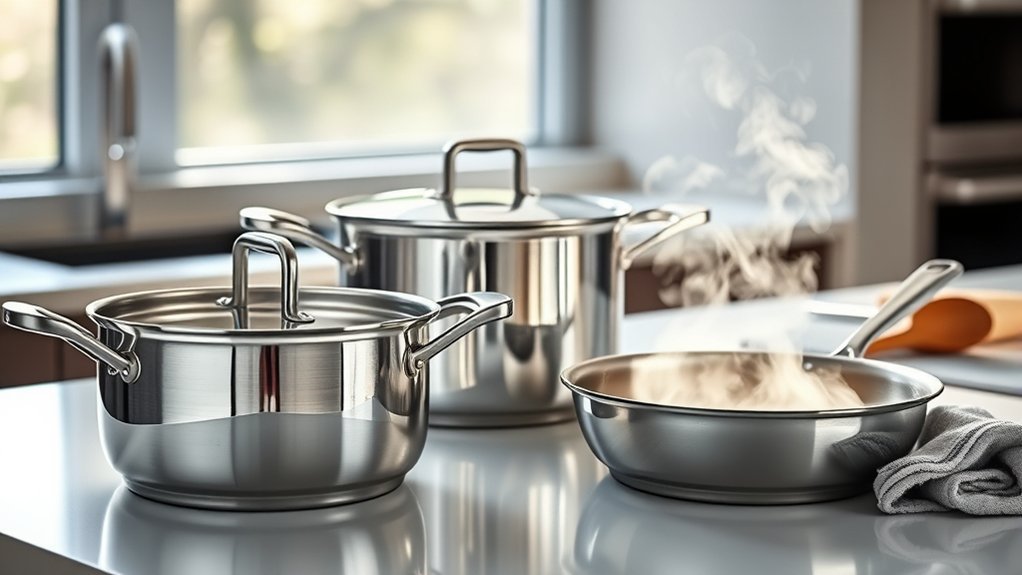
All-Clad stainless steel cookware uses bonded layers of stainless steel with more conductive materials such as aluminum, copper, or graphite to spread heat more evenly than a simple stainless-steel shell. Current D3, D5, G5 Graphite Core, and Copper Core cookware is designed for searing, sautéing, browning, simmering, sauces, and stovetop-to-oven cooking. Most current pots and pans in these lines also work on induction, although specialty pieces should always be checked individually.
Quick Answer
All-Clad stainless steel is fully clad cookware that bonds a stainless cooking surface to heat-conductive core layers. D3 emphasizes simple tri-ply performance, D5 adds five-ply stability, G5 uses lightweight graphite for fast response, and Copper Core adds copper for precise temperature control. Current major stainless lines are generally oven-safe to 600°F and are best handwashed.
Key Takeaways
- The stainless-steel cooking surface provides durability and flavor-neutral cooking, while the bonded core is responsible for most of the pan’s heat spreading and responsiveness.
- D3, D5, G5 Graphite Core, and Copper Core use different layer designs, so they do not all heat, weigh, or respond exactly the same way.
- For browning and searing, All-Clad recommends preheating stainless cookware over low to moderate heat rather than routinely using maximum burner heat.
- Current product guidance for the major stainless collections recommends handwashing, even though older All-Clad cookware was sometimes marketed as dishwasher safe.
- A limited lifetime warranty supports long-term ownership, but normal wear, scratches, overheating, thermal shock, and misuse are among the exclusions.
What Is All-Clad Stainless Steel?
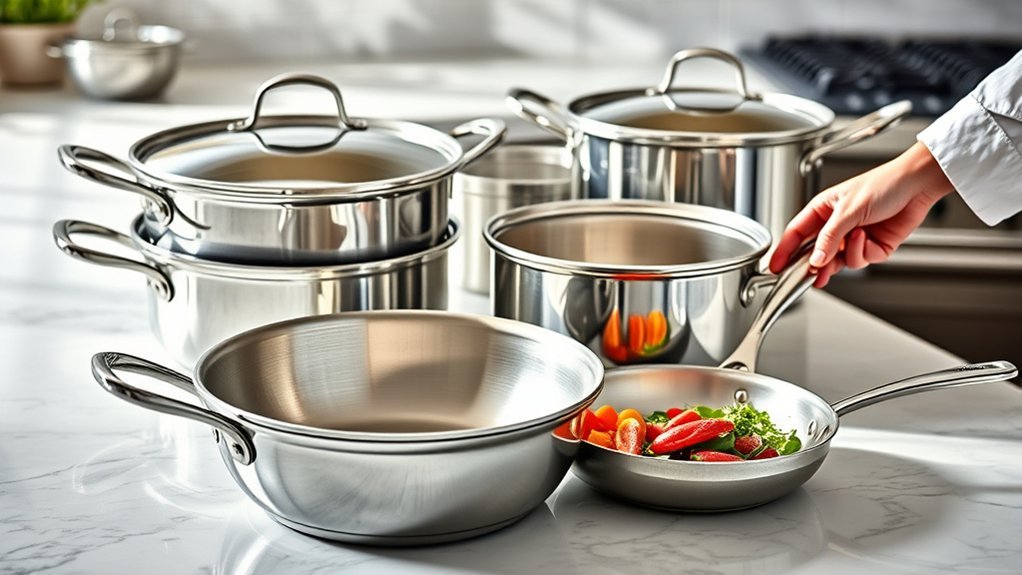
All-Clad stainless steel cookware is a family of bonded cookware built around a durable stainless-steel cooking surface. Rather than relying on stainless steel alone to move heat, the cookware combines it with more thermally conductive materials. The exact construction depends on the collection.
For example, All-Clad’s current stainless-steel collection guide lists D3 and D3 Everyday with an aluminum core, D5 with alternating stainless and aluminum layers, G5 with a graphite-centered construction, and Copper Core with copper as part of its five-ply system.
The food-contact surface used on major All-Clad stainless collections is high-quality 18/10 stainless steel. All-Clad describes this surface as flavor-neutral and suitable for foods such as tomato sauce, wine reductions, and other acidic ingredients.
Current D3, D5, G5, and Copper Core pots and pans are generally compatible with gas, electric, ceramic, and induction cooktops. Many are also oven- and broiler-safe up to 600°F. Specialty products, lids, inserts, and accessories can have different limits, so the individual product page should take priority over a blanket specification.
The key idea behind All-Clad is not stainless steel alone—it is the combination of a durable stainless cooking surface with bonded core materials chosen to move and control heat.
How Is All-Clad Stainless Steel Made?
All-Clad’s fully clad cookware is made by bonding multiple metal layers into one structure before the material is formed into cookware. The bonding extends across the cooking surface rather than limiting the conductive material to a separate disc attached only to the bottom.
Current product pages for major D3, D5, G5, and Copper Core pieces describe the cookware as made in the USA with global components at All-Clad’s Pennsylvania factory. All-Clad also describes many of these lines as bonded, engineered, and assembled in Canonsburg, Pennsylvania. Included inserts, accessories, and specialty items can have different countries of origin, so it is more accurate to check the specific SKU than to claim that every All-Clad item is entirely manufactured in one location.
Bonded Layer Construction
Bonded construction places stainless steel around one or more core materials with better heat-transfer characteristics. D3 uses three bonded layers: a stainless interior, an aluminum core, and a magnetic stainless exterior. The aluminum distributes heat more rapidly than stainless steel alone while the outer stainless layer adds strength and induction compatibility.
D5 expands the structure to five layers, including aluminum and a stainless-steel core layer. Copper Core uses five layers with copper at the center, surrounded by aluminum and stainless steel. G5 Graphite Core uses a lightweight, highly conductive graphite-centered design within a five-layer structure.
Because each construction uses different core materials, the collections have different cooking personalities. D3 is straightforward and relatively responsive, D5 emphasizes controlled and steady heating, Copper Core changes temperature quickly, and G5 is designed to combine rapid heating with lower weight.
Precision Crafting Process
The exact proprietary manufacturing process is not fully published, but the general progression for bonded cookware involves creating the multi-layer material, shaping it into cookware bodies, finishing surfaces and edges, attaching hardware, and inspecting the final product. The following is a simplified overview rather than a factory specification.
| Step | Purpose |
|---|---|
| Bonding | Join the metal layers into one clad structure |
| Rolling | Produce consistent bonded material and thickness |
| Forming | Shape the bonded material into cookware bodies |
| Hand-finishing | Finish rims, surfaces, handles, and other details |
| Inspection | Check construction, finish, and product quality |
The result is cookware whose conductive layers extend through the body of the pan rather than existing only as a separate base plate. That fully clad structure is central to the way All-Clad’s major stainless collections spread heat.
Why Does All-Clad Cook So Evenly?
All-Clad cookware spreads heat well because stainless steel is bonded to more conductive core materials. In D3, for example, an aluminum core carries heat across the pan while stainless steel provides the cooking and exterior surfaces. All-Clad describes its current D3 Stainless cookware as fully bonded tri-ply with an aluminum core designed for fast, even heat.
D5 modifies that behavior with five layers and a stainless core between aluminum layers. Copper Core uses copper to increase responsiveness, while G5 uses graphite to heat and cool rapidly while keeping weight lower than a similarly performance-focused heavy metal core.
The polished or brushed finish affects appearance and cleanup more than heat distribution. The bonded conductive core is the important part when explaining why the pan heats more evenly.
Even heat does not mean a pan is immune to burner-size problems. A small burner under a large skillet can still create temperature differences. Matching the burner reasonably closely to the pan base gives the cookware a better chance to distribute energy evenly.
Pro Tip: Give the pan time to preheat over low to moderate heat instead of turning the burner immediately to maximum. Stainless cookware can hold enough heat to brown food well without routinely using the highest setting.
What Should You Cook in All-Clad?
All-Clad stainless steel is especially useful for foods that benefit from browning, fond development, deglazing, simmering, and stovetop-to-oven cooking. It works well for meat, poultry, vegetables, sauces, braises, pasta dishes, and acidic recipes.
| Food or Task | Why Stainless Works Well | Typical Result |
|---|---|---|
| Steak | Strong browning and fond development | Well-developed crust |
| Chicken | Even browning with oven-finishing capability | Brown exterior with controlled doneness |
| Tomato sauce | Flavor-neutral stainless cooking surface | No need to avoid acidic ingredients |
| Pan sauce | Fond can be deglazed directly in the pan | Concentrated sauce and browned flavor |
| Pasta bake or braise | Many current pieces move from stovetop to oven | Fewer cookware changes during the recipe |
Stainless steel is less forgiving than nonstick cookware for delicate eggs, thin fish fillets, or other foods that easily adhere to a dry metal surface. Those foods can still be cooked successfully, but temperature control, fat, and timing matter more.
How Should You Preheat All-Clad Stainless Steel?
All-Clad’s current care instructions recommend starting with food at or near room temperature when practical, drying its surface, and preheating the pan over low to moderate heat. Once the pan is properly heated, add enough oil to coat the cooking surface, let the oil heat, and then add the food.
Protein often sticks temporarily when it first touches stainless steel. As browning develops, it usually releases more easily. Trying to force it loose too early can tear the food and leave more residue behind.
Warning: Do not leave an empty pan over strong heat after preheating. All-Clad warns that overheating empty cookware can cause discoloration, warping, or other damage. High burner settings are generally unnecessary for normal sautéing and searing.
Which All-Clad Collections Are Best?
The better collection depends on whether you prioritize simplicity, steadier heating, low weight, or rapid temperature response. The current stainless-steel range includes D3, D3 Everyday, D5, G5 Graphite Core, and Copper Core.
| Collection | Construction | Cooking Character | Best Fit |
|---|---|---|---|
| D3 Stainless | 3-ply stainless / aluminum / stainless | Fast, even heating with straightforward construction | Everyday searing, sautéing, sauces, and general-purpose cooking |
| D5 Stainless | 5-ply with stainless and aluminum layers | Steady, controlled heat with additional layered mass | Cooks who prefer deliberate temperature changes and a heavier feel |
| G5 Graphite Core | 5-ply with graphite at the core | Very quick heating and cooling with relatively low weight | Cooks who want fast response without a heavy pan |
| Copper Core | 5-ply with copper surrounded by aluminum and stainless steel | Rapid response to burner adjustments | Temperature-sensitive sauces and cooks who value precise adjustments |
D3 is often the simplest entry point because it combines the classic fully clad design with fewer layers. D5 adds a different heat-control feel rather than simply being a universally superior version of D3. G5 is notable for its fast-heating graphite construction, while Copper Core uses copper for especially quick thermal response.
Current D3, D5, G5, and Copper Core product pages commonly list oven and broiler compatibility up to 600°F and induction compatibility for regular pots and pans. Always check the exact item if buying a specialty roaster, insert, lid, or other unusual piece.
How Do You Choose the Right All-Clad Piece?
Start with the cooking job rather than the size of a boxed set. Buying pieces that match your normal meals often provides more value than owning a large collection of seldom-used pans.
- Fry pan or skillet: suited to searing meat, browning vegetables, frying, and quick pan sauces.
- Sauté pan: straight sides provide more usable volume for one-pan meals, shallow braises, frying, and dishes with sauces.
- Saucepan or saucier: useful for grains, soups, reductions, custards, reheating, and smaller batches of sauce.
- Stockpot: better for pasta water, stocks, soups, and large-volume cooking.
- Dutch oven or deeper covered pan: useful for braising, stews, and recipes that move from stovetop to oven.
After choosing the shape, compare collection characteristics. D3 is a practical general-purpose choice; D5 has a heavier, steadier feel; G5 prioritizes fast response and low weight; Copper Core prioritizes responsiveness and comes at a higher price.
Also consider storage space and physical comfort. A pan that feels balanced when empty can become much heavier after it is filled with food, liquid, and a lid.
What Are the Downsides of All-Clad Stainless Steel?
Premium construction does not make stainless steel perfect for every cook. The most obvious drawback is cost. D5, G5, and Copper Core can cost substantially more than basic clad stainless cookware, and the performance difference may not matter equally to every household.
Stainless steel also has a learning curve. Food can stick when the pan is too cool, too hot, too dry, or disturbed before it naturally releases. Nonstick cookware is often easier for eggs and other delicate foods that do not need strong browning.
Cosmetic changes are normal. Stainless cookware can develop scratches, cloudy mineral marks, rainbow heat tint, or browned-on residue. These do not automatically mean the pan is defective.
Weight is another consideration. Collection design and pan size affect how heavy a piece feels. G5 was specifically designed to reduce weight, while multi-layer D5 and copper-centered cookware can feel more substantial.
Finally, current major stainless-steel product pages recommend handwashing, which may be less convenient for buyers who want cookware that can routinely go straight into a dishwasher.
How Do You Care for All-Clad Stainless Steel?
All-Clad’s current Care & Use guidance recommends letting stainless cookware cool before cleaning, washing it with warm soapy water and a sponge or soft cloth, rinsing it, and drying it promptly to limit spotting.
For tougher residue, a nylon scrubbing pad can be used on stainless surfaces. All-Clad advises against steel wool, steel scouring pads, oven cleaner, harsh detergents, and products containing bleach or peroxide because they can damage the cookware.
- Burnt food: All-Clad recommends adding baking soda and water and bringing the mixture to a boil, then loosening residue with a wooden utensil.
- Blue or rainbow discoloration: wipe the cooled pan with white vinegar and a soft sponge or cloth.
- Cloudy hard-water marks: boil a 1:1 mixture of white vinegar and water, then rinse and dry.
- Water spots: dry cookware soon after rinsing rather than allowing droplets to evaporate on the surface.
Do not place a very hot pan directly under cold water. The sudden temperature change can create thermal shock and may warp the cookware.
All-Clad also advises adding salt after liquid has begun boiling or after food has started cooking rather than sprinkling salt into a cold or heating pan. This can reduce the chance of small white pits developing on the stainless surface.
Note: Current D3, D5, G5 Graphite Core, and Copper Core product listings say “Handwash Only.” For an older piece, check its model-specific care instructions rather than relying on an old dishwasher-safe statement.
Is All-Clad Stainless Steel Worth the Price?
All-Clad’s higher price pays for fully bonded construction, stainless cooking surfaces, multiple core options, U.S. manufacturing for many major cookware pieces, and a limited lifetime warranty. Whether that represents good value depends on how often the cookware will be used and whether its performance advantages matter for the buyer’s cooking style.
A cook who regularly browns meat, deglazes pans, makes reductions, braises, or moves cookware between burner and oven may benefit more from premium clad stainless cookware than someone who mainly reheats food or cooks delicate items on low heat.
Premium Materials And Build
The cooking surface on major All-Clad stainless lines is high-quality stainless steel, commonly 18/10, while the bonded internal materials vary by collection. D3 uses aluminum, D5 uses a multi-layer stainless-and-aluminum structure, Copper Core adds copper, and G5 uses graphite.
The stainless interior is durable and flavor-neutral, but it should not be described as scratch-proof. Cosmetic scratches can develop with use, and All-Clad’s warranty specifically distinguishes ordinary scratches, stains, and discoloration from manufacturing defects.
Many major stainless pieces are produced in the United States with global components at All-Clad’s Pennsylvania factory. Country of origin can differ for inserts, accessories, and certain specialty products.
Performance Justifies Investment
The strongest performance argument is versatility. Stainless cookware can brown, sauté, simmer, deglaze, and move into a hot oven without the temperature restrictions associated with many coated pans.
Current D3, D5, G5, and Copper Core cookware is commonly rated by All-Clad for oven and broiler use up to 600°F. Stainless-steel lids can have similarly high ratings, but glass lids and specialty components may have lower limits, so model-specific instructions remain important.
More expensive construction is most useful when the cook takes advantage of it. Someone who values rapid temperature response may appreciate Copper Core or G5, while a buyer who simply wants dependable fully clad stainless cookware may find D3 sufficient.
Long-Term Value And Durability
Stainless steel has no conventional nonstick coating to wear away, which makes fully clad stainless cookware well suited to long-term use. The cookware can still scratch, stain, discolor, or be damaged by overheating and thermal shock, so durability should not be confused with indestructibility.
All-Clad backs its cookware with a limited lifetime warranty covering qualifying defects in material, construction, or workmanship under normal use and the stated care instructions. The warranty includes exclusions for normal wear, misuse, thermal shock, overheating, scratches, stains, and other conditions.
For buyers who expect to use a stainless pan frequently for many years, that repair-or-replacement framework and the absence of a disposable nonstick coating can strengthen the long-term value proposition.
Frequently Asked Questions
What’s the Difference Between Stainless Steel and Stainless Clad?
Stainless steel describes the material used in the cookware, while “clad” describes how multiple layers are bonded together. Stainless cookware can itself be fully clad. In All-Clad D3, for example, a stainless cooking surface and stainless exterior are bonded around an aluminum core. Cladding lets the cookware combine stainless steel’s durability with the stronger heat conductivity of the core material.
Is All-Clad Real Stainless Steel?
Yes. Major All-Clad stainless collections use a genuine stainless-steel cooking surface, commonly high-quality 18/10 stainless steel. The cookware is not solid stainless steel all the way through because the bonded core uses materials such as aluminum, stainless steel, copper, or graphite to improve heat performance.
What Grade of Stainless Steel Is All-Clad?
All-Clad states that its stainless cooking surface is high-quality 18/10 stainless steel and describes its formulation as part of the 304 series. The “18/10” designation refers to the nominal chromium and nickel composition commonly associated with this type of corrosion-resistant food-contact stainless steel.
Can All-Clad Stainless Steel Go in the Dishwasher?
Current D3, D5, G5 Graphite Core, and Copper Core product listings recommend handwashing and commonly state “Handwash Only.” Older pieces may have been sold with different instructions, so owners should follow the care directions for their specific model rather than assuming all generations have the same dishwasher guidance.
Why Does Food Stick to All-Clad Stainless Steel?
Food often sticks when stainless cookware is insufficiently preheated, overheated, too dry, or disturbed before browning has developed. Preheat over low to moderate heat, add oil after the pan is warm, add dry food to hot oil, and allow proteins time to brown. They often release more easily once a crust forms.
Does All-Clad Stainless Steel Work on Induction?
Most current D3, D5, G5 Graphite Core, and Copper Core pots and pans are induction-compatible because their exterior construction includes a magnetic stainless layer. Specialty pieces can be exceptions, so verify the individual product specification before buying for an induction-only kitchen.
What Is the Lawsuit Against All-Clad?
The best-known litigation was In re All-Clad Metalcrafters, LLC, Cookware Marketing and Sales Practices Litigation, MDL No. 2988. Plaintiffs alleged that certain D3, D5, and LTD cookware had been marketed as dishwasher safe even though dishwasher use could erode bonded layers near the rim and create sharp edges. All-Clad denied the allegations and wrongdoing. The U.S. District Court for the Western District of Pennsylvania granted final approval of the class settlement on February 17, 2023. Later court records stated that the claims process was substantially complete in 2024.
Conclusion
All-Clad stainless steel stands out because its stainless cooking surface is bonded to core materials selected to improve heat distribution and temperature control. D3 offers classic tri-ply construction, D5 uses five layers for steadier heat behavior, G5 Graphite Core emphasizes speed and lower weight, and Copper Core focuses on rapid response.
The cookware performs especially well for browning, sautéing, deglazing, sauces, braising, and oven finishing, but getting the best results requires reasonable preheating rather than excessive burner heat. Current care guidance also favors handwashing, careful cleaning, and avoiding thermal shock.
Its premium price makes the most sense for cooks who will use those strengths regularly. With appropriate care, fully clad stainless cookware can provide long service, while All-Clad’s limited lifetime warranty offers additional protection for qualifying defects rather than a promise against every form of wear or damage.
Sources
- All-Clad — Stainless Steel Cookware Collections — current D3, D5, G5 Graphite Core, Copper Core construction and collection information.
- All-Clad — D3 Stainless Fry Pan — tri-ply construction, aluminum core, induction compatibility, oven/broiler limit, manufacturing, and care specifications.
- All-Clad — Copper Core Fry Pan — five-ply copper-centered construction, heat response, induction compatibility, and oven/broiler specification.
- All-Clad — Care & Use — preheating, washing, stain removal, thermal-shock, and stainless-steel cleaning guidance.
- All-Clad — Warranty Details — current limited lifetime cookware warranty information.
- U.S. District Court, Western District of Pennsylvania — All-Clad Cookware Litigation Opinion — dishwasher-safe allegations and February 17, 2023 final settlement approval.

1 thought on “What Is All-Clad Stainless Steel? Meaning, Uses & Key Facts”