
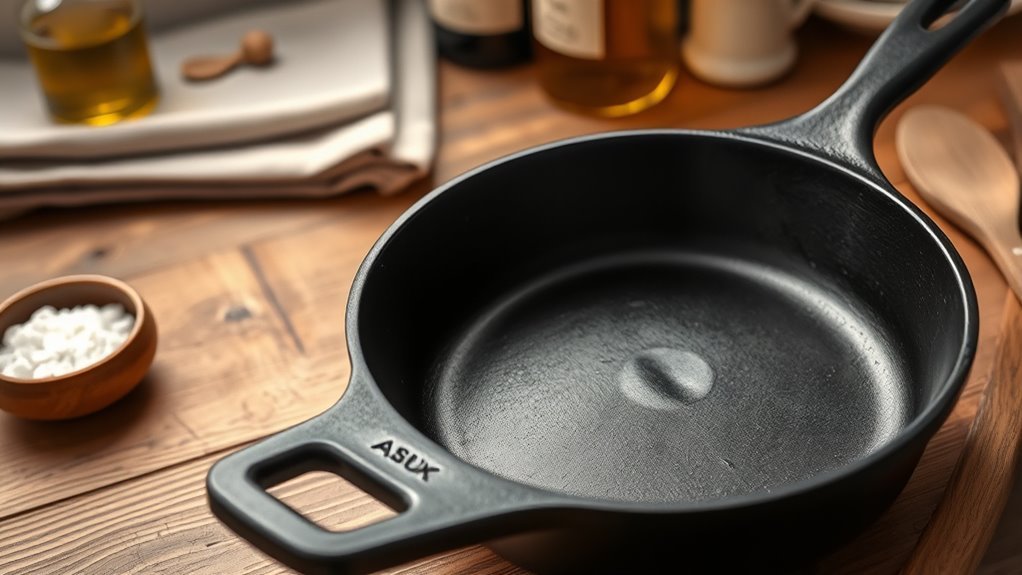
You might think a “pre‑seasoned” skillet is ready forever, but it’s really just factory‑baked oil that gives a basic nonstick layer. You’ll still need to understand what seasoning actually is, how to care for it, and when to build up more layers to get the durable, stick‑resistant surface you want. Learn the simple prep, fixes, and maintenance that keep cast iron performing like new.
What “Pre‑Seasoned” Means for a Cast Iron Skillet
Although a pre-seasoned cast iron skillet comes ready to use, the term simply means the maker applied a factory oil coating to give you an initial non-stick surface.
You’ll find that this coating—often sprayed on—lets you cook right away, but it’s not the same as a deeply built-up, hand-seasoned finish.
Wash the skillet before first use to remove any loose residue; factory seasoning can flake during early cooking.
Treat the pre-seasoned cast iron skillet as a head start, not a final solution: you’ll want to maintain and reinforce the surface through regular seasoning to achieve lasting release and rust protection.
Re-season every six to eight months or whenever food begins to cling.
If you crave autonomy in the kitchen, take control by layering your own seasoning over the factory coat; that’s how you transform a usable pan into a dependable, personal tool that serves you for decades.
Factory Pre‑Seasoning: Process, Limits, and What to Expect
Factory pre-seasoning is a light, spray-on oil baked onto the iron so you can use the skillet right away, but it’s a thin film meant as a starter rather than a final surface.
You’ll notice it provides basic non-stick performance but can wear, flake, or wash off with soap or high heat.
Wash the pan before first use and plan to build your own seasoning over time, re-oiling and re-seasoning every 6–8 months for best results.
How Factory Seasoning Works
When you buy a new cast iron skillet it usually comes with a spray-on oil layer that gives you a basic nonstick surface right out of the box, but that coating is a starter—not a substitute for the hard-won seasoning you build with cooking.
Factory seasoning is applied as a thin spray to protect the pan and reduce initial stickiness. You should wash the skillet before first use to remove residues so your own seasoning bonds better.
That factory layer can be less durable than layers you build by cooking and may flake, so expect to re-season when needed.
For reliable performance, re-seasoning every 6–8 months or after flaking restores nonstick qualities and extends the skillet’s life.
Limits Of Spray-On Coatings
You’ll notice that the spray-on layer you just washed off or kept on is only a quick fix, not the long-term answer for a reliable nonstick surface. Factory spray-on coatings give you protection out of the box but can flake, attract residue, and fail under heavy use. Wash before first use, then re-season thoroughly to build a robust, lasting surface. With consistent cooking and oiling you’ll replace the fragile factory film with a thicker, smoother seasoning that frees you from dependence on industrial shortcuts.
| Benefit | Limit | What to do |
|---|---|---|
| Quick protection | Can flake | Wash first |
| Ready-to-use | Less durable | Re-season |
| Low cost | May stick | Maintain regularly |
First Use: Prepping Your Pre‑Seasoned Cast Iron Skillet
Although your skillet arrives pre-seasoned, give it a quick wash with hot water and a cloth or sponge to remove any factory residue. Then dry it thoroughly to prevent rust.
When prepping your pre-seasoned cast iron skillet, you take control: you’re removing manufacturing oils and confirming the surface is ready for real cooking. Dry immediately and heat it briefly on the stove to drive off any remaining moisture.
Follow this simple checklist to start strong:
- Wash gently with hot water and a sponge — no harsh detergents.
- Completely dry and warm on low heat to prevent rust.
- Plan to re-season in 6–8 months or when food sticks.
You’ll also keep temperatures consistent while cooking to build the skillet’s natural non-stick qualities.
Hand wash only, avoid chemical cleaners, and do periodic re-seasoning. That maintenance preserves performance and freedom from disposable cookware cycles.
Everyday Benefits of a Well‑Seasoned Cast Iron Skillet
When you use a well‑seasoned cast iron skillet you’ll notice superior heat retention that keeps temperatures steady and minimizes hot spots.
That same seasoning gives you everyday non‑stick performance, so food releases easily and cleanup is quicker.
With regular care the surface only improves, making cooking more reliable and the pan last for generations.
Superior Heat Retention
Because a well‑seasoned cast iron skillet holds heat so well, you’ll get more consistent results with less fuss: food cooks evenly, hot spots vanish, and browning becomes predictable.
That superior heat retention lets you work confidently—sear, sauté, or braise—without constant temperature babysitting. You’ll save time and energy, and meals come out reliably.
Use this mindset to simplify your cooking:
- Preheat until the skillet is uniformly hot for even sears.
- Rely on residual heat to finish dishes without high flames.
- Move between stovetop and oven without losing temperature control.
A well‑seasoned pan’s durability and steady warmth free you to cook boldly. It becomes a tool of liberation—dependable, efficient, and built to last.
Everyday Non‑Stick Performance
If you keep a cast iron skillet well seasoned, it’ll act like a natural non‑stick pan—food releases easily, cleanup’s faster, and you’ll spend less time coaxing stuck bits free.
You get that effect because seasoning the pan builds a polymerized oil layer that prevents sticking and wards off rust.
Use and maintain it regularly: each cook thickens and smooths the seasoning, improving release.
Control your heat—steady, appropriate temperatures maximize non‑stick performance and stop food from bonding to the surface.
The payoff is practical freedom: you can sear, fry, and bake without battling your cookware, and simple maintenance keeps it reliable.
Bonus: modest iron transfer during cooking can boost your dietary iron as you reclaim control in the kitchen.
Fix Sticking, Flaking, and Rust: Quick Repair Steps
Although a well-seasoned cast iron skillet should perform reliably, you’ll occasionally encounter sticking, flaking, or surface rust—and quick, targeted repairs will get it back to cooking-ready fast.
Even a well-seasoned cast iron skillet can stick, flake, or rust—quick, focused repairs restore cooking readiness fast.
If you need to fix sticking, start by checking for dull spots; scrub gently, dry thoroughly, then apply a thin oil layer and reseason.
For flaking, remove loose seasoning with a mild abrasive, wash, dry, oil, and reseason the area to restore a uniform coating.
To tackle rust, dry immediately after washing and rub on oil; for heavy rust, sand to bare metal, clean, dry, then reseason.
Follow this simple sequence to reclaim freedom in your kitchen:
- Clean and assess: remove food, rust, or loose seasoning.
- Repair surface: scrub or sand as needed; wash and dry completely.
- Protect and reseason: apply thin oil, heat to bond the layer.
These steps let you reclaim control and keep the skillet reliable without delay.
How to Build and Strengthen Seasoning Over Time
To build and strengthen seasoning, always apply oil in a very thin, even layer before heating so each coat bonds and smooths the surface.
Use the skillet regularly and plan a full re-seasoning every 6–8 months or sooner if you notice sticking or dull spots.
For a durable finish, wipe excess oil, then bake the skillet upside down at high heat (about 500ºF) for an hour to cure the new layer.
Layering Oil Thinly
Start with one very thin coat of a high-smoke-point oil—like vegetable or canola—and wipe it down until the surface looks barely glossy; you’re aiming for molecular-thin coverage so each bake polymerizes evenly instead of pooling or flaking.
When layering oil thinly, you build freedom from sticky pans and rust by adding disciplined, incremental strength.
Repeat short seasoning cycles rather than slathering oil; each translucent layer bonds and toughens the surface.
- Apply tiny amount, wipe away excess.
- Bake to polymerize, cool, repeat.
- Use and maintain; thin layers accumulate resilience.
You’ll gain a smooth, durable non-stick barrier that eases cleaning and resists flaking.
This method empowers you to reclaim your cooking surface through intentional, minimal action.
Routine Re-Seasoning
When you re-season your cast iron every 6–8 months and after obvious wear, you keep its non-stick surface strong and predictable; simply apply a thin coat of high-smoke-point oil, wipe away excess, and bake the skillet upside down at 500°F for an hour to lock in the layer. Routine re-seasoning isn’t ritual — it’s liberation from sticky pans. Watch for sticking food, dull spots, or visible wear; those signal action. Use immediate drying, avoid harsh chemicals, and cook regularly to build thicker, smoother seasoning. Repeat the bake cycle when needed to strengthen layers. Be deliberate: thin oil, even wipe, consistent heat. Your skillet responds to care, rewarding you with resilience and freedom at the stovetop.
| Step | Action |
|---|---|
| 1 | Clean gently |
| 2 | Dry fully |
| 3 | Oil thinly |
| 4 | Bake 1 hr |
| 5 | Cool upside down |
Best Oils, Temperatures, and Methods for Reseasoning
Although a good seasoning comes from consistent care, you’ll get the best, most durable finish by using a high-smoke-point fat—vegetable or canola oil, lard, or Crisco—and curing it at about 500°F so the oil can properly polymerize.
Use a high-smoke-point fat and cure at ~500°F for a durable, properly polymerized cast-iron seasoning.
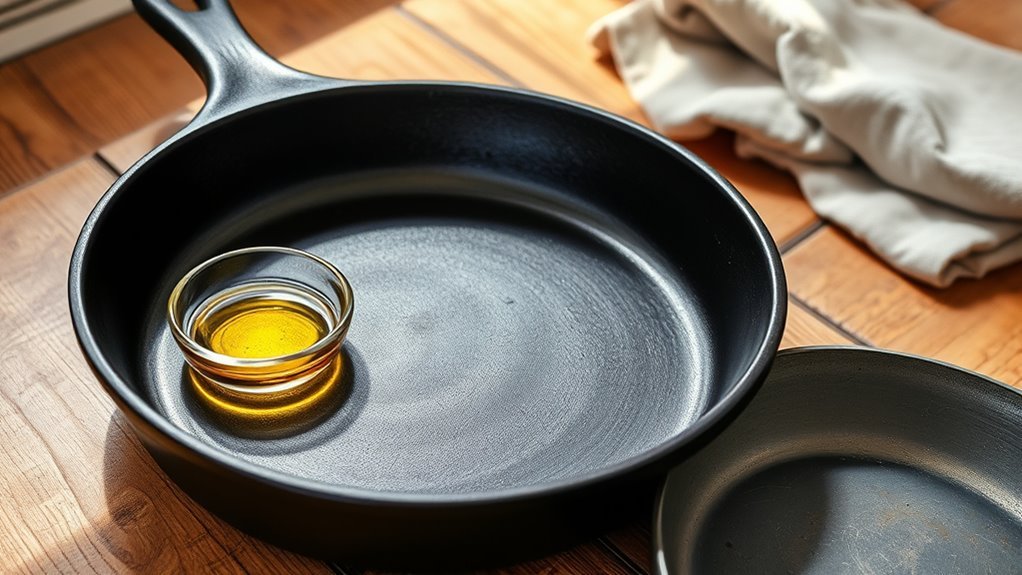
You’ll restore and protect your skillet by following a simple, empowering method: thin coat, high heat, patience. Apply a very thin layer of your chosen best oils, wiping away excess until the surface looks dry to the touch.
Place the skillet upside down in a preheated 500°F oven for one hour with foil on a lower rack to catch drips. For a resilient surface, repeat the cycle multiple times; each pass builds a tougher, smoother finish.
If you’ve stripped the pan back to bare metal, reseasoning isn’t optional—it’s liberation from rust and stickiness.
Remember the practical steps:
- Thin coat, wipe excess.
- 500°F, upside down, one hour.
- Repeat for multiple layers.
This method gives you control, durability, and a truly nonstick cast iron.
Care Do’s and Don’ts: Cleaning, Storage, and Acidic Foods
Because your skillet’s seasoning is its frontline defense, treat cleaning, drying, and storage as routine maintenance rather than optional chores.
Always hand wash your pre-seasoned cast iron with hot water and a cloth or sponge; avoid harsh chemicals that strip the seasoning. If food sticks, scrub gently with a nonmetal brush or coarse salt, rinse, and repeat.
After cleaning, dry the pan immediately—heat it briefly on the stove if needed—to prevent rust.
Once dry, apply a thin layer of oil to nourish the seasoning and store the skillet in a dry place. Slide a paper towel between the skillet and any lid or stacked pan to absorb moisture and keep air flowing.
Limit cooking highly acidic foods like tomatoes until your seasoning is well established; acids can dull the finish and create metallic flavors.
If you notice sticking or dull spots, plan to re-season periodically to reclaim performance and freedom in your kitchen.
Pre‑Seasoned vs. DIY Seasoning: When to Re‑Season Yourself
If you want predictable performance from your skillet, plan to re-season it yourself every 6–8 months or whenever you see sticking, dull spots, or rust starting to form. Pre-seasoned cast iron skillets give you a helpful head start, but factory coatings vary and won’t replace your intentional care.
When you re-season, you build a tougher, longer-lasting surface by applying a thin oil layer and baking the pan upside down at high heat.
Re-seasoning is empowering: it frees you from inconsistent factory finishes and lets you control durability. Watch for these triggers to act:
- Visible rust or pitting.
- Food starts sticking or leaving dull patches.
- After aggressive scrubbing removes seasoning.
Regular cooking on a pre-seasoned skillet will improve its finish, but temperature control and maintenance determine success.
If you want liberation from flaky non-stick performance, re-season proactively—it’s simple, repeatable, and it returns authority over your cookware to you.
Is a Pre‑Seasoned Cast Iron Skillet Right for You?
Wondering whether a pre‑seasoned cast iron skillet fits your kitchen? If you want freedom from plastic-coated pans and crave durable, versatile cookware, this is a strong choice.
A pre-seasoned cast iron skillet arrives with a factory coating that gives immediate non-stick performance, so you can sear, fry, and bake right away. You’ll still need to engage: regular use improves the surface, and reinforcing seasoning every 6–8 months or after heavy use keeps it performing at its best.
Care is simple but deliberate — hand wash, avoid harsh detergents, and dry thoroughly to protect the seasoning and the pan’s lifespan. That attention rewards you with cookware that can be passed down.
If you prefer low-maintenance disposables or dislike hands-on care, it mightn’t suit you. But if you want control, longevity, and liberation from throwaway culture, a pre-seasoned cast iron skillet gives immediate utility plus the potential to become better with your care.
Frequently Asked Questions
What Is the Difference Between Pre-Seasoned and Seasoned Cast Iron?
Pre-seasoned cast iron arrives ready to use with a factory-applied coating, while seasoned cast iron’s non-stick surface comes from your repeated Seasoning Process.
You’ll reclaim control: pre-seasoned may need re-seasoning sooner, whereas a well-seasoned pan improves with your care and cooking.
You’ll maintain liberation by regularly applying oil and heating the pan, building durability and superior non-stick performance tailored to how you cook and live.
Do I Need to Do Anything With a Pre-Seasoned Cast Iron Skillet?
About 85% of cast iron owners report better results after initial care, so yes—you should do a few things.
Rinse and dry your pre-seasoned skillet before first use, then oil it lightly.
For ongoing Maintenance Tips, avoid soap, scrub with hot water and a brush, dry thoroughly, and heat with a thin oil layer every few months.
That keeps your skillet non-stick, rust-free, and ready to liberate your cooking.
Should I Trust a Pre-Seasoned Cast Iron Skillet?
You can trust a pre-seasoned cast iron skillet as a usable starting point, but don’t rely on it as the final answer.
The Trust Factor is moderate: it’ll work right away, yet factory seasoning can flake and won’t match a lovingly built finish.
You’re empowered to wash, inspect, and add layers of seasoning for durability and better non-stick performance.
Do that, and you’ll reclaim full control of your skillet’s lifespan.
How to Use a Pre-Seasoned Cast Iron for the First Time?
You’ll worship the skillet like a tiny tyrant: wash off flaky factory seasoning with hot water and a cloth, then preheat gradually to avoid thermal shock.
Use medium–low heat at first — Cooking Tips: don’t blast it. Avoid acidic foods until seasoning builds.
After cooking, hand-wash with hot water and a mild scouring pad if needed, dry immediately to stop rust, and reclaim freedom through steady, practical care.
Conclusion
A pre‑seasoned cast iron skillet gives you a head start, but it’s only a first step — treat it like a foundation, not the finished house. With routine seasoning, gentle cleaning, and the right oils and temps, you’ll build a durable, naturally non‑stick surface that improves with use. Fix rust or flaking promptly, avoid harsh soaps and acidic foods early on, and re‑season when needed — then your skillet will pay you back tenfold.
