
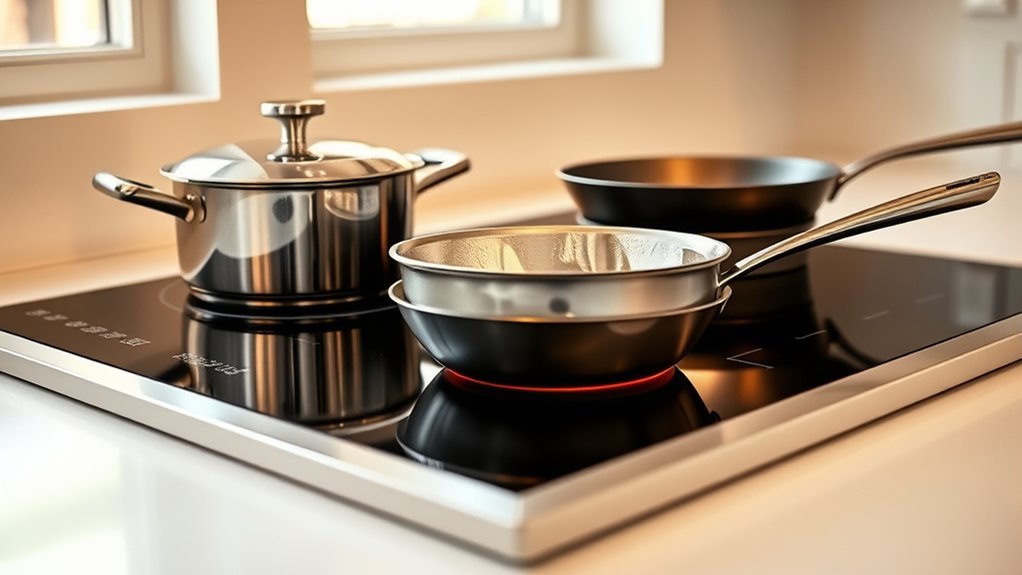
Induction-ready cookware promises efficiency and precision, yet it doesn’t assure oven safety. While materials like cast iron and magnetic stainless steel excel in both domains, others may falter under heat. You’ll want to evaluate the specific features of your cookware to avoid mishaps. Understanding which materials work best can elevate your cooking experience. Curious about how to guarantee your cookware meets both standards? Let’s explore the essential details together.
What Does “Induction-Ready” Mean?
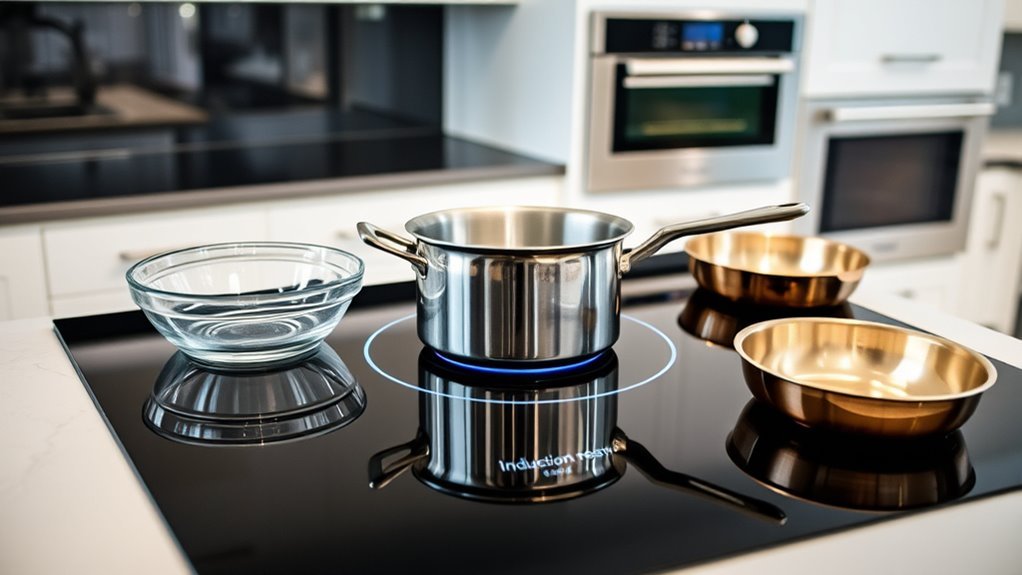
When you hear the term “induction-ready,” think of cookware that’s designed to work seamlessly with induction cooktops. This means it features a magnetic base made from ferromagnetic materials like cast iron or magnetic stainless steel.
Induction cooking uses electromagnetic fields to generate heat directly in the cookware, so choosing the right materials is vital for peak performance. To check if your cookware is induction-ready, perform a simple magnet test—if the magnet sticks to the bottom, you’re good to go!
While many pots and pans are made from induction-ready materials, not all are oven-safe. It’s important to consult the manufacturer’s guidelines for specific temperature limits and compatibility.
Variations exist, so always verify labeling to confirm your cookware meets both induction and oven-safe standards. Embracing induction cooking opens up a world of efficient, precise culinary experiences!
Are All Induction-Ready Cookware Brands Oven Safe?
Not all induction-ready cookware brands confirm oven safety, so it’s important to do a little research before making a purchase.
While many induction-compatible cookware options, like cast iron and magnetic stainless steel, are generally oven safe, you should always check the manufacturer’s specifications.
Some induction cookware, particularly those with nonstick coatings, may have temperature limits that restrict their oven use. Pay close attention to these ratings to avoid mishaps.
Additionally, brands vary; some offer specific lines labeled as oven safe, catering to various temperature ranges.
If your cookware has plastic handles or non-metal components, it likely won’t hold up in the oven, even if the base is induction compatible.
To verify versatility in your cooking, look for dual labels indicating both induction compatibility and oven safety.
Doing so will empower your culinary adventures, allowing you to explore a range of cooking methods with confidence.
Essential Materials for Induction and Oven Safety
Choosing the right materials for your induction and oven-safe cookware can greatly enhance your cooking experience. Opt for induction cookware made from ferromagnetic materials like cast iron or magnetic stainless steel. These materials are not only induction-compatible but are also generally oven-safe, provided there are no non-oven-safe components, such as plastic handles.
Here’s a quick comparison of essential materials:
| Material | Oven-Safe? |
|---|---|
| Cast Iron | Yes |
| Magnetic Stainless Steel | Yes |
| Non-Stick Aluminum | No |
Always check the manufacturer’s guidelines, as some products may have temperature limits. Many enameled cast iron and stainless steel pots are both versatile and durable, able to withstand high temperatures, typically up to 500°F (260°C). Remember, while a magnet test confirms induction compatibility, it doesn’t guarantee oven safety. Always refer to specific product instructions.
How to Test Your Cookware for Induction Compatibility
To confirm your cookware is compatible with induction cooking, performing a simple magnet test is essential. Grab a magnet and see if it sticks to the bottom of your pots and pans. If it does, you’ve got induction-compatible cookware!
Materials like cast iron, magnetic stainless steel, and carbon steel, which have a ferromagnetic base, work best for induction cooking.
On the flip side, non-compatible materials like aluminum, glass, and copper won’t cut it unless they feature a bonded magnetic layer. Be wary of cookware with a thin or partially magnetic base, as it can lead to detection issues at higher power settings, impacting efficiency.
Before buying new cookware, always check for induction-compatible labeling. This guarantees your cookware works seamlessly on induction cooktops, giving you the liberation to cook with confidence!
Top Induction and Oven-Safe Cookware
When you’re choosing cookware, understanding the best materials is key to finding pieces that are both induction-ready and oven-safe.
Brands like A1 ScratchDefense™ offer durable options that excel in both cooking environments.
Let’s explore the top materials and recommended brands to elevate your culinary experience.
Best Materials Overview
While exploring the best materials for induction-ready and oven-safe cookware, you’ll find that several options stand out for their versatility and performance.
Induction cookware like magnetic stainless steel and cast iron excels in both stovetop and oven use. These materials can typically withstand high temperatures, often between 400°F to 500°F, making them perfect for a variety of cooking methods.
Look for thicker options, such as tri-ply stainless steel or enameled cast iron, as they offer better heat retention. Just remember to check if your cookware is labeled oven-safe, since some nonstick coatings may limit temperature.
Recommended Cookware Brands
Choosing the right cookware can transform your cooking experience, especially when you want versatility in both induction and oven use.
High-quality cookware brands like All-Clad and Cuisinart excel in offering induction cookware that’s also oven-safe, typically rated for temperatures up to 500°F.
If you’re looking for durability, consider Le Creuset’s enameled cast iron; it’s not only induction-compatible but also withstands high oven temperatures.
T-fal’s stainless steel options feature a magnetic base, making them perfect for induction while being designed for oven use.
When shopping, always check for labels confirming both induction compatibility and oven-safe ratings to guarantee you get the best performance across your cooking environments.
Your culinary adventures deserve nothing less!
Debunking Myths: What You Should Know About Induction Cooking
Although many people believe that all cookware labeled as induction-ready is suitable for oven use, this isn’t always the case. Induction cookware features a magnetic base, allowing it to work on induction cooktops, but that doesn’t guarantee oven safety. Always check the manufacturer’s guidelines.
| Cookware Type | Oven Safe? |
|---|---|
| Stainless Steel | Yes, if magnetic |
| Cast Iron | Yes |
| Nonstick Coated | Check temp limits |
| Ceramic-Clad | Must have iron layer |
What Makes Different Cookware Materials Unique?
When you explore different cookware materials, you’ll discover each one brings its own unique qualities to the kitchen.
Cast iron is renowned for its heat retention and even cooking, making it perfect for searing and baking; plus, it’s oven-safe.
Magnetic stainless steel combines a sleek exterior with a ferromagnetic base, ensuring it’s both induction-compatible and oven-safe for various cooking tasks.
Carbon steel, like cast iron, is durable and oven-friendly, developing a natural non-stick surface with proper seasoning.
Enameled cast iron offers a non-reactive surface and vibrant colors, also being induction-compatible and oven-safe for versatile use.
Finally, ceramic-clad cookware features a magnetic base with a ceramic coating, making it oven-safe, though it’s wise to check manufacturer guidelines for temperature limits.
Each material provides distinct advantages, empowering you to choose what best fits your culinary needs.
How to Maintain Induction and Oven Cookware
To keep your induction and oven-safe cookware in top shape, understanding maintenance is key. Always check the manufacturer’s guidelines for your induction cookware to confirm it can handle the oven’s temperature limits.
Materials like cast iron and certain stainless steel are generally safe, but nonstick coatings may have restrictions that you need to respect.
Proper maintenance involves hand washing your cookware with mild soap and avoiding abrasive cleaners to preserve its integrity.
Additionally, store your pots and pans carefully to prevent scratches or damage, which can compromise performance on both induction cooktops and in the oven.
Safety Tips for Using Cookware in the Oven
When using cookware in the oven, it’s essential to know the materials’ limits and guidelines.
While cast iron and stainless steel can handle high temperatures, nonstick options mightn’t be as reliable.
Always check for any plastic parts that could melt, and remember to avoid sudden temperature changes to keep your cookware safe.
Oven-Safe Cookware Materials
Choosing the right cookware for your oven can make all the difference in your cooking experience. When selecting oven-safe options, consider these compatible materials:
- Cast Iron: Perfect for heat retention and induction-ready, but check for specific temperature limits.
- Stainless Steel: Durable and versatile, often oven-safe, yet confirm with the manufacturer.
- Glass/Ceramic: Induction-compatible, verify they’re marked as oven-safe to avoid thermal shock.
Always handle cookware with care; use oven mitts or heat-resistant gloves to prevent burns.
Avoid sudden temperature changes, especially with glass and ceramic, to prevent warping or cracking.
Temperature Limitations and Guidelines
Although many induction-ready cookware options are oven-safe, it’s essential to pay attention to their specific temperature limitations. Here’s a quick guide to help you navigate the temperature limits of different materials:
| Cookware Type | Oven-Safe Temp Limit | Notes |
|---|---|---|
| Cast Iron | Over 500°F (260°C) | Excellent heat retention |
| Stainless Steel | Up to 600°F (316°C) | Durable and versatile |
| Nonstick Cookware | 350°F (177°C) | Check for oven-safe rating |
| Aluminum | Up to 400°F (204°C) | Lightweight but less durable |
| Enamel-Coated Cast Iron | Up to 500°F (260°C) | Colorful and stylish |
Always verify that handles or knobs are heat-resistant. Exceeding these limits can lead to warping and safety hazards. Stay informed and cook safely!
Where to Find the Best Induction and Oven-Compatible Cookware
Finding the best induction and oven-compatible cookware can elevate your cooking experience, especially with the right tools at your fingertips.
When searching for options, keep an eye out for induction cookware made from magnetic stainless steel or cast iron, as these materials guarantee compatibility with induction cooktops and are often oven-safe.
- Check reputable brands: Look for labels from Cuisinart, All-Clad, and Circulon that assure both induction-ready and oven-safe features.
- Explore trusted retailers: Stores like Bosch Accessories offer extensive selections tailored to your cooking style.
- Verify specifications: Always check product details for oven-safe temperature limits to avoid damaging nonstick coatings.
With these tips, you’ll find the best options that not only enhance your culinary creations but also offer the versatility you crave in the kitchen.
Happy cooking!
Frequently Asked Questions
What Does Induction Ready Mean?
Induction ready means your cookware uses induction technology to work efficiently on induction cooktops.
It’s made from magnetic materials like cast iron or magnetic stainless steel, ensuring cookware compatibility and heating efficiency.
When you place it on an induction surface, it generates heat directly in the pot or pan, leading to energy savings.
To check if your cookware is induction ready, see if a magnet sticks to the bottom.
Can You Use Induction Ready Cookware on a Regular Stove?
Absolutely, you can use induction-ready cookware on a regular stove!
Think of it as the chameleon of your kitchen—its induction versatility shines through.
With cookware compatibility in mind, materials like cast iron and magnetic stainless steel provide excellent heat distribution and cooking efficiency.
You’ll enjoy the material benefits, ensuring your meals are cooked evenly, no matter the heat source.
Just remember to adjust your cooking times for best results!
What Cannot Be Cooked on Induction?
You can’t cook with non-ferromagnetic materials like aluminum or glass on an induction cooktop.
Induction cooktop limitations mean that traditional round-bottom woks and oversized pans lead to uneven heating and hot spots.
While gas stoves excel in heat distribution efficiency, many mistakenly believe any cookware works on induction.
Remember, suitable cookware materials include magnetic stainless steel and cast iron for ideal performance.
Avoid common misconceptions to enjoy smooth cooking experiences.
Can I Use Aluminum Pots and Pans on an Induction Cooktop?
You can’t just toss any aluminum pot on your induction cooktop. It needs that magnetic layer to work!
Aluminum’s known for its excellent conductivity and heat distribution, but without the right surface compatibility, you’re left with cold cookware.
Check the weight, too—lighter pans often lack the necessary base.
For cooking efficiency, always look for labels indicating “induction compatible.”
Otherwise, your culinary adventure might just fizzle out!
Conclusion
As you navigate the world of induction and oven-safe cookware, picture a seamless kitchen dance—each piece of cookware performing its role flawlessly. Understanding the nuances of materials and safety standards empowers you to choose wisely, ensuring that your culinary creations emerge perfectly cooked every time. So, whether you’re sautéing vegetables or baking a savory casserole, remember that the right cookware is your trusted partner in the kitchen, elevating each dish to delicious new heights.
