
For 2027, the best robotic lawn mowers blend wire-free setup, smart mapping, and strong slope handling. Top picks include the Roborock RockNeo Q110H, ECOVACS Goat A2000, ECOVACS Goat O1000 RTK and LiDAR models, DREAME A3 AWD 1000, MOVA LiDAX Ultra 1000, and Segway Navimow i210 AWD. These mowers suit yards from small to mid-sized, with features like app control, obstacle avoidance, and fast charging. More detail reveals which model fits each lawn best.
Roborock RockNeo Q110H Wire-Free Robot Lawn Mower
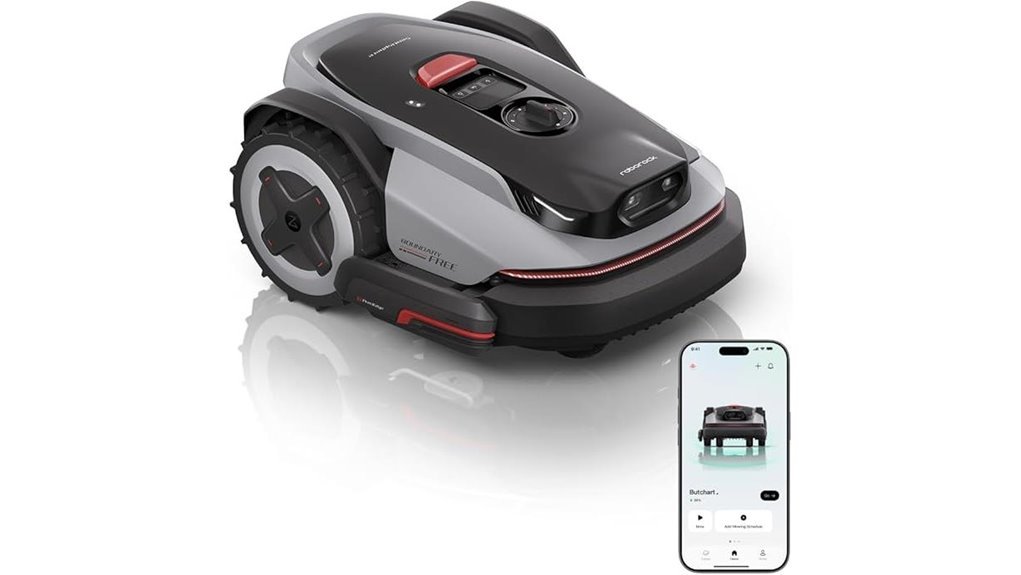
The Roborock RockNeo Q110H is a strong pick for homeowners who want a wire-free mower for medium-sized yards up to 1/4 acre, especially on challenging terrain. Its Full-Band RTK and VSLAM navigation support AI auto-mapping for open lawns or manual boundary tracing in the app. Dual-camera AI vision helps it avoid people, pets, furniture, and toys. It can handle slopes up to 45% and obstacles up to 1.57 inches. The mower also offers multi-zone scheduling, progress tracking, wildlife-friendly mode, PIN protection, alarm security, and optional 4G tracking.
Best For: Homeowners with medium-sized, challenging lawns up to 1/4 acre who want a wire-free robot mower with advanced mapping, obstacle avoidance, and app-based control.
Pros:
- Wire-free setup with Full-Band RTK + VSLAM navigation for flexible mapping
- Dual-camera AI vision helps avoid people, pets, furniture, and toys
- Handles steep slopes up to 45% and narrow passages as tight as 2.3 feet
Cons:
- Best suited for smaller yards, maxing out at about 1/4 acre
- Optional 4G tracking may require extra cost for enhanced theft protection
- Cutting width is relatively narrow at 8.7 inches, which may make mowing slower
ECOVACS Goat A2000 LiDAR PRO Robot Lawn Mower, Dual LiDAR Navigation
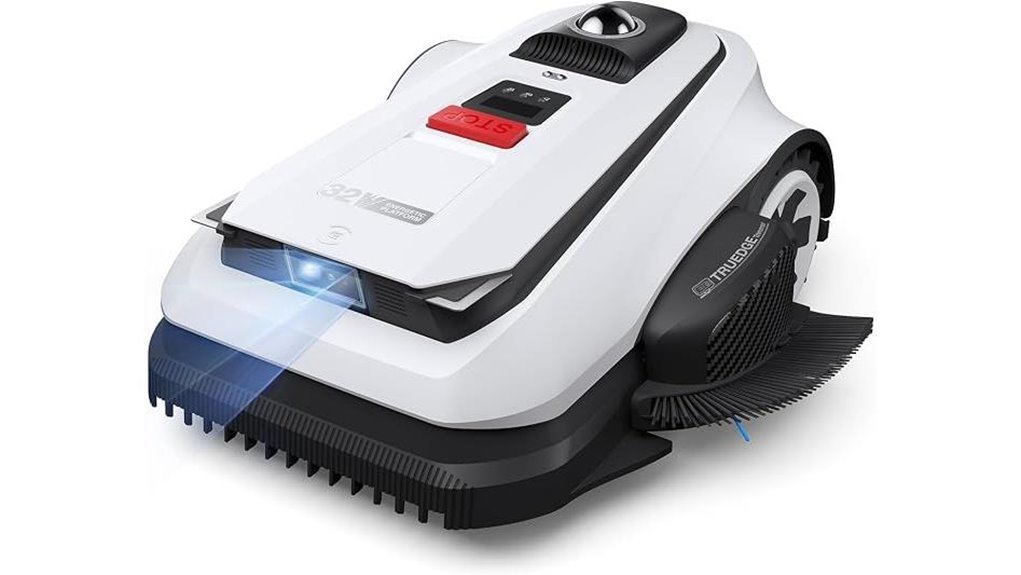
ECOVACS’s Goat A2000 LiDAR PRO suits homeowners with complex yards needing wire-free precision. Dual LiDAR navigation and the HoloScope 360° system create automatic yard maps with 2 cm positioning accuracy, helping it handle intricate layouts without boundary wire installation. Its TruEdge trimmer supports edge-to-edge mowing along driveways, sidewalks, and flower beds, while the dual-blade disc and 32V motor are built for dense grasses such as Bermuda, Zoysia, Fescue, and St. Augustine. A 3.0Ah battery and 50-minute fast charging support medium to large yards up to 1/2 acre. The ECOVACS app manages zones, exclusions, height, speed, and schedules.
Best For: Homeowners with complex, medium-to-large yards who want a wire-free robot mower with precise navigation, strong edge trimming, and app-based customization.
Pros:
- Dual LiDAR and HoloScope 360° mapping provide accurate wire-free navigation with 2 cm positioning precision.
- TruEdge trimming and dual-blade cutting help deliver cleaner results along edges and in dense grass.
- Fast charging and app controls make it convenient to manage mowing schedules, zones, and exclusions.
Cons:
- The 3.6-inch cutting width may make mowing slower than wider-deck robot mowers.
- Best suited for up to 1/2 acre, so it may not be ideal for larger properties.
- Plastic construction may feel less premium than metal-bodied alternatives.
ECOVACS Goat O1000 RTK Care Robot Lawn Mower, RTK Navigation, 1/4 Acre
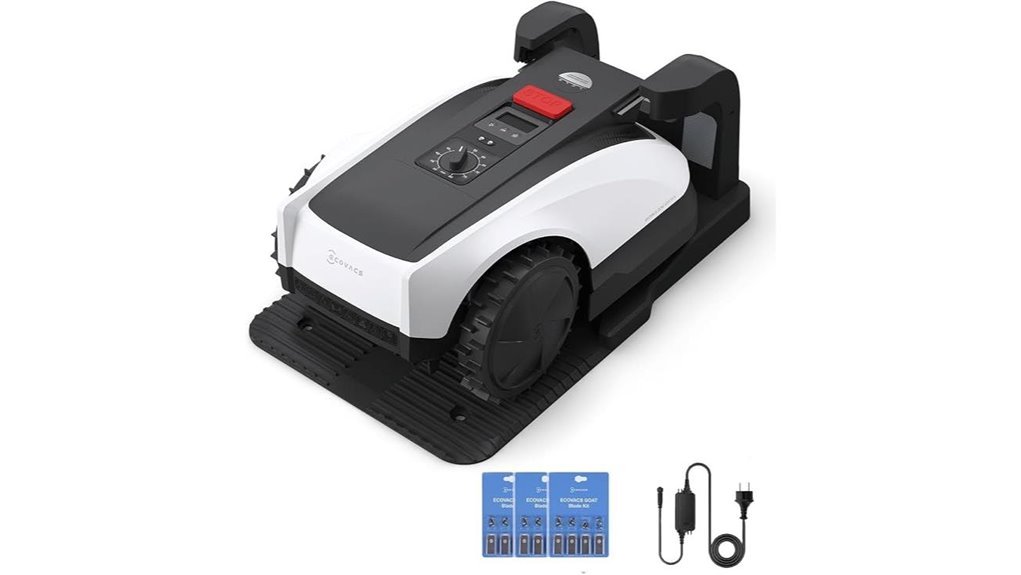
With RTK precision navigation and wire-free mapping, it suits homeowners seeking hands-off, accurate mowing for small yards. The ECOVACS Goat O1000 RTK Care Robot Lawn Mower covers up to 1/4 acre and uses centimeter-level positioning to follow systematic mowing paths without perimeter wires. Its auto-mapping and app-based controls support multi-zone scheduling and tailored cutting areas. The CARE upgrade adds 36 replacement blades for longer maintenance intervals. A 90-minute battery cycle, 8.66-inch cutting width, adjustable 1.2-to-3.2-inch height, and 62dB operation keep it practical, quiet, and efficient.
Best For: Homeowners with small yards up to 1/4 acre who want a wire-free, hands-off robotic mower with precise RTK navigation and app-based scheduling.
Pros:
- Centimeter-level RTK navigation enables accurate, systematic mowing without perimeter wires.
- Auto-mapping and multi-zone control make it easy to customize mowing areas and schedules.
- CARE version includes 36 extra replacement blades for longer maintenance intervals.
Cons:
- 90-minute battery life may require multiple charging cycles for larger or more complex lawns.
- 8.66-inch cutting width can make mowing less efficient than wider models.
- Best suited for smaller properties, so it may not meet the needs of larger yards.
(Upgraded) DREAME A3 AWD 1000 LiDAR Robot Lawn Mower, 45-Min Fast Charge
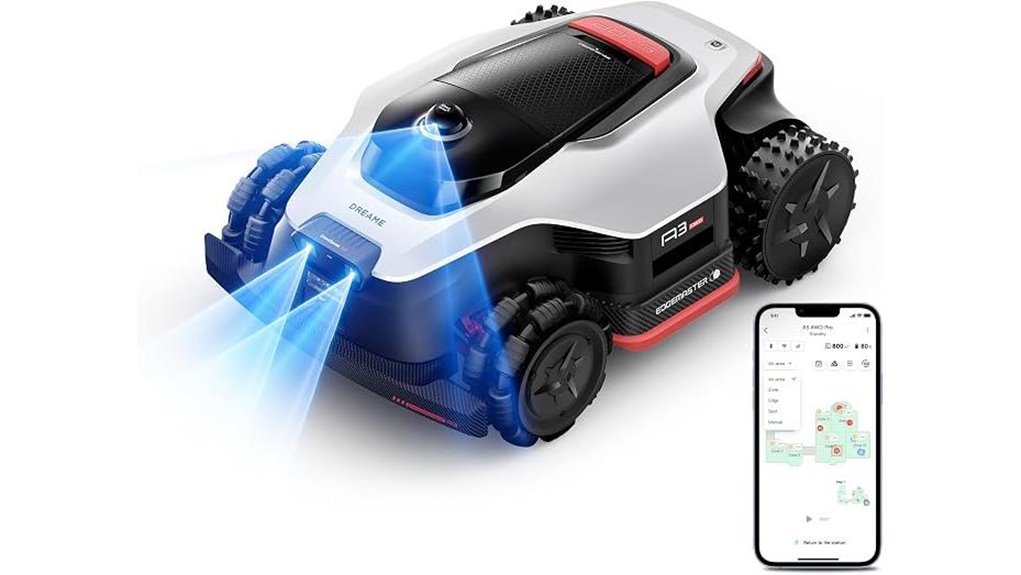
Designed for challenging yards, the DREAME A3 AWD 1000 excels on steep slopes, obstacles, and complex layouts. Its all-wheel drive tackles 80% gradients, 2.17-inch barriers, and lawns with L- or U-shaped sections across 0.25 to 0.50 acres. 360° LiDAR and AI dual vision support precise mapping, while OmniSense 3.0 and EdgeMaster 2.0 trim edges within 1.97 inches. It can avoid over 300 obstacles, recharge in 45 minutes, and finish mowing in a day. Night operation, app control, theft protection, and a 3-year warranty enhance convenience.
Best For: Homeowners with challenging, medium-sized lawns who want a smart, low-maintenance robot mower that can handle slopes, obstacles, and complex layouts with minimal supervision.
Pros:
- Handles steep slopes, 2.17-inch obstacles, and complex lawn shapes with AWD and precise LiDAR navigation.
- Fast 45-minute charging and efficient mowing help complete yard work in a single day.
- App control, night mowing, theft protection, and a 3-year warranty add strong convenience and peace of mind.
Cons:
- Best suited for lawns in the 0.25 to 0.50 acre range, so larger properties may need a different model.
- Advanced features may require time to set up and learn through the app.
- Higher-end technology and AWD capabilities may come at a premium price.
ECOVACS Goat O1000 LiDAR Robot Lawn Mower
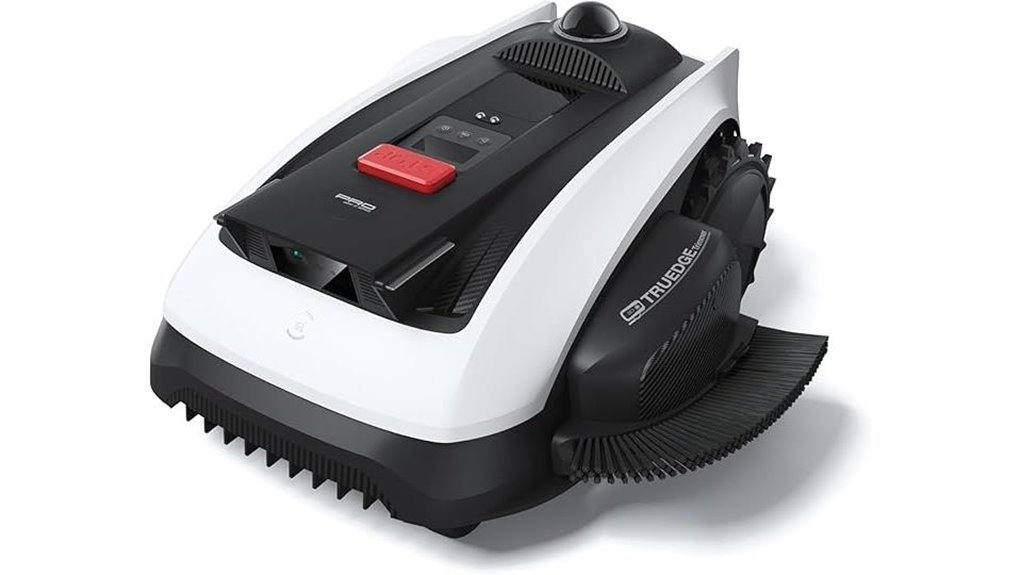
The ECOVACS Goat O1000 LiDAR suits homeowners with small, complex lawns. This wire-free mower handles yards up to 1/4 acre without perimeter cables or an RTK antenna. Its HoloScope 360° Dual-LiDAR mapping system delivers 2 cm positioning, even in shade, while AI Vision and 3D ToF LiDAR detect obstacles. It recognizes more than 200 objects with 5 cm precision and keeps safe clearance. A built-in TruEdge trimmer improves edge cutting, and the app allows zoning, scheduling, and no-go areas. Its 0.8 m slim body reaches narrow gaps.
Best For: Homeowners with small to medium complex lawns who want a wire-free robot mower with precise mapping, strong obstacle detection, and clean edge trimming.
Pros:
- Wire-free setup with no perimeter wire or RTK antenna required
- 2 cm LiDAR-based positioning works well even in shaded areas
- TruEdge trimming and a slim 0.8 m body help it handle edges and tight spaces
Cons:
- Best suited for lawns up to 1/4 acre, so it may be too small for larger yards
- Advanced features may come at a higher price than simpler robot mowers
- Still may need occasional monitoring in very cluttered or unusually shaped yards
DREAME LiDAR Robot Lawn Mower A3 AWD
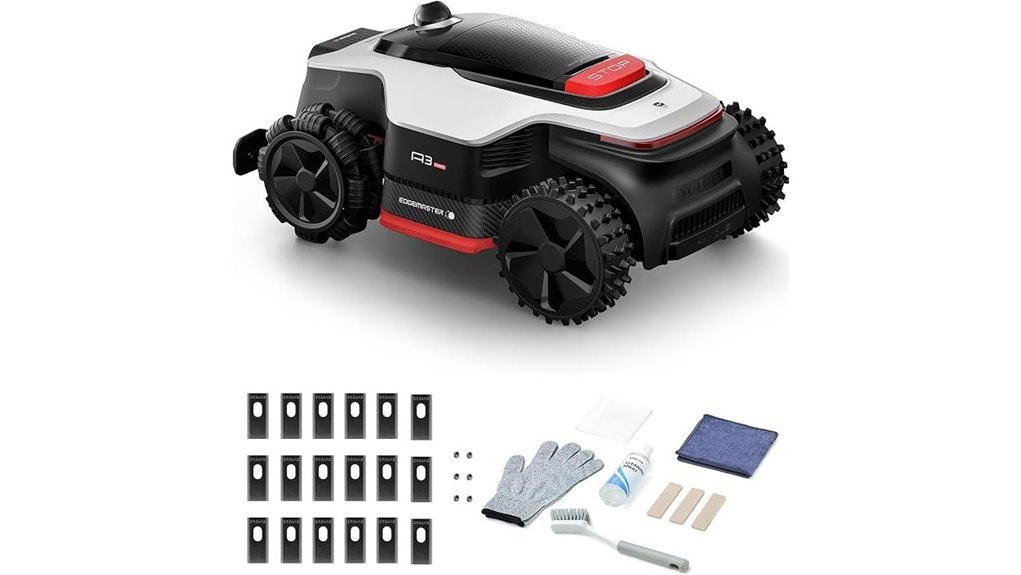
For sloped, obstacle-filled yards, the DREAME LiDAR Robot Lawn Mower A3 AWD stands out. This wire-free, all-terrain mower uses 360° LiDAR and AI Dual Vision to map lawns in minutes without a boundary wire or RTK station. Its AWD system handles slopes up to 80% while avoiding more than 300 obstacles, including pets and hoses. EdgeMaster 2.0 trims close, and the optional trimmer module narrows the gap further. It serves lawns up to 0.5 acres, recharges in 45 minutes, and supports quiet night mowing, app control, and theft protection.
Best For: Homeowners with sloped, obstacle-filled lawns who want a wire-free, low-maintenance robotic mower with advanced mapping, strong traction, and app-based control.
Pros:
- Handles tough terrain with AWD and up to 80% slope capability.
- Uses 360° LiDAR and AI Dual Vision to map quickly without a boundary wire or RTK station.
- Mows quietly, supports night operation, and offers app control with theft protection.
Cons:
- Higher-end feature set may come with a premium price.
- Best suited for medium-sized lawns, not very large properties beyond 0.5 acres.
- Optional trimmer module may be needed for the closest edge cutting.
MOVA LiDAX Ultra 1000 Wire-Free Robot Lawn Mower
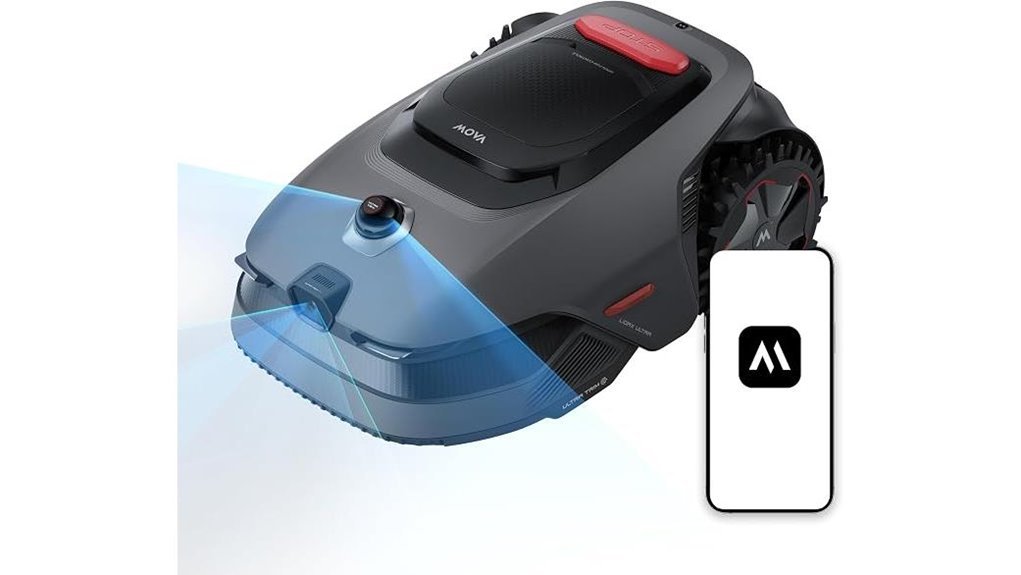
With wire-free RTK-free setup and AI-assisted auto-mapping, the MOVA LiDAX Ultra 1000 suits homeowners seeking simple installation. Its 360° 3D LiDAR system maps lawns automatically and supports up to 1/4 acre, while zero-edge cutting and UltraTrim 1.0 trim within 2 inches of walls, hedges, and raised borders. The mower adjusts from 1.2 to 3.9 inches, follows smart U-shaped routes, and resumes after charging. It handles slopes to 45%, recognizes over 300 obstacles, and uses rear-wheel drive with off-road wheels for traction. Dual maps, 150 zones, anti-theft tracking, and a 3-year warranty add practical value.
Best For: Homeowners with small to mid-sized lawns up to 1/4 acre who want a wire-free, easy-to-set-up robot mower with strong obstacle handling, precise edge trimming, and smart multi-zone management.
Pros:
- Wire-free, RTK-free setup with AI-assisted auto-mapping makes installation simple.
- Strong cutting and navigation features, including UltraTrim 1.0, 360° 3D LiDAR, and smart U-shaped mowing.
- Handles tough conditions well with 45% slope capability, obstacle detection, dual maps, and 150 zones.
Cons:
- Best suited only for lawns up to 1/4 acre, so it may be too limited for larger properties.
- Premium features like LiDAR, AI mapping, and anti-theft tracking may come at a higher price point.
- Performance can depend on lawn complexity, and very irregular layouts may still require setup tuning.
Segway Navimow i210 AWD Robot Lawn Mower Wire Free, 0.25 Acre, 45% Slopes
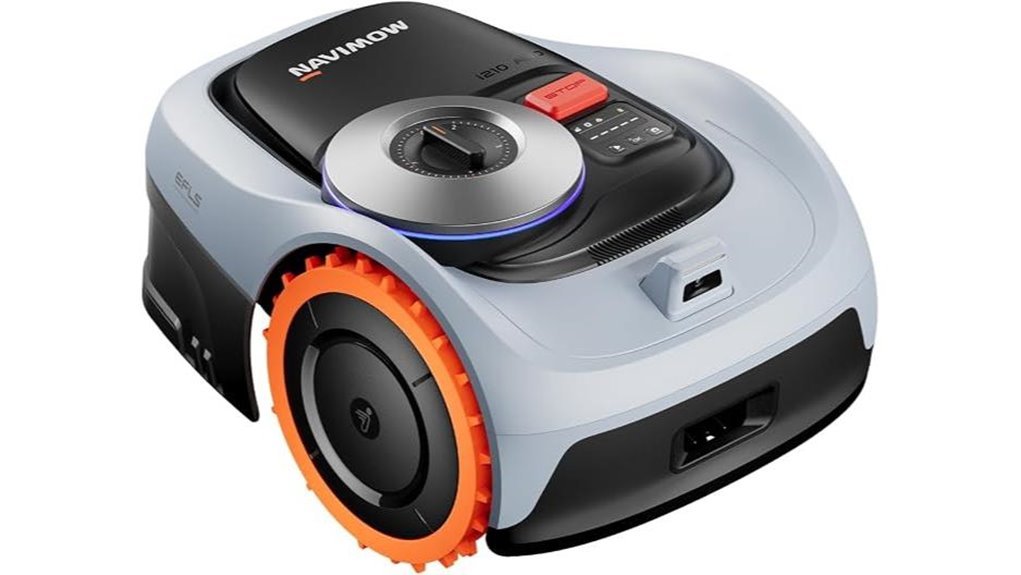
Built for hilly, wire-free lawns, the Segway Navimow i210 AWD suits homeowners managing up to 0.25 acres. Its all-wheel drive and electronic stability control help it hold traction on slopes up to 45 percent, while zero-turn steering and a concentric third wheel reduce turf scuffing. Setup is hands-free, using EFLS Network RTK auto mapping with centimeter-level precision. Smart Multi-Zone Control manages up to 20 areas, and app alerts report lifting or boundary exits. A 5.1Ah battery supports up to 2,690 square feet per charge, with seamless auto-charge resumes.
Best For: Homeowners with small to medium lawns up to 0.25 acres who want a wire-free robot mower that can handle steep, uneven terrain with minimal setup.
Pros:
- Handles slopes up to 45% with all-wheel drive and electronic stability control for better traction.
- Wire-free setup with EFLS Network RTK auto mapping makes installation quick and easy.
- Smart Multi-Zone Control and app alerts add convenient lawn management and security.
Cons:
- Best suited for lawns up to 0.25 acres, so it may not fit larger properties.
- The 7.1-inch cutting width is relatively narrow, which can mean longer mow times.
- Premium features like RTK mapping and AWD likely come with a higher price point.
Factors to Consider When Choosing Robotic Lawn Mowers in 2026

When evaluating robotic lawn mowers in 2026, attention typically turns to lawn size coverage, navigation technology, slope and terrain handling, obstacle avoidance, and cutting width. These factors shape how well a mower fits a yard’s layout and maintenance demands. A careful comparison of each feature helps narrow the field to models that perform reliably in real-world conditions.
Lawn Size Coverage
Lawn coverage is a key starting point for comparing robotic lawn mowers, since models typically handle anywhere from about 1/4 to 1/2 acre. Matching the mower’s coverage rating to the property prevents frequent recharging interruptions and incomplete cutting cycles. For larger yards, multi-zone management can help the machine handle separate areas efficiently without wasting passes or repeating sections. Smaller lawns often suit compact models that fit narrow gaps, turn more easily, and store with less effort. Terrain also matters, because some mowers are better able to manage slopes, uneven ground, and minor obstacles. Choosing a unit that fits both area and layout improves mowing consistency, reduces stress on the system, and supports more reliable day-to-day operation across the lawn.
Navigation Technology
Navigation technology is becoming one of the most important differences among robotic lawn mowers in 2026. RTK and LiDAR systems deliver centimeter-level positioning, helping mowers map yards accurately without boundary wires. AI-assisted mapping can identify mowing zones automatically, making setup faster and lawn care more precise. Dual-camera AI vision improves obstacle detection by recognizing both fixed and moving objects, which supports safer operation around garden features and pets. Some models combine full-band RTK with VSLAM, giving them smoother movement through narrow passages and better adaptability to varied yard layouts. Advanced navigation also supports effective operation on challenging properties, including slopes up to 45% and obstacles as high as 1.57 inches, making navigation quality a key purchase factor.
Slope And Terrain
Terrain matters just as much as mapping accuracy because a mower still has to move cleanly across the property it has mapped. Slope is consequently a central specification. Many robotic lawn mowers can handle inclines near 45%, which makes them practical for hills and graded yards. On steeper or less even ground, all-wheel drive can improve traction and reduce slippage, helping the machine stay stable and maintain cutting quality. Precision systems such as RTK and LiDAR also contribute by letting the mower adapt its route to complex contours more reliably. Buyers should compare the lawn’s slope percentage, narrow passages, and rough patches against the mower’s rated capabilities. Matching the machine to the land is essential for consistent coverage and fewer interruptions.
Obstacle Avoidance
Obstacles are where a robotic mower’s intelligence is put to the test. Advanced models use dual-camera AI vision to recognize furniture, decorations, and other fixed objects, then steer around them with minimal interruption. Some systems detect obstacles with precision as fine as 5 cm, helping protect people, pets, and other moving hazards in the yard. The strongest units can interpret more than 300 obstacle types, which supports reliable operation in varied outdoor settings. AI-assisted navigation also enables real-time path corrections, improving performance in cluttered or uneven areas. Many mowers can even roll over low barriers such as branches or hoses without stopping, reducing downtime and preserving efficiency. For buyers, obstacle avoidance should be judged by accuracy, adaptability, and the range of objects handled.
Cutting Width
After obstacle handling, cutting width becomes another key measure of how well a robotic mower fits a yard. Most robotic mowers offer widths from 3.6 inches to 8.7 inches, and that range strongly affects mowing efficiency. A wider deck covers more grass in each pass, which suits expansive lawns and shortens maintenance time. A narrower deck is often better in tight layouts, such as passages between garden beds or areas crowded by fixtures, because it can make cleaner turns and more complete trims. Cutting width should also be matched with adjustable cutting heights, often between 1.2 and 3.9 inches, to suit different grass types. Choosing the right width for the lawn’s size and shape supports smoother performance and more effective care overall.
Battery And Charging
Battery life and charging speed are central to how effectively a robotic lawn mower can maintain a yard, with typical run times of about 90 to 130 minutes per charge shaping how much ground it can cover in one session. Charging performance matters nearly as much, since some units return to service in about 50 minutes, while others need longer to refill their batteries. Models with fast-charging technology can recharge up to 22% faster than standard versions, reducing downtime between mowing cycles. Battery power also affects cutting ability, especially on slopes, dense grass, or uneven terrain where higher-voltage systems tend to perform better. Some mowers include battery management systems that regulate charging cycles, helping extend battery life and maintain consistent output over time.
App Control Features
App control features can greatly improve how a robotic lawn mower fits into a homeowner’s routine, especially when the app allows scheduling, cutting-height adjustments, and no-go zone setup from a phone. These tools let users tailor mowing to grass growth, weather, and landscape needs without manual intervention. Real-time progress tracking through app notifications adds convenience by showing where the mower is working and when a task is finished. Models with multi-zone support are especially useful for properties with separate lawn areas, while wildlife-friendly modes can reduce disruption in yards with pets or animals. A clear interface also matters, since mowing patterns and efficiency settings should be easy to adjust. Overall, strong app control makes automated lawn care more precise, flexible, and manageable.
Security And Theft Protection
Security and theft protection are increasingly important when comparing robotic lawn mowers, especially for owners who leave equipment outdoors for long periods. Many current models include PIN code locks and audible alarms to discourage unauthorized use. Others add real-time tracking modules that can send alerts if the mower is moved outside a set boundary or lifted from the ground. App-based monitoring extends this oversight, allowing status checks and theft notifications from a phone. These features help users respond quickly if a mower is tampered with or stolen. Advanced obstacle detection also contributes indirectly to security by identifying human presence and reducing accidental contact. Together, automated alerts, tracking, and access controls improve protection and offer greater confidence to owners concerned about damage, loss, or misuse.
Frequently Asked Questions
How Often Should Robotic Mower Blades Be Replaced?
Blades should typically be replaced every one to three months, depending on lawn size, debris, and mowing frequency. Dull blades can worsen cut quality and strain the mower, so inspection should remain regular.
Can Robotic Mowers Handle Complex Multi-Zone Lawns?
Yes—some handle complex multi-zone lawns, while others stumble at narrow passages and steep shifts. Their software maps separate areas, yet success depends on boundary setup, signal strength, and terrain complexity across zones.
What Weather Conditions Stop Robotic Mowers From Mowing?
Robotic mowers stop in heavy rain, lightning, freezing temperatures, snow, or overly wet grass, because traction, safety, and cutting quality suffer. Most also pause during extreme heat or when sensors detect poor visibility or obstacles.
How Secure Are Robotic Mowers Against Theft or Hacking?
Robotic mowers are moderately secure against theft, with PIN locks, GPS tracking, alarms, and geofencing helping recovery. Hacking risks remain low but real; strong passwords, firmware updates, and encrypted apps reduce exposure considerably.
Do Robotic Mowers Increase Electricity Costs Significantly?
Typically, a robotic mower uses about as much power as a few lightbulbs, so electricity costs usually rise only slightly. For most owners, monthly usage remains modest, often far less than traditional mower fuel expenses.
Conclusion
As the list of 2027’s best robotic lawn mowers shows, the right choice depends on yard size, terrain, and navigation style. From LiDAR to RTK and wire-free systems, each model offers a different path to easier mowing. Homeowners can now choose with clearer confidence and less guesswork. In a very modern twist, these machines feel almost like clockwork in sneakers, bringing precision, convenience, and a neatly trimmed finish to everyday lawn care.
