
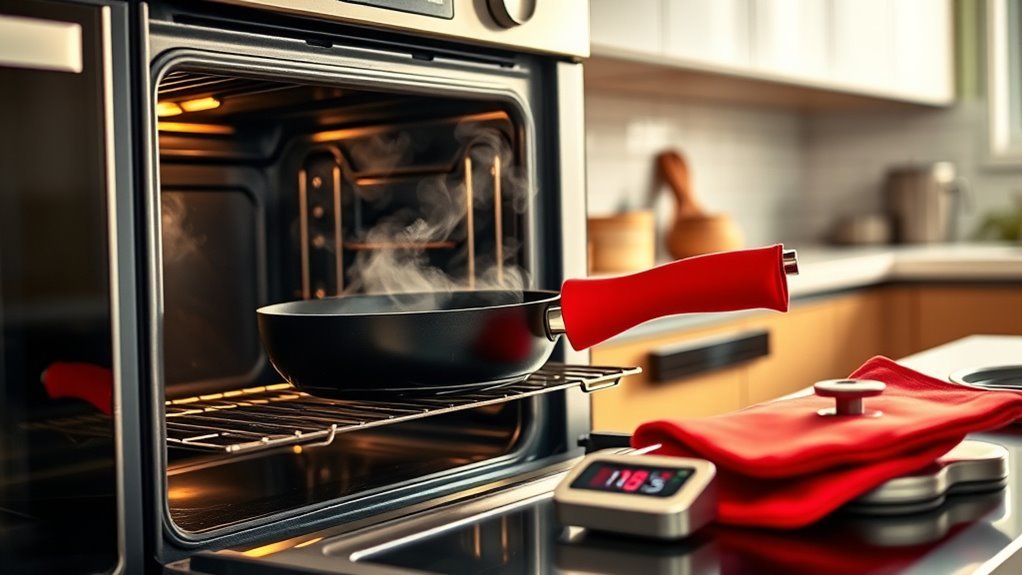
Can Teflon pans go in the oven? Some can, but not every Teflon-coated pan is designed for oven use. The coating, handle, lid, and temperature rating all affect safety. Knowing these limits helps you avoid damaged cookware, overheating, and unnecessary risks while baking or roasting.
Quick Answer
Yes, but only if the manufacturer confirms that your Teflon pan is oven-safe. PTFE nonstick coatings generally have a maximum recommended temperature of 500°F (260°C), while some complete pans are limited to 350°F or 400°F. Always follow the lowest temperature rating for the pan, handle, and lid. Avoid broiling.
Key Takeaways
- A metal pan body does not guarantee oven safety. Plastic handles, silicone grips, and glass lids may have lower heat limits.
- Never use PTFE-coated cookware during an oven’s self-cleaning cycle or under intense broiler heat.
- Minor scratches are not proven to make PTFE cookware toxic, but peeling or badly damaged coatings reduce performance.
- PTFE is different from PFOA. A PFOA-free label does not necessarily mean the pan contains no PTFE.
- For high-temperature roasting or broiling, suitable cast iron or stainless steel cookware is generally a better choice.
What You Should Know About Teflon Coating
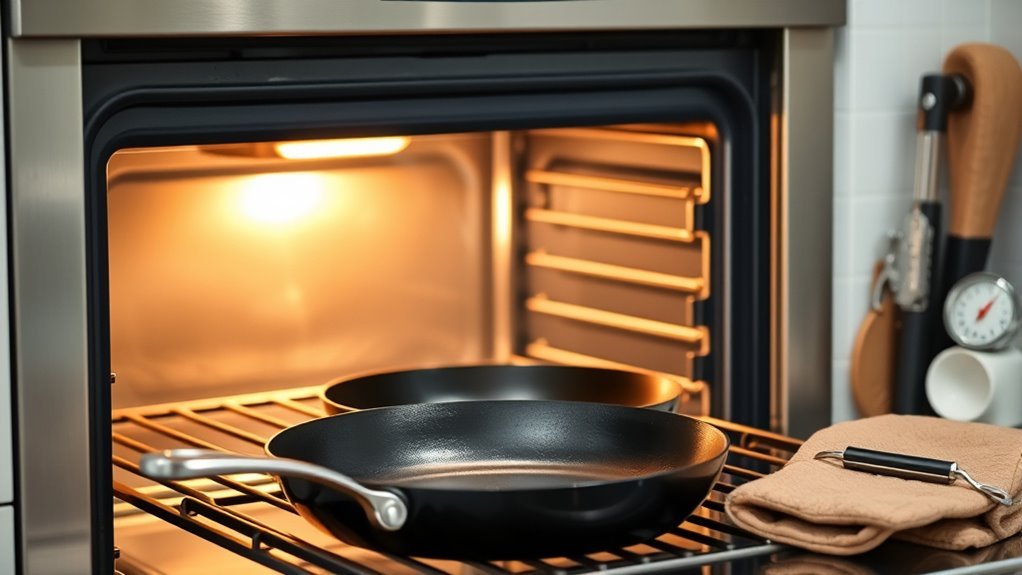
Teflon is a well-known brand of nonstick coating made with polytetrafluoroethylene (PTFE). This material creates a smooth, low-friction cooking surface that helps food release easily.
PTFE is useful for cooking eggs, fish, pancakes, and other foods that tend to stick. However, it has temperature limits that you need to respect.
The general recommended maximum for PTFE cookware is 500°F (260°C). That does not mean every Teflon pan can safely go into a 500°F oven.
Other parts of the cookware may have lower heat ratings. Repeated overheating can also reduce the coating’s nonstick performance.
Is Teflon the Same as PFOA?
No. Teflon refers to a coating brand, while PTFE is the polymer commonly used to create its nonstick surface. PFOA is a separate chemical that was historically used during some nonstick coating manufacturing processes.
PFOA has been phased out of nonstick cookware production because of health and environmental concerns.
However, a PFOA-free label does not mean the coating is PTFE-free or free from every type of PFAS.
The U.S. Food and Drug Administration’s guidance on PFAS and nonstick cookware explains that approved polymerized coatings have negligible PFAS migration into food under their intended conditions of use.
The main concern during everyday cooking is avoiding excessive heat and following the cookware manufacturer’s instructions.
What Oven Temperatures Are Safe for Teflon Pans?
Most oven-safe Teflon pans have manufacturer-defined limits between 350°F and 500°F (177°C to 260°C). The exact limit depends on the cookware’s construction and components.
According to Health Canada’s cookware safety guidance, nonstick cookware should not be exposed to temperatures above 500°F (260°C), whether on the stovetop or in the oven.
However, that general recommendation is not permission to use a particular pan at that temperature.
Understanding Common Oven-Safe Temperature Ratings
Manufacturers publish different limits for their cookware collections. For example, official cookware use-and-care specifications identify nonstick products rated for 400°F, 450°F, and 500°F, depending on the collection.
The following table shows how to interpret these ratings.
| Oven Temperature | When It Is Acceptable | Important Precaution |
|---|---|---|
| 350°F (177°C) | When the complete pan is rated for at least 350°F. | Check the handle and lid separately. |
| 400°F (204°C) | When the manufacturer lists a rating of 400°F or higher. | Some models are limited to lower temperatures. |
| 450°F (232°C) | Only when the complete cookware setup is rated for at least 450°F. | A glass lid may have a lower rating. |
| 500°F (260°C) | Only for cookware specifically approved for this temperature. | This is the general upper recommended limit for PTFE cookware. |
| Above 500°F (260°C) | Not recommended for ordinary PTFE-coated cookware. | Choose cookware designed for higher temperatures. |
These temperatures describe oven settings, not a guarantee that every component will remain safe under all conditions.
For example, a pan may tolerate 500°F without its lid, while the matching glass lid is rated for only 350°F.
Warning: Never use PTFE-coated pans under a broiler or leave them inside an oven during a self-cleaning cycle. Intense heat can damage the coating and create hazardous fumes. Do not assume that staying below 600°F makes overheating safe.
How to Tell If Your Teflon Pan Isn’t Oven-Safe
You can determine whether a Teflon pan is oven-safe by checking its manufacturer instructions, handle materials, and maximum temperature rating.
Do not rely on the appearance of the pan alone. A metal body with a nonstick coating may still have parts that cannot withstand oven heat.
Check These Five Things Before Using Your Pan
- Look for an oven-safe marking. Inspect the pan’s base, packaging, and original instructions. Some models display an oven symbol or maximum temperature.
- Identify the exact cookware model. Find the product name or model number and match it to the manufacturer’s published oven-use instructions.
- Examine the handle. Plastic, rubber, wooden, and some silicone-covered handles may have lower temperature limits or may not be oven-safe.
- Check the lid and knob. Tempered glass lids and their fittings may have different ratings from the pan itself.
- Inspect the coating and pan body. Look for severe peeling, warping, loose handles, or other damage before exposing the cookware to heat.
Are Teflon Pan Handles and Glass Lids Oven-Safe?
Some are, but their limits depend on the materials and design.
All-metal handles are often suitable for higher oven temperatures. However, silicone sleeves, plastic inserts, and decorative fittings can reduce the maximum safe temperature.
The same applies to lids.
For example, published nonstick cookware specifications show a pan rated for 500°F (260°C) with a glass lid rated for only 350°F (177°C).
When the lid’s rating is lower than the pan’s, you must follow the lid’s limit or remove it if the recipe allows.
Pro Tip: Save a photo of the cookware’s model number and oven-temperature instructions on your phone. This makes it easier to confirm the limit later, especially if you discard the packaging.
If you cannot identify the model or confirm an oven-safe rating, use a different pan rather than guessing.
Best Practices for Oven Use With Teflon Pans
Using an approved Teflon pan in the oven can be convenient for recipes that begin on the stovetop and finish with baking.
However, safe oven cooking requires more than selecting the correct temperature.
How to Use an Oven-Safe Teflon Pan
- Confirm the temperature limit. Make sure the recipe’s oven temperature does not exceed the lowest rating of the pan and its components.
- Prepare the food. Add the ingredients before placing the pan in the oven. Avoid heating empty nonstick cookware unnecessarily.
- Use the middle rack. Keep the cookware away from direct contact with heating elements and allow enough space for air circulation.
- Use the regular bake setting. Avoid broiling, direct flames, and other intense heating methods that may exceed the coating’s recommended limits.
- Handle the pan carefully. Use dry oven mitts or suitable heat-resistant holders. Metal handles can become extremely hot inside the oven.
- Allow gradual cooling. Set the pan on a suitable heat-resistant surface and let it cool before washing.
These steps help protect the nonstick coating while reducing the risk of burns and thermal damage.
What Happens if a Teflon Pan Overheats?
Excessive heat can damage PTFE coatings and may release fumes that are harmful when inhaled.
The risk increases when cookware becomes extremely hot, particularly when heated empty.
If you suspect a pan has overheated, turn off the heat when safe, leave the hot cookware undisturbed, and ventilate the area. Avoid breathing fumes.
If anyone develops breathing difficulty or other significant symptoms after suspected exposure, seek medical advice promptly.
Special Precautions if You Have Pet Birds
Birds are particularly sensitive to fumes produced by overheated PTFE cookware.
According to veterinary guidance on PTFE poisoning in birds, exposure can cause serious respiratory problems and may be fatal.
For households with pet birds, avoiding PTFE-coated products is the safest approach. Keeping birds out of the kitchen alone does not eliminate the risk.
Note: If you suspect a pet bird has inhaled fumes from overheated PTFE, move the bird to fresh air and seek emergency veterinary care immediately. An avian veterinarian can assess the exposure and recommend appropriate treatment.
Alternatives to Teflon for Oven Cooking
If you frequently cook at high temperatures, ceramic, cast iron, and stainless steel cookware may offer better options.
Each material has different advantages, so the right choice depends on your recipes and preferred cooking methods.
Ceramic Cookware Benefits
Ceramic cookware can be a practical alternative to PTFE-coated pans, particularly if you prefer a different type of nonstick surface.
Many modern ceramic-coated nonstick pans use a coating designed without PTFE. However, ceramic-coated metal cookware is different from traditional solid ceramic bakeware.
Potential benefits include:
- Easy food release: A suitable ceramic nonstick coating can help prevent delicate foods from sticking.
- PTFE-free options: Many ceramic-coated products are specifically labeled as PTFE-free and PFOA-free.
- Convenient cleaning: Smooth cooking surfaces usually require less effort to clean when maintained properly.
- Oven versatility: Some models are approved for baking and roasting at temperatures suitable for everyday meals.
However, not every ceramic pan can withstand 500°F (260°C). Some have lower ratings, especially when fitted with heat-sensitive handles or lids.
Ceramic nonstick coatings can also lose their easy-release properties with wear or repeated overheating.
Choose a model designed for your cooking temperature and follow its care instructions. Dishwasher compatibility varies by product, and gentle hand washing can help preserve the surface.
Cast Iron Versatility
Cast iron is an excellent option for oven cooking because it retains heat well and works with many high-temperature recipes.
You can use suitable cast iron cookware for roasting, baking, stovetop searing, and certain broiling tasks.
Unlike PTFE-coated cookware, traditional bare cast iron develops a seasoned cooking surface through layers of heated cooking oil.
This seasoning helps reduce sticking and protects the metal against rust.
Cast iron offers several advantages:
- Excellent heat retention for steady cooking temperatures.
- Suitable construction for many high-temperature oven recipes.
- Versatility across stovetop and oven cooking.
- A durable surface that can be maintained and reseasoned.
According to the official cast iron product guide, seasoned cast iron cookware is suitable for high-heat environments. However, seasoning can begin breaking down during sustained heating around 650°F (343°C).
Some cast iron pieces also have attached knobs or handles with their own restrictions.
After cooking, clean the pan, dry it thoroughly, and maintain its seasoning as needed.
With proper care, cast iron cookware can provide years of dependable service.
Stainless Steel Options
Stainless steel cookware is another reliable alternative for baking, roasting, and high-temperature cooking.
It has no PTFE nonstick coating to protect, making suitable stainless steel pans particularly useful for browning and oven finishing.
Its main advantages include:
- Durability: Quality stainless steel cookware resists routine wear when handled properly.
- Browning performance: The cooking surface is suitable for searing foods and developing flavorful browned bits.
- Heat distribution: Models with aluminum or copper cores distribute heat more evenly than plain stainless steel alone.
- Versatility: Many collections work on both the stovetop and in the oven.
Some fully bonded stainless steel cookware is rated for oven temperatures up to 600°F (316°C).
For example, manufacturer guidance for stainless steel cookware lists several collections that are oven- and broiler-safe up to 600°F, while certain glass lids are limited to 350°F.
Always confirm the specifications for your own cookware.
Stainless steel does not provide the same easy-release surface as Teflon, so proper preheating and a little cooking fat may be necessary.
Debunking Teflon Myths for Oven Use
Several common claims about Teflon cookware confuse coating temperature limits with actual health risks.
Understanding these differences can help you make safer decisions without unnecessary alarm.
Myth 1: Every Teflon Pan Is Oven-Safe Up to 500°F
This is false. The general PTFE temperature limit does not override restrictions imposed by handles, lids, or cookware construction.
A pan rated for 350°F should not be placed in a 450°F oven, even if its nonstick coating could tolerate that temperature.
Myth 2: Scratched Teflon Always Releases Toxic Chemicals
Minor scratches do not automatically make a Teflon pan toxic.
The German Federal Institute for Risk Assessment states that accidentally swallowing tiny PTFE particles from scratched cookware is not expected to cause adverse health effects.
PTFE is chemically inert, and these small particles are not digested by the body.
However, deeply scratched or peeling pans may lose their nonstick performance. Replacing badly damaged cookware is a sensible choice.
Scratching and overheating are different issues. The major concern with excessive heating is the potential release of hazardous fumes.
Myth 3: A PFOA-Free Pan Is Automatically Free of All PFAS
This is also incorrect.
PFOA is one specific member of the broad PFAS group. PTFE itself is classified as a fluoropolymer within that group.
A PFOA-free product may still contain PTFE. If you specifically want to avoid PTFE, look for cookware clearly labeled PTFE-free.
Myth 4: Teflon Pans Are Suitable for Broiling
Broiling is generally unsuitable for PTFE-coated cookware because it exposes the pan to intense radiant heat.
Even when your oven’s baking setting is within the cookware’s rating, the broiler can create much hotter conditions near the heating element.
Use suitable cast iron or stainless steel cookware when a recipe calls for broiling.
Maintenance Tips for Your Teflon Cookware
Proper maintenance helps preserve your Teflon cookware’s nonstick performance and reduces unnecessary wear.
The most useful habits involve gentle cleaning, controlled stovetop heating, and careful storage.
Proper Cleaning Methods
Hand washing is a gentle way to maintain PTFE cookware, even when a manufacturer describes a particular model as dishwasher-safe.
Follow these cleaning steps:
- Allow the pan to cool before washing.
- Use warm water and mild dish soap.
- Clean the surface with a soft sponge or non-abrasive cloth.
- For stubborn food residue, soak the pan in warm, soapy water before wiping it clean.
- Rinse thoroughly and dry before storing.
For greasy residue that remains after soaking, a small amount of baking soda mixed with water can provide gentle cleaning. Apply it with a soft cloth rather than scrubbing aggressively.
Avoid steel wool, sharp scrapers, and abrasive cleaning powders.
Silicone, nylon, and wooden cooking utensils are generally kinder to nonstick coatings than sharp metal tools.
Avoiding High Heat
Low to medium stovetop heat is usually sufficient for cooking with Teflon pans.
Using excessive heat can shorten the coating’s useful life, even when the cookware does not reach a temperature associated with dangerous decomposition.
Choose cooking methods that suit the coating:
- Use gentle heat for eggs, pancakes, and delicate fish.
- Use moderate heat for everyday sautéing.
- Avoid leaving an empty pan heating on a burner.
- Choose a suitable uncoated pan for intense searing.
Repeated overheating may cause the surface to lose its nonstick properties sooner.
Proper temperature control is one of the simplest ways to extend cookware life.
Storage Best Practices
Careful storage helps prevent scratches, dents, and unnecessary damage to Teflon cookware.
You do not need a complicated storage system, but it helps to keep the coated surfaces protected.
- Store cookware in a clean, dry cabinet.
- Place soft pan protectors or dishcloths between stacked pans.
- Avoid placing heavy cookware directly on delicate nonstick surfaces.
- Keep sharp utensils away from the coating.
- Make sure pans are dry before stacking them.
Regularly inspect the cooking surface and handle connections for wear.
If a pan becomes warped, badly scratched, or develops extensive peeling, replacement may be more practical than continued use.
Frequently Asked Questions
Is Teflon Safe at 350 Degrees?
Yes, Teflon-coated cookware can be used at 350°F (177°C) if the complete pan is rated for that temperature. The coating itself generally tolerates this heat during normal use. However, you must also confirm that the handle and any lid are oven-safe.
Is Teflon Safe if Scratched?
Minor scratches do not automatically make Teflon cookware unsafe. Accidentally swallowed tiny PTFE particles are not expected to harm your health. However, replace cookware with extensive peeling, serious surface damage, or poor nonstick performance.
Can I Put a Nonstick Pan in the Oven at 400 Degrees?
Yes, if your nonstick pan is specifically rated for 400°F (204°C) or higher. Some cookware collections permit this temperature, while others have lower limits. Check the handle, lid, and manufacturer instructions before placing the pan in the oven.
How Can I Remove Baked-On Grease From My Teflon Pans?
Soak the cooled pan in warm, soapy water for about 30 minutes, then wipe it with a soft sponge. For stubborn grease, try a small amount of baking soda mixed with water. Avoid steel wool, metal scrapers, and harsh abrasive cleaners.
Can Teflon Pans Go Under the Broiler?
No, PTFE-coated pans generally should not be placed under a broiler. The intense radiant heat can exceed the coating’s recommended temperature and damage the cookware. Use an appropriately rated cast iron or stainless steel pan for broiling instead.
What Should I Do if I Accidentally Overheat a Teflon Pan?
Turn off the heat when safe and ventilate the area. Avoid inhaling fumes and let the pan cool without handling it unnecessarily. Seek medical advice if you develop significant symptoms after exposure. If a pet bird may have inhaled fumes, obtain emergency veterinary care.
Conclusion
Teflon pans can be convenient for oven cooking, but only when the complete cookware setup is approved for the temperature you plan to use.
Keep the oven within the manufacturer’s stated limit, protect the nonstick coating, and avoid intense broiler heat.
For higher-temperature roasting or searing, choose suitable cast iron or stainless steel cookware instead.
Before your next oven meal, identify your pan’s exact temperature rating and confirm that its handle and lid can safely handle the heat.
Sources
- Health Canada, The Safe Use of Cookware and Bakeware: Recommendations for safe use of nonstick cookware, overheating prevention, and temperature limits.
- U.S. Food and Drug Administration, Questions and Answers on PFAS in Food: Information on polymerized nonstick coatings and migration of PFAS into food.
- German Federal Institute for Risk Assessment, PTFE Nonstick Cookware Safety: Scientific guidance on coating overheating, released particles, and consumer health risks.
- Calphalon, Cookware Use and Care: Manufacturer specifications for oven-safe temperatures and nonstick cookware maintenance.
- All-Clad, Essentials Nonstick Cookware Specifications: Example of different oven-temperature limits for a nonstick pan and its glass lid.
- All-Clad, Customer Service and Cookware Guidance: Stainless steel oven and broiler compatibility and cookware temperature limits.
- Lodge Cast Iron, Product Guide: Cast iron oven compatibility, seasoning limits, and care recommendations.
- VCA Animal Hospitals, Teflon Poisoning in Birds: Veterinary information on overheated PTFE fumes and risks to pet birds.
