
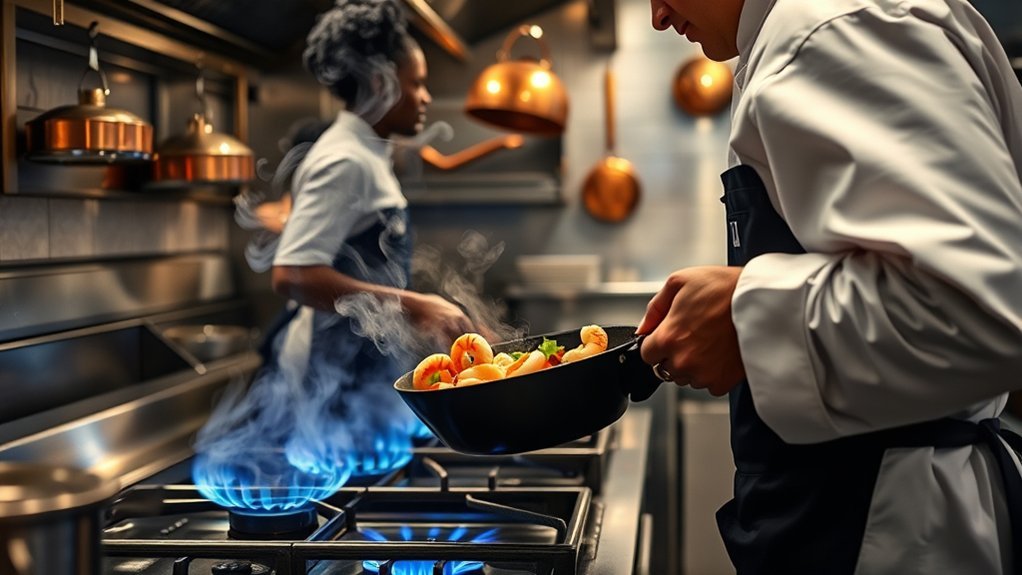
In a commercial kitchen, the sauté cook manages one of the most demanding, fast-paced stations on the hot line. Specializing in rapid, high-heat cooking with minimal fat, this culinary professional transforms raw meats, seafood, and fresh produce into finished, sauced entrees in a matter of minutes. Operating the sauté station demands sharp heat regulation, split-second timing, continuous pan movement, and tight synchronization with the rest of the kitchen brigade to ensure every ticket reaches the pass in peak condition.
Quick Answer
A sauté cook is a specialized line cook responsible for preparing foods à la minute using high heat, minimal oil, and continuous pan tossing. Working a high-volume station, they sear tender proteins, sweat vegetables, build caramelized fond, deglaze pans to build emulsified sauces, and coordinate ticket timing so hot entrees leave the kitchen simultaneously.
Key Takeaways
- High-Heat, Fast Execution: Sauté cooking relies on thermal conduction through hot metal, searing ingredients quickly while preserving internal moisture and crisp textures.
- Fond and Pan Sauces: Flavor is built directly in the pan by browning proteins (the Maillard reaction), deglazing with wine or stock, and finishing with cold butter (monter au beurre).
- Equipment Mastery: Cooks rely primarily on straight-sided sautoirs for shallow liquid reductions and curved sauteuses for rapid tossing and flipping.
- Brigade Coordination: Sauté cooks must continuously call out ticket times, synchronizing pick-up times with the grill, fry, and pantry stations.
- Rigorous Temperature Control: Crowding the pan drops thermal mass and turns searing into steaming, ruining crust formation and sauce clarity.
At a Glance: Sauté Cook Role & Station Profile
| Station Hierarchy | Senior Line Cook (often positioned directly below the Sous Chef or Saucier) |
| Primary Cooking Method | Dry-heat cooking using conduction via shallow pans with minimal fat (350°F–450°F / 175°C–230°C) |
| Primary Tools | Stainless steel/carbon steel sautoirs and sauteuses, high-heat tongs, fish spatulas, instant-read thermometers, tasting spoons |
| Typical Experience Required | 2–4 years of commercial kitchen experience (prep, pantry, and fry stations) |
What Is a Sauté Cook?
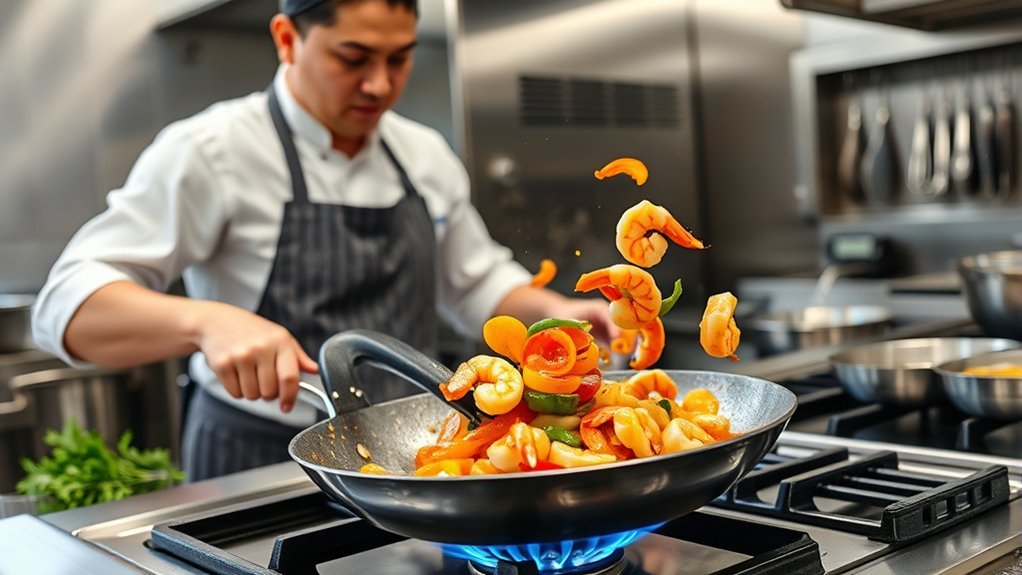
A sauté cook is a line cook who operates the sauté station on a commercial restaurant line, executing individual orders à la minute (cooked to order). The term derives from the French verb sauter, meaning “to jump,” referring to the rapid motion of tossing ingredients within a curved pan to ensure even thermal transfer and prevent scorching.
In traditional culinary frameworks developed by culinary pioneer Auguste Escoffier, the sauté station is considered one of the cornerstone positions of the classical kitchen brigade system. While smaller operations combine sauté duties with those of a general line cook, fine dining and high-volume commercial kitchens treat the sauté station as a distinct, senior-level post due to the technical complexity of making individual pan sauces while monitoring multiple searing proteins simultaneously.
“The sauté station tests a cook’s sensory memory: listening to the sizzle pitch, smelling the fond caramelize before it scorches, and feeling protein resistance through the tips of their tongs.”
What a Sauté Cook Does on the Line
During active dinner service, the sauté cook works at the center of the kitchen’s hot line. With tickets printing continuously, the station operator must sequence multiple pans over high-output gas burners (often rated between 15,000 and 30,000 BTUs per burner) or commercial induction hobs, turning out distinct dishes within tight time windows.
Fast Line Execution and Ticket Management
Service begins with ticket prioritization. When an order fires, the sauté cook determines the exact moment to drop each protein based on cooking time, thickness, and required degree of doneness. Because poultry, tender beef cuts, fish fillets, and shellfish each possess unique cooking curves, a cook might handle six to eight distinct pans simultaneously:
- Seeding pans on high heat with measured cooking oils.
- Starting long-cook items (like thick duck breast or bone-in pork chops) before dropping flash-cook seafood (such as sea scallops or shrimp).
- Coordinating completion times so the entire ticket—including sides from the grill and fryer—finishes at the exact same second.
Precision Pan Searing
Pan searing requires an exact balance of surface heat and fat. The cook places dry, well-seasoned proteins into shimmering oil to initiate the Maillard reaction—the chemical reaction between amino acids and reducing sugars that forms a golden-brown exterior crust and deep savory flavor.
Crucially, the cook resists moving or pressing the meat prematurely. Letting proteins establish uninterrupted pan contact allows surface moisture to vaporize cleanly. Once the crust develops, natural release occurs, leaving behind a layer of caramelized pan drippings known as fond.
Deglazing and Pan Sauce Emulsion
Unlike stations that simply reheat pre-batched sauces, the sauté station is celebrated for building sauces à la minute directly inside the cooking vessel:
- Deglazing: Once seared meat is removed to rest, excess fat is poured off, and cold liquid (wine, stock, fortified spirits, or vinegar) is splashed into the scorching pan. The sudden thermal shock dissolves the fond from the metal floor.
- Reduction: The cook scrapes the pan bottom vigorously, boiling the liquid down until it coats the back of a spoon (nappe consistency).
- Monter au Beurre: Off direct heat, the cook vigorously whisks or swirls cold cubes of unsalted butter into the hot reduction. The milk solids and fat form a silky, glossy suspension without breaking.
Pro Tip: Never reduce an acidic deglazing liquid (like dry white wine) to complete dryness before adding stock or butter. Leave a tablespoon of liquid in the pan so the sugars do not burn on the hot stainless steel, preserving a balanced, clean acidity in your finished sauce.
Plating, Resting, and Ticket Synchronization
The sauté cook works hand-in-hand with the expediter at the pass. Seared proteins require a mandatory rest period—typically 3 to 8 minutes depending on cut thickness—to allow cell structures to relax and redistribute internal juices throughout the meat fibers. Rushing a seared steak or breast onto a plate without resting causes juices to bleed out, ruining both the sauce and the visual presentation.
Key Tools for a Sauté Cook
Speed and safety on the line depend heavily on choosing the correct pan geometry and thermal materials. Professional sauté cooks rely on specific commercial cookware designed for distinct mechanical tasks.
| Tool / Pan Type | Design Features | Primary Operational Use |
|---|---|---|
| Sautoir | Wide flat base with straight, vertical sides; heavy tri-ply or copper base. | Searing large quantities, shallow poaching, building reductions without liquid splashing out over the rim. |
| Sauteuse | Flared, sloping walls with a slightly narrower floor; lightweight construction. | Tossing and rolling vegetables, pasta dishes, and tender proteins over an open burner. |
| Fish Spatula (Peltex) | Thin, flexible offset stainless steel head with angled draining slots. | Sliding underneath delicate fish skin, tenderloins, and scallops without disturbing the sear crust. |
| Instant-Read Thermometer | Calibrated thermocouple digital probe with 2–3 second read times. | Verifying internal meat and poultry temperatures to eliminate guesswork and food waste. |
| Side Towels (Dry) | Heavyweight, 100% cotton lint-free kitchen towels. | Handling scorching pan handles safely; damp towels cause instantaneous steam burns. |
Sauté Cook Skills That Matter Most
Executing clean dishes under the strain of a ninety-minute peak ticket rush requires both physical dexterity and sharp culinary reasoning.
Knife Speed and Uniform Mise en Place
Because sautéing takes place across 90 seconds to 6 minutes, ingredients cut to mismatched dimensions will cook unevenly: small pieces burn while thick chunks remain raw in the core. Sauté cooks must master uniform knife cuts—such as brunoise (1/8-inch dice), julienne (matchsticks), and clean slicing—ensuring thermal energy penetrates every morsel at an identical rate.
Heat Control and Oil Selection
A professional cook does not drop ingredients into cold oil or cold pans. Heat control begins with identifying the shimmer point of fat—the moment surface tension weakens and small ripples form across the pan floor, indicating thermal readiness just prior to degradation.
Selecting cooking oils with appropriate smoke points is vital. Unrefined oils breakdown rapidly, creating acrid flavors and carcinogenic free fatty acids:
| Fat / Oil Type | Smoke Point | Recommended Sauté Line Application |
|---|---|---|
| Avocado Oil (Refined) | ~520°F (271°C) | Ultra-high-heat searing of dense steaks, venison, and thick chops. |
| Grapeseed Oil | ~420°F (216°C) | Neutral daily workhorse for delicate fish, chicken cutlets, and sauces. |
| Clarified Butter (Ghee) | ~450°F (232°C) | Browning scallops, sole meunière, and wild mushrooms without milk solids burning. |
| Extra Virgin Olive Oil | ~375°F (190°C) | Gentle vegetable sweating and quick pasta tosses; unsuited for high-heat searing. |
Warning: Never attempt to cool an overheating oil pan by splashing water into it. Water rapidly vaporizes underneath boiling oil, causing explosive grease aerosolization and instantaneous line flash fires. If a pan is smoking excessively, remove it completely from the heat source and allow it to cool down gradually away from open flames.
Teamwork and Callouts
The sauté cook cannot operate as an island. They respond constantly to the kitchen expediter’s calls (“Ordering table four: two ribeye mid-rare, one halibut sauté!”). A strong sauté cook announces “All Day” counts (the total running tally of a given item currently working on their station) and calls out remaining pick-up times clearly so the grill cook, fry cook, and plate garnishers plate in lockstep.
Techniques and Timing: Step-by-Step Execution
Every à la minute sauté dish follows a logical thermodynamic sequence. Understanding this progression keeps food crisp, proteins juicy, and pan sauces rich.
- Preheat the Dry Pan: Place the clean pan over medium-high heat until hot. A droplet of water should dance across the metal without evaporating instantly (the Leidenfrost effect).
- Add High-Smoke-Point Fat: Swirl 1 to 2 tablespoons of oil. Wait for the oil to ripple and shimmer across the cooking surface.
- Layer Ingredients by Density: Introduce fibrous root vegetables (carrots, parsnips, broccoli florets) first. Allow them to brown partially before adding softer, water-rich vegetables (zucchini, mushrooms, spinach) that release steam.
- Maintain Searing Contact: Avoid constant shaking or frantic stirring when browning proteins. Let the crust establish itself before initiating tossing motions.
- Rest and Finish: Transfer seared items to a warm resting rack. Deglaze the fond with stock or wine, reduce rapidly, adjust salt and acid balance, mount with butter, and pour the sauce over or beneath the sliced protein on the final serving plate.
Best Ingredients for a Sauté Station
Because sautéing relies on quick cooking cycles, ingredient selection is critical. Tough, collagen-heavy cuts (like beef chuck or brisket) require hours of braising and fail miserably in a sauté pan. Ideal station ingredients include:
- Tender Meats: Beef tenderloin (filet mignon), sirloin strips, pork tenderloin medaillons, veal scallopini, and boneless skinless chicken breasts.
- Seafood: Scallops, shrimp, cod, sea bass, red snapper, and trout fillets.
- Fresh Produce: Asparagus spears, snow peas, bell peppers, wild chanterelles, cremini mushrooms, and shallots.
- Finishing Aromatics: Fresh chervil, tarragon, chives, parsley, and citrus zest added during the final 30 seconds of cooking to retain volatile aromatic oils.
Common Sauté Cook Mistakes to Avoid
Overcrowding the Cooking Surface
When too many wet items are crammed into a single pan, the metal’s heat drops drastically. Trapped moisture cannot vaporize into the ambient air, condensing inside the pan walls instead. As a result, the food steams in its own pooling juices rather than searing. Sauté cooks maintain at least a 1/2-inch buffer between protein cuts or execute orders across two separate pans during volume spikes.
Ignoring Carryover Cooking on Tender Cuts
A frequent error among junior line cooks is pulling meat off the heat at its final target temperature. Thermal energy on the exterior crust continues radiating inward even after leaving the pan. Sauté cooks pull whole beef cuts approximately 5°F to 10°F below target doneness according to USDA Safe Minimum Internal Temperature standards, letting resting carry the protein to the intended doneness.
Note on Resting Times: Allow a seared steak or breast to rest for roughly half its total active cook time on an elevated wire rack. Resting directly on a flat cutting board soaks the crisp bottom crust in pooled juices, ruining exterior texture.
Sauté Cook vs. Other Line Cook Roles
While every station cook handles heat and timing, the specific skill sets, equipment demands, and working tempos diverge sharply across the line.
| Station | Primary Equipment | Cooking Dynamic | Sauce Responsibility |
|---|---|---|---|
| Sauté Cook | Gas burners, induction hobs, sautoirs, sauteuses | Continuous pan handling, shallow fat, à la minute tossing and searing | Builds fresh pan sauces per plate (deglazes fond, reduces, emulsifies) |
| Grill Cook (Grillardin) | Charbroiler, wood/charcoal grills, planchas | Radiant heat, cross-hatch marking, thermal hot-spot management | Generally uses pre-batched sauces, glazes, compound butters |
| Fry Cook (Friturier) | Deep-fat fryers, recovery basins, spider skimmers | Submersion frying in large fat volumes; oil temperature recovery management | None; relies on separate cold sauces, aiolis, and dressings |
| Saucier (Classical) | Steam kettles, heavy rondeaus, saucepans | Large-scale stocks, master mother sauces, complex stews, and braises | Primary station responsible for all foundational kitchen stocks and gravies |
Where Sauté Cooks Work, Salary, and Career Outlook
Sauté cooks work across a wide variety of professional culinary establishments, including:
- Fine Dining & Bistro Restaurants: Developing customized reductions, delicate fish preparations, and seasonal vegetable sautés.
- Luxury Hotels and Resorts: Handling multi-course banquet service and dynamic hotel dining lines.
- High-End Catering Operations: Executing on-site à la minute stations for wedding galas and private dining events.
According to the U.S. Bureau of Labor Statistics, restaurant cooks earn a median hourly wage ranging from $17.00 to $22.00 per hour, depending on geographic market and kitchen prestige. Because the sauté station requires advanced culinary mastery, experienced sauté cooks often command wages at the top end of the line cook pay scale.
Mastering the sauté station is widely viewed by executive chefs as the final trial before promotion. Line cooks who demonstrate composure, sauce-making finesse, and leadership on sauté regularly step up to Tournant (relief cook), Saucier, or Sous Chef positions.
Frequently Asked Questions
What does a sauté cook do?
A sauté cook is responsible for preparing à la minute dishes using high heat and small amounts of cooking oil in a sauté pan. Their duties include searing proteins, sautéing vegetables, creating pan sauces by deglazing fond, and coordinating ticket timing with other line cooks during service.
Is sautéing the same as frying?
No. Sautéing uses very little oil—just enough to coat the bottom of the pan—and relies on rapid tossing and high thermal conduction to cook tender cuts quickly. Pan-frying uses moderate oil (submerging ingredients halfway), while deep-frying fully immerses items in deep hot oil to crisp battered or breaded coatings.
Is sauté cooking healthy?
Yes. Sautéing is considered a healthy cooking method because ingredients spend minimal time exposed to heat, helping retain water-soluble vitamins, colors, and crisp textures. Because only a light film of healthy cooking oil is required, fat absorption is significantly lower than in deep-frying or heavy braising.
How do you properly sauté without sticking?
To prevent sticking in a stainless steel or carbon steel pan, always preheat the dry pan over medium-high heat first. Add oil only once the pan is hot, waiting until it ripples. Ensure all ingredients are patted completely dry with paper towels before entering the pan, as surface moisture drops the oil temperature and forms a sticky steam layer.
What is the difference between a sauté cook and a saucier?
In the classic French brigade system, the saucier is a senior station head responsible for preparing all primary stocks, mother sauces, and braised dishes for the entire restaurant. In modern restaurant kitchens, the sauté line cook works the live service station, directly searing individual cuts and constructing rapid, plate-level pan reductions à la minute.
Conclusion
The sauté cook occupies a pivotal position in the professional kitchen, serving as both a rapid technician and a master of pan chemistry. Transforming raw ingredients into beautifully seared proteins and silkily mounted pan sauces within minutes demands deep discipline, instinctive heat regulation, and unwavering communication with the rest of the line. By mastering pan anatomy, oil smoke points, fond deglazing, and the pace of service, a sauté cook keeps the hot line running with precision—anchoring restaurant service and setting the standard for culinary execution.
Sources
- Auguste Escoffier School of Culinary Arts — Classical Kitchen Brigade System and Station Responsibilities
- The Culinary Institute of America (CIA) — Professional Pan Searing, Fond Development, and Culinary Techniques
- U.S. Bureau of Labor Statistics (BLS) — Occupational Outlook Handbook: Cooks and Line Cook Compensation
- USDA Food Safety and Inspection Service (FSIS) — Safe Minimum Internal Temperature Guidelines and Resting Protocols