
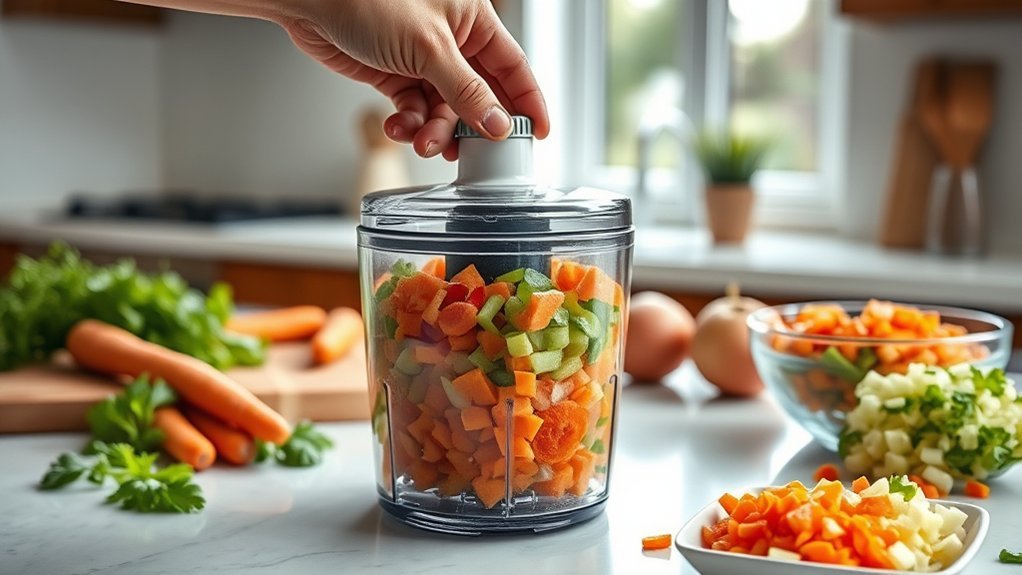
A manual food chopper makes quick work of onions, herbs, vegetables, nuts, and other suitable foods without electricity. For the best results, assemble the blade correctly, cut large ingredients into manageable pieces, avoid overfilling the bowl, secure the lid, and use smooth pulls until you reach the texture you want. Because capacities, blade designs, and cleaning instructions vary, always follow your chopper’s manual or marked fill line first.
Quick Answer
To use a manual food chopper, place the blade securely in the bowl, add evenly sized ingredients without exceeding the recommended fill level, lock the lid, hold the chopper on a stable surface, and pull the cord smoothly. Check the texture every few pulls and stop when the food is chopped as finely as you want.
Key Takeaways
- Cut large or firm ingredients into smaller, fairly even pieces before loading the bowl.
- Follow the chopper’s maximum-fill line or manufacturer instructions instead of forcing in a full bowl.
- Use smooth, controlled pulls and check the food every few pulls; more pulls generally create a finer texture.
- Keep fingers away from sharp blade edges and remove the blade carefully before emptying the bowl.
- Cleaning rules vary by model, especially for pull-cord lids, so confirm which components are dishwasher-safe or immersible.
At a Glance
| Time Required | Usually 1–5 minutes per batch, depending on preparation and desired texture |
| Difficulty | Easy |
| Tools Needed | Manual pull-cord chopper, cutting board, and knife for larger ingredients |
| Cost | No operating cost or electricity required for a standard manual model |
How to Use a Manual Food Chopper Step by Step
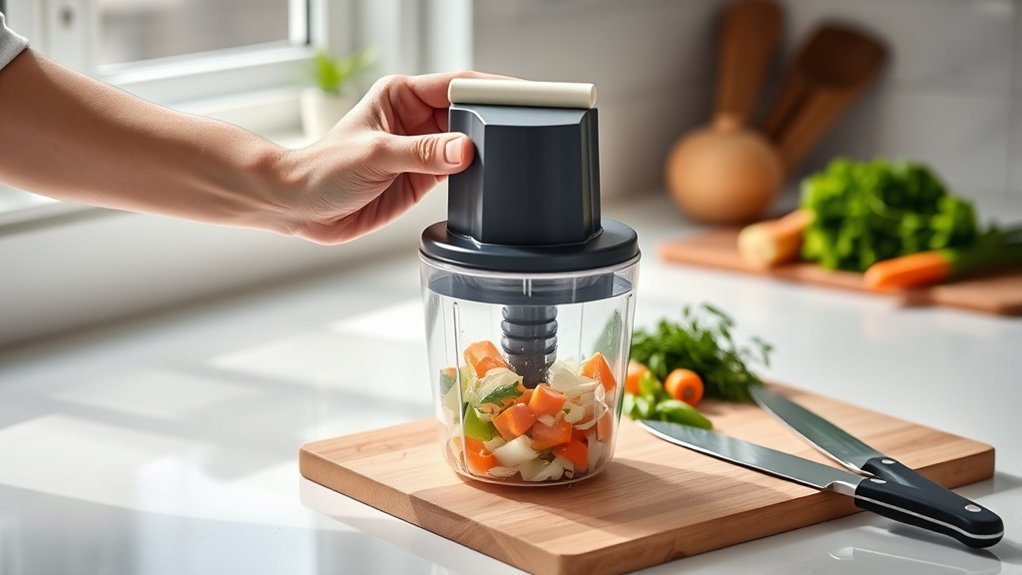
The exact assembly varies by model, but most pull-cord choppers use a bowl, removable blade assembly, and lid containing the cord mechanism. Current guidance from manufacturers such as Tupperware follows the same basic pattern: position the blade securely, add food around it, lock the cover, hold the base steady, and pull the cord.
- Set the bowl on a stable surface. A clean, flat, dry counter helps prevent the chopper from sliding while you pull.
- Install the blade assembly. Hold it by its central stem or other designated safe area rather than touching the cutting edges.
- Add prepared ingredients. Distribute them around the blade instead of packing everything tightly against one side.
- Stay below the recommended fill level. Follow a marked maximum line or the manufacturer’s instructions. If your model gives no specific limit, leave enough empty space for the food to circulate around the blades.
- Secure the lid. Align and lock it exactly as your model requires before pulling the cord.
- Hold the bowl and pull smoothly. Let the cord retract normally between pulls rather than yanking or snapping it.
- Check the texture every few pulls. Stop at a coarse chop or continue for a finer mince or purée if your model and ingredients support it.
- Remove the blade before emptying the bowl. Handle it by the stem or designated grip and keep fingers away from the cutting edges.
Warning: Manual chopper blades can be extremely sharp. Keep fingers away from the cutting edges during assembly, use, washing, and storage, and keep the blade assembly out of children’s reach. Do not reach into the bowl while the blade is installed.
Prepare Vegetables and Other Ingredients
Prepare fresh produce before it goes into the chopper. The U.S. Food and Drug Administration recommends washing fresh produce thoroughly under running water before preparation. Firm produce can be scrubbed with a clean produce brush. Soap, detergent, and commercial produce washes are not recommended for washing fruits and vegetables.
After rinsing, dry the produce with a clean towel when practical. Removing excess surface water can help prevent watery results when chopping onions, herbs, peppers, or similar foods.
Large or firm ingredients should be cut into manageable, fairly uniform chunks before loading. The ideal size depends on the bowl and blade system, but smaller pieces move more freely and put less demand on the mechanism than oversized pieces.
Prepare ingredients so they fit comfortably around the blade and can move freely instead of being wedged tightly into the bowl.
- Remove tough stems, pits, seeds, shells, or other parts your chopper is not designed to process.
- Cut large carrots, potatoes, apples, onions, and similar foods before adding them.
- Keep portions reasonably even so one large piece does not block smaller pieces from reaching the blades.
- Check the manufacturer’s instructions before processing meat, nuts, ice, frozen foods, or other demanding ingredients.
Pro Tip: If you want an even dice-like texture rather than a purée, start with similarly sized ingredients and inspect the bowl after only a few pulls. It is easy to pull again, but you cannot reverse over-chopping.
Load the Bowl Without Overfilling It
A manual food chopper needs open space inside the bowl so ingredients can move toward the blades. Some models recommend filling only about two-thirds of the container, while others provide a specific maximum line or quantity. Treat your manufacturer’s stated limit as the controlling instruction.
Do not press vegetables down simply to fit more into one batch. A packed bowl can produce uneven pieces and may make the cord harder to pull. Processing two smaller batches is usually easier than forcing one overloaded batch.
| Loading step | Purpose | Result |
| Follow the fill line or manual | Leaves working space | Better blade movement |
| Spread ingredients around the blade | Improves distribution | More even chopping |
| Avoid tight packing | Lets food circulate | Less resistance and jamming |
Pull the Cord Evenly for Better Chopping
A smooth pull keeps the mechanism working normally and gives you better control over texture. Hold the bowl firmly with one hand and pull the handle with the other according to your manufacturer’s directions. Allow the cord to retract before beginning the next pull.
There is no universal number of pulls that works for every chopper or ingredient. Zyliss, for example, describes its Easy Pull as a manual system for chopping, blending, and puréeing, while other manufacturers recommend checking texture repeatedly during use. In practice, start with a few pulls, look through the bowl if it is transparent, and continue until the pieces reach the size you want.
- Use fewer pulls for a coarse texture.
- Use additional pulls for finer chopping when the food and chopper are suitable.
- Do not yank the handle violently or pull farther than the mechanism is designed to travel.
- If the cord suddenly becomes difficult to pull, stop rather than forcing it.
If a cord, gear, blade mount, or other component appears damaged, follow the manufacturer’s repair or replacement instructions. Do not assume a dull or damaged blade should be sharpened at home.
What Foods Can You Put in a Manual Food Chopper?
Typical pull-cord choppers can handle foods such as onions, garlic, herbs, peppers, softer vegetables, fruits, and ingredients for dips or sauces. Some models also process nuts, cooked foods, meat, or other ingredients, but capabilities vary significantly.
Do not assume that ice, coffee beans, frozen foods, bones, whole hard spices, or very hot ingredients are safe just because the blades are metal. For example, Tupperware’s SuperSonic Chopper Compact guidance says not to use that model with hot or frozen ingredients and identifies several very hard foods that should not be processed.
Note: Special attachments can change what a chopper can handle. For example, some Tefal 5 Second Chopper configurations use dedicated blades for specific tasks. Check the exact model and attachment rather than applying another chopper’s capabilities to yours.
Troubleshooting a Manual Food Chopper
Why Is the Pull Cord Hard to Pull?
Stop pulling and check the setup. The bowl may be overfilled, an ingredient may be too large or hard, the blade may not be seated correctly, or the lid may not be fully engaged. Remove some food, cut oversized pieces smaller, confirm the blade position, and reinstall the lid before trying again.
Why Are the Pieces Chopping Unevenly?
Uneven results usually improve when ingredients are cut to similar starting sizes, the bowl has more free space, and food is spread around the blade rather than packed tightly. If your manufacturer permits it, gently redistributing ingredients between chopping cycles can also help.
What If Food Sticks to the Sides?
Stop operating the chopper and wait until all movement has stopped. Remove the lid carefully and use an appropriate utensil to move food back toward the center. Keep hands away from the cutting edges. Never reach around an installed blade with your fingers.
What If the Cord Does Not Retract?
Do not force the handle back into the lid or repeatedly yank the cord. Empty the chopper, check for incorrect assembly or visible damage, and consult the product manual or manufacturer for service or replacement options.
Clean and Store Your Food Chopper
Take the chopper apart after use, handling the blade assembly by its stem or designated grip. Wash food-contact components according to the instructions for your exact model.
Cleaning rules are not universal. Current Zyliss Easy Pull care instructions state that its bowl and blade unit are dishwasher-safe but its lid should be hand washed and the pull-cord mechanism should not be immersed. Other brands may specify different procedures, so check before putting any component in a dishwasher or under running water.
When hand washing a blade, use warm soapy water and a suitable brush or other method that keeps fingers away from the cutting edges. Rinse as instructed and dry the components thoroughly before storage.
Store the chopper in a clean, dry location. If your model includes a blade guard or protective storage arrangement, use it. Keep loose blades where children cannot reach them.
Frequently Asked Questions
How Do I Use My Food Chopper?
For a manual pull-cord food chopper, install the blade securely, add prepared ingredients without exceeding the recommended fill level, lock the lid, hold the bowl on a stable surface, and pull the cord smoothly. Check the texture every few pulls and stop when the food reaches the consistency you want.
How Do You Use a Food Processor Step by Step?
An electric food processor is different from a manual pull-cord chopper. Generally, you install the correct bowl and blade, add appropriately sized ingredients, lock the lid, plug in the appliance, and use pulse or continuous processing according to its manual. Stop the machine and disconnect power before removing blades or reaching into the bowl.
How to Use Easy Chopper?
If “Easy Chopper” refers to a pull-cord manual chopper, fit the blade, add prepared food within the model’s fill limit, secure the lid, and use smooth pulls until the desired texture is reached. Because products sold under similar names can differ, use the instructions supplied with your exact model for capacity, suitable foods, and cleaning.
What to Do With a Food Processor for Beginners?
Beginners can use an electric food processor for tasks such as chopping vegetables, slicing, shredding, mixing sauces, making crumbs, or preparing dips when the correct blade or attachment is installed. Start with simple pulse-controlled tasks and follow the processor’s manual for assembly, capacity, food restrictions, and cleaning.
How Many Times Should I Pull a Manual Food Chopper?
There is no single pull count for every manual chopper. Start with a few smooth pulls, inspect the texture, and continue as needed. Ingredient hardness, batch size, blade design, and the desired coarse or fine texture all affect how many pulls are required.
Can I Put a Manual Food Chopper in the Dishwasher?
Only if the manufacturer says the specific parts are dishwasher-safe. Some models allow the bowl and blade in the dishwasher but require the pull-cord lid to be cleaned by hand. Never assume that the lid or cord mechanism can be submerged.
Conclusion
A manual food chopper works best when the blade is installed correctly, ingredients are prepared to a manageable size, the bowl has enough free space, and the cord is pulled smoothly. Check the texture as you work instead of relying on a fixed number of pulls. Most importantly, protect your hands from the sharp blades and follow your model’s instructions for capacity, suitable foods, cleaning, and storage.
Sources
- U.S. Food and Drug Administration — Selecting and Serving Produce Safely — produce washing and preparation guidance.
- Zyliss — Easy Pull Food Processor — manual pull-cord operation, component design, and current cleaning guidance.
- Tupperware — SuperSonic Chopper Compact — manual-chopper use, safety, food restrictions, cleaning, and storage guidance.
- Tefal — 5 Second Chopper 900 ml Instructions — manufacturer information for a current manual chopping system.

1 thought on “How to Use Food Chopper: Simple Step-by-Step Guide”