
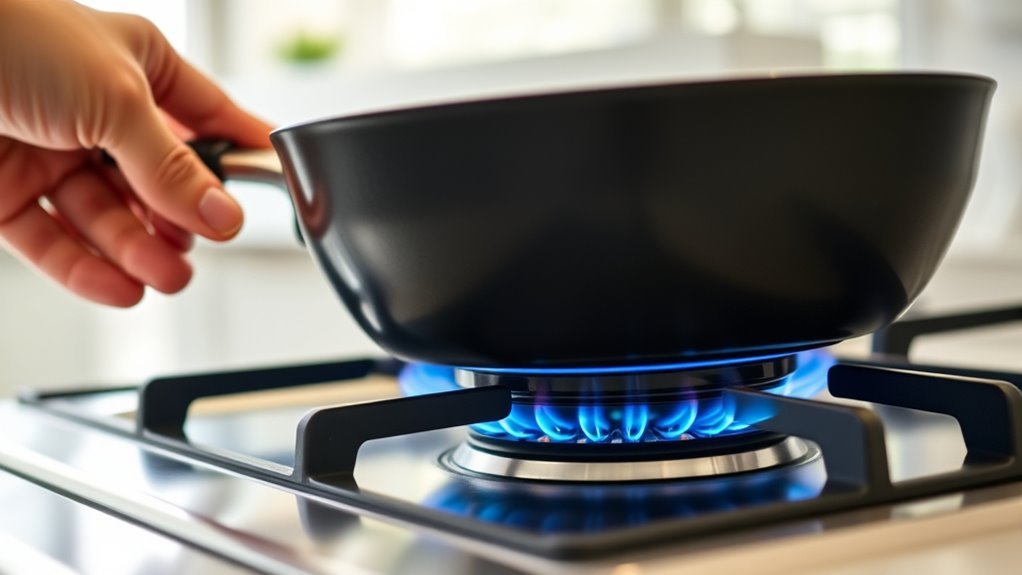
You can usually use an induction pan on a gas stove if it’s made from magnetic materials like stainless steel or cast iron, but there are a few practical checks and precautions you should follow. Do a magnet test, inspect the base thickness and coating, center the pan over the flame, and avoid oversized or exposed flames to prevent warping or damage — and there’s more to evaluate before you decide which pans to trust.
Quick Answer: Can You Use an Induction Pan on a Gas Stove?
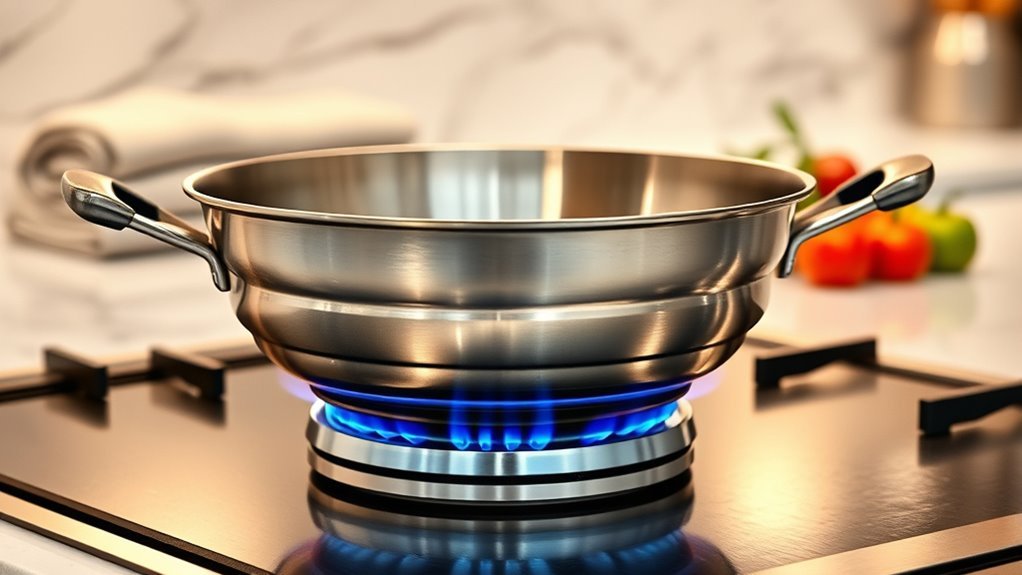
Yes—you can use an induction pan on a gas stove, because most induction-ready cookware is made from magnetic materials like stainless steel or cast iron that work fine over open flame.
You’ll want to confirm the pan’s magnetic base with a simple magnet test; if it sticks, the pan’s compatible.
Place the pan on a level grate so heat distribution stays even and you avoid persistent hot spots that scar cookware and food.
Remember induction cookware often heats faster, so dial the flame down to maintain control and prevent overheating that can warp the base or damage finishes.
Monitor flame size closely; don’t let flames lap up the sides, which wastes energy and risks handles.
Using induction pans on gas gives you flexibility and autonomy in the kitchen, but requires attention: flat, smooth bases, controlled flames, and routine checks keep performance consistent and extend the life of your cookware.
How Induction Pans Work vs. Regular Cookware
Now that you know induction pans can be used on gas, it helps to understand how they actually work compared with regular cookware.
You’ll find induction pans heat via electromagnetic fields that induce currents in a magnetic base, so the metal itself becomes the heat source. Regular cookware, by contrast, depends on an external flame or coil to transfer heat into the pan, making it slower and prone to heat loss.
Because induction heats the pan directly, you get faster response and finer temperature control—useful when you want freedom in the kitchen and to avoid overcooking.
Because induction heats the pan directly, you get faster response and finer temperature control to avoid overcooking.
Induction-compatible pieces require a magnetic base; pure aluminum or copper without a magnetic layer won’t work.
On gas stoves, induction pans often feature thicker, more stable bases that distribute heat evenly and resist hot spots common with regular cookware. That design also improves retention and reduces warping during high-heat work, letting you cook confidently without sacrificing performance.
Materials and Base Designs That Handle Open Flames
When you choose induction cookware for a gas stove, prioritize thick magnetic bases that sit flat and spread heat evenly to resist warping.
Look for flame‑resistant coatings and corrosion‑resistant stainless or cast iron finishes that tolerate direct flame without degrading.
Even with robust materials, keep flames moderate and check that a magnet sticks firmly to the base to confirm compatibility.
Thick Magnetic Bases
Because thick magnetic bases combine dense materials like stainless steel or cast iron with deliberate design, they give you even heat distribution and resistance to warping when used over gas flames.
You’ll find thick magnetic bases on many induction pans intended for general use, enabling quick, efficient heating and reliable performance on both induction hobs and gas cooking.
The mass and flatness improve contact with burners and reduce hotspots, while magnetic response keeps induction compatibility intact.
Still, you must monitor flame size and avoid blasting high flames up the sides, which can overheat rivets or finishes.
Choose pans with smooth, heavy bottoms and reputable construction so you can cook freely but cautiously, trusting cookware that withstands open flames without sacrificing control.
Flame‑Resistant Coatings
Heat-resistant coatings and reinforced base designs let you use induction pans confidently over gas flames without sacrificing durability.
You should look for induction cookware with flame-resistant coatings that resist deformation and surface damage during gas cooking. Manufacturers often combine specialized outer layers with thicker, reinforced bases so the pan holds shape and gives even heat distribution, reducing hot spots and long-term warping.
Check each maker’s guidance: flame resistance varies, and misuse can still cause damage. High-quality models also resist scratching and retain performance after repeated exposure to flame heat, which frees you to cook boldly while protecting your investment.
Use care with open flames, follow instructions, and choose proven construction to guarantee safe, reliable gas cooking.
Compatibility Test: Magnet Test + Visual Checklist
If you want to know whether a pan meant for induction will also work reliably on a gas hob, start with a simple magnet test and a quick visual checklist:
Place a magnet on the center of the pan’s base—if it sticks firmly, the pan is likely induction-compatible and can be used on gas stoves.
Next, inspect the base: look for an induction symbol (coil or loop) and confirm the base is flat and smooth to guarantee even heat on flames.
Read manufacturer specs to verify suitability for both induction and gas cooking.
Avoid pans with thin bases or non-stick coatings on the underside; they often warp or heat unevenly on open flames.
You want cookware that gives you freedom in the kitchen, so choose robust, labeled pieces with a level cooking surface.
These simple checks free you from guesswork while keeping performance and safety intact.
Using Induction Pans Safely on Gas Flames
When you use an induction pan on a gas flame, keep the flame small enough that it doesn’t wrap up the sides to protect the base and finish.
Control heat gradually to avoid overheating thin bottoms, which can warp or cause uneven cooking, and follow the manufacturer’s temperature limits.
Clean off soot or burnt marks with mild detergent to preserve the cookware and check guidelines for any additional safety recommendations.
Flame Size And Control
Because induction pans conduct heat quickly, you should keep the gas flame at or below the diameter of the pan’s base to prevent overheating, warping, and damage to finishes. You’ll favor a medium flame for even heating; higher flames risk overheating and uneven cooking. Monitor heat closely—induction cookware responds fast—so you can seize control, avoid burns, and free yourself from guesswork. Place pans on stable, flat supports and avoid rough grates to protect cookware integrity.
| Action | Guideline |
|---|---|
| Flame size | At or below base diameter |
| Heat level | Medium for even heating |
| Monitoring | Watch closely; adjust quickly |
| Surface | Stable, flat, non-abrasive support |
Control the flame, preserve performance, and cook with confident liberation.
Protecting Cookware Finish
Having controlled flame size and kept heat moderate, you now need to guard the pan’s finish against direct flame and high temperatures. When you use induction pans on gas stoves, direct flame can leave burnt marks; clean these promptly with mild detergent to preserve appearance.
Prevent overheating and dry-firing—induction cookware conducts heat efficiently and can deform if abused—so monitor flame and never leave an empty pan over heat. To protect the finish, avoid steel wool and abrasive cleaners that scratch surfaces; choose soft sponges and manufacturer-recommended products.
Prefer thick-bottomed induction cookware for even heat distribution and fewer hot spots. Always verify cookware compatibility and care instructions from the maker so your pans last and you stay free from avoidable damage.
Heat And Safety Limits
If you use induction-compatible pans on a gas stove, keep the flame moderate and watch the heat closely to prevent overheating and warping.
Stay within clear heat and safety limits: prefer medium to low heat rather than high flames that can warp thicker bases or degrade finishes.
You’ll find induction pans heat quickly and evenly, but direct flame contact can still damage undersides or non-stick layers over time.
On gas stoves, center the pan, aim for a steady, controlled flame that doesn’t lap the sides, and inspect regularly for discoloration, warping, or coating wear.
This cautious approach preserves performance and gives you the freedom to cook boldly without sacrificing cookware longevity or safety.
Safety Warnings: Coatings, Thin Bases, and Manufacturer Limits
When you use induction pans on a gas stove, pay close attention to coatings, base thickness, and any manufacturer limits because open flames and high heat can degrade non-stick surfaces, warp thin bottoms, or damage electronic components.
Always check the maker’s guidance and control the flame to protect performance and appearance. You’ll want to confirm induction compatibility with a magnet test, but don’t stop there: read the label for explicit gas-stove approval.
Check the maker’s guidance, use a magnet for induction, and confirm explicit gas-stove approval before cooking.
Avoid pans with thin bases—they heat unevenly, risk warping, and undermine reliable cooking. Protect non-stick coatings by keeping flames low and steady; exposed edges or excessive heat speeds deterioration.
If the cookware includes embedded electronics or sensors, assume they’re vulnerable to direct flame unless the manufacturer states otherwise.
Follow any manufacturer limits for maximum temperature and flame type to preserve function and finish. Acting deliberately and respecting those limits gives you the freedom to use versatile cookware without sacrificing longevity or safety.
Cleaning and Maintenance After Gas Use
Because sudden temperature changes can warp or weaken pans, let an induction pan cool fully after using it on a gas stove before you wash it; then clean with mild soap and a soft sponge to protect non-stick surfaces and avoid thermal shock.
After cooling, rinse off food particles, address burnt marks promptly with a gentle detergent, and avoid abrasive pads that scratch coatings.
For regular maintenance, wipe rims and bases to remove soot from gas flames so corrosion and discoloration don’t set in.
Don’t run pans on high flame—the reduced overheating lowers the risk of deformation and prolongs lifespan.
When storing, dry cookware thoroughly and separate stacked pieces with cloth or paper towels to prevent surface damage.
Keep a simple routine: cool, clean, inspect, dry, and store.
That disciplined general care preserves performance and gives you freedom from constant replacements, letting your cookware serve you longer without sacrificing safety or efficiency.
When Induction Pans Won’t Perform Well on Gas : and Better Alternatives
Although induction pans are built for magnetic cooktops, they often struggle on open flames: thin bases can warp and create hot spots, non-stick coatings can blister or peel under high flame contact, and materials like plain aluminum or copper perform poorly unless paired with a magnetic, heavy-duty base.
Induction pans fare poorly over open flames—thin bases warp, coatings blister, and lightweight metals need heavy magnetic bases.
You’ll notice uneven cooking and faster wear if you push an induction pan beyond its design on a gas stove. Don’t assume every induction-marked pan will heat evenly over a flame; check construction and intended use first.
If your goal is freedom from frequent replacement, choose heavier, thicker-bottomed cookware made for direct flame—cast iron, heavy stainless steel, or clad pans with a true magnetic base will resist warping and distribute heat evenly.
Reserve delicate non-stick induction pans for induction hobs. That way you preserve performance and maintain options: use the right tool for each stove, protect coatings, and avoid the frustration of warped pans and inconsistent results.
Buying Guide: What to Look For in Dual-Compatible Cookware
How do you pick cookware that handles both induction and gas without compromise? Start by checking for a magnetic base — a firm magnet stick test is the quickest assurance of induction cooking readiness.
Prefer stainless steel or cast iron for resilience and high-heat performance on gas; stainless steel combines durability with a smooth finish and often lighter weight.
Evaluate base thickness: heavier, multi-layer bases distribute heat evenly on open flames and stabilize temperature for sensitive techniques. Look for explicit dual compatibility markings; credible brands label pans for all stove types.
Read user reviews to confirm real-world performance across induction and gas, focusing on warping, heat response, and longevity.
Finally, weigh practicality: balanced handle design, oven safety, and maintenance. Choose cookware that liberates your cooking style without forcing compromises — reliable magnetic base, robust construction, and verified dual compatibility will keep your options open and predictable.
Frequently Asked Questions
Can I Use an Induction Pan on a Gas Stove?
Yes — you can use an induction pan on a gas stove. You’ll value induction cookware compatibility for its magnetic base and durability, while watching gas stove efficiency by adjusting flame size.
Choose pans with thick bases to improve heat distribution comparison and resist warping. Check cooking surface materials with a magnet, clean gently to avoid burns, and stay cautious with high flames so your cookware lasts and you keep cooking freely.
What Cannot Be Cooked on Induction?
Imagine trying to light a campfire with wet tinder—that’s what happens with non-magnetic pots. You can’t cook foods needing open flame charring (like certain wok stir-fries), items in glass/ceramic bakeware, or anything in pure aluminum/copper pans because of induction cookware limitations.
Induction heat sources won’t work with warped, thin-bottomed, or non-magnetic cookware. Induction vs electric differs in response; heed induction safety concerns and choose magnetic, flat-based pans for freedom to cook safely.
Do Chefs Prefer Induction Over Gas?
Some chefs do prefer induction over gas for its cooking efficiency and precise heat control, but preferences vary.
You’ll value induction’s safety features, cleaner environment, and quick response, which free you to focus on technique.
Others stick with gas for flavor and tactile feedback.
Weigh chef preferences against your need for speed, consistency, and safety features; choose the mode that liberates your cooking style and priorities.
What’s the Downside of an Induction Cooktop?
You’ll face higher upfront cost and limited cookware choices, plus dependence on electricity during outages.
Induction efficiency and cooking speed are excellent, but the cost comparison often favors gas for purchase price.
You’ll need to adapt to rapid heat changes and protect the surface from scratches, which raises practical upkeep.
Energy consumption is lower overall, yet the learning curve and replacement costs can restrict your freedom to switch instantly.
Conclusion
Yes—you can use an induction pan on a gas stove if it’s magnetic (stainless steel or cast iron). Do the magnet test: if it sticks, it’s compatible. Center the pan over the flame, keep flames below the sides, and avoid overheating nonstick coatings. About 60% of home cooks report using multipurpose pans; imagine three of five meals cooked on the same pan. Be practical: check the base thickness, follow manufacturer limits, and clean promptly after gas use.

