
Keeping your hydroponic reservoir at the right pH helps plants absorb nutrients. The best pH test strips for hydroponics make routine water checks simple, but not all strips offer the same range, reading method, or level of detail.
Just Fitter Alkaline Water pH Test Strips are our overall pick for versatile liquid testing. For frequent checks, the PUREFIZ 200-pack offers more strips and a four-color indicator system.
These five options are compared using their stated specifications, testing methods, pack sizes, and available product information. Test strips are useful for screening, but a calibrated digital meter is preferable when you need precise pH adjustments in nutrient solutions.
Hydroponic pH Test Strips Compared
The main differences are testing range, strip quantity, and how you read the result. A broad pH range gives you flexibility, while a narrower scale with finer color steps may be easier to use near your crop’s target pH.
| Product | Best for | pH range | Strip count |
|---|---|---|---|
|
Mid-range
|
Versatile liquid testing | 2.0–12.0 | 150 |
| pH, alkalinity, and hardness checks | 5.5–8.0 | 120 | |
| General-purpose testing | 0–14 | 100 | |
|
Budget
|
Frequent testing | 0–14 | 200 |
| Portable drop-on-paper testing | 1–14 | 160 |
Hydroponic pH Test Strips: Our Top Picks
These three options cover the most common needs: everyday water checks, larger supplies for frequent testing, and reusable-style plastic construction with disposable indicators.
1. Just Fitter Alkaline Water pH Test Strips
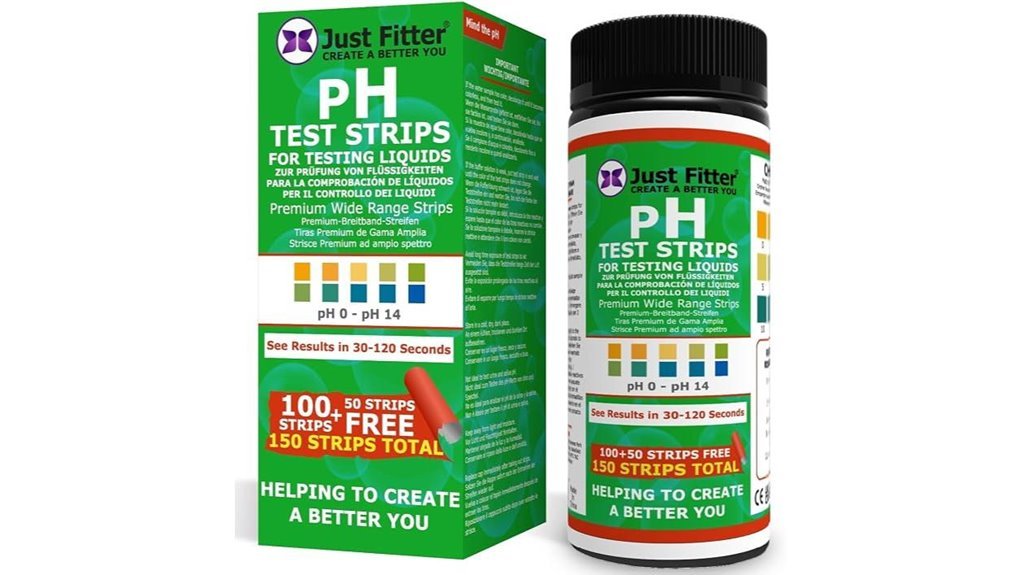
Bottom line: Just Fitter Alkaline Water pH Test Strips suit growers who want an easy way to check water pH and use the same kit for other household liquids. Their 2.0–12.0 range includes typical hydroponic growing conditions.
- pH range: 2.0–12.0, covering common growing-water conditions.
- Strips per pack: 150, suitable for repeated checks.
- Reading method: Dip and compare colors with the included chart.
- Reading time: Approximately 30–120 seconds, following product instructions.
The Just Fitter Alkaline Water pH Test Strips work with drinking water, aquariums, pools, and liquids used for fermentation or brewing. This versatility makes them useful if you have several water-testing tasks at home.
For hydroponics, you can collect a clean reservoir sample, dip the strip as instructed, and compare its developed color with the chart. The process needs no batteries, probes, or calibration solutions.
However, the result depends on how well you distinguish the colors. Dark nutrient solutions can make the reading less dependable. Use a calibrated digital meter to confirm a result before making a precise pH correction.
- Works with several types of liquid samples.
- Simple color-chart reading method.
- 150 strips support repeated testing.
- No electronic equipment or calibration required.
- Color matching can be subjective.
- Moisture, heat, and light can damage the indicators.
- Less suitable than a calibrated digital meter for precise hydroponic adjustments.
2. Hydroponic 3-in-1 Water Test Strips (120 Count)
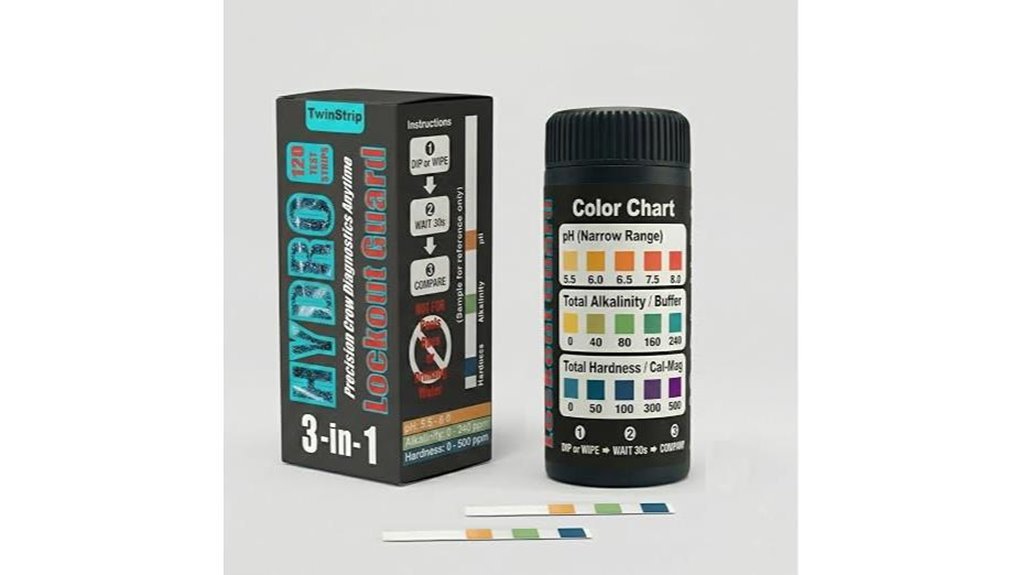
Bottom line: The Hydroponic 3-in-1 Water Test Strips combine pH, alkalinity, and hardness testing. They suit growers who want a broader picture of their water chemistry without buying separate test strips for each parameter.
- pH range: 5.5–8.0, centered on common hydroponic conditions.
- Strips per pack: 120, intended for regular checks.
- Reading method: Dip and compare several indicator colors.
- Reading time: About 30 seconds, according to the product description.
Unlike basic pH-only paper, these 3-in-1 strips also measure alkalinity and hardness. Alkalinity describes how strongly water resists changes in pH. Hardness relates mainly to dissolved calcium and magnesium.
That extra information can help you investigate changes in reservoir chemistry. If leaves turn yellow or growth slows, checking these parameters may provide useful clues, although no strip can identify every possible nutrient deficiency.
The stated design suits deep water culture (DWC), aeroponics, drip irrigation, and indoor hydroponic systems. You dip a strip into a sample, wait for the indicator to develop, and compare the colors.
The kit does not measure electrical conductivity (EC) or the concentration of individual nutrients. Its Amazon product identity also requires confirmation before purchase.
- Combines three water chemistry checks.
- Focused pH range for hydroponic use.
- Stated reading time of about 30 seconds.
- No batteries, probes, or calibration needed.
- Color matching is less precise than a good digital meter.
- Does not measure EC or individual nutrient levels.
- The linked Amazon listing needs identity verification.
3. LabRat Supplies Plastic pH Test Strips LRS-4801
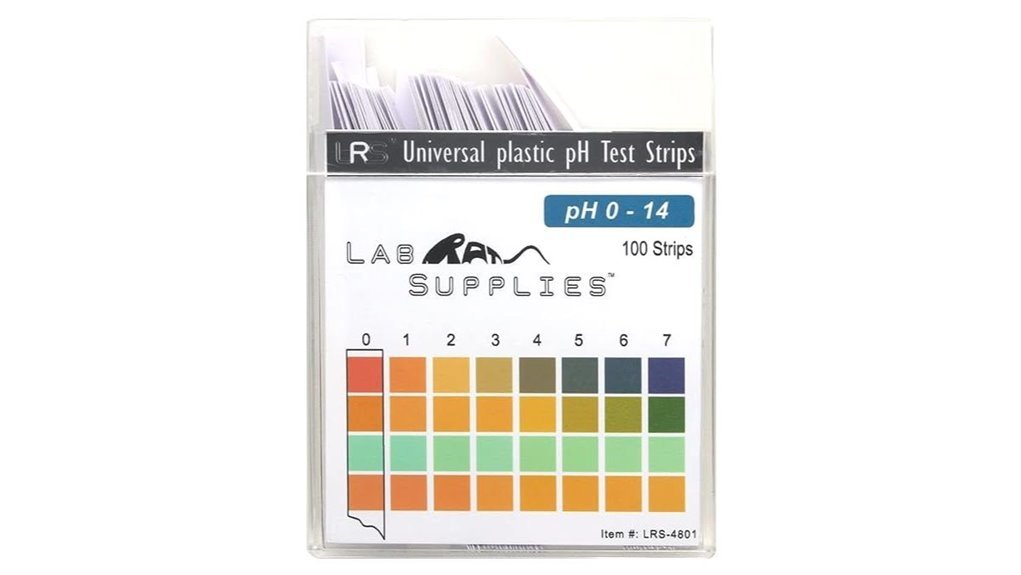
Bottom line: LabRat Supplies Plastic pH Test Strips LRS-4801 are useful for general-purpose acidity and alkalinity checks. Their full 0–14 range is versatile, but one-pH-unit intervals are too coarse for careful hydroponic nutrient adjustments.
- pH range: 0–14, covering strongly acidic to alkaline samples.
- Strips per pack: 100, for regular basic testing.
- Reading method: Dip the strip and compare its color.
- Reading time: Color change occurs almost immediately.
The LabRat Supplies LRS-4801 set is designed for applications including water, soil solutions, soaps, food, saliva, urine, and laboratory samples. Its plastic strip construction makes it a practical alternative to thin paper indicators.
However, range and resolution are different things. A strip that reads from 0 to 14 is not necessarily better for hydroponics than one focused on a smaller range.
With one-unit chart intervals, it may be difficult to distinguish a nutrient solution near pH 5.5 from one near 6.5. This limits its usefulness when small changes matter.
Store the unused strips in their original packaging in a cool, dry location. The product is identified as model LRS-4801, with UPC 013189988144.
- Full 0–14 testing range.
- Suitable for many types of liquid samples.
- Rapid color changes.
- 100 strips for routine checks.
- One-unit intervals limit precision.
- Indicator quality depends on proper storage.
- The original product information states that returns are restricted.
4. PUREFIZ Universal pH Test Strips (200 Pack)
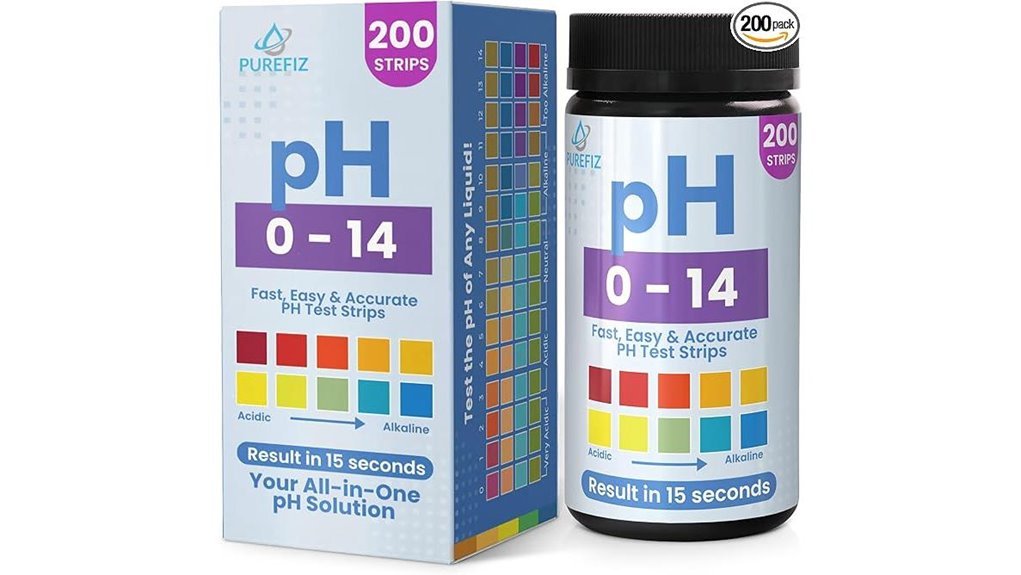
Bottom line: PUREFIZ Universal pH Test Strips are a practical choice if you test frequently and want a larger supply. The 200-count pack covers the full pH scale and uses a four-color indicator system.
- pH range: 0–14, suitable for broad liquid testing.
- Strips per pack: 200, the largest pack in this comparison.
- Reading method: Dip and compare four indicator colors.
- Reading time: Results develop in seconds, according to the product description.
The PUREFIZ Universal pH Test Strips work with water and liquids used in brewing, fermentation, soap making, and other household applications. Their large pack size is convenient for regular screening.
Four-color indicators give you more than one color area to compare against the supplied chart. This can help with interpretation, although it does not guarantee laboratory-level accuracy.
The strips come in moisture-resistant packaging. Keep the container closed between tests, and avoid touching the reactive areas with wet fingers.
For hydroponics, these are best treated as a quick way to estimate pH. A digital meter remains the better tool when you need to measure small changes and adjust fertilizer solution carefully.
- 200 strips support frequent testing.
- Full 0–14 range for multiple applications.
- Four-color indicator system.
- Easy dip-and-compare procedure.
- Visual color readings remain subjective.
- Moisture exposure can shorten useful storage life.
- Not a replacement for a calibrated meter in precision hydroponics.
5. HomEnjoy Universal pH Test Paper (160 Strips)
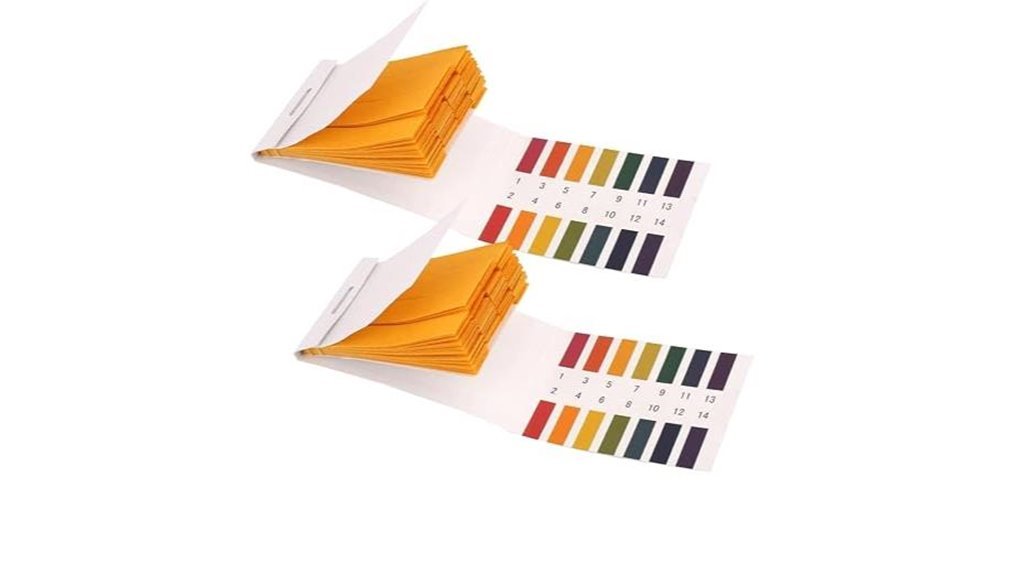
Bottom line: HomEnjoy Universal pH Test Paper is an option for growers who prefer applying a few drops of liquid to disposable indicator paper. The two sealed packs contain 160 strips and cover pH 1–14.
- pH range: 1–14, for acidic and alkaline samples.
- Strips per pack: 160, divided into two packs.
- Reading method: Apply liquid to the paper rather than immersing it.
- Reading time: About five seconds, according to the product description.
The HomEnjoy Universal pH Test Paper can be used for water, soil extracts, rainwater, soap-making liquids, and similar samples. Its lightweight paper format is easy to keep with basic gardening supplies.
Unlike the other dip-style products, the instructions recommend placing the test liquid onto the paper. A clean dropper or glass rod helps prevent accidental contamination.
After applying the sample, compare the developed color against the chart within the recommended reading time. Do not use dry soil or other solid materials directly; first prepare a suitable liquid sample.
The broad range makes this product versatile, but the color-based result is still approximate. It is better for screening than making fine corrections to hydroponic nutrient solutions.
- 160 strips in two packs.
- Broad pH range from 1 to 14.
- Quick color development.
- Lightweight and portable design.
- Requires a liquid sample.
- Manufacturer instructions discourage direct immersion.
- Visual color comparisons can be difficult in tinted solutions.
Just Fitter vs PUREFIZ: Is the Upgrade Worth It?
Just Fitter offers a narrower stated pH range and a versatile liquid-testing kit. PUREFIZ focuses on pack quantity and general-purpose testing. Neither should replace a calibrated pH meter when precision matters.
- Pack size: Just Fitter includes 150 strips, while PUREFIZ includes 200.
- Testing range: Just Fitter covers pH 2.0–12.0; PUREFIZ covers 0–14.
- Reading system: Both use color comparison, with PUREFIZ specifying four indicator colors.
- Best choice: Choose Just Fitter for versatile household testing or PUREFIZ when strip quantity matters most.
Which Hydroponic pH Test Strips Should You Buy?
Choose based on the type of water you test, how often you test it, and whether you need pH alone or additional information.
- General home and hydroponic screening: Get the Just Fitter strips.
- Frequent testing: Choose the PUREFIZ 200-pack.
- Plastic strip format: Consider the LabRat Supplies LRS-4801.
- Small liquid samples: The HomEnjoy test paper uses a drop-application method.
- Several water parameters: The Hydroponic 3-in-1 kit is designed to check pH, hardness, and alkalinity together. Confirm the linked product’s identity first.
How We Chose These pH Test Strips
We compared stated product specifications and instructions rather than claiming laboratory accuracy or hands-on performance testing.
- Hydroponic relevance: The testing range should cover the pH levels typically used for nutrient solutions.
- Ease of use: Clear instructions, suitable reading times, and practical sample-handling methods matter.
- Pack size: Frequent testing favors a convenient supply of disposable strips.
- Reading limitations: We considered color interpretation, chart resolution, and the effects of nutrient solution dyes.
- Reference guidance: We used product information alongside guidance from University of Missouri Extension and Penn State Extension on nutrient solutions and pH measurement.
Factors to Consider When Choosing pH Test Strips for Hydroponics in 2026
The best hydroponic pH strips should match your target range, provide readable results, and suit your testing routine. Pay particular attention to resolution, because a strip with broad range coverage may still miss small but useful changes in pH.
pH Range Accuracy
For most hydroponic crops, a pH of around 5.5 to 6.5 is a useful general target, although specific plants may have different needs. University of Missouri Extension identifies this as a typical optimum range for many hydroponic crops.
Look at the actual numbers printed beside the strip’s color chart. A scale that changes in whole pH units provides less detail than one with smaller intervals near your target.
For example, knowing that a solution is somewhere between pH 5 and 6 may not be enough if you want to keep it close to 5.8. The total testing range alone does not tell you the strip’s accuracy or resolution.
Hydroponic Compatibility
Choose pH strips that can be used with the type of liquid you intend to test. Hydroponic nutrient solutions may contain dyes, suspended particles, or other ingredients that complicate color interpretation.
A multi-parameter strip can offer additional information. Alkalinity helps explain resistance to pH changes, while hardness gives information related to dissolved calcium and magnesium.
However, neither measurement replaces EC testing. Electrical conductivity helps you track the total concentration of dissolved ions in a nutrient solution, although it cannot identify each nutrient separately.
University guidance from Missouri specifically cautions against relying on color-based strips in fertilizer solutions because fertilizer dyes can affect readings. A calibrated pH meter is preferable for precise nutrient management.
Response Time
Response time tells you how long to wait before interpreting a strip. The products in this comparison describe results ranging from almost immediate color changes to readings that take longer to develop.
Read the strip only at the time specified by its manufacturer. Reading too early may catch an incomplete reaction, while waiting too long can change the apparent color.
Faster strips make repeated testing convenient, but speed does not prove accuracy. The clarity and resolution of the color chart matter just as much.
Strip Quantity
Pack quantity matters when you test several hydroponic reservoirs or check the same system regularly. The products here range from 100 to 200 strips per pack.
A 120-strip package may last much longer in a small home setup than in a commercial room with several separate reservoirs.
Calculate how many strips you normally use before buying in bulk. Larger packs can reduce the need for reordering, but only if you can use the strips before their labeled expiration date.
Storage Stability
Proper storage helps protect the chemical indicators on pH strips. Keep unused strips in a cool, dry location away from direct sunlight.
Close the original packaging promptly after every use. Moisture and heat can damage the indicators, making colors weaker or less reliable.
Some products use sealed packs or moisture-resistant containers. A desiccant-containing container may provide additional moisture protection when recommended by the manufacturer.
Always check the product’s expiration date. Shelf life varies by formulation and packaging, and some products are labeled for storage periods of one to three years.
Ease of Reading
Clear colors and a readable comparison chart make pH testing easier. A high-contrast chart helps you distinguish nearby values without guessing.
Multi-color indicator strips can provide several areas to compare, while narrow-range strips may give clearer differences near a specific target pH.
Use neutral white lighting when reading a strip. Colored grow lights, shadows, and reflections can change how the indicator appears to your eyes.
For beginners, readable chart markings and simple instructions may be more valuable than an unusually wide testing range.
Mistakes to Avoid When Buying Hydroponic pH Test Strips
- Choosing range over resolution: Check the chart intervals near pH 5.5–6.5, not just the minimum and maximum values.
- Assuming every strip can be dipped: Some test papers require drops of liquid instead of direct immersion.
- Ignoring nutrient color: Dark or dyed solutions can make the indicator difficult to interpret.
- Confusing pH with nutrient strength: Use EC testing when you need information about dissolved nutrient concentration.
- Making large corrections from uncertain readings: Confirm questionable results with a properly calibrated digital meter before adjusting your reservoir.
FAQs
How Often Should Hydroponic pH Strips Be Replaced?
Hydroponic pH strips are single-use, so use a fresh strip for every test. The original article recommends refreshing stored supplies every 6 to 12 months, but the manufacturer’s labeled expiration date should determine whether unused strips remain suitable.
Replace strips sooner if they fade, discolor, become damp, or give inconsistent results. Store unused strips sealed and away from heat and direct sunlight.
Can pH Strips Work With Nutrient Solutions Containing Dyes?
Yes, pH strips may react in dyed nutrient solutions, but the resulting color may be difficult to interpret. Fertilizer pigments can stain or mask the indicator, leading to uncertain readings.
Use a fresh sample and neutral lighting if you attempt a strip test. For dependable nutrient management, a calibrated digital pH meter is a better option, especially with dark or opaque solutions.
Do Lighting Conditions Affect pH Strip Color Readings?
Yes. Lighting can change how you see the colors on pH test strips. Yellow, blue, purple, or dim lighting may make the indicator appear different from the reference chart.
Read the strip under consistent neutral white light. Hold the chart beside the strip and follow the stated reading time to reduce interpretation errors.
Are Reusable pH Strips Available for Hydroponics?
Traditional chemical pH strips are not reusable. Their indicators react when they contact a liquid sample, so you need a fresh strip for each measurement.
If you want a reusable testing tool, consider an electronic pH meter. Digital meters require maintenance and calibration, but they provide numerical results and are more suitable for monitoring small pH changes.
What pH Range Is Best for Lettuce in Hydroponics?
A pH range of about 5.5 to 6.5 is generally suitable for hydroponic lettuce. Many growers aim near 6.0 to support nutrient availability and consistent growth.
Suppose your lettuce develops poor growth after the reservoir pH drifts beyond its target. Checking and correcting the pH may improve nutrient availability, provided the problem is related to pH rather than another growing condition.
Can pH Test Strips Replace an EC Meter?
No. pH strips measure acidity or alkalinity, while an EC meter measures electrical conductivity, which reflects the concentration of dissolved ions in your nutrient solution.
You need different measurements to understand these two parts of reservoir chemistry. A multi-function strip that tests pH, alkalinity, and hardness still does not directly measure EC.
Should You Test Hydroponic pH Before or After Adding Nutrients?
Test the final mixed nutrient solution before deciding whether to adjust its pH. Adding fertilizers can change the solution’s acidity, so a reading taken only before mixing may no longer represent the water your plants receive.
Mix the nutrients according to their instructions, allow the solution to become uniform, and then measure pH. Confirm uncertain readings before making further adjustments.
What Should You Do if pH Strips and a Digital Meter Disagree?
First, check that your digital meter is clean, correctly stored, and calibrated with suitable buffer solutions. Then repeat the measurement using a fresh sample and a fresh strip.
If the results still differ, do not make a large pH adjustment based only on the strip’s color. A properly calibrated, functioning pH meter generally provides the better basis for precise reservoir adjustments.
Final Verdict
The best pH test strips for hydroponics are useful for convenient water screening, but their limitations matter. Choose strips that cover your target range and have a chart you can read confidently.
For general-purpose liquid testing, Just Fitter is our overall pick. If you want more strips for frequent checks, PUREFIZ is a practical value alternative. For precise nutrient-solution control, use a calibrated digital pH meter rather than relying on test strips alone.
For a larger supply, compare the PUREFIZ Universal pH Test Strips. For broad testing with plastic strips, see the LabRat Supplies LRS-4801.
