
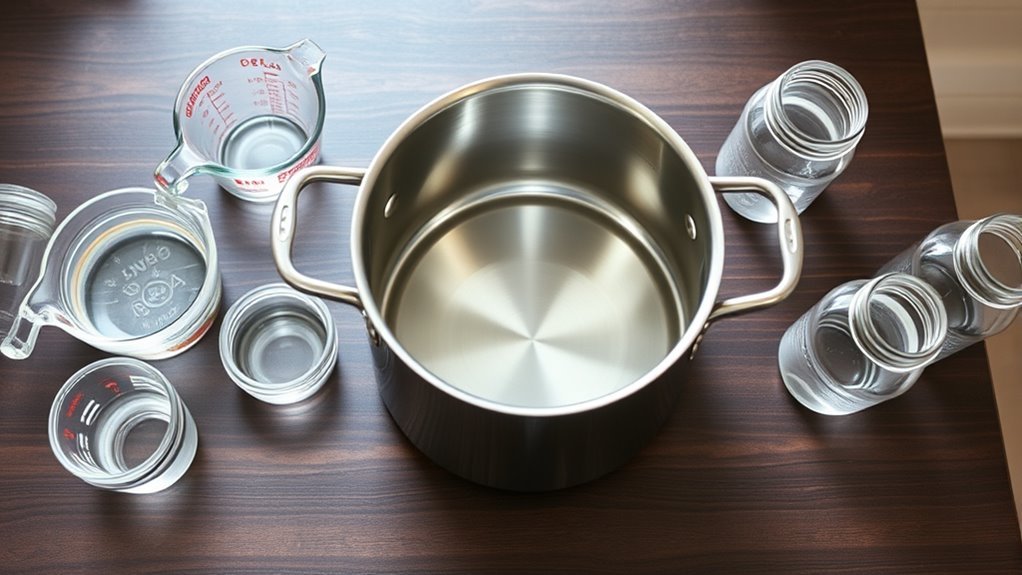
You’ll want the right stock pot size for efficient cooking and consistent results, so knowing how many quarts each pot holds matters. This guide helps you match 4–20 qt options to households, dishes, and occasions, and shows how diameter, depth, and fill limits affect real capacity. Keep this in mind as you compare sizes, materials, and practical tips—because choosing wrong can mean wasted time, uneven cooking, or spilled stock, and there’s more to take into account.
Quick Guide: Which Stock Pot Size Should You Buy?
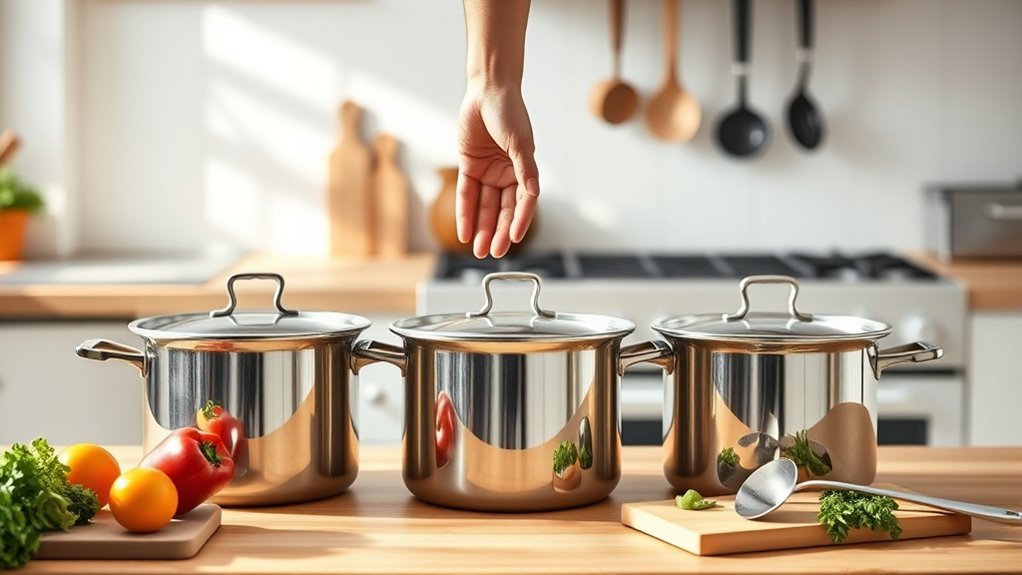
Choosing the right stock pot comes down to how much you cook: a typical home cook will find an 8-quart pot versatile. A 6-quart works well for meals for two to four, a 12-quart handles larger batches for six to eight, and 16-quart or larger pots suit catering or big gatherings.
When you choose, think about the right size for your routine: an 8-quart meets most needs, while a 6-quart is efficient for small soups and daily meals. If you’re planning large batches like stews or batch-cooking, step up to 12 quarts or more, remembering usable volume is about 75–85% of capacity. You’ll avoid overflow and underuse by matching capacity to purpose.
Consider storage, stovetop fit, and how often you’ll cook at scale. Familiarize yourself with common sizes so you can liberate your kitchen practice—pick one pot that frees you from compromise, and you’ll streamline cooking, save time, and reclaim control.
Common Stock Pot Sizes (4–20 QT) and What Each Handles
You’ve already got a sense of which pot suits your routine; now let’s look at specific sizes and what they handle. Think of stock pot size as a tool for freedom in the kitchen: pick what matches your needs.
A 4 QT stock pot fits cooking small batches—sauces, small soups—for 1–2 people. It saves space and energy when you don’t want waste.
The 8-quart size is the everyday workhorse; it handles 8–12 servings of soup, pasta, or stew and suits most households.
An 8-quart pot is the everyday workhorse—perfect for 8–12 servings of soup, pasta, or stew for most homes.
A 12-quart pot gives you room for family batches and modest bone broths, serving roughly 6–8 people while still fitting home stoves.
When you need to feed a crowd or preserve produce, turn to 16–20 quart sizes. These larger pots handle large amounts for canning, catering, or bulk stock, letting you scale up without struggling.
Choose the size that liberates your cooking, not limits it.
Measuring a Stock Pot: Diameter, Depth, and Usable Fill
Measure both the internal diameter and depth to know what your stock pot can actually hold, since those dimensions determine its maximum volume. You’ll use the diameter to calculate surface area and the depth to calculate volume; together they define the pot’s size and true capacity.
Check stamped markings first — they often show quarts — then measure if unsure.
When planning fill levels, stick to 75–85% of rated capacity to prevent boil-over and allow stirring. Remember that a wider diameter gives more surface for searing and faster reduction, while greater depth reduces evaporation and holds broth moisture.
Consider even heating: a broad base distributes heat across ingredients, while depth influences how heat moves vertically. Measure with a ruler or tape to the interior wall and bottom, then compute volume if you need exact quarts.
Knowing diameter, depth, and usable fill frees you to cook boldly without fear of overflow or uneven results.
Which Stock Pot to Choose by Household, Dish, and Occasion
Think about who you usually cook for, what you make, and how much you need to serve.
A 6–8 quart pot fits one to a small family, 12–20 quarts work for big batches like bone broth or stews, and 16+ quarts suit parties, canning, or community events.
Also check your storage space and choose stackable or narrower designs if room is limited.
Household Size Guide
Picking the right stock pot comes down to who you’re cooking for, what you’re making, and how often you’ll be batch-cooking. For 1–2 people, a 6‑quart pot keeps portions manageable. An 8‑quart handles most family meals (8–12 servings). A 12‑quart suits regular meal prep for 6–8 people, and 16 quarts or more is best for events or bulk batches.
You want freedom in the kitchen, so choose a pot that matches your routine: smaller for daily simplicity, larger for abundance and shared meals.
- 6 QT stock pot: ideal for solo or couples, prevents overflow
- 8 QT stock pot: versatile, everyday family size
- 12 QT stock pot: perfect for cooking soups and meal prep
- larger stock pots: use for events, canning, big batches
Dish-Based Capacity
When you’re deciding which stock pot to use, match the pot size to your household and the dish you’re making so you don’t end up with half-cooked pasta or overflowing broth.
Choose a Size Stock Pot that fits the recipe scale: small batches and precise recipes work best in 3–8 quarts—6-quart is perfect for 1–2 people, 8-quart handles everyday soups for more servings.
For larger cooking tasks, move to 12–16 quarts; a 12-quart suits family meals and batch cooking, while 16-quart handles bone broth and extended simmering.
If you need truly large capacity, 20-quart+ is for high-volume needs.
Match Stock to dish type and cooking rhythm so you stay efficient, empowered, and free from waste.
Occasion And Volume
For different occasions you’ll want a stock pot that matches both the number of mouths you’re feeding and the dish’s volume demands. You choose with purpose: a 6–8 QT stock pot used for daily soups or sides fits 1–6 people; the 12 QT pot serves 6–8 and handles family broths and braises.
When you’re cooking for larger events or batch preserving, step up to 16–20+ QT to fit multiple jars or big batches. For community feeds, lobster boils, or soup kitchens, a 20+ QT becomes essential for efficiency and freedom from constant refilling.
- 1–2 people: 6 QT for compact meals
- Families (3–6): 8 QT for everyday use
- Batch/families: 12 QT pot for versatility
- Large-scale stock/canning: 20+ QT for events
How Material, Shape, and Construction Affect Capacity Use
Although the material, shape, and construction of a stock pot might seem like separate choices, they work together to determine how much of the pot you can practically use. You’ll find stainless steel and aluminum change heat retention and distribution; stainless steel with a multi-ply base gives you even heat, so you can rely on the pot reaching and holding temperature across its full capacity.
Shape matters: deep, narrow pots slow evaporation and let you simmer large volumes without losing liquid, while wide, shallow shapes increase surface area and evaporation, which concentrates stocks faster but reduces usable volume for long cooks.
Deep, narrow pots preserve liquid for long simmers; wide, shallow pans speed evaporation and concentrate stocks faster
Construction quality—tight seams, sturdy welds, solid handles—keeps heat consistent and prevents warping that can cut usable capacity. Consider internal diameter and depth: more diameter means more surface area, more depth aids fat skimming.
Use these factors to choose a pot that matches your cooking rhythms and the freedom to cook at the volume you want.
Practical Tips: Fill Limits, Quart Conversions, and Buying Checklist
Because you’ll need headroom for simmering and stirring, don’t fill a stock pot past about 75–85% of its listed capacity; that prevents boil-overs and leaves space for ingredients to move.
Use that rule as your core fill limits guideline and check size markings—listed capacity rarely accounts for active cooking. Remember quart conversions: 1 quart ≈ 0.946 liters, so convert recipes quickly and avoid overfilling when switching units.
Choose a pot based on cooking volume and household needs: a 6-quart pot suits 2–4 servings, a 12-quart handles 6–8 or batch stock.
When you buy, prioritize sturdiness, clear markings, and lid fit.
- Confirm marked capacity and plan for 75–85% usable volume
- Keep a mental quart→liter conversion (1 qt ≈ 0.946 L)
- Match cooking volume to household size (6 qt vs 12 qt)
- Use a buying checklist: durability, markings, lid seal, intended use
Follow these practical, liberating steps to control portions and cook confidently.
Frequently Asked Questions
How Big Is a 6 Qt Stock Pot?
A 6 qt stock pot is compact, typically about 8.5–9 inches across with a cooking capacity suited for 1–2 people.
You’ll appreciate its stock pot dimensions for small-batch soups, stews, chili, and pasta.
Choose material types like stainless steel or nonstick for durability and better heat distribution.
It’s recipe suitability is ideal for modest meals, freeing you from excess bulk while keeping versatile kitchen power.
What Size Is a Normal Stock Pot?
A normal stock pot is about 8–12 quarts. Picture a small cauldron freeing your kitchen—8 quarts serves 8–12 people, 12 quarts handles larger batches.
Choose stock pot materials for even heat distribution and match cooking techniques to capacity. You’ll want pot maintenance routines to keep surfaces clean and efficient.
Use it for soup, stew, pasta and broth recipe ideas that let you cook boldly and liberate your meals.
How Many Quarts Are in an 8 Inch Pot?
An 8-inch pot usually holds about 3 to 4 quarts. You’ll gauge pot dimensions and cooking capacity by depth and shape; shallower designs hold less.
Consider material types and heat distribution—stainless steel with an aluminum core heats evenly, cast iron retains heat.
That size suits small recipes and single-batch soups; it limits recipe suitability for large gatherings. You’ll want to fill it about 75–85% for safe simmering and evaporation control.
Is a 10 Qt Stock Pot Big Enough?
Yes — a 10 qt stock pot is big enough for small-batch prep; it meets basic stock pot capacity needs for serving 6–8 and for ideal stock recipes or simmering grains.
You’ll struggle with cooking large batches or 5+ gallon soups, so consider larger sizes.
Pick pot material options like stainless or aluminum for heat control, and use space saving solutions (stackable inserts, smaller batches) to maintain freedom and kitchen efficiency.
Conclusion
You’ll usually pick a stock pot between 4 and 20 quarts, depending on how many people you feed and what you cook. For perspective, a 12-quart pot holds about 3 gallons—enough for roughly 24 cups of soup, serving 6–8 people. Use diameter and depth to measure usable fill, and never exceed two-thirds full for safe simmering. With that, choose a size that matches your household and recipes for consistent, confident results.
