
A washing machine leak can damage your flooring, walls, and belongings before you notice the problem. The best automatic water shutoff systems detect escaping water and close a valve to limit further flooding.
For direct washing machine protection, the FloodStop FS3/4H-90 is our top pick. Its two motorized valves protect the washer’s hot and cold supply lines. For broader protection without cutting pipes, consider the YoLink EVO Shutoff Kit.
These five systems offer different valve designs, sensor coverage, power options, and smart home features. We compared their specifications, installation requirements, and practical limitations to help you choose.
Automatic Water Shutoff Systems Compared
The main difference is where each system stops the water. FloodStop protects a washing machine directly, while several smart kits control a compatible supply valve that may serve the entire home.
| Product | Best for | Valve setup | Leak sensors |
|---|---|---|---|
| Dedicated washer protection | Two 3/4-inch hose-threaded valves | One contact sensor | |
| Long-range smart protection | EVO operator on compatible ball valve | Three wireless sensors | |
| Installing a new motorized valve | 1/2-inch stainless steel inline valve | Three wireless sensors | |
| Matter smart home integration | Existing levered ball valve | Three included; expandable to 20 | |
| Local leak alarms | 3/4-inch NPT inline brass valve | Contact sensors; check kit variant |
Automatic Water Shutoff Systems: Our Top Picks
1. FloodStop FS3/4H-90
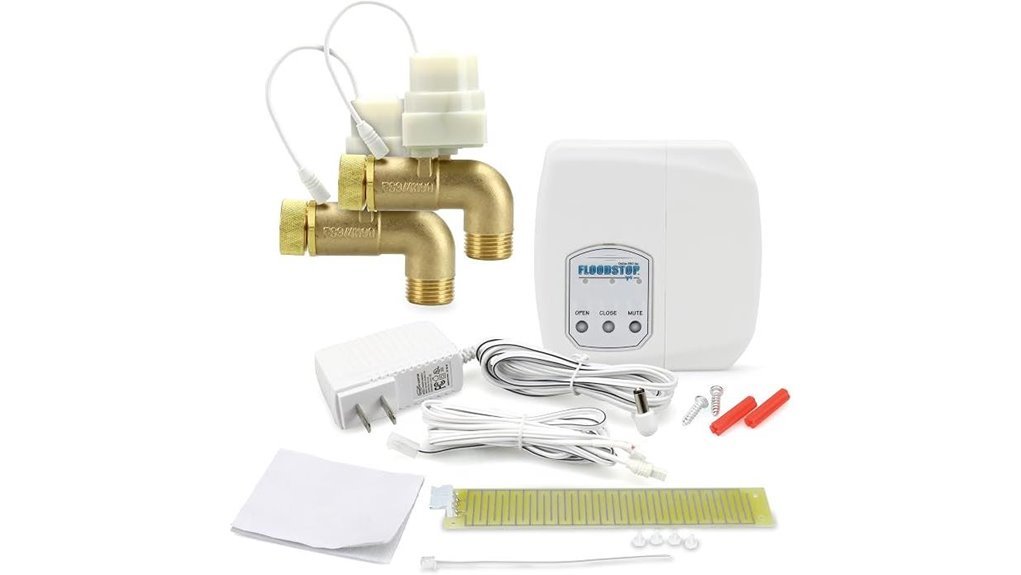
Bottom line: The FloodStop FS3/4H-90 is the best fit if your main concern is a leaking washing machine. Its two motorized valves shut off the washer’s hot and cold water supplies when its sensor detects moisture.
- Valve setup: Two 3/4-inch, 90-degree hose-threaded brass valves for washing machine connections.
- Sensor coverage: One wired contact sensor detects water near the appliance.
- Power and control: AC adapter with optional battery backup and manual valve controls.
- Alerts: Audible alarm and flashing indicator when water is detected.
The system places a motorized valve on each washing machine supply connection. If water reaches the floor sensor, the controller closes both valves and sounds an alarm. This lets the rest of your plumbing continue operating while isolating the appliance.
The kit includes a controller, sensor, power adapter, and two motorized valves. Installation is designed to be straightforward on compatible hose connections. The original product information describes an installation time of about 15 minutes, although access and plumbing conditions can affect the work.
Its solid brass valves and lead-free compliance information make it suitable for a dedicated laundry setup. The manufacturer’s documentation also describes manual open, close, and mute controls, so you can operate the valves without a smartphone.
The main limitation is coverage. FloodStop stops incoming water at the washer connections, but it cannot remove water already inside the drum or hoses. It also does not provide the same remote monitoring features as the smart YoLink and Bulldog systems.
- Automatically closes both washer supply lines.
- Audible and visual leak warnings.
- Standard washing machine hose connections.
- AC operation with optional battery backup.
- Manual controls for opening and closing valves.
- Protects the washing machine rather than the entire home.
- Requires access to both supply connections.
- Does not offer built-in smartphone notifications.
2. YoLink EVO Shutoff Kit
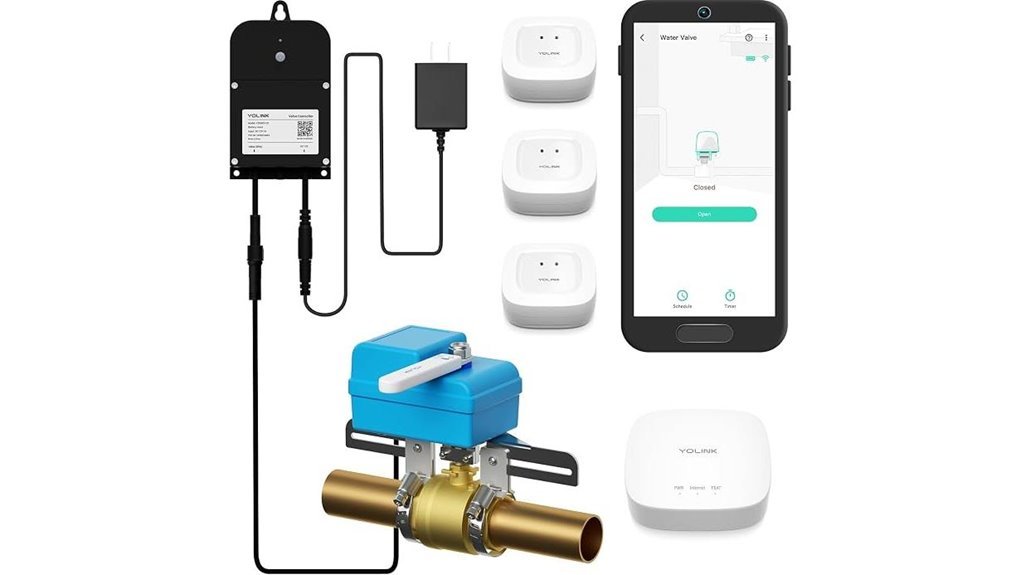
Bottom line: The YoLink EVO Shutoff Kit is a strong option if you want automatic leak protection without installing a new inline valve. Its EVO operator fits a compatible existing ball valve, and three wireless sensors monitor separate leak-prone locations.
- Valve setup: EVO operator attaches to a compatible existing ball valve.
- Sensor coverage: Three wireless water leak sensors for several locations.
- Power and control: Battery-supported valve control, LoRa communication, and YoLink hub.
- Wireless range: Up to 2,034 feet under open-air conditions.
- Smart features: App notifications, email, SMS options, and supported smart home integrations.
YoLink’s long-range LoRa communication is useful in larger homes, basements, and areas where ordinary Wi-Fi coverage is weak. You can place sensors near the washing machine, water heater, or other plumbing fixtures.
The system’s main advantage is Control-D2D device-to-device communication. After proper pairing, a leak sensor can command the valve controller directly. This allows automatic shutoff to continue during an internet outage, provided the devices have working power.
The included hub supports connected features such as remote monitoring and alerts. The system also integrates with platforms including Alexa, Google Assistant, IFTTT, and Home Assistant, depending on the configuration.
Fit is the main concern. The EVO operator needs a compatible quarter-turn ball valve that moves freely, with enough room for the mounting hardware. It cannot repair a damaged or seized valve. The hub and internet connection also remain necessary for cloud notifications.
- No pipe cutting on a compatible existing valve.
- Three sensors support broader leak monitoring.
- Long-range LoRa communication.
- Local device-to-device shutoff after pairing.
- Remote alerts and smart home integrations.
- Will not fit every ball valve design.
- Needs sufficient clearance around the valve shaft.
- Remote alerts depend on a working hub and internet connection.
3. YoLink 1/2-Inch Stainless Valve Kit
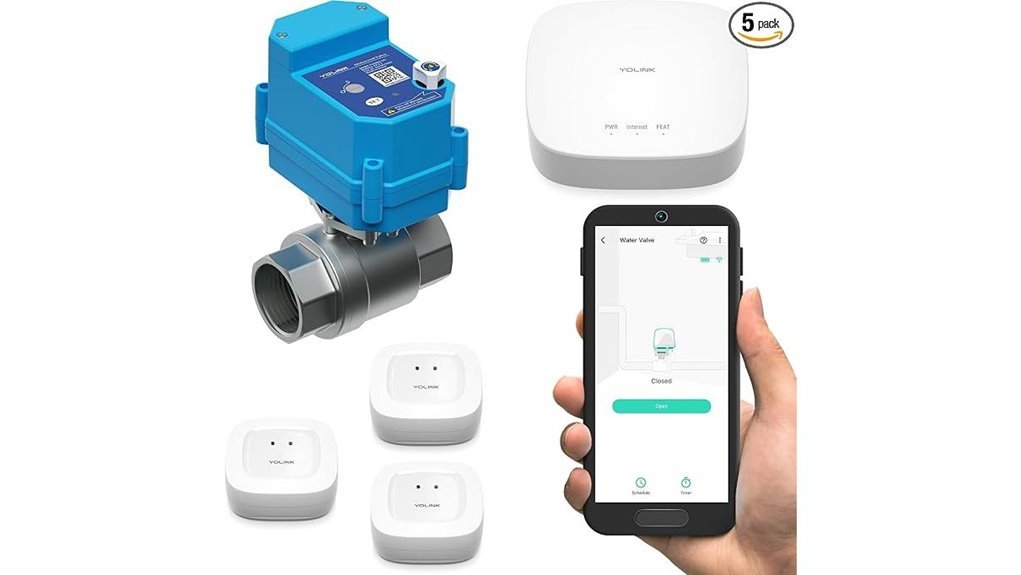
Bottom line: The YoLink 1/2-Inch Stainless Valve Kit is suitable when you want to install a motorized valve directly into a water line. Unlike the EVO kit, this option uses a stainless steel valve assembly rather than a motor that turns an existing manual valve.
- Valve setup: 1/2-inch stainless steel motorized inline ball valve.
- Sensor coverage: Three wireless water leak sensors.
- Power and control: Battery-powered valve with LoRa communication and hub-based monitoring.
- Wireless range: Up to a quarter mile in open air.
- Valve control: App access, direct sensor pairing, and local manual controls.
The integrated motorized valve gives you automatic water control without having to attach a separate operator to a manual valve handle. You can install sensors near the washing machine, sinks, toilets, and water heater to monitor several areas.
YoLink’s device-to-device pairing lets compatible sensors command the valve without relying on the internet. Because the valve operates on batteries, correctly configured local shutoff can remain functional during a household power interruption.
Remote notifications and smartphone control require the included YoLink hub and an internet connection. The platform supports additional integrations, including Alexa, IFTTT, and Home Assistant.
The main drawback is installation. Unlike an external valve operator, this product must be fitted into a compatible water line. The 1/2-inch valve also will not directly replace every washing machine connection. The valve has threaded plumbing connections rather than standard 3/4-inch washing machine hose fittings.
- Integrated stainless steel motorized valve.
- Includes three wireless leak sensors.
- Battery-powered local shutoff operation.
- Long-range LoRa connectivity.
- Remote monitoring and automation support.
- Requires installation into a compatible pipe.
- 1/2-inch fittings do not suit every plumbing setup.
- Cloud alerts still require hub power and internet access.
4. EcoNet Bulldog Matter Starter Kit
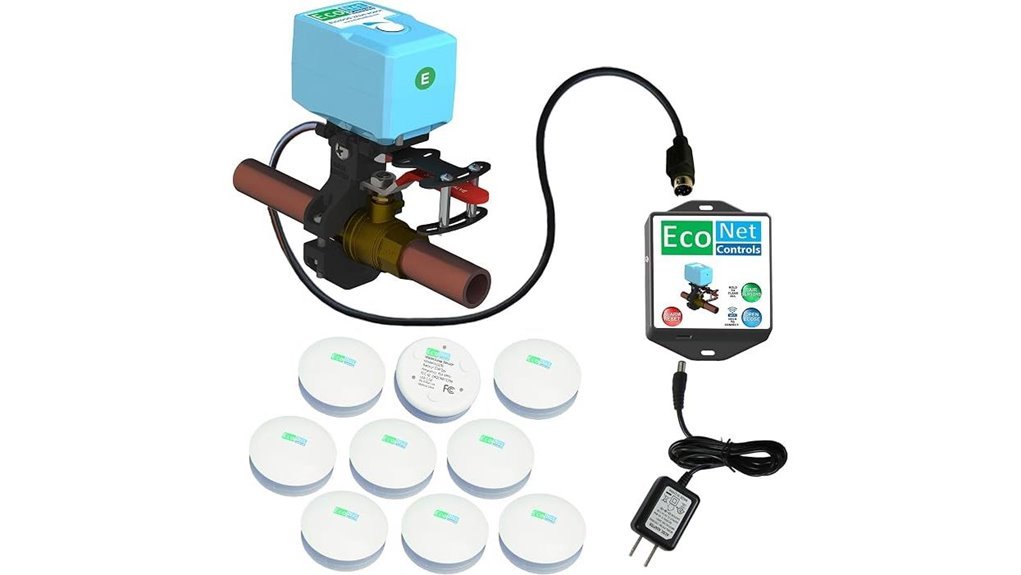
Bottom line: The EcoNet Bulldog Matter Starter Kit is designed for homes that want automatic water shutoff with broad smart home compatibility. Its external valve operator installs over a compatible existing ball valve, while the included sensors detect water in different areas.
- Valve setup: External operator for compatible levered ball valves.
- Sensor coverage: Three included sensors, expandable to 20.
- Power and control: Powered valve controller with Wi-Fi and Matter connectivity.
- Valve compatibility: Common 3/4-inch to 1.5-inch levered ball valves.
- Smart platforms: Apple Home, Google Home, Alexa, and SmartThings through supported Matter setups.
The Bulldog uses a high-torque motor and intelligent stroke control to operate the existing shutoff valve. You can install it without cutting water pipes when the valve handle and mounting space are compatible.
Matter-over-Wi-Fi support makes the system appealing if you already use a connected home platform. The controller can also operate independently for local leak protection, so you do not have to build a large smart home system to use its basic shutoff function.
With three sensors included, you can monitor places such as the laundry area, kitchen, and basement. The system supports adding more compatible sensors if you want broader coverage.
The limitations are physical fit and power requirements. The operator is not made for every valve type. Older round-handle gate valves and damaged ball valves may require plumbing changes before the Bulldog can operate correctly. Connected features also depend on the relevant network and platform setup.
- Compatible with major Matter smart home platforms.
- Installs over suitable existing valves.
- Includes three leak sensors.
- Expandable coverage with additional sensors.
- Local operation without requiring a smart home hub.
- Requires a compatible levered ball valve.
- Additional sensors must be purchased separately.
- Remote smart home features depend on network and platform availability.
5. E-SDS WL0805 Shutoff Kit
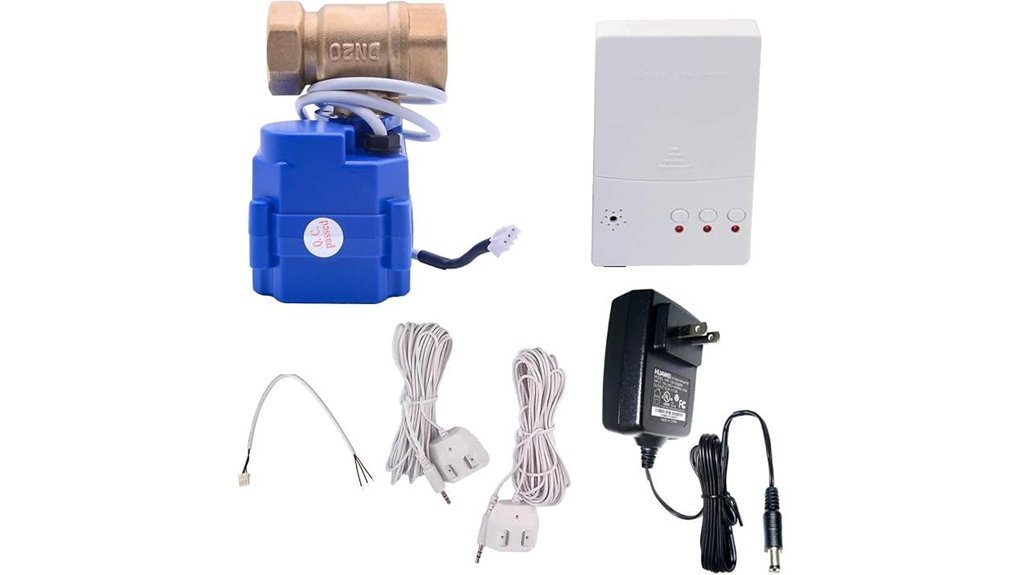
Bottom line: The E-SDS WL0805 Shutoff Kit is designed for buyers who want automatic water shutoff with an immediate local warning. It uses a wired moisture sensor, a motorized brass valve, audible alarms, and flashing indicators.
- Valve setup: 3/4-inch NPT brass motorized shutoff valve.
- Sensor coverage: Contact-type moisture detection; included sensors vary by kit configuration.
- Power and control: AC power with four AA batteries for backup.
- Alerts: Audible alarm and flashing LED indicators.
- Response: The product description states shutoff within two seconds of leak detection.
The E-SDS detects water where its sensor is placed, then closes the motorized valve to stop further incoming flow. Its wired design can suit installations where you prefer direct contact detection and a local alarm rather than relying on remote notifications.
The brass valve is intended for compatible threaded plumbing. It can protect water heaters, laundry plumbing, and other fixtures when installed in the correct supply line.
The original product description reports fast automatic shutoff and a loud alarm. However, published alarm volume specifications differ between sellers. The system should therefore be selected primarily for its automatic valve control, with the exact alarm rating confirmed for the supplied model.
The main trade-off is the plumbing work. This is not a simple sensor that you place on the floor and forget. The valve must be fitted into the line correctly, and the battery backup must be installed and maintained.
- Automatic shutoff after leak detection.
- Audible and visual warnings.
- Brass motorized valve construction.
- AC power with battery backup.
- Requires installation into existing plumbing.
- Four AA backup batteries are not included.
- Exact sensor count and alarm specifications depend on the supplied configuration.
FloodStop FS3/4H-90 vs YoLink EVO Shutoff Kit: Which Should You Get?
Choose FloodStop if your only goal is protecting a washing machine. Choose YoLink EVO if you want to monitor several leak-prone areas and shut off water through a compatible existing valve.
- Water shutoff: FloodStop closes two dedicated washer supply valves. YoLink EVO operates one compatible existing ball valve.
- Monitoring: FloodStop provides local alarms, while YoLink includes wireless sensors and connected notifications.
- Power outages: Both can support shutoff without normal household power when properly configured with working backup batteries.
- Installation: FloodStop connects to washer hoses. YoLink EVO mounts to an existing compatible valve.
Which Automatic Water Shutoff System Should You Buy?
Your best choice depends on whether you need to protect one appliance, operate an existing valve, or install new plumbing hardware.
- Dedicated washing machine protection: Get the FloodStop FS3/4H-90.
- Long-range wireless leak monitoring: Choose the YoLink EVO Shutoff Kit.
- A new inline stainless steel valve: Consider the YoLink 1/2-Inch Stainless Valve Kit.
- Matter-compatible smart home control: Pick the EcoNet Bulldog Matter Starter Kit.
- Local alarms with an inline valve: Consider the E-SDS WL0805 Shutoff Kit.
How We Chose
We compared the five systems using the practical features that affect leak protection and installation. This is a specification-based comparison, not a claim that we physically tested every product.
- Shutoff design: Whether each kit closes a dedicated appliance supply line, an existing manual valve, or a newly installed inline valve.
- Leak detection: Included sensors, supported coverage, and direct sensor-to-valve operation.
- Power resilience: Battery operation, backup power, and whether local shutoff can continue without internet access.
- Installation and compatibility: Valve type, connection size, plumbing changes, mounting clearance, and setup requirements.
- Manufacturer documentation: We checked available FloodStop installation instructions, YoLink product documentation, and EcoNet Matter compatibility information.
Factors to Consider When Choosing Automatic Water Shutoff Systems for Washing Machines in 2026
Choosing the right system starts with identifying the water supply you need to control. Leak detection speed matters, but so do valve compatibility, backup power, sensor placement, and reliable shutoff during an emergency.
Leak Detection Speed
A system must detect moisture before it can stop the water supply. Contact sensors respond when water reaches their sensing surface, so their placement often matters as much as their electronic response time.
Some systems advertise valve closure within seconds after detecting water. However, that does not mean a leak will always be discovered immediately. Water may need to travel across a floor or drain pan before reaching the sensor.
For the best results, place sensors near likely leak points and test the complete shutoff sequence. Direct sensor-to-valve communication can help reduce dependence on internet services.
Valve Compatibility
Valve compatibility is one of the most important checks. A shutoff system cannot protect your home properly if its motor does not fit or cannot close the chosen water valve.
Washing machines commonly use 3/4-inch hose-threaded supply connections. The FloodStop FS3/4H-90 is designed for these connections and includes separate valves for hot and cold water.
Other systems connect to a main water supply valve or use an inline NPT-threaded valve. A 3/4-inch NPT fitting is not interchangeable with a 3/4-inch washing machine hose connection simply because both share the same nominal size.
External valve operators require a suitable manual ball valve. Inline motorized valves must match pipe size, material, pressure requirements, and applicable plumbing codes.
Power Backup Options
Backup power helps a shutoff system remain useful during electrical outages. Without it, an AC-powered controller may stop responding when household power fails.
The FloodStop and E-SDS systems offer battery backup options. YoLink’s battery-supported devices can continue local shutoff after proper device-to-device pairing, even when the internet or household AC power is unavailable.
Check which components require electricity. A battery-powered sensor alone does not guarantee protection if the valve controller loses power.
Replace batteries according to the manufacturer’s instructions. Low-battery warnings should never be ignored.
Smart Connectivity
Smart connectivity helps you monitor leaks when you are away from home. Depending on the system, you may receive app notifications, SMS messages, or email alerts and remotely operate the valve.
YoLink uses LoRa communication between its compatible devices. This supports long-range operation where ordinary Wi-Fi signals may struggle.
The EcoNet Bulldog Matter kit supports connected home platforms such as Apple Home, Google Home, Alexa, and SmartThings. This is useful if you want water shutoff to work alongside your other smart home devices.
Keep local shutoff separate from remote monitoring in your decision. A system may continue closing its valve during an outage while app notifications remain unavailable.
Installation Simplicity
The easiest installation depends on the existing plumbing. A product that connects to washer hoses can be simpler than an inline valve that requires pipe modifications.
FloodStop uses dedicated hose connections. YoLink EVO and Bulldog use external valve operators on compatible existing manual valves. These can avoid pipe cutting when the installation space and valve design are suitable.
An inline valve, such as the YoLink stainless steel model or E-SDS unit, requires correct pipe fittings and leak-free connections. Professional plumbing work may be the safer choice if you are unfamiliar with shutoff valve installation.
After installation, restore water slowly, inspect every connection, and perform a controlled leak test according to the manufacturer’s instructions.
Alarm Volume
Audible alarms are helpful when the washing machine is running in a separate room. They alert nearby occupants even when phone notifications are unavailable.
The FloodStop uses an audible alarm and visual indicators. The E-SDS also provides audible and LED warnings, although the exact published decibel specification should be checked for the selected version.
Higher alarm volume may be helpful in noisy laundry rooms. However, warning volume does not replace automatic shutoff, especially when nobody is home.
Consider whether the alarm can be heard from occupied rooms and whether a flashing indicator is easy to see.
Safety Certifications
Safety certifications help you assess plumbing materials and electrical components. They are especially important when the device becomes part of a home’s permanent water supply.
The FloodStop FS3/4H-90 documentation lists lead-free material compliance and references standards including AB1953 and NSF 61. Its published documentation also addresses plumbing code compatibility.
Check that any new inline valve is suitable for the water temperature and pressure of the installation. Drinking-water applications may require additional material approvals.
Local plumbing and electrical codes still apply. A certified product must also be installed correctly.
Sensor Placement
Sensor placement determines whether a leak is detected early or only after water has spread. Position the sensing contacts where water is likely to reach them first.
For a washing machine, useful locations include the floor below the supply hoses, the base of the appliance, or a suitable drain pan.
For broader protection, place additional sensors near water heaters, under sinks, and beside other water-using appliances.
Avoid locations where normal cleaning water or condensation may cause repeated false alarms. Keep sensor housings and batteries protected as instructed by the manufacturer, while leaving the actual sensing contacts exposed to potential leaks.
Hot and Cold Water Shutoff
A washing machine may receive water through separate hot and cold supply hoses. If you want direct appliance protection, confirm that the system can close both supplies.
FloodStop includes two motorized valves for this purpose. A single inline valve or main-line operator may instead control one water line or the supply serving several fixtures.
Check your home’s plumbing layout before deciding where the shutoff valve should go. Closing only one washer supply may leave the other line pressurized.
What Happens After a Leak?
Automatic shutoff limits additional incoming water, but it does not necessarily prevent all damage. Water already stored inside the appliance, hoses, or nearby plumbing can still escape.
Once the system closes its valve, inspect the appliance and the surrounding floor. Find and repair the leak before reopening the water supply.
Do not reset the controller repeatedly while an active leak remains. Test the system again after completing repairs.
Mistakes to Avoid When Buying Automatic Water Shutoff Systems
- Ignoring valve type: Check whether the kit requires a levered ball valve, a washing machine hose connection, or threaded pipe fittings.
- Assuming Wi-Fi independence: Confirm which functions still operate without internet access or electricity.
- Buying too few sensors: Place enough sensors to cover the areas where water could escape.
- Skipping the backup battery: Install compatible batteries when outage protection is part of the system’s design.
- Failing to test shutoff: Confirm that a sensor alarm actually commands the intended valve to close.
FAQs
How Do Automatic Water Shutoff Systems Connect to Smart Home Platforms?
Automatic water shutoff systems connect through supported wireless technologies and controllers, including Wi-Fi, LoRa, Matter, Zigbee, or Z-Wave, depending on the model. A compatible hub or app can provide leak alerts, valve status, and remote operation. Some systems also support automation rules that close the water supply when a sensor detects moisture. Not every model supports every platform.
Can These Systems Work During a Power Outage?
Yes, some automatic shutoff systems can continue operating during a power outage. Models with battery-powered controllers, backup batteries, or suitable local device-to-device communication may still close their valves. Remote notifications may stop if the hub, router, or internet connection loses power. Always verify the power requirements of both the leak sensors and the shutoff valve.
What Maintenance Do Water Shutoff Valves Require?
Automatic shutoff valves need periodic inspection and functional testing. Check batteries, sensors, power connections, and visible plumbing joints for wear or damage. Operate the valve according to the manufacturer’s instructions to confirm it opens and closes correctly. Smart systems may also need firmware updates. If the motor struggles or the valve sticks, have the problem inspected before relying on it for protection.
Are Automatic Shutoff Systems Compatible With Older Plumbing?
Many automatic shutoff systems work with older plumbing, but compatibility depends on the existing valve and pipe condition. External operators need accessible, working ball valves. Inline motorized valves may require pipe modifications or adapters. Older gate valves, corrosion, and limited clearance can complicate installation. A plumber can check whether the existing water supply is suitable for the selected system.
How Much Water Damage Can a Shutoff System Prevent?
An automatic shutoff system can reduce water damage by limiting the amount of additional water entering a leaking appliance or pipe. The actual protection depends on how quickly the sensor detects water, where the valve is installed, and how much water has already escaped. No system guarantees a completely dry floor. Good sensor placement and regular testing improve its effectiveness.
Final Verdict
For direct laundry-room protection, the FloodStop FS3/4H-90 is our top choice among these five automatic water shutoff systems. It focuses on the main washing machine risk by closing both incoming supply connections when the sensor detects a leak.
If you need wider coverage, remote notifications, or smart home integration, the YoLink and EcoNet kits offer additional flexibility. Your existing valve type and power requirements should guide the final decision.
For longer-range smart monitoring, compare the YoLink EVO Shutoff Kit. For Matter-based home automation, consider the EcoNet Bulldog Matter Starter Kit.
